长安汽车

Search documents
中美AI竞赛进入下半场,决胜点在哪?
Guan Cha Zhe Wang· 2026-02-04 06:59
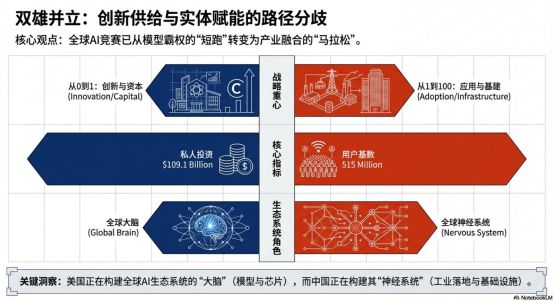
Core Insights - The current phase of the AI industry is shifting from a "technology parameter competition" to a focus on "application landing," emphasizing the creation of real value in sectors like healthcare, education, and government efficiency [1][2] - A "dual oligopoly" is emerging in the AI landscape, with the U.S. leading in foundational models and high-value software services, while China is advancing in large-scale applications and industrial empowerment [2][3] Group 1: U.S. and China's Competitive Landscape - The U.S. maintains an advantage in original innovation and high-value software services, while China is establishing barriers in large-scale applications and industrial empowerment [2][3] - Despite the U.S. leading in foundational model capabilities, China's models are proving to be cost-effective and competitive, closing the gap significantly in performance metrics [3][7] - The RAND Corporation's report indicates that the U.S. cannot solely rely on chip superiority to prevent Chinese models from reaching Tier-1 levels [3][6] Group 2: AI Application and Industrial Integration - China's AI applications are deeply integrated into core production processes, with a high adoption rate of 67% in manufacturing compared to the U.S.'s 34% [9][10] - Chinese companies are focusing on embedding cost-effective models into various smart hardware and industrial software, moving away from merely benchmarking against models like GPT-5 [9][10] - The integration of AI into industries such as steel and mining is transforming operational efficiency and safety, showcasing AI's role as a productivity tool rather than just a technological novelty [14][18] Group 3: Challenges and Opportunities - The transition of AI from theoretical applications to practical tools faces challenges, including unique industry scenarios, data accessibility, and the long value chain from technology validation to economic benefits [13] - Each industry challenge overcome can create unique competitive barriers, providing opportunities for China to build a robust AI ecosystem [13] - The development of domestic AI infrastructure, such as Huawei's CloudMatrix, is crucial for supporting complex AI applications and ensuring long-term operational stability [14][20]

2025年度中国汽车产业盘点——销量篇 车企竞争进入深水区
Zhong Guo Zhi Liang Xin Wen Wang· 2026-02-04 06:51
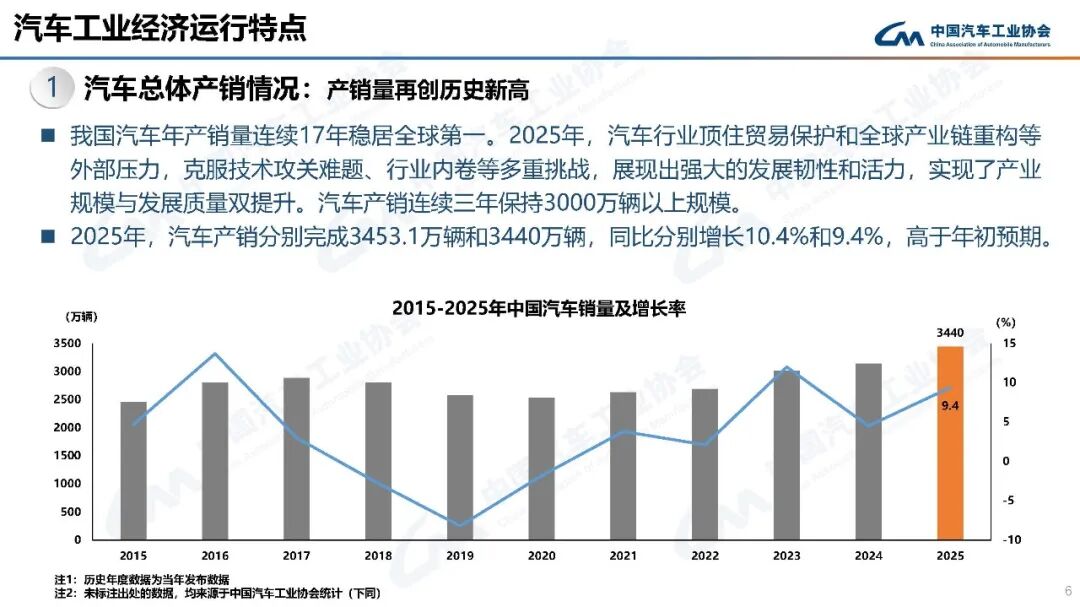
Overall Market - In 2025, China's automotive industry achieved record production and sales, with 34.53 million vehicles produced and 34.40 million sold, marking year-on-year growth of 10.4% and 9.4% respectively, driven by policy support and market dynamics [1][5] - The market demonstrated strong resilience against global trade protectionism, supply chain restructuring, and intensified competition [1] Market Dynamics - The "Two New" policy expanded consumer goods categories and support for equipment upgrades, stimulating vehicle replacement demand, particularly in lower-tier cities [5] - The transition to electric vehicles (EVs) was facilitated by stable tax policies and improved charging infrastructure, lowering barriers for potential EV buyers [5] - Consumer preferences are shifting towards intelligent features and green travel, pushing the market towards higher quality development [5] Segmented Market - In 2025, new energy vehicles (NEVs) became the dominant growth segment, with production and sales reaching 16.63 million and 16.49 million respectively, reflecting year-on-year growth of 29% and 28.2% [6] - NEVs accounted for 47.9% of total new vehicle sales, a 7 percentage point increase from the previous year [6] - The traditional fuel vehicle market is undergoing structural adjustments, with demand for high-displacement, high-fuel-consumption models declining, while smaller, hybrid models remain popular [10] Market Structure - Domestic brands solidified their leading position, with their market share exceeding 60% for the first time, driven by strong performances from companies like BYD, Geely, and Changan [13][15] - BYD led the market with over 4.6 million units sold, benefiting from its technological advancements in NEVs [15] - Joint venture brands faced significant pressure, with declining market shares due to slow adaptation to the NEV market and product homogenization [16] Export Market - In 2025, China's automotive exports exceeded 7 million units, achieving a year-on-year growth of 21.1%, maintaining its position as the world's largest automotive exporter for three consecutive years [18] - Emerging markets in Southeast Asia, the Middle East, and South America remain key destinations for Chinese automotive exports, with NEVs becoming a significant export category [18] Sales Rankings - The top ten automotive brands in 2025 showcased a strong performance from domestic brands, with five spots occupied by them, and a combined market share of 37.3% [21] - BYD, Geely, and Changan maintained their positions through a dual strategy of fuel and NEV offerings [21] - Traditional joint venture brands like FAW-Volkswagen and SAIC Volkswagen continued to experience declines, unable to offset losses from fuel vehicle sales with NEV growth [21] Emerging Brands - New entrants like Leap Motor and Hongmeng Zhixing showed remarkable growth, with Leap Motor doubling its sales through self-developed technology and competitive pricing [23] - Traditional automakers' NEV sub-brands also performed well, rapidly capturing market share through targeted strategies [23] Consumer Trends - Successful models in 2025 aligned with market trends, focusing on price adaptability, user needs, and technological highlights [24] - Family and young consumers emerged as core target groups, with vehicles designed for spaciousness and smart features gaining popularity [26] - The integration of new energy and intelligent technologies became essential for popular models, addressing consumer concerns about range and charging [26] Future Outlook - The strong rise of NEVs indicates China's automotive industry is positioned advantageously in the global transformation of the sector [28] - Continued policy support for NEVs and smart vehicles is expected, alongside growing consumer demand for high-quality, intelligent products [28] - The industry is likely to see further integration across the supply chain, enhancing competitiveness [28]




时代长安动力电池有限公司注册资本增至40亿元
Zheng Quan Ri Bao Wang· 2026-02-04 04:12
本报讯(记者袁传玺)天眼查App显示,近日,时代长安动力电池有限公司发生工商变更,注册资本由15 亿元增至40亿元。股东信息显示,该公司由宁德时代(300750)、深蓝汽车科技有限公司、长安汽车 (000625)共同持股。 ...

太抓马!马斯克母亲晒偶遇特斯拉图片,网友:这是深蓝
Xin Lang Cai Jing· 2026-02-04 01:51
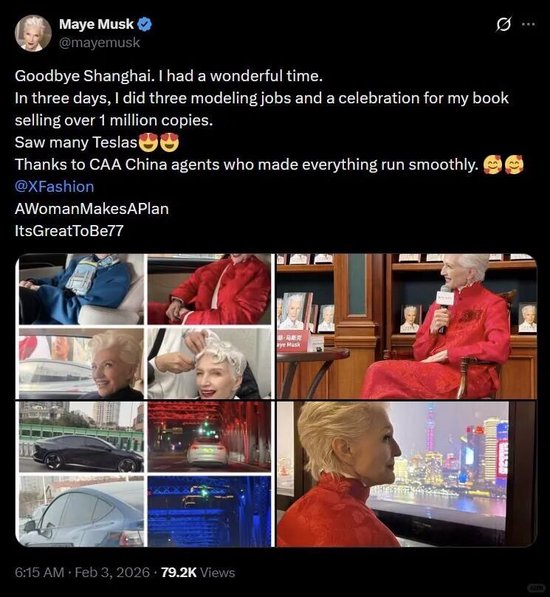
鞭牛士 对此,有网友戏称,"我开深蓝,经常有人问你这个特斯拉看起来怎么不太一样"。 责任编辑:凌辰 鞭牛士 昨日,马斯克的母亲梅耶·马斯克在社交平台发文,分享自己结束上海旅程的心情。 昨日,马斯克的母亲梅耶·马斯克在社交平台发文,分享自己结束上海旅程的心情。 她表示,"再见上海,这趟行程太愉快了。三天里完成了三个模特工作,还庆祝了我的书销量破百万 册,路上看到好多特斯拉。" 同时,她晒出九宫格照片,其中包括四张汽车图。 不过眼尖的网友很快发现,左上方的黑色汽车并非特斯拉车型,而是长安汽车旗下的深蓝品牌。 她表示,"再见上海,这趟行程太愉快了。三天里完成了三个模特工作,还庆祝了我的书销量破百万 册,路上看到好多特斯拉。" 同时,她晒出九宫格照片,其中包括四张汽车图。 不过眼尖的网友很快发现,左上方的黑色汽车并非特斯拉车型,而是长安汽车旗下的深蓝品牌。 对此,有网友戏称,"我开深蓝,经常有人问你这个特斯拉看起来怎么不太一样"。 责任编辑:凌辰 ...

销量环比下滑超20%,单车成本激增7000元:2026车市开局承压
Xin Hua Cai Jing· 2026-02-04 01:16
Core Viewpoint - The automotive market in China experienced a significant month-on-month decline in January 2026, influenced by changes in tax policies and early consumer demand, while year-on-year sales remained relatively stable [1]. Group 1: Market Performance - In January 2026, the retail sales of narrow passenger vehicles in China were approximately 1.8 million units, representing a month-on-month decrease of 20.4% and a slight year-on-year increase of 0.3% [1]. - The retail sales of new energy vehicles (NEVs) in January were around 800,000 units, showing a year-on-year decline of 40.2%, but a month-on-month growth of 7.5% [1]. - Major traditional automakers like SAIC and Geely surpassed BYD in sales, with SAIC selling 327,000 units (up 23.9% year-on-year) and Geely selling 270,200 units (up 1.3% year-on-year) [2]. Group 2: New Energy Vehicle Segment - In the new energy vehicle sector, brands like Xiaomi, Hongmeng Zhixing, and NIO saw significant year-on-year growth, with Xiaomi's sales increasing by 95% to over 39,000 units [3][4]. - NIO delivered 27,200 units in January, marking a 96% year-on-year increase, driven by the new ES8 model [4]. - Conversely, companies like XPeng and Li Auto experienced declines, with XPeng's deliveries down 47% month-on-month and 34% year-on-year [4]. Group 3: Cost Pressures - The automotive industry is facing rising costs, with single-vehicle costs increasing by 4,000 to 7,000 yuan due to surging prices of key materials like lithium, aluminum, and DRAM [5][6]. - The price of battery-grade lithium carbonate rose from 75,700 yuan per ton at the beginning of 2025 to 146,600 yuan per ton by February 3, 2026, a nearly 94% increase [5]. - UBS reported that the cost increases in metals and chips could compress profit margins significantly, with potential reductions of 33% to 93% for vehicles priced at 150,000 yuan [6]. Group 4: Strategic Directions - To counteract rising costs and stagnant market demand, automakers are focusing on international expansion, with Chery exporting 119,600 units in January, accounting for nearly 60% of its total sales [7]. - BYD's overseas sales exceeded 100,000 units, a year-on-year increase of 43.3%, while Geely's exports grew by over 120% [7]. - Companies are also targeting the high-end market, with Great Wall Motors launching the WEY brand's flagship V9X, indicating a competitive push in the premium segment [9]. Group 5: Market Outlook - The automotive consumption index for January 2026 was reported at 31.1, reflecting a cautious consumer sentiment influenced by various factors, including the upcoming Spring Festival and changes in tax policies [10]. - Industry experts suggest that the market may not see a clear recovery until March or the end of the first quarter [10].


华为投资的汽车芯片公司瑞发科启动IPO,国产车载SerDes芯片加速突围
Sou Hu Cai Jing· 2026-02-03 14:33
..... . . . . M �� ������������������� 记者 周菊 证监会官网信息显示,天津车载SerDes芯片设计企业——瑞发科半导体(天津)股份有限公司(简称"瑞发科"),已于1月29日在天津证监局办理上市辅导 备案,拟在A股首次公开募股(IPO),辅导机构为华泰联合证券。 瑞发科成立于2009年7月,注册资本7000万元,专注于高速互联与控制芯片、音视频传输及处理芯片的研发与销售。在汽车领域,公司主要产品为车载 SerDes(串行器/解串器)芯片。随着汽车智能化进程加速,这类芯片已成为车载摄像头、雷达、显示屏等设备间高速数据传输的核心枢纽,直接影响汽车 的智能化水平。 智能汽车的普及正推动车载SerDes市场快速增长。据第三方机构QR Research预测,全球汽车SerDes芯片市场规模将从2023年的4.47亿美元,增长至2030年的 16.77亿美元,年复合增长率达20.28%。 瑞发科备受市场关注,一方面源于其技术实力。公司宣称,其是全球仅有的三家能够研发并量产12.8Gbps车载SerDes芯片的厂商之一,也是国内唯一实现该 技术量产的企业。公司具备从芯片设计到量产的全流 ...
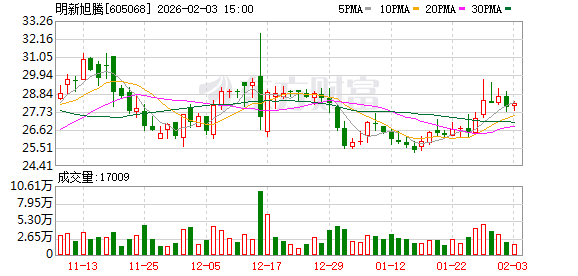
明新旭腾:公司主业客户结构未发生重大变化
Zheng Quan Ri Bao· 2026-02-03 12:08
Core Viewpoint - Mingxin Xuteng has reported that there have been no significant changes in the customer structure of its main business as of now [2] Group 1: Customer Collaboration - The company's products are currently supplied to major automotive manufacturers including FAW-Volkswagen, SAIC-GM, BYD, NIO, Li Auto, Xpeng, Mercedes-Benz, BMW, Audi, Seres, Changan, Geely, Chery, and Leap Motor [2] - The collaboration with core customers continues to deepen, indicating a strong and stable partnership with leading automotive brands [2]

被低估之中亚,能否重塑中国青训“走出去”逻辑?
3 6 Ke· 2026-02-03 12:08
深化国际交流合作,有机结合"走出去"与"引进来",是中国足球构建高质量人才体系的 关键。当前,中国 青少年足球国际合作中"引进来"成效凸显, 但"走出去"方面,虽足协积极组织青少年队伍赴国外交流,球员融入国外青训体系仍困难重重,推动人才"走出去"是亟待解决的问题。 从新型国际关系理念看,应将足球人才对外流动融入国际科教、赛事、产业利益链条,巩固合作基础,激发对方合作意愿。 鉴于欧洲职业足球竞争激 烈,需考量中国青少年足球人才"走出去"是否采用从"近亚"到"远欧"的递进式路径。 研究聚焦哈萨克斯坦与乌兹别克斯坦,分析我国与中亚两国开展青少年足球合作的领域和价值,为相关政策制定提供理论指导。 中国青少年足球国际合作与中亚两国选择 国家方略 一方面,中国与中亚两国政治关系稳定,在体育等领域合作空间广泛。2025 年 6 月签署的相关条约提出各方要在多领域积极开展交流合作,为体育合作 提供了政策与法律基础。 另一方面,新疆是中国足球人才重要培养区域,其语言、文化习俗和社会环境与中亚两国相似,且我国西北地区 5 省(自治区)依托上合组织与中亚两国 在多领域联系不断加深。但西北地区 5 省(自治区)职业足球发展滞后,20 ...

汽车视点 | 销量环比下滑超20%,单车成本激增7000元:2026车市开局承压
Xin Hua Cai Jing· 2026-02-03 10:12
Core Viewpoint - The overall automotive market in China experienced a significant month-on-month decline in January 2026, influenced by changes in tax policies and early consumer demand, while year-on-year sales remained relatively stable [1]. Group 1: Sales Performance - In January 2026, the retail sales of narrow passenger vehicles in China were approximately 1.8 million units, representing a month-on-month decrease of 20.4% and a slight year-on-year increase of 0.3% [1]. - Major traditional automakers like SAIC and Geely outperformed BYD, with SAIC selling 327,000 vehicles (up 23.9% year-on-year) and Geely selling 270,200 vehicles (up 1.3% year-on-year) [2]. - BYD's sales fell to 205,500 vehicles, a month-on-month decline of 49% and a year-on-year decrease of about 30% due to high base effects and product line adjustments [2]. Group 2: New Energy Vehicle (NEV) Trends - NEV sales in January were approximately 800,000 units, showing a year-on-year decline of 40.2%, but a month-on-month increase of 7.5% [1]. - New entrants like Xiaomi and Hongmeng Zhixing saw significant growth, with Xiaomi's sales increasing by 95% year-on-year to over 39,000 units [4]. - NIO delivered 27,200 vehicles, a year-on-year increase of 96%, with the new ES8 model being a major contributor [5]. Group 3: Cost Pressures - The automotive industry is facing rising costs, with single vehicle costs increasing by 4,000 to 7,000 yuan due to surging prices of key materials like lithium, aluminum, and DRAM [6][7]. - The price of battery-grade lithium carbonate rose from 75,700 yuan per ton at the beginning of 2025 to 146,600 yuan per ton by February 3, 2026, marking an increase of approximately 94% [6]. - UBS reported that the cost increases could compress profit margins significantly, with potential reductions of 33% to 93% in profits for vehicles priced at 150,000 yuan [7]. Group 4: Strategic Directions - To counteract rising costs and stagnant demand, automakers are focusing on international expansion, with Chery exporting 119,600 vehicles in January, accounting for nearly 60% of its total sales [8]. - BYD's overseas sales surpassed 100,000 units, a year-on-year increase of 43.3%, while Geely's exports exceeded 60,000 units, showing a growth of over 120% [8]. - Companies are also targeting the high-end market, with new flagship models being launched, indicating a competitive shift towards premium offerings [10][11]. Group 5: Market Outlook - The automotive market is expected to face challenges in the short term, with a recovery point likely not becoming clear until March or after the first quarter [12]. - The automotive consumption index for January 2026 was reported at 31.1, reflecting a cautious consumer sentiment influenced by various factors [12]. - Overall, the automotive industry is entering a "deep water zone" in 2026, with strategies for international expansion, high-end market penetration, and cost efficiency being critical for future positioning [12].

20万元 家用2.0T动力车型盘点
Zhong Guo Zhi Liang Xin Wen Wang· 2026-02-03 09:27
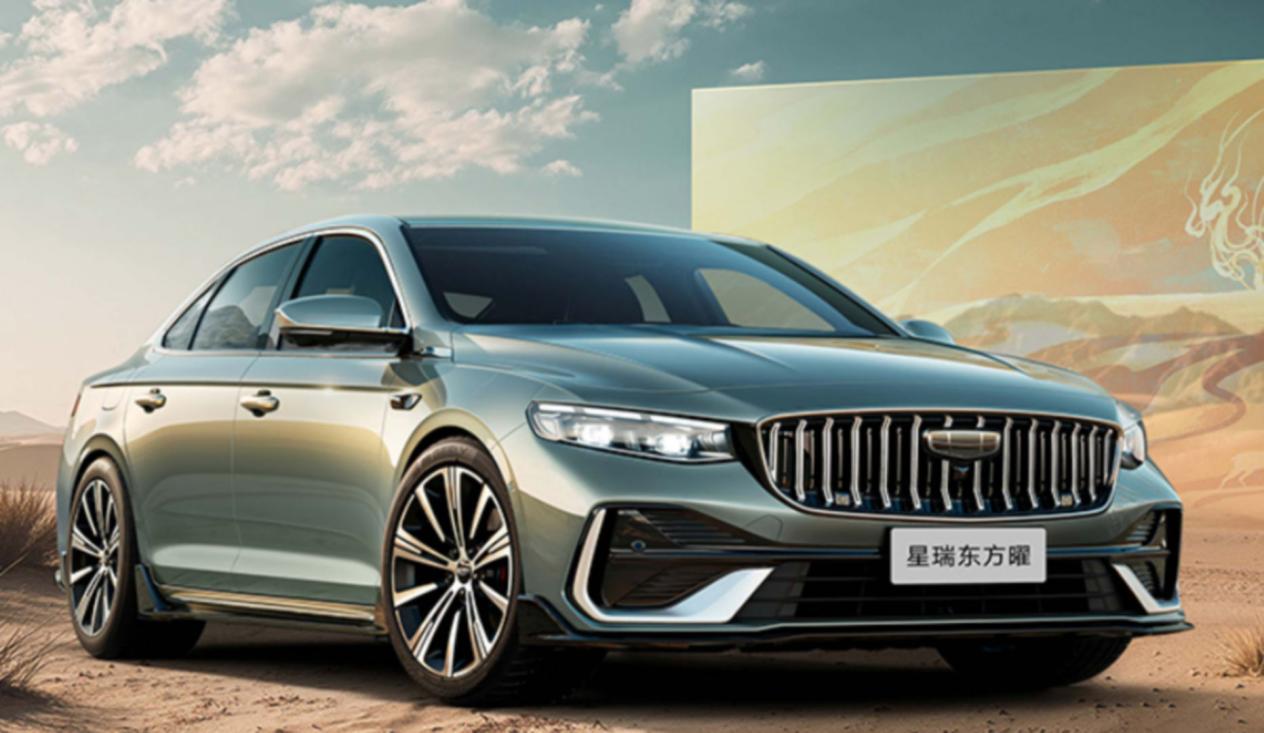
上至奔驰G级、宝马7系这种百万级豪车,中级的奔驰A45 AMG,奥迪S3一类的性能机器,入门的别克君威、领克01这类运动型家用车,2.0T的发动机屡见 不鲜,它动力强劲、技术成熟、适配广泛受无数消费者追捧。本文盘点了10万元-20万元的部分家用2.0T动力车型,看看哪款更适合你的需求。 吉利星瑞 2026款 东方曜 2.0TD 霄汉版 指导价:11.87万元 星瑞基于CMA架构打造,同平台代表车型包括沃尔沃XC40、吉利星越L等。除了强劲的动力表现外,这个平台的底盘操控性方面也有突出的表现。 星瑞轴距达到2800mm,长度超过传统A级车型,接近B级车水平,后排腿部头顶都有充足余量。整车长宽高达到4825×1869×1469(mm),纯家用场景下, 空间表现优秀。 2026款吉利星瑞东方曜搭载JLH-4G20TDH发动机,这款发动机基于沃尔沃Drive-E发动机平台,与领克03+同源,最大功率高达200kW(272马力),峰值扭 矩400牛米,匹配爱信8AT变速箱,零百加速仅需6.5秒,极速可达215km/h,动力配置方面表现出色。同时,WLTC油耗为7.15L/100km,需要加注95号汽 油。 外观方面,星 ...