良品铺子

Search documents
休闲食品板块9月11日跌0.64%,万辰集团领跌,主力资金净流出3.08亿元
Zheng Xing Xing Ye Ri Bao· 2025-09-11 08:43
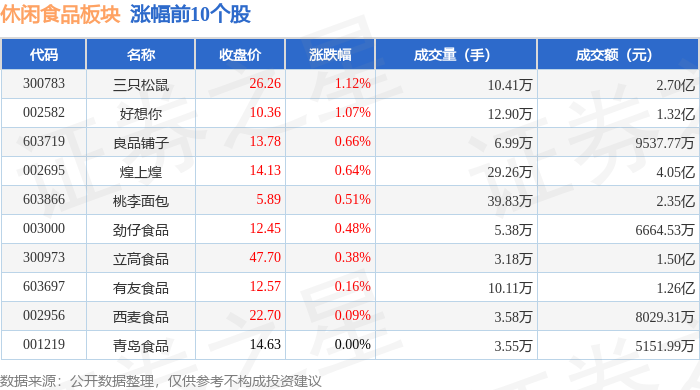
Market Overview - The leisure food sector experienced a decline of 0.64% on September 11, with Wancheng Group leading the drop [1] - The Shanghai Composite Index closed at 3875.31, up 1.65%, while the Shenzhen Component Index closed at 12979.89, up 3.36% [1] Individual Stock Performance - Notable gainers in the leisure food sector included: - Three Squirrels (300783) with a closing price of 26.26, up 1.12% on a trading volume of 104,100 shares and a turnover of 270 million [1] - Good Idea (002582) closed at 10.36, up 1.07% with a trading volume of 129,000 shares and a turnover of 132 million [1] - Conversely, Wancheng Group (300972) led the decline with a closing price of 171.90, down 3.13% on a trading volume of 44,400 shares and a turnover of 761 million [2] Capital Flow Analysis - The leisure food sector saw a net outflow of 308 million from institutional investors, while retail investors contributed a net inflow of 318 million [2][3] - The capital flow for individual stocks showed: - Zhi Zhi Food (002557) had a net inflow of 10.23 million from institutional investors, while retail investors had a net outflow of 798,600 [3] - Good Idea (002582) experienced a net outflow of 938,500 from institutional investors but a net inflow of 13.30 million from retail investors [3]

新生代家长对“天然、健康、功能化”的追求,催生出千亿婴童食品市场
Xin Jing Bao· 2025-09-11 07:06
Market Overview - The infant and child food market in China is projected to reach a scale of 3 trillion yuan by 2027, with the infant complementary food market estimated at 55.91 billion yuan and the children's food market at approximately 214 billion yuan in 2024 [1][3] - The compound annual growth rate (CAGR) for the infant complementary food market from 2019 to 2024 is 8.9%, expected to maintain a CAGR of 7.9% over the next five years [3][25] - The children's food market is anticipated to grow at an average annual rate of 14% from 2025 to 2027, with a market size projected to exceed 300 billion yuan by 2027 [3][25] Investment and Capital Influx - Major traditional snack brands such as Liangpinpuzi, Baicaowei, and Three Squirrels have launched child snack sub-brands to capitalize on the growing market [1][4] - Brands like Ying's Holdings and others have received multiple rounds of financing, indicating strong investor interest in the sector [4][25] Standardization and Regulation - There is currently a lack of unified standards for children's food, leading to discrepancies in product quality and safety [2][6] - Since 2019, 63 standards related to children's food have been published, with a significant number expected in 2024 [6][7] - The absence of mandatory standards has resulted in higher pricing for products labeled as "infant" or "children's," raising questions about their value [2][19] Quality Concerns and Production Models - The prevalence of outsourcing in production has raised concerns about quality control, with several brands facing scrutiny over product safety [22][24] - Reports of non-compliance in product testing have emerged, highlighting potential risks associated with the reliance on contract manufacturers [22][23] Consumer Behavior and Market Trends - Over 70% of millennial parents express a strong demand for "natural, healthy, and functional" products, often willing to pay a premium for items marketed as children's food [19][20] - The market is seeing a shift towards high-end, refined feeding habits, with increasing interest in organic and specialized products [26][28] Competitive Landscape - Domestic brands are gradually overtaking foreign brands in the infant complementary food market, with Ying's Holdings and others capturing significant market shares [5][25] - The competitive landscape is evolving, with a focus on product differentiation and meeting specific nutritional needs for children [27][28]
千亿婴童食品市场的机遇与挑战:“智商税”还是高品质?
Xin Jing Bao· 2025-09-11 06:07
Core Insights - The pursuit of "natural, healthy, and functional" products by the new generation of parents has led to the emergence of a trillion-yuan baby food market in China, with the infant complementary food market expected to reach 55.91 billion yuan in 2024 and the children's food market around 214 billion yuan, potentially exceeding 300 billion yuan by 2027 [1][3][24] Market Overview - The infant food industry is divided into two main segments: infant complementary foods for ages 6 months to 3 years, which have strict production qualifications and safety standards, and children's foods for ages 3 to 12, which currently lack mandatory unified standards [3][6] - The infant complementary food market is projected to grow at a compound annual growth rate (CAGR) of 8.9% from 2019 to 2024, with an expected market size of 81.75 billion yuan by 2029 [3][24] - The children's food market is expected to grow at an annual rate of 14% from 2025 to 2027, with a market size of approximately 214 billion yuan in 2024 [3][24] Investment and Capital Influx - The rapid growth of the industry has attracted various capital investments, with traditional snack giants like Liangpinpuzi, Baicaowei, and Three Squirrels launching children's snack sub-brands [4][24] - Brands such as Ying's Holdings and others have received multiple rounds of financing, indicating strong investor interest in the sector [4][24] Standardization Challenges - There is a lack of unified standards for children's food, leading to higher premiums for products labeled as "baby food," raising questions about their value [2][12] - Since 2019, 63 standards related to children's food have been published, with a significant number expected in 2024, but opinions are divided on the necessity of a unified standard [1][7][8] Quality Concerns - Some brands have faced scrutiny for product quality, with reports of non-compliance in testing and concerns over the reliance on contract manufacturing [2][21][23] - The prevalence of contract manufacturing in the industry raises questions about quality control and safety, as many brands outsource production to multiple manufacturers [22][23][27] Consumer Behavior and Market Trends - Over 70% of millennial parents are willing to pay a premium for high-quality, health-oriented products, driving demand for children's food [18][19] - The market is seeing a shift towards high-end, refined feeding habits, with parents increasingly interested in organic, low-allergen, and functional foods [25][27] Future Outlook - The penetration rate of infant complementary foods in China is only 38%, indicating significant growth potential as standards improve and consumer awareness increases [24][27] - The demand for children's food is expected to rise as parents focus on nutrition for growth and development, with a projected increase in the market size for children's food [26][27]

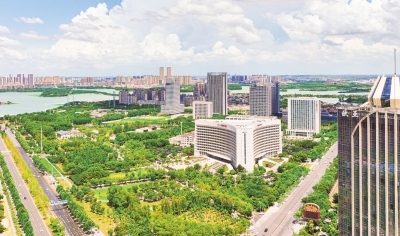
郊野湖泽变身环湖经济圈 40余家总部企业环抱金银湖
Chang Jiang Ri Bao· 2025-09-08 00:29
Core Insights - The transformation of the Jin Yin Lake area from a rural wetland to a thriving economic hub is highlighted, with over 40 headquarters enterprises established and an annual output value exceeding 100 billion yuan [1][8][12] - The area's ecological advantages and strategic location have attracted significant investments from various enterprises, including state-owned enterprises [4][6][10] - The integration of ecology, production, and living has created a desirable environment for residents and businesses alike, contributing to a population of approximately 230,000 [12][13] Group 1: Economic Development - The Jin Yin Lake headquarters economy has developed rapidly, with a focus on industries such as finance, health, high-end manufacturing, and modern services [7][8] - The establishment of the Jianghan Water Network Construction Development Co., Ltd. marked a significant milestone in attracting major enterprises to the area [3][4] - The Jin Yin Lake area has seen a continuous influx of headquarters enterprises since the early 2000s, with notable companies like China Unicom and Good Products entering the market [7][10] Group 2: Investment Attraction - The successful investment decisions by companies like Jiangsu Zhihui Port Technology Industry Group were influenced by the area's ecological environment and mature urban infrastructure [6][10] - The local government has played a crucial role in facilitating investments by providing comprehensive support throughout the project lifecycle [9][10] - The Jin Yin Lake Technology Park has attracted over 200 enterprises, primarily technology-driven, indicating a strong interest in the region's economic potential [11][12] Group 3: Community and Lifestyle - The integration of living spaces with business and ecological environments has enhanced the quality of life for residents, making it an attractive place for talent and executives [12][13] - The development of community infrastructure has expanded significantly, with the number of communities increasing from 9 to 18 and residential areas growing to accommodate the rising population [12][13] - The vision for the future includes creating a dual center of headquarters economy and modern services, further enhancing the area's appeal [14]

零跑汽车完成26亿元内资股增发 | 融中投融资周报
Sou Hu Cai Jing· 2025-09-07 02:58
Group 1 - Leap Motor announced the completion of a domestic stock issuance, raising a total of 2.6 billion yuan, with funds aimed at supporting core technology R&D and enhancing vehicle performance and smart features [2] - Xizhi Technology completed a C-round financing exceeding 1.5 billion yuan, with participation from notable investors, aiming to accelerate the commercialization of photonic chips in computing centers [3] - Jinbei Automotive plans to invest 240 million yuan as a limited partner in the Shenyang Automotive Industry Investment Fund, which has a total subscription amount of 800 million yuan [4] Group 2 - Anthropic raised 13 billion USD in its F-round financing, achieving a post-money valuation of 183 billion USD, with plans to expand enterprise customer adoption and enhance safety research [5] - Figure Technologies plans to raise up to 526.32 million USD through an IPO, with a proposed share price range of 18 to 20 USD [6] - Black Rock Coffee Bar aims for an IPO seeking a valuation of up to 860.7 million USD, marking a rare consumer sector IPO amid a tech-driven market recovery [8] Group 3 - The Jinan Zhongying Industrial Development Semiconductor AI Equity Investment Partnership was established with a capital contribution of 1 billion yuan, focusing on private equity investments [9] - The Honghui Yuyin Fund, a smart medical equipment fund, was launched in Banan District with a scale of 500 million yuan, targeting investments in the healthcare sector [10] - Caitong Capital's Caitong Qihang Fund completed an exclusive investment in Wase Technology, focusing on global demand for audio-visual technology solutions [11] Group 4 - The Beijing Agricultural Industry Investment Fund was officially launched with a total scale of 500 million yuan, expected to generate 600 million yuan in new output and create 1.5 billion yuan in tax revenue [12]


2025年1-7月农副食品加工业企业有26538个,同比增长2.08%
Chan Ye Xin Xi Wang· 2025-09-05 01:30
Group 1 - The core viewpoint of the article highlights the growth in the number of enterprises in the agricultural and sideline food processing industry in China, with a total of 26,538 enterprises as of January to July 2025, representing a year-on-year increase of 540 enterprises, or 2.08% [1] - The proportion of agricultural and sideline food processing enterprises in the total industrial enterprises stands at 5.1% [1] - The report referenced is titled "2025-2031 China Agricultural and Sideline Food Processing Equipment Manufacturing Industry Market Dynamics Analysis and Development Prospects" published by Zhiyan Consulting [1] Group 2 - The data source for the statistics on the number of agricultural and sideline food processing enterprises is the National Bureau of Statistics, organized by Zhiyan Consulting [2] - Zhiyan Consulting is recognized as a leading industry consulting firm in China, specializing in deep industry research and providing comprehensive consulting services for investment decisions [2]

“满屏满地铁的AI广告,差点把我吓出心脏病”
虎嗅APP· 2025-09-04 13:46
Core Viewpoint - The article discusses the pervasive influence of AI in advertising and consumer experiences, highlighting the disconnect between brand perceptions and consumer realities, leading to a decline in brand trust and authenticity [5][32][35]. Group 1: AI in Advertising - AI-generated content is increasingly replacing traditional advertising methods, with costs reduced to about one-fourth of traditional production processes [32]. - Brands are adopting AI for marketing, with examples like VOGUE and H&M using AI models to create content without human involvement, aiming for efficiency and cost savings [23]. - Despite the cost savings, the effectiveness of AI-generated ads is questioned, as consumers perceive them as lower quality, impacting brand image negatively [35]. Group 2: Consumer Experience and Perception - Consumers are becoming wary of AI-generated images and advertisements, leading to a demand for authenticity in marketing [24][25]. - The article highlights instances where AI misrepresents products, such as the "peanut tree" advertisement by a brand, which led to public ridicule and a subsequent apology [8][11]. - The rise of AI in consumer interactions, such as in KTVs where AI judges singing performances, adds to the frustration of consumers who feel overwhelmed by AI's presence in leisure activities [28]. Group 3: The Impact of AI on Employment and Creativity - The article notes that while AI can enhance efficiency, it also raises concerns about job displacement and the quality of creative work, as artists fear being overshadowed by AI-generated content [41]. - There is a growing sentiment that human creativity and expertise are essential in leveraging AI effectively, as the nuances of human experience cannot be replicated by AI [40]. - The introduction of regulations requiring AI-generated content to be clearly labeled reflects the industry's recognition of the need for transparency and accountability [41].

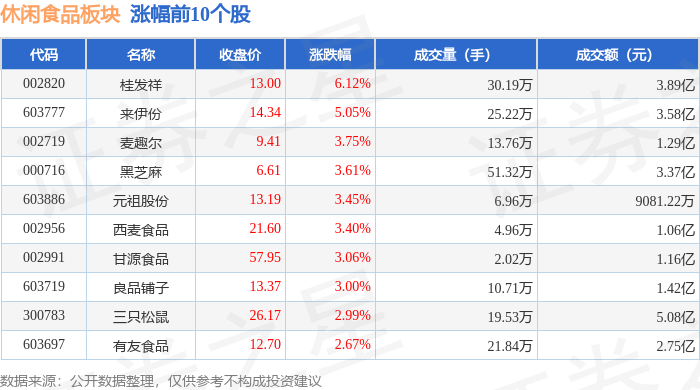
休闲食品板块9月4日涨0.68%,桂发祥领涨,主力资金净流入2775.36万元
Zheng Xing Xing Ye Ri Bao· 2025-09-04 08:50
Group 1 - The leisure food sector increased by 0.68% on September 4, with Gui Faxiang leading the gains [1] - The Shanghai Composite Index closed at 3765.88, down 1.25%, while the Shenzhen Component Index closed at 12118.7, down 2.83% [1] - Notable performers in the leisure food sector included Gui Faxiang, which rose by 6.12% to a closing price of 13.00, and Lai Yifen, which increased by 5.05% to 14.34 [1] Group 2 - The leisure food sector saw a net inflow of 27.75 million yuan from main funds, while retail investors contributed a net inflow of 84.39 million yuan [2] - Major stocks like San Zhi Song Shu and Lai Yifen experienced significant net outflows from speculative funds, with San Zhi Song Shu seeing a net outflow of 3.71 million yuan [2] - The data indicates a mixed sentiment among different types of investors, with main funds showing positive interest while speculative funds withdrew [2]


“满屏满地铁的AI广告,差点把我吓出心脏病”
Hu Xiu· 2025-09-03 09:07
Group 1 - The article discusses the pervasive influence of AI in various aspects of daily life, highlighting its presence in advertising, food delivery, and entertainment, often leading to a disconnect between consumer expectations and reality [5][9][38] - AI-generated content is criticized for lacking authenticity and quality, with examples of misleading advertisements and subpar products that do not match their AI-enhanced representations [19][27][38] - The cost-effectiveness of AI in advertising is emphasized, with reports indicating that AI-generated ads can be produced at approximately one-fourth the cost of traditional methods, raising concerns about the impact on brand image and consumer trust [36][37][38] Group 2 - The article notes that brands are increasingly adopting AI technologies, with major companies like H&M and Levi's utilizing AI models to create diverse marketing images without human involvement, which may lead to a decline in the perceived value of human creativity [23][48] - There is a growing trend of AI-generated models in e-commerce, with platforms like Taobao and Pinduoduo facing challenges related to authenticity and consumer trust, as AI-generated images often do not reflect the actual products [19][20][27] - The introduction of regulations requiring clear labeling of AI-generated content is mentioned, indicating a shift towards greater transparency in the use of AI in marketing and advertising [50][51]

休闲食品板块9月3日跌2.28%,有友食品领跌,主力资金净流出2.64亿元
Zheng Xing Xing Ye Ri Bao· 2025-09-03 08:40
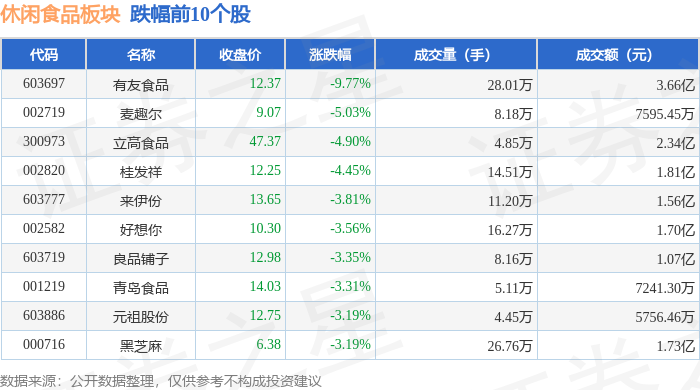
Core Viewpoint - The leisure food sector experienced a decline of 2.28% on September 3, with Youyou Food leading the drop [1] Group 1: Market Performance - The Shanghai Composite Index closed at 3813.56, down 1.16% [1] - The Shenzhen Component Index closed at 12472.0, down 0.65% [1] - Youyou Food's stock price fell by 9.77% to 12.37 [1] - Other notable declines include Maijiao (-5.03%), Lihigh Food (-4.90%), and Guifaxiang (-4.45%) [1] Group 2: Trading Volume and Value - Youyou Food had a trading volume of 280,100 shares and a transaction value of 366 million yuan [1] - Lihigh Food recorded a transaction value of 234 million yuan with a trading volume of 48,500 shares [1] - Guifaxiang had a transaction value of 181 million yuan with a trading volume of 145,100 shares [1] Group 3: Capital Flow - The leisure food sector saw a net outflow of 264 million yuan from main funds, while retail investors contributed a net inflow of 283 million yuan [2] - Speculative funds experienced a net outflow of 18.87 million yuan [2]