
平安银行

Search documents
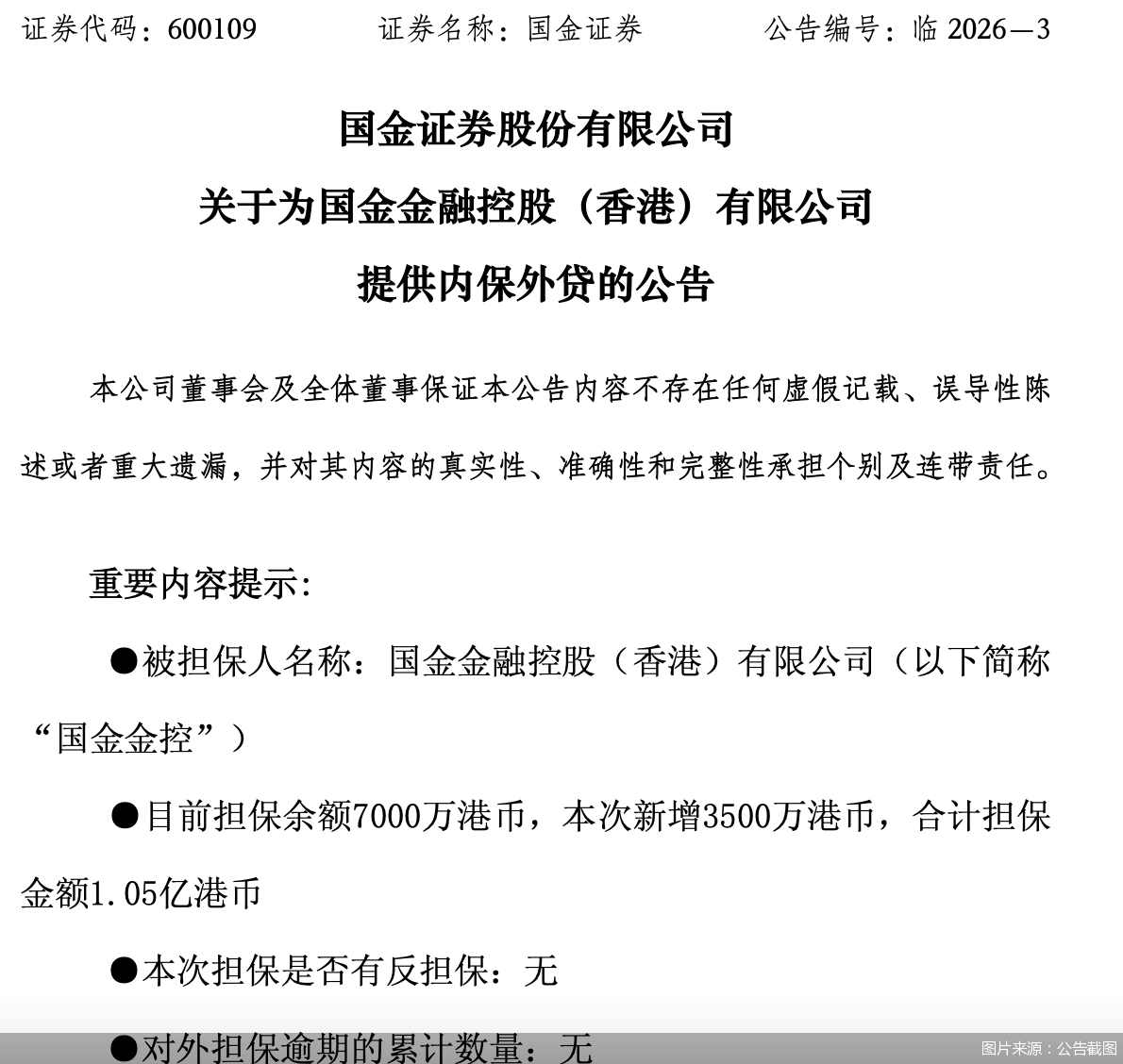
国金证券股份有限公司 关于为国金金融控股(香港)有限公司 提供内保外贷的公告
Zhong Guo Zheng Quan Bao - Zhong Zheng Wang· 2026-01-18 23:02
Summary of Key Points Core Viewpoint - The company is providing a guarantee for its wholly-owned subsidiary, Guojin Financial Holdings (Hong Kong) Limited, to enhance its competitive strength and support its business development in Hong Kong, with a total guarantee amount of 105 million HKD [2][6]. Group 1: Guarantee Overview - The current guarantee balance is 70 million HKD, with an additional 35 million HKD being added, resulting in a total guarantee amount of 105 million HKD [2]. - The company has signed a comprehensive credit limit contract with Ping An Bank for an offshore credit limit of 200 million HKD, with an exposure limit of 105 million HKD, valid for one year [2]. - The company will provide a guarantee for the offshore loan application made by Guojin Financial Holdings to Ping An Bank through an internal guarantee for external loans [2][6]. Group 2: Internal Decision-Making Process - The company’s board of directors approved the guarantee proposal on April 23, 2025, and the shareholders' meeting on June 18, 2025, allowing for a total guarantee amount not exceeding 200 million RMB (or equivalent foreign currency) for Guojin Financial Holdings [3]. - The guarantee amount can be managed on a rolling basis within the authorized limit, effective until the next annual shareholders' meeting [3]. Group 3: Reporting Procedures - The company submitted a report to the China Securities Regulatory Commission on December 29, 2025, regarding the internal guarantee for external loan financing [4]. - On December 31, 2025, the company applied for registration and filing with the State Administration of Foreign Exchange, receiving the necessary documentation on January 9, 2026 [4]. Group 4: Financial Data of the Guaranteed Entity - Guojin Financial Holdings (Hong Kong) Limited is a wholly-owned subsidiary with a registered capital of 908,999,900 HKD, and its main business includes securities trading, investment banking, and asset management [5]. - The company’s recent financial data indicates a strong operational capacity, supporting the rationale for the guarantee [5]. Group 5: Board of Directors' Opinion - The board believes that the financial risks associated with Guojin Financial Holdings are manageable and that providing the guarantee will not harm the interests of the company and its shareholders [7]. Group 6: Total Guarantee Amount - As of the announcement date, the total amount of guarantees provided to subsidiaries is approximately 794.38 million RMB, which represents about 2.26% of the equity attributable to the parent company as of September 30, 2025 [8].


平安基金管理有限公司关于新增平安源恒6个月 持有期混合型基金中基金(FOF)销售机构的公告
Zhong Guo Zheng Quan Bao - Zhong Zheng Wang· 2026-01-18 22:53
Group 1 - The company has signed a sales agreement with several banks, including Bank of Communications, Ningbo Bank, and Ping An Bank, to add them as sales institutions for the Ping An Yuanheng 6-month holding period mixed fund of funds (FOF) starting from January 19, 2026 [1] - The sale period for the Ping An Yuanheng 6-month holding period mixed fund of funds (FOF) is from January 19, 2026, to January 30, 2026 [1] - Investors can consult details through the customer service numbers and websites of the involved banks and the fund management company [1] Group 2 - The announcement is made by Ping An Fund Management Co., Ltd. on January 19, 2026 [2] - A MACD golden cross signal has formed, indicating that certain stocks are experiencing a good upward trend [2]


海富通瑞祥一年定期开放债券型证券投资基金开放申购、赎回和转换业务的公告
Shang Hai Zheng Quan Bao· 2026-01-18 18:46
根据《海富通瑞祥一年定期开放债券型证券投资基金基金合同》(以下简称"《基金合同》")及《海富 通瑞祥一年定期开放债券型证券投资基金招募说明书》(以下简称"《招募说明书》"),本基金以定期 开放的方式运作。本基金的封闭期为自《基金合同》生效之日起(包括《基金合同》生效之日)或自每 一开放期结束之日次日起(包括该日)一年的期间。本基金的首个封闭期为自《基金合同》生效之日起 (包括《基金合同》生效之日)一年的期间。第二个封闭期为首个开放期结束之日次日起(包括该日) 一年的期间,以此类推。本基金封闭期内不办理申购与赎回业务,也不上市交易。本基金自每个封闭期 结束之后第一个工作日起进入开放期,期间可以办理申购与赎回业务。 本基金《基金合同》生效日为2017年7月28日,经过前期运作,本基金第八个封闭期为2025年1月21日至 2026年1月20日止日。根据本基金《基金合同》、《招募说明书》的规定,基金管理人决定自2026年1月 21日起(含该日)至2026年2月25日(含该日)期间的工作日,本基金接受投资者的申购、赎回、转入 及转出申请。自2026年2月26日至2027年2月25日,为本基金的第九个封闭期,封闭期内本基 ...
从吃息差到拼能力 金融机构打响“突围战”
Shang Hai Zheng Quan Bao· 2026-01-18 18:15
◎ 记者 黄坤 重新审视传统盈利模式 在低利率背景下,银行、保险机构面临的核心挑战,在于依赖传统业务的盈利路径正在失效,必须主动 求变、探索新路径。 "躺着赚息差的日子一去不复返了。"浙江一家城商行人士告诉上海证券报记者,过去加大信贷资产投放 尚能通过"以量补价"维持营收规模,如今即便资产规模继续增长,利息收入却不升反降,营收承压成普 遍现象。 "新的一年,利差收窄仍是我们面临的最大挑战。"站在2026年初的时间节点上,无论是来自银行、保险 公司,还是资管机构的人士,几乎都表达了相同的感慨——低利率正在重塑资管行业的盈利模式和经营 思路。 低利率带来的是低息差、低收益,利率中枢持续下移的趋势下,银行净息差承压、保险利差损风险加 大,这些相互交织的挑战,正将金融行业推入一个前所未有的压力测试。如何在低利率环境中优化业务 结构、寻找可持续的业绩新增长点,金融从业者正在积极寻求答案。 "做了才有机会" "现在贷款利率这么低,大家都是赔本赚吆喝。"多位银行业人士向上海证券报记者感慨道,银行盈利空 间正被不断挤压,业务打法也随之发生变化,过去是银行"筛选客户",现在变为"做了才有机会",只能 把希望放在未来业务合作上, ...


金融行业周报(2026、01、18):央行宣布结构性降息,衍生品交易监管更规范-20260118
Western Securities· 2026-01-18 11:43
Investment Rating - The report does not explicitly state an overall investment rating for the financial industry, but it provides specific recommendations for various sectors and companies within the industry [3][21]. Core Insights - The financial industry experienced a decline this week, with the non-bank financial index down by 2.63%, underperforming the CSI 300 index by 2.06 percentage points. The banking sector saw a decline of 3.03%, also underperforming the CSI 300 index by 2.46 percentage points [1][9]. - The report highlights a structural interest rate cut by the central bank, which is expected to impact various financial sectors, particularly banks and insurance companies. The insurance sector is viewed as being in a critical window for performance and valuation recovery [3][21]. - Regulatory measures have been introduced to stabilize the derivatives market, which is expected to benefit well-capitalized and compliant brokerage firms [2][17]. Summary by Sections 1. Weekly Performance and Sector Insights - The non-bank financial index decreased by 2.63%, with the securities, insurance, and diversified financial indices down by 2.21%, 3.59%, and 1.83% respectively [1][9]. - The banking sector's performance was notably poor, with state-owned banks, joint-stock banks, city commercial banks, and rural commercial banks experiencing declines of 2.20%, 4.08%, 2.40%, and 2.20% respectively [1][9]. 2. Insurance Sector Insights - The insurance sector's index fell by 3.59%, underperforming the CSI 300 index by 3.02 percentage points. The report indicates that regulatory cooling measures have created short-term pressure on the insurance sector, but the long-term outlook remains positive due to asset growth and interest margin recovery [1][13][15]. - Key companies such as China Pacific Insurance, China Life, and New China Life are recommended for investment due to their strong fundamentals and recovery potential [3][16]. 3. Brokerage Sector Insights - The brokerage sector saw a decline of 2.21%, with the report emphasizing the potential benefits of new regulatory measures aimed at enhancing the derivatives market. The focus is on larger, well-capitalized firms that can navigate the evolving regulatory landscape [2][17]. - Recommendations include major brokerages like Guotai Junan and Huatai Securities, which are expected to benefit from the anticipated recovery in profitability and valuation [2][18]. 4. Banking Sector Insights - The banking sector's index fell by 3.03%, with the central bank's recent interest rate cut expected to support the sector's performance in the long run. The report suggests that banks may see a gradual recovery in net interest income and profitability [3][21][22]. - Specific banks such as Hangzhou Bank and Ningbo Bank are highlighted as potential investment opportunities, particularly those with previously undervalued positions [3][22].




国金证券:已合计为国金金控提供1.05亿港币担保
Bei Jing Shang Bao· 2026-01-18 11:19
Group 1 - The core point of the article is that Guojin Securities announced its plan to support its wholly-owned subsidiary, Guojin Financial Holdings (Hong Kong) Co., Ltd., by applying for a bank loan from Ping An Bank, with Guojin Securities providing a guarantee for this financing [1] - Guojin Securities currently has a guarantee balance of 70 million HKD for Guojin Financial Holdings, and an additional 35 million HKD will be added, bringing the total guarantee amount to 105 million HKD [1] - As of the announcement date, the total guarantee amount provided by Guojin Securities to its wholly-owned subsidiaries is 794 million RMB, which accounts for approximately 2.26% of the equity attributable to the parent company as of September 30, 2025 [1]

开年“关停潮”持续!多家银行信用卡分中心“谢幕”
Bei Jing Shang Bao· 2026-01-18 11:12
Core Viewpoint - The ongoing wave of credit card center closures in banks reflects a significant industry shift from "incremental expansion" to "deep cultivation of existing stock," driven by the evolution of offline business models and the need for enhanced digital capabilities and merchant ecosystem collaboration [1][8]. Group 1: Industry Trends - As of January 2026, several banks, including state-owned and city commercial banks, have closed credit card centers, indicating a trend towards operational efficiency [3]. - Since 2025, over 60 credit card centers have closed, with a notable decline in card issuance from 807 million in Q2 2022 to 707 million by Q3 2025, representing a loss of 100 million cards [3]. - The shift towards online card applications has diminished the effectiveness of traditional offline sales teams, leading to increased operational costs without corresponding revenue growth [3][4]. Group 2: Business Strategy - Banks are focusing on optimizing existing cardholder services and leveraging technology such as big data and AI to restructure their business models and manage costs effectively [4][5]. - The closure of credit card centers is expected to lead to a consolidation of operations under local branches, retaining only essential personnel for customer service and account management [5]. - The industry is moving towards a phase of refined operations, emphasizing the importance of extracting deeper value from existing customers rather than pursuing aggressive growth [6][8]. Group 3: Future Outlook - The trend of closing local credit card centers is anticipated to continue, with more banks expected to follow suit in optimizing their operations [8]. - The restructuring is viewed not as a sign of industry decline but as a necessary realignment of operational logic, focusing on existing customer service, enhancing digital capabilities, and deepening merchant collaborations as key directions for sustainable development in the credit card business [8].

国金证券:拟为子公司新增3500万港币内保外贷担保
Xin Lang Cai Jing· 2026-01-18 07:43
Group 1 - The core point of the announcement is that Guojin Securities is supporting its wholly-owned subsidiary, Guojin Financial Holdings (Hong Kong) Limited, by applying for a credit-backed external loan business from Ping An Bank [1] - The current guarantee balance is 70 million HKD, with an additional 35 million HKD being added, bringing the total guarantee amount to 105 million HKD [1] - The relevant matters have passed internal decision-making and reporting procedures [1] Group 2 - As of the announcement date, the total guarantee amount for the wholly-owned subsidiary is 794 million CNY, which accounts for approximately 2.26% of the equity attributable to the parent company as of September 30, 2025 [1] - There are no overdue guarantees reported [1]
信用债周度观察(20260112-20260116):信用债发行量整体环比上升,各行业信用利差整体上行-20260117
EBSCN· 2026-01-17 10:58
Report Industry Investment Rating No relevant content provided. Core View of the Report - From January 12 to January 16, 2026, the issuance volume of credit bonds increased overall on a month - on - month basis, and the credit spreads of various industries also showed an overall upward trend [1]. Summary According to the Directory 1. Primary Market 1.1 Issuance Statistics - During January 12 - 16, 2026, a total of 342 credit bonds were issued, with a total issuance scale of 331.801 billion yuan, a month - on - month increase of 6.25%. Among them, 156 industrial bonds were issued, with a scale of 171.1 billion yuan (a 26.40% month - on - month increase, accounting for 51.57% of the total); 162 urban investment bonds were issued, with a scale of 92.801 billion yuan (a 33.19% month - on - month decrease, accounting for 27.97%); 24 financial bonds were issued, with a scale of 67.9 billion yuan (a 78.68% month - on - month increase, accounting for 20.46%) [1][11]. - The average issuance term of credit bonds this week was 2.67 years. The average issuance term of industrial bonds was 2.11 years, urban investment bonds was 3.40 years, and financial bonds was 1.68 years [1][13]. - The average issuance coupon rate of credit bonds this week was 2.17%. The average issuance coupon rate of industrial bonds was 2.04%, urban investment bonds was 2.33%, and financial bonds was 1.87% [2][17]. 1.2 Cancellation of Issuance Statistics - Five credit bonds were cancelled for issuance this week [23]. 2. Secondary Market 2.1 Credit Spread Tracking - By industry, in the Shenwan primary industries, the largest upward movement in the credit spread of AAA - rated industries was in real estate, up 6.9BP; the largest upward movement in the AA + - rated industries was in electrical equipment, up 12.3BP, and the largest downward movement was in leisure services, down 0.4BP; the largest upward movement in the AA - rated industries was in leisure services, up 21.6BP [3]. - By region for urban investment bonds, the largest upward movement in the AAA - rated credit spread was in Anhui, up 6.2BP; the largest upward movement in the AA + - rated was in Xinjiang, up 6BP, and the largest downward movement was in Henan, down 1.8BP; the largest upward movement in the AA - rated was in Shanghai, up 3BP, and the largest downward movement was in Guangxi, down 0.5BP [3]. - Overall, credit spreads in various sectors such as coal, steel, urban investment, non - urban investment, state - owned enterprises, and private enterprises showed an upward trend, while regional urban investment credit spreads showed mixed trends [25]. 2.2 Trading Volume Statistics - The total trading volume of credit bonds was 1521.829 billion yuan, a month - on - month increase of 8.40%. The top three types of credit bonds in terms of trading volume were commercial bank bonds, corporate bonds, and medium - term notes. Specifically, the trading volume of commercial bank bonds was 506.172 billion yuan (an 8.35% month - on - month increase, accounting for 33.26%); corporate bonds was 398.637 billion yuan (an 8.05% month - on - month increase, accounting for 26.19%); medium - term notes was 362.973 billion yuan (a 19.35% month - on - month increase, accounting for 23.85%) [4][27]. 2.3 Actively Traded Bonds This Week - The report selected the top 20 urban investment bonds, industrial bonds, and financial bonds in terms of trading volume this week for investors' reference [29].
2025年12月份证券类APP月活达1.75亿
Xin Lang Cai Jing· 2026-01-17 06:24
Core Insights - The report highlights the increasing competition among brokerage firms as they enhance their apps to provide comprehensive wealth management services, with a focus on investment advisory and insurance sales [1][4]. Group 1: App Usage and Growth - As of December 2025, the monthly active users (MAU) of securities apps reached 175 million, marking a 1.75% month-on-month increase and a 2.26% year-on-year increase, setting a new monthly record for 2025 [1]. - Huatai Securities' "Zhangle Wealth" and Guotai Junan's "Guotai Junan Junhong" led the brokerage apps with MAUs of 12.12 million and 10.40 million, respectively, showing month-on-month growth of 2.59% and 2.12% [2]. - The app "Xingye Securities Youlibao" exhibited the most significant year-on-year growth, with a 20.66% increase, reaching an MAU of 1.87 million in December [2]. Group 2: Wealth Management Transformation - Brokerage firms are focusing on optimizing their apps by enhancing investment advisory services and introducing insurance sections to meet diverse user investment needs [4]. - The introduction of new investment advisory services, such as "Stock Selection Treasure" and "Beixin Lingdong+", aims to provide tailored services for different customer segments [4]. - The shift towards comprehensive wealth management is seen as essential for brokerages to overcome challenges posed by declining commission rates, with a focus on offering a full range of asset allocation services [5].


