
长城汽车

Search documents
主机厂原材料涨价后续影响分析
Zhong Guo Neng Yuan Wang· 2026-02-03 01:55
Core Viewpoint - The automotive industry has experienced significant price increases in raw materials since 2020, primarily driven by two distinct phases of price surges, with lithium carbonate leading the increases [1][2]. Group 1: Price Trends - The first phase of price increases occurred from Q3 2020 to Q1 2022, where the average price of battery-grade lithium carbonate rose from 40,000 yuan/ton in Q3 2020 to 550,000 yuan/ton by Q4 2022 [1][2]. - The second phase began in Q4 2025, with notable increases in prices for lithium carbonate, lithium hexafluorophosphate, copper, and aluminum, with price increases of 187% for lithium carbonate and 180% for lithium hexafluorophosphate compared to their lowest values in 2025 [2]. Group 2: Impact on Stakeholders - The price increases have been shared among upstream component suppliers, manufacturers, and consumers, with component suppliers experiencing a decline in gross margins from 19.3% in Q3 2020 to 15.3% in Q4 2021 [3]. - Vehicle manufacturers also faced margin pressures, with gross margins for passenger vehicles dropping from 12.7% in Q4 2020 to 8.8% in Q4 2021 [3]. - Consumers have seen price increases for electric vehicles, with companies like BYD raising prices by 1,000 to 7,000 yuan due to rising raw material costs and subsidy reductions [3]. Group 3: Future Outlook - The automotive industry is expected to manage raw material cost increases through moderate price hikes or product enhancements, rather than significant price increases, to avoid negatively impacting sales [4]. - The penetration rate of new energy vehicles is projected to reach 54% by 2025, which may influence pricing strategies as manufacturers navigate subsidy reductions and rising costs [4]. - The domestic passenger car market may face challenges due to raw material price increases, but high-end manufacturers are expected to maintain profitability, while exports of new energy vehicles are anticipated to grow [5].
光大证券晨会速递-20260203
EBSCN· 2026-02-02 23:37
Market Overview - The secondary market prices of publicly listed REITs in China showed a fluctuating upward trend in January 2026, with the CSI REITs closing at 809.56 and the CSI REITs total return index at 1052.42, yielding returns of 3.98% and 4.22% respectively [1] - Compared to other major asset classes, the return rates ranked as follows: Gold > Crude Oil > Convertible Bonds > A-shares > REITs > US Stocks > Pure Bonds [1] Industry Research - SpaceX plans to deploy one million computing satellites, expanding the commercial space demand [2] - The ability to manufacture and launch reusable rockets is fundamental for large-scale constellation construction [2] - Laser communication networks are key for achieving large-scale inter-satellite communication [2] - Recommended companies in the rocket sector include Superjet, Highhua Technology, and Zhongheng Design; in the satellite sector, focus on Shaanxi Huada, Shanghai Port, Shanghai Huanxun, Zhenlei Technology, Changguang Huaxin, Aerospace Electronics, Jiayuan Technology, and Shanghai Huguang [2] Company Research - Baihehua (603823.SH) plans to invest in a 1000-ton PEEK project, enhancing its position in the new materials sector [3] - The forecast for Baihehua's net profit for 2025-2027 is adjusted to 173 million (down 22%), 223 million (down 22%), and 270 million yuan, with corresponding EPS of 0.42, 0.54, and 0.65 yuan [3] - Zhongxin Fluorine Materials (002915.SZ) expects to achieve a net profit of 16-20 million yuan in 2025, benefiting from the recovery in pesticide demand and reduced losses from Fujian Gaobao [4] - The projected net profits for Zhongxin Fluorine Materials for 2025-2027 are 18 million, 75 million, and 110 million yuan [4] - Jiu Ri New Materials (688199.SH) anticipates a net profit of 21-31.5 million yuan in 2025, driven by the price recovery of photoinitiators [6] - The projected net profits for Jiu Ri New Materials for 2025-2027 are 31 million, 78 million, and 136 million yuan [6] - Great Wall Motors (601633.SH, 2333.HK) reported a profit forecast for 2025, with net profits adjusted to 9.9 billion, 12.4 billion, and 15.7 billion yuan for 2025-2027 [7] - Apple (AAPL.O) reported record revenue growth in FY1Q26, driven by strong demand for the iPhone 17 series and the continued penetration of AI features [8] - The company maintained a high gross margin despite rising storage costs, showcasing its pricing power and supply chain management capabilities [8] - Aoyou (1717.HK) expects a revenue growth of 1.1% in 2025, with net profits adjusted to 236 million, 262 million, and 280 million yuan for 2025-2027 [9]



长城汽车财报出炉:营收超2227亿元 单车收入为历史最佳
Zhong Guo Jing Ying Bao· 2026-02-02 23:14
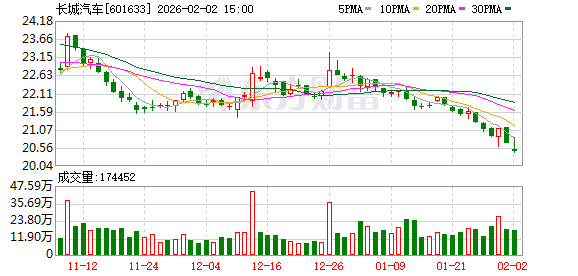
Core Viewpoint - In 2025, the Chinese automotive industry transitions from "price competition" to "value competition," leading to a high-quality development phase, with increased market differentiation and revenue pressure on most automakers. However, Great Wall Motors achieves significant revenue growth through a clear strategic focus on high-end and new energy vehicles, reaching a record revenue of 222.79 billion yuan, a 10.19% year-on-year increase [2][3]. Industry Background - The automotive market in China is undergoing a critical adjustment phase, with lingering effects from previous price wars and accelerated transitions to new energy vehicles, resulting in many automakers facing profitability challenges [3][4]. Revenue Growth Drivers - Great Wall Motors' revenue growth is attributed to a shift from "scale competition" to a "value-driven" business model, enhancing the quality and sustainability of revenue growth. The average vehicle price reached 201,300 yuan in 2025, reflecting a significant increase in product premium capabilities [4][6]. High-End and New Energy Vehicle Growth - In 2025, sales of high-end and new energy vehicles at Great Wall Motors both saw substantial growth, validating the company's strategic focus on brand elevation and energy transition. The high-end brand sales, particularly from the WEY and Tank brands, significantly contributed to revenue growth [5][7]. Product Structure Optimization - Great Wall Motors has established a clear multi-brand matrix, covering price ranges from 100,000 to 450,000 yuan, allowing for differentiated competition and avoiding internal competition. This structure supports the company's transition to high-value and high-quality products [10][11]. Technological Investment - The company has invested heavily in technology and innovation, with a team of 23,000 engineers and significant investments in testing facilities. This focus on technology is expected to enhance product quality and brand value, positioning Great Wall Motors for future growth [12].

吉利超比亚迪,中国汽车销量排行变天
汽车商业评论· 2026-02-02 23:10
Core Viewpoint - The Chinese automotive market is experiencing a downturn in early 2026, with significant declines in sales and a shift in market dynamics, particularly affecting new energy vehicle (NEV) companies and traditional automakers [4][5][8]. Group 1: Market Performance - In January 2026, the automotive sector saw a decline in stock prices across both Hong Kong and A-shares, with NEV companies experiencing larger drops of 4%-7%, while traditional automakers faced smaller declines of 1%-4% [4]. - The primary reason for the market downturn is attributed to disappointing sales figures in January, which fell short of expectations, alongside a significant drop in international gold prices impacting resource stocks [5][8]. - The overall sales of domestic passenger vehicles decreased by 18.1% year-on-year, while exports surged by 50.5%, providing some support to the market [7]. Group 2: Sales Rankings and Trends - The sales rankings among new energy vehicle manufacturers have shifted, with Xiaomi leading in January 2026, followed by Li Auto and NIO, while traditional automakers like Geely and BYD also showed significant sales figures [10][13][15]. - Geely's sales reached 270,200 units in January, marking a strong performance with both year-on-year and month-on-month growth, while BYD's sales dropped by 30% year-on-year and 50% month-on-month, indicating a significant slowdown [15][17]. - Traditional automakers are showing resilience, with GAC's sales growing by 18.47% year-on-year, highlighting the continued market presence of fuel vehicles amidst the NEV price wars [20]. Group 3: Future Outlook - The automotive industry is predicted to enter a "zero growth" phase in 2026, with expectations of a 20.4% month-on-month decline in January sales and only a slight year-on-year increase of 0.3% [30][31]. - Experts suggest that the market will shift from stimulus-driven growth to a more structured approach, with reduced incentives for low-priced NEVs, leading to a more competitive landscape [32]. - The focus on international expansion is expected to become a critical strategy for automakers, as the market adapts to changing consumer demands and competitive pressures [34].



1月车市分化加剧:自主品牌座次洗牌 新势力环比普降
Zhong Guo Zheng Quan Bao· 2026-02-02 23:03
Core Insights - The automotive market in January 2026 shows a clear distinction between traditional domestic brands, which are performing strongly, and new energy vehicle (NEV) startups, which are facing challenges [1][5] Traditional Domestic Brands Performance - Major traditional automakers like SAIC, Geely, and Chery reported over 20% year-on-year sales growth in January 2026, with SAIC leading the market [2][3] - SAIC sold 327,400 vehicles in January, a 23.9% increase year-on-year, with 214,000 units from its own brands, marking a 39.6% increase [2] - Geely's sales reached 270,200 units, a 1% year-on-year increase, with NEV sales contributing significantly [2] - Chery's sales totaled 200,300 units, with exports accounting for 119,600 units, a 48.1% increase year-on-year [3] - GAC Group saw a significant increase in sales, reaching 116,600 units, up 18.47% year-on-year, driven by its new energy and overseas sales [3] New Energy Vehicle Startups Challenges - In contrast, nine major NEV startups experienced a collective decline in sales, with month-on-month drops ranging from 21.2% to 47.0% [5][6] - Despite the downturn, some brands like NIO and Zeekr reported year-on-year growth exceeding 95% [6][7] - The decline in NEV sales is attributed to short-term factors such as policy changes and seasonal demand fluctuations [6][7] - The market is expected to stabilize post-policy transition, with a potential recovery in sales anticipated in February and March 2026 [7] Market Dynamics and Future Outlook - The automotive industry is witnessing a restructuring of brand rankings, with traditional brands solidifying their positions while new entrants face increasing competition [1][5] - The long-term growth logic of the NEV sector remains intact, with expectations for a gradual recovery as new products are launched and market conditions improve [7]




GREAT WALL MOTOR(2333.HK):4Q25 EARNINGS MISSED; DOWNGRADE TO SELL ON EARNINGS DOWNSIDE RISK AND VALUATION OVERSTRETCH
Ge Long Hui· 2026-02-02 22:46
机构:中银国际 研究员:LOU Jia/Olivia NIU/Maggie CAI Based on preliminary results, GWM's 4Q25 revenue grew 13% QoQ to RMB69.2bn, but net profit plunged 44% QoQ to RMB 1.3bn, sharply missing expectations due to seasonal bonus accruals, low sales efficiency from aggressive direct-sales set-up, and lower Russian scrap tax rebates. For 2026, the sales target of 1.8m units (1.2m domestic, 600k overseas) implies a 45%+ YoY domestic surge, driven by intensive rollouts under EC/DE platform. However, we deem the goal challengi ...
1月车市分化加剧: 自主品牌座次洗牌 新势力环比普降
Zhong Guo Zheng Quan Bao· 2026-02-02 20:51
截至2月2日,国内主流车企2026年1月产销数据陆续披露。整体市场呈现"传统自主强势领跑、新势力普 遍承压"的鲜明格局:上汽、吉利、奇瑞等头部车企销量同比多实现20%以上增长,自主品牌座次因新 能源与出口表现差异出现重构。 1月传统自主车企集团凭借完善的产品矩阵与全球化布局,交出亮眼成绩单,头部阵营座次因各板块增 长动能差异出现显著调整。 具体来看,上汽集团(600104)延续领跑态势,1月实现整车批售32.74万辆,同比增长23.9%,终端零 售36.3万辆,批发与零售双双领跑行业。分板块来看,自主品牌表现尤为突出,销量达21.4万辆,同比 增长39.6%,占集团总销量比重升至65.3%。 其中,上汽乘用车销售7.7万辆,同比增幅达53.8%;上汽通用五菱销售10.5万辆,同比增长37%。新能 源与海外市场成为核心增长引擎,1月新能源汽车销量8.5万辆,同比增长39.7%;海外销量10.5万辆, 同比增长51.7%,仅MG品牌在欧洲市场就交付近2.6万辆,同比增长15%。 吉利汽车以27.02万辆的销量位居次席,同比增长1%,环比增长14%,新能源业务成为重要支撑。1月新 能源汽车销量达12.43万辆,同比 ...
自主品牌座次洗牌 新势力环比普降
Zhong Guo Zheng Quan Bao· 2026-02-02 20:45
截至2月2日,国内主流车企2026年1月产销数据陆续披露。整体市场呈现"传统自主强势领跑、新势力普 遍承压"的鲜明格局:上汽、吉利、奇瑞等头部车企销量同比多实现20%以上增长,自主品牌座次因新 能源与出口表现差异出现重构。 与此同时,9家主流造车新势力则遭遇集体环比下滑。业内分析指出,短期政策切换、淡季效应等因素 扰动终端,但自主车企核心竞争力持续提升,新势力"马太效应"加剧,行业高质量发展的长期逻辑未 变。 ● 本报记者 龚梦泽 自主品牌座次重构 奇瑞集团凭借出口优势跃居前列,1月销售汽车20.03万辆,其中出口11.96万辆,同比增长48.1%,连续 9个月出口突破10万辆。新能源板块同样稳步推进,1月销量5.21万辆,形成"出口+新能源"双轮驱动格 局。旗下主要品牌中,奇瑞品牌销量13.56万辆,捷途品牌4.27万辆,星途、iCAR、智界品牌分别销售 5276辆、3419辆、4506辆,产品矩阵覆盖从主流到高端的全细分市场。 广汽集团自主板块爆发式增长,推动整体销量达11.66万辆,同比增长18.47%。这是昊铂埃安BU和传祺 BU完成组建后首次披露月度销量,成效立竿见影:昊铂埃安BU销量超2.16万辆 ...

1月车企销量公布!宝马更换全新车标!特斯拉净利润首次大幅下滑!我国新能源车保有量4397万辆,其中纯电动车3022万辆!丨一周大事件
电动车公社· 2026-02-02 16:53
New Car Launches - The new BJ40 range-extended version has been launched at a price of 279,800 yuan [2] - The new BJ40 features a rugged design with custom paint and off-road enhancements, including a total length of 4861mm, width of 2065mm, height of 2110mm, and a wheelbase of 2760mm [4] - The vehicle is equipped with a 138kW 1.5T range extender and dual motors with a total power of 403kW, paired with a 40.3kWh lithium battery, offering a pure electric range of 150km [8][10] - BYD's new flagship models, the Seal 08 sedan and the Sea Lion 08 SUV, have been recently revealed [11] Company Dynamics - General Motors projects a revenue of $185 billion for 2025, a year-on-year decline of 1.3%, with a net profit of $2.7 billion, significantly down from $6 billion in 2024 [14][15] - Tesla anticipates delivering 1.6363 million vehicles in 2025, a 9% decrease year-on-year, with total revenues declining for the first time [23][25] - Toyota expects global sales of 11.3 million vehicles in 2025, marking a 4.6% increase year-on-year, maintaining its position as the world's largest automaker [26][27] - Zotye Auto forecasts a net loss of 281 to 417 million yuan for 2025, a significant reduction from a previous loss of 1 billion yuan [30][31] Domestic News - A mandatory national standard for automotive steering systems has been released, effective July 1, which clarifies technical requirements and testing methods for new technologies [34][35] - The number of new energy vehicles in China has reached 43.97 million, with pure electric vehicles accounting for 30.22 million [38] - China is projected to export 8.32 million vehicles in 2025, a 30% increase year-on-year, with 3.43 million of those being new energy vehicles, reflecting strong competitiveness [39][41] - The country plans to add over 10,000 charging guns in service areas to enhance the convenience of charging for new energy vehicles [44][46] Vehicle Sales - BYD sold 205,518 passenger vehicles in January, maintaining its lead in the new energy vehicle market [47][51] - Geely's total sales reached 270,167 units in January, with 124,252 units being new energy vehicles [52][55] - NIO delivered 27,182 vehicles in January, with the ES8 model achieving significant sales [69][72]


1月份车企销量分化明显
Zheng Quan Ri Bao· 2026-02-02 16:41
进入2月份,多家车企陆续披露1月份销量数据,行业运行态势逐步明朗。受春节临近、需求阶段性透支 等因素影响,1月份车市整体处于传统淡季,但新能源汽车板块仍保持较强韧性,头部车企凭借产品矩 阵和体系能力维持较高销量规模,行业分化特征进一步凸显。 具体来看,1月份,自主品牌阵营重新洗牌。上汽集团汽车销量为32.74万辆,同比增长23.94%,再度登 顶月销量榜首。紧随其后的是吉利汽车,汽车销量为27.02万辆,同比增长1%;昔日龙头比亚迪汽车销 量为21.01万辆,同比下滑30.11%。此外,奇瑞集团汽车销量为20.03万辆;广汽集团汽车销量为11.66万 辆,同比增长18.47%;长城汽车汽车销量为9.03万辆,同比增长11.59%;赛力斯汽车销量4.59万辆,同 比增长104.85%。 1月份,部分传统车企在新能源汽车与出口端的表现亦出现积极变化。例如,吉利汽车的海外出口总销 量同比实现翻倍增长;新能源汽车销量占销售总量的比例为46%,共销售12.43万辆,同比增长3%。上 汽通用汽车披露,1月份终端销量超5.1万辆,同比增长约8%,其中新能源车型销量同比增长接近90%, 出口销量同比增长超过一倍。奇瑞集团出口 ...