
巨子生物

Search documents
商贸零售行业周报:双十一电商大促落幕,美妆、珠宝表现亮眼-20251116
KAIYUAN SECURITIES· 2025-11-16 11:48
Investment Rating - The industry investment rating is "Positive" (maintained) [7] Core Insights - The 2025 Double Eleven e-commerce promotion concluded with a total online sales of 1,695 billion yuan, representing a 14.2% increase compared to 2024. Tmall led in overall e-commerce sales, while JD reported record high transaction volumes with a 40% increase in the number of orders and nearly 60% growth in order volume [3][26] - The jewelry sector performed exceptionally well, with gold products favored by younger consumers. The demand for gold has evolved from a singular focus on value preservation to a multifaceted need for cultural recognition and emotional value, indicating higher growth potential for aesthetically and culturally rich gold jewelry [3][29] - The beauty sector achieved a total GMV of 132.5 billion yuan, with skincare and fragrance/cosmetics sales reaching 99.1 billion yuan and 33.4 billion yuan, respectively. Domestic brands like Proya and Han Shu dominated the sales charts, showcasing the strength of local brands [3][32] - The integration of AI technology in retail is enhancing consumer experiences, creating a virtuous cycle among consumers, merchants, and platforms [3][42] Summary by Sections Retail Market Review - The retail industry index rose by 4.06% during the week of November 10-14, 2025, outperforming the Shanghai Composite Index, which fell by 0.18%. The retail sector ranked third among 31 primary industries [5][14] - The supermarket sector saw the highest increase, with a weekly growth of 7.09%, while the jewelry sector led the year-to-date performance with a 23.66% increase [18][21] Retail Insights: Double Eleven Promotion - The Double Eleven e-commerce event showed resilience in growth, with significant sales increases across platforms. Tmall's comprehensive e-commerce sales reached 16,191 billion yuan, while instant retail sales soared by 138.4% [26] - Gold jewelry sales saw a remarkable increase, with the flagship store of Lao Pu Gold achieving over 3 billion yuan in sales within 10 minutes of opening on Tmall [29] - The beauty category's GMV reached 132.5 billion yuan, with domestic brands capturing significant market share, particularly in skincare and cosmetics [32] Focus on High-Growth Sectors - Investment recommendations include focusing on high-quality companies in sectors driven by emotional consumption themes, such as gold jewelry, offline retail, cosmetics, and medical aesthetics [6][48] - Specific companies highlighted for investment include Lao Pu Gold, Proya, and Aimeike, among others, which are expected to benefit from current market trends [49]


行业点评报告:10月社零同比+2.9%,金银珠宝表现亮眼
KAIYUAN SECURITIES· 2025-11-14 14:57
Investment Rating - The industry investment rating is "Positive" (maintained) [1] Core Insights - The retail sector shows a steady recovery in consumer spending, with a year-on-year increase of 4.3% in retail sales from January to October 2025, and a 2.9% increase in October alone [5] - Key categories such as essential goods like grains and oils maintain resilience, while discretionary items like gold and jewelry show remarkable performance, with jewelry sales up by 37.6% year-on-year in October [6] - Online retail continues to grow, with a 9.6% increase in online sales from January to October 2025, while offline retail channels also show signs of recovery [7] Summary by Sections Industry Overview - The retail sector is experiencing a robust recovery, with October retail sales reaching 46,291 billion yuan, exceeding market expectations [5] - The overall consumer price index (CPI) has turned positive, driven by rising prices in services and industrial goods [6] Consumer Behavior - Essential consumption categories like grains and oils have shown strong growth, while discretionary spending on cosmetics and jewelry has surged, indicating a shift towards "emotional consumption" [6][8] - The report emphasizes the importance of brands that resonate with consumers' emotional values and competitive strengths [8] Investment Recommendations - Focus on high-quality companies in the "emotional consumption" theme, particularly in four key areas: 1. Gold and jewelry brands with unique product offerings [8] 2. Offline retail companies adapting to market changes [8] 3. Domestic cosmetic brands emphasizing emotional value and safety [8] 4. Medical beauty firms with differentiated products and expansion strategies [8]
国货美妆双十一大促收官:函得仕成头皮护理“黑马”,优时颜守擂眼霜品类,自然堂新品油敷膜借李佳琦直播间“破圈”
Cai Jing Wang· 2025-11-14 14:15
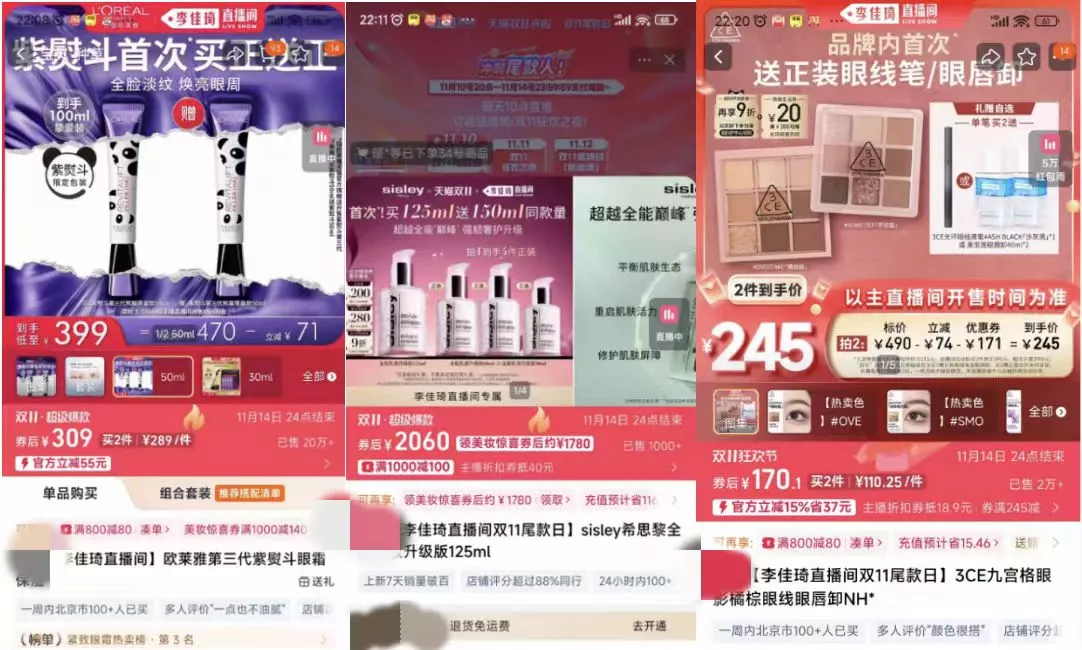
Core Insights - The "Double Eleven" shopping festival has evolved into a prolonged and competitive battle, requiring brands to adapt their strategies for sustained engagement rather than relying solely on price cuts [1] - Brands are increasingly focusing on building long-term trust and reputation with consumers, rather than just chasing high sales growth [1][5] Industry Trends - The preparation period for the beauty industry during "Double Eleven" has lengthened, while the time available for product incubation has shortened [2] - New brands are leveraging platforms like Li Jiaqi's livestream to launch products and accelerate growth, with significant increases in the number of new products introduced compared to previous years [2][3] - The head care segment has become a focal point for many beauty companies, with brands like Proya and Orange Group making strategic investments in this area [4] Company Strategies - Companies are adopting new marketing strategies to cope with declining online traffic efficiency, emphasizing the importance of product quality and user experience [6] - Natural brands like Chando are focusing on competitive pricing while maintaining product quality, achieving over 30% sales growth during "Double Eleven" [12] - Brands are increasingly engaging with consumers through pre-sale experiences and feedback collection to refine their products [3][5] Competitive Landscape - International brands are introducing promotional strategies such as "buy the original, get the original" to attract consumers, intensifying competition in the beauty market [7][9] - The beauty market is characterized by a rapid pace of product iteration, with brands needing to adapt quickly to consumer preferences and market dynamics [10][11] Sales Performance - Chando achieved over 2 billion yuan in sales during "Double Eleven," with specific product categories like masks and serums seeing significant growth [12] - The sales performance of new products like the "Lingyu Cream" from Pechoin and the "Collagen Hair Mask" from Hande Shi indicates a strong consumer response, with both products selling over 100,000 units [4][12]

锦盛新材:行政处罚落地,将持续专注主业提升经营质量
Zheng Quan Shi Bao Wang· 2025-11-14 12:00
Core Viewpoint - Jinsong New Materials (300849) received an administrative penalty of 5.5 million yuan from the Zhejiang Securities Regulatory Bureau for failing to disclose related party transactions in its 2022 annual report [1] Company Summary - The company acknowledged the penalty and expressed sincere apologies to investors, committing to improve internal governance and enhance the quality of information disclosure [1] - Jinsong New Materials has been engaged in the production and sales of cosmetic packaging materials for over 20 years, being one of the more specialized companies in the domestic industry with a comprehensive range of products [1] - The company offers over 1,000 product specifications, including cream jars and lotion bottles, serving well-known cosmetic brands such as Estée Lauder, Shanghai Jahwa (600315), and others [1] - For the first three quarters of the year, the company achieved a revenue of 238 million yuan [1]

如何看待医美行业上下游产业链的变化?
2025-11-14 03:48
Summary of the Medical Aesthetic Industry Conference Call Industry Overview - The medical aesthetic industry is experiencing intensified competition, with upstream companies facing profit erosion on single products and downstream chain medical aesthetic institutions accelerating mergers and acquisitions. Leading brands like Meili Tianyuan are emerging, indicating a shift from product-driven growth to user demand-driven growth, resulting in a transfer of power within the industry towards downstream players [1][2][16]. Key Points on Companies Juzhi Biotechnology - In the first half of 2025, Juzhi Biotechnology's sales were impacted by a public relations incident, with its brand Kefu Mei not recovering sales during the Double Eleven shopping festival. Contributing factors include underwhelming influencer marketing recovery and a 20% reduction in advertising budget. The GMV from Douyin channel dropped over 60% year-on-year, reflecting challenges in brand marketing strategies [1][4][3]. Jinbo Biotechnology - Jinbo Biotechnology's revenue and profit growth slowed in Q3 2025, primarily due to price erosion of its core product, the 4mg ultra-pure product, which saw its terminal price drop from a suggested retail price of 6,800 yuan to just over 1,000 yuan. The company is expanding its distribution channels to 4,000, which is lower than competitors like facial fillers. New product launches are facing high sales expense ratios, putting pressure on profits [1][5][8]. Meili Tianyuan - Meili Tianyuan has distinguished itself through excellent user operations, digital membership management, and effective acquisition strategies. The brand has maintained same-store growth of 5% to 6% over the past two years, with a 10% increase in user numbers offsetting a 5% decline in average transaction value. The company has expanded its scale through acquisitions, increasing its store count to around 700-800 [1][11][10]. Industry Dynamics - Downstream chain medical aesthetic institutions are enhancing their operational capabilities through mergers and acquisitions, which is increasing their bargaining power. Leading brands like Meili Tianyuan are establishing close ties with upstream companies through customized collaborations, achieving mutual growth [1][6][12]. Challenges and Opportunities - Upstream companies are facing increased competition and declining profits on single products, necessitating strategic adjustments to attract users. Downstream institutions are experiencing high customer acquisition costs and insufficient standardization of products, leading to increased survival pressure. However, those companies that can effectively manage user needs and supply chain advantages are likely to emerge successfully from the current challenges [1][9][16]. Conclusion - The medical aesthetic industry is transitioning from a phase of rapid growth to one characterized by demand stabilization and intensified competition. Downstream companies must adapt quickly to market changes, while upstream companies need to enhance their channel management capabilities. Despite the challenges, companies that excel in user demand understanding and membership operations are positioned to achieve new growth [1][16][15].
2025年第45周:美妆行业周度市场观察
艾瑞咨询· 2025-11-14 00:06
Group 1 - L'Oréal has dropped out of the top 10 beauty brands, with domestic brands gaining market share, particularly on platforms like Douyin, where domestic brands occupy 7 out of the top 10 spots [3][9] - The beauty market is experiencing a significant shift, with domestic brands like Han Shu and Proya leading, while international brands face pressure [3][9] - The cosmetic market is seeing a rise in niche segments, such as neck care, with brands like KAZOO and SDX emerging as notable players [3] Group 2 - The medical beauty market is projected to reach 370 billion by 2025, attracting beauty companies to diversify into this sector [4] - Companies like Juzhi Biotech have received NMPA approval for innovative collagen products, indicating increased competition in the collagen injection market [4] - Challenges in the medical beauty sector include high regulatory barriers and product homogenization, necessitating breakthroughs in technology for sustainable growth [4] Group 3 - The soap market is undergoing a transformation, with a shift towards high-end products priced between 10-20 yuan, driven by consumer demand for natural ingredients [5] - Handmade soaps are gaining popularity among environmentally conscious consumers, although they face challenges in scaling production [5] - Brands are innovating by expanding usage scenarios for soaps, indicating a trend towards personalized and situational products [5] Group 4 - PDRN technology is transitioning from a niche medical beauty ingredient to a mainstream skincare component, with innovations in raw materials and product formulations [6] - The market is seeing a diversification of PDRN applications, including anti-aging and sensitive skin care, enhancing its appeal [6] - Companies are leveraging AI and molecular optimization to improve product efficacy and absorption [6] Group 5 - Hong Kong is emerging as a testing ground for domestic beauty brands aiming for global expansion, with brands like Guansha and Dr. Wong adopting different strategies to penetrate the market [8] - The recovery of Hong Kong's tourism sector provides a significant opportunity for these brands to attract international customers [8] Group 6 - The luxury beauty sector is entering a "cooling period," with major players like Kering and L'Oréal focusing on resource sharing and strategic partnerships rather than aggressive expansion [10] - L'Oréal's acquisition of Kering's Creed brand for 4 billion euros highlights the trend of luxury brands consolidating their beauty portfolios [10] - The collaboration also signals a growing interest in health and longevity science within the beauty industry [10] Group 7 - The medical beauty industry is focusing on technological advancements, with new materials becoming a strategic priority [11] - Recent funding trends indicate a strong interest in injectable fillers and functional skincare materials [11] - Companies are exploring innovative applications of new materials to enhance safety and efficacy in medical beauty products [12] Group 8 - The domestic fragrance brand "Song Dynasty Fragrance" is rapidly expanding, with a unique dual pricing strategy for online and offline sales [13] - The brand's marketing approach, particularly targeting male consumers, has raised concerns about brand positioning and long-term image [13] - The brand's growth is heavily reliant on social media platforms like Douyin for sales [13] Group 9 - The return of popular Douyin beauty influencer Zhu Guagua highlights the ongoing importance of influencer marketing in driving brand growth [14] - Zhu Guagua's success is attributed to a focus on high-quality beauty selections and effective promotional strategies [14] - The trend indicates that brands need to balance collaborations with top influencers and their own direct sales channels for optimal growth [14] Group 10 - Hermès is exploring the skincare market, with plans to launch products post-2028, indicating a strategic move to expand its beauty portfolio [15] - The brand's current beauty offerings primarily include perfumes and cosmetics, with a recent decline in sales prompting a reevaluation of its strategy [15] - This initiative reflects a broader trend of luxury brands diversifying their product lines to enhance market presence [15] Group 11 - Yatsen Group has released China's first beauty innovation white paper, showcasing advancements in research and sustainable development in the beauty sector [16] - The white paper emphasizes the importance of collaboration between academia and industry to drive innovation [16] - Yatsen's investment in R&D highlights its commitment to leading in the global beauty technology landscape [16] Group 12 - The acquisition of Italian hair care brand Foltène by Juhui Group marks a significant step in expanding its portfolio in the hair care market [17] - The brand's focus on gender-specific hair loss products aligns with growing consumer demand in China [17] - This acquisition reflects a trend among domestic beauty companies to pursue multi-brand strategies for international growth [17]


深度 | CDA2025观察:美妆医研共创迈向新高度
FBeauty未来迹· 2025-11-13 14:44
Core Insights - The beauty industry is undergoing a technological transformation, with the integration of medical research driving value upgrades in cosmetics. This dual integration of medicine and beauty is defining a new competitive logic in the industry [3][6][24]. Industry Trends - The 20th China Dermatology Association (CDA) conference showcased over 10,000 dermatologists and more than 100 companies, including both domestic and international beauty brands, highlighting the industry's focus on scientific collaboration [3][4]. - The concept of "medical-research co-creation" emerged as a key theme, with brands actively participating in discussions on how to contribute to the skin science system, moving from mere users of research to active participants in scientific understanding and industry standards [7][24]. Brand Innovations - Winona, a brand known for its scientific foundation, showcased its "NUTE" principle at CDA 2025, which emphasizes clinical needs, unique mechanisms, technology empowerment, and credible evidence in product development [10]. - HBN, a domestic skincare brand, initiated the establishment of a group standard for "Cosmetic Efficacy Evidence Weight Assessment Guidelines," aiming to shift the industry from experience-driven to evidence-based competition [11][13]. - Estee Lauder's Clinique presented a white paper on the causes and distribution patterns of post-inflammatory hyperpigmentation, demonstrating the brand's commitment to scientific validation [14][16]. Research and Development - The integration of research and clinical application is evident in the initiatives taken by brands like Giant Bio and Zhenyan Bio, which are expanding the boundaries of medical-research co-creation through innovative collagen products and clinical studies [20][22]. - The collaboration between brands and medical experts is evolving, with companies like Ximu Yuan conducting extensive research on sensitive skin, showcasing a shift from being mere users of research to contributors to scientific inquiry [24][25]. Future Outlook - The CDA conference highlighted a significant shift in the beauty industry towards a more scientific and collaborative approach, with brands, medical institutions, and research organizations forming a new ecosystem that emphasizes shared data and mutual advancement [47][48]. - The focus on original ingredient research is becoming a core strategy for leading domestic brands, as they aim to differentiate themselves from homogenized competition [38][39].



美妆行业:周度市场观察-20251113
Ai Rui Zi Xun· 2025-11-13 07:03
Investment Rating - The report does not explicitly provide an investment rating for the beauty industry Core Insights - The beauty industry is experiencing a significant shift with domestic brands gaining market share, while international brands like L'Oréal are facing challenges [4][6][10] - The medical beauty sector is expanding, with companies like Juzhi Biotech and Naturals launching innovative products, indicating a trend towards cross-industry collaboration [4][6] - The soap market is evolving with a focus on high-end products and natural ingredients, appealing to environmentally conscious consumers [6] - PDRN technology is transitioning from niche medical applications to mainstream skincare, enhancing product efficacy and market accessibility [6][10] - Hong Kong is emerging as a testing ground for domestic beauty brands aiming for global expansion, leveraging its mature market and tourism recovery [6][10] - The competitive landscape is intensifying, with domestic brands dominating the top rankings and new entrants disrupting traditional market dynamics [4][6][10] Industry Environment - L'Oréal has dropped out of the top 10 rankings in the Douyin beauty market, with domestic brands like Han Shu and Proya leading the charge [4] - The medical beauty market is projected to reach 370 billion by 2025, attracting investments from beauty companies [4] - The soap market is witnessing a shift towards premium products, with handmade soaps gaining traction among consumers [6] - PDRN technology is being adopted in mainstream skincare, with various brands innovating in formulations and applications [6] - Domestic beauty brands are increasingly focusing on international markets, with Hong Kong serving as a strategic entry point [6] Top Brand News - The domestic fragrance brand "Song Dynasty Fragrance" is rapidly expanding, with a unique dual strategy for online and offline sales [12] - Influencer Zhu Guagua has regained prominence in the Douyin beauty market, significantly impacting brand sales through effective marketing strategies [12] - Hermès is exploring the skincare segment, with plans to launch products post-2028, indicating a strategic move to enhance its beauty portfolio [12] - Yatsen Group has released China's first beauty innovation white paper, showcasing advancements in research and sustainable development [12] - Juyi Group has acquired the Italian brand Foltène to strengthen its position in the hair care market, reflecting a trend of consolidation among domestic beauty companies [12]


“双11”大促期间 服务消费热点频现 “AI+电商”模式屡次被提及
Mei Ri Jing Ji Xin Wen· 2025-11-13 06:08
Core Insights - The Hong Kong stock market's consumer sector experienced fluctuations, with the consumer ETF (513230) showing a slight decline. Notable performers included Samsonite, which surged over 21%, while companies like Wynn Macau and Miniso faced significant declines [1] Group 1: Market Performance - The consumer ETF (513230) tracks the CSI Hong Kong Stock Connect Consumer Theme Index, encompassing major players in the internet e-commerce and new consumption sectors, including Pop Mart, Lao Pu Gold, and Miniso, alongside tech giants like Tencent and Alibaba [2] - During this year's "Double 11" shopping festival, total online retail sales reached nearly 2.4 trillion yuan, marking a new high with a year-on-year growth of over 10% [1] Group 2: Consumer Trends - The "Double 11" event is shifting from a product-driven model to one focused on services, experiences, and emotional value, reflecting changing consumer preferences [1] - The integration of AI technology in e-commerce is becoming increasingly prominent, with platforms aiming to leverage AI to create a "second growth curve" [1]
“双11”大促期间,服务消费热点频现,“AI+电商”模式屡次被提及
Mei Ri Jing Ji Xin Wen· 2025-11-13 03:14
Group 1 - The Hong Kong stock consumer sector experienced fluctuations, with the consumer ETF (513230) showing a slight decline as of the report time [1] - Notable performers included Samsonite, which surged over 21%, while companies like Wynn Macau and Miniso faced significant declines [1] - The "Double 11" shopping festival saw online retail sales reach nearly 2.4 trillion yuan, marking a new high with a year-on-year growth of over 10% [1] Group 2 - The consumer ETF (513230) tracks the CSI Hong Kong Stock Connect Consumer Theme Index, encompassing a wide range of sectors including new consumption leaders and major internet e-commerce players [2] - The ETF includes companies like Pop Mart, Lao Pu Gold, and major tech firms such as Tencent and Alibaba, highlighting a strong tech-consumer integration [2]
