
Stellantis N.V.

Search documents
欧盟调整禁燃令,减排承诺打折背后的困境
2 1 Shi Ji Jing Ji Bao Dao· 2025-12-24 06:18
Core Insights - The EU has adjusted its "ban on combustion engines" from a 100% zero-emission target by 2035 to a 90% reduction, reflecting a compromise between climate goals and industrial realities [1][2] - Ford has announced a significant write-down of $19.5 billion, halting production of its electric flagship model F-150 Lightning, highlighting the challenges faced by traditional automakers in the electric vehicle (EV) market [1][5] - The adjustments in both the EU and Ford signal a retreat from aggressive electrification strategies, potentially opening a favorable window for Chinese electric vehicle manufacturers [1][6] EU Policy Adjustments - The European Automobile Manufacturers Association (ACEA) has been a key lobbyist for the EU's policy shift, citing low sales of EU-produced electric vehicles and inadequate charging infrastructure as major concerns [2] - The new EU plan maintains a long-term carbon neutrality goal for 2050 but significantly relaxes immediate targets, allowing for a compensation mechanism that permits up to 10% of emissions to be offset through alternative fuels and technologies [2][3] - The policy also introduces incentives for small, affordable electric vehicles produced in the EU, indicating a balanced approach to support both existing industries and the transition to electric mobility [3] Market Dynamics - As of October 2025, hybrid electric vehicles (HEVs) hold a 34.6% market share in the EU, while battery electric vehicles (BEVs) only account for 16.4%, indicating consumer preference for more practical hybrid options [4] - Ford's financial losses are attributed to the cancellation of electric vehicle models and the closure of a battery joint venture, marking a significant shift in its electrification strategy towards hybrids and range-extended vehicles [5] - Other traditional automakers, such as General Motors and Stellantis, are also pivoting towards hybrid technologies, reflecting a broader trend in the industry [5] Opportunities for Chinese Manufacturers - Chinese electric vehicle manufacturers like BYD and SAIC MG are experiencing significant growth in the EU market, with BYD's new car registrations increasing by 239.6% year-on-year [6] - The shift in the EU's policy landscape may provide new opportunities for Chinese companies to expand their market presence, leveraging their competitive advantages in cost and innovation [6][7] - The EU's "battery booster" plan aims to develop a local battery supply chain, which could also benefit competitive Chinese component manufacturers looking to establish production in Europe [7] Strategic Implications - Traditional European automakers face the challenge of balancing profitability from existing combustion engine vehicles while accelerating the adoption of hybrid technologies [7] - The evolving landscape necessitates that Chinese manufacturers remain adaptable to diverse technological pathways and market demands [7] - The automotive industry's transformation is ongoing, with the ultimate winners likely to be those who can navigate market dynamics with technological foresight and financial resilience [7]

零跑汽车迎来创立十周年,累计销量破120万辆将启新征程
Zhong Guo Qi Che Bao Wang· 2025-12-24 02:20
Core Insights - Leap Motor celebrates its 10th anniversary on December 24, 2025, with a focus on future development and achievements over the past decade [1][10] - The company aims to transition from a "new force" in the automotive industry to a "sustainable and respected world-class car manufacturer" [10] Group 1: Company Achievements - Leap Motor is expected to achieve nearly 600,000 vehicle sales in 2025, with approximately 60,000 units delivered overseas, leading the new car-making forces [6] - Cumulative sales have surpassed 1.2 million units, with market expansion to 35 countries and over 800 stores [6][12] - The company has completed its annual sales target of 500,000 units ahead of schedule by November 2025, setting a target of 1 million units for 2026 [10] Group 2: Financial Performance - Leap Motor's net profit has remained positive in Q3 2025, marking consecutive quarters of profitability, with 2025 projected to be its first profitable year [8] - The company maintains a gross margin of 14%-15% while ensuring competitive pricing through self-research and production of 65% of core components [8] Group 3: Product Development - In 2025, Leap Motor launched several new models including B10, B01, and Lafa5, with the C10 model achieving monthly sales of 20,000 units [8] - The flagship D series and the A series are set to be unveiled, with significant market interest anticipated [8] Group 4: Strategic Direction - The company emphasizes continuous innovation in technology, extreme quality, accelerated overseas market expansion, and maintaining an efficient organizational structure as part of its future strategy [10] - Leap Motor's long-term goal is to become a world-class electric vehicle manufacturer, targeting annual sales of 4 million units [10]



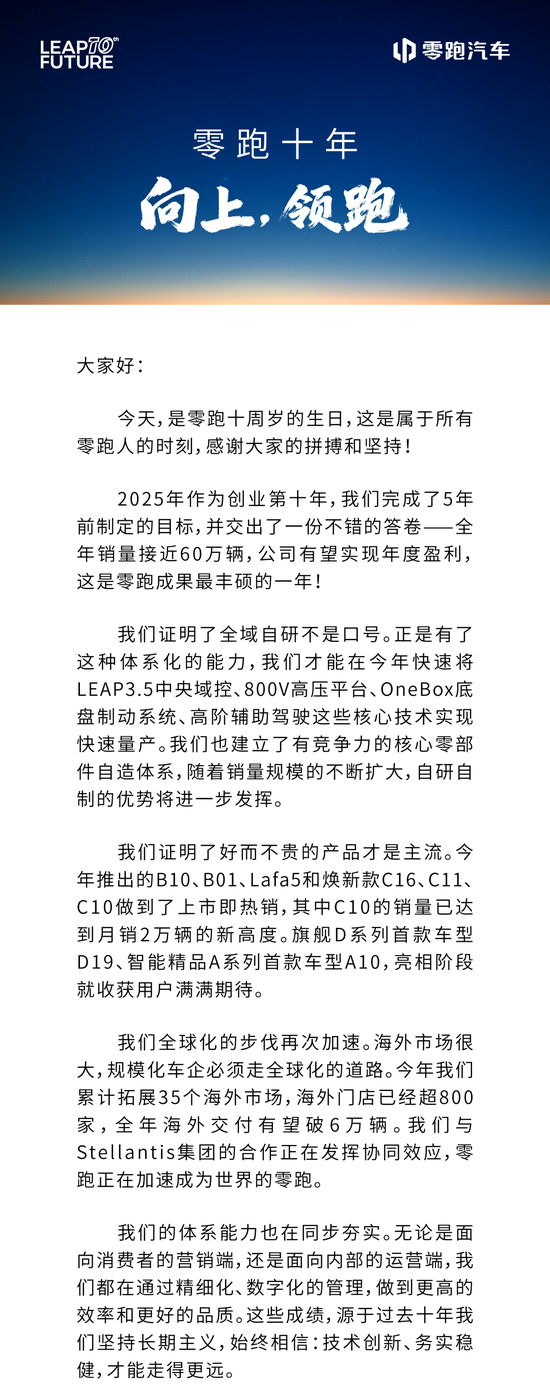
零跑创立十周年,朱江明发布内部信:2026年向着年销百万目标发起挑战
Xin Lang Cai Jing· 2025-12-24 01:44
Core Viewpoint - Leap Motor aims to achieve a sales target of 1 million vehicles by 2026, emphasizing continuous innovation, quality excellence, accelerated overseas expansion, and maintaining an efficient organization [1][6][10] Group 1: Sales and Growth Targets - The company has set a sales goal of 1 million vehicles for 2026, marking a significant milestone as it approaches its tenth anniversary [1][6] - In 2025, Leap Motor is projected to achieve nearly 600,000 vehicle sales and is expected to turn a profit, indicating a successful year [8] Group 2: Key Focus Areas for 2026 - Continuous innovation in technology is essential, with a commitment to self-research and development as the foundation for ongoing advancements [3][10] - Quality must be prioritized, with every product aiming to set a benchmark in its class, ensuring timely and quality deliveries to build consumer trust [4][10] - The company plans to accelerate its overseas market expansion, having already entered 35 international markets and established over 800 overseas stores, with a target of delivering over 60,000 vehicles abroad this year [3][9] - Organizational efficiency and agility are crucial, especially in a competitive market, to maintain a consumer-focused approach [10]
欧盟调整“禁燃令”,减排承诺“打折”背后的汽车产业困境
2 1 Shi Ji Jing Ji Bao Dao· 2025-12-24 00:34
Group 1 - The EU has revised its "automotive package" target from 100% zero emissions by 2035 to a 90% reduction, reflecting a compromise between climate goals and industrial realities [1][2] - The European Automobile Manufacturers Association (ACEA) has been a key lobbyist for this shift, citing low electric vehicle sales, inadequate charging infrastructure, and high supply chain dependency as major concerns [2][3] - Germany, along with other EU member states, has publicly questioned the single electric vehicle route, leading to a new EU plan that allows for a 10% emissions offset through alternative fuels and technologies [2][3] Group 2 - The market share of hybrid electric vehicles (HEVs) in the EU reached 34.6%, while battery electric vehicles (BEVs) only accounted for 16.4%, indicating a consumer preference for more practical hybrid options [4] - Ford has announced a significant $19.5 billion loss, primarily due to the cancellation of electric vehicle models and the closure of a battery plant, marking a financial reset for its electric strategy [4][5] - Other traditional automakers, such as General Motors and Stellantis, are also adjusting their strategies by increasing investments in hybrid vehicles while scaling back electric vehicle plans [5] Group 3 - Chinese electric vehicle manufacturers are gaining market share in Europe, with BYD's new car registrations increasing by 239.6% year-on-year, while Tesla's sales in the region have dropped by 39.2% [6] - The shift in the EU's policy framework presents opportunities for supply chain restructuring, particularly through the €1.8 billion "Battery Booster" plan aimed at developing local battery supply chains [7] - The automotive industry is undergoing a transformation that requires companies to maintain technological flexibility and market sensitivity, as the direction towards cleaner and smarter transportation remains unchanged [7]


Stellantis (STLA) Extends Losses on Cautious EU Outlook
Yahoo Finance· 2025-12-23 17:52
Core Viewpoint - Stellantis NV is experiencing a decline in stock performance due to a cautious investment outlook in Europe, exacerbated by the European Commission's revised vehicle emission rules [1][2]. Group 1: Stock Performance - Stellantis shares fell for the fifth consecutive day, dropping 3.99% to close at $11.08, reflecting negative investor sentiment [1]. - The company's stock struggles are highlighted in a report identifying 10 stocks underperforming ahead of Christmas [1]. Group 2: CEO's Comments and Investment Outlook - CEO Antonio Filosa criticized the European Commission's revised vehicle emission rules for lacking a clear growth strategy, which complicates justifying further investments in Europe [2]. - Filosa expressed concerns that without growth, it becomes challenging to consider increased investments, which are essential for building a resilient supply chain vital for European jobs and prosperity [5]. Group 3: Emission Rules and Industry Impact - The revised rules allow automakers to emit 10% of their 2021 levels and continue selling internal combustion and hybrid models, but they must compensate by using low-carbon steel and sustainable fuels [3]. - Filosa stated that the current package does not adequately address the urgent measures needed for the European automotive sector to return to growth [3]. Group 4: Future Investment Conditions - Stellantis indicated a willingness to increase spending in Europe if the EU eases its 2035 phase-out plan for petrol engines, but current conditions remain unfavorable for investment [4]. - The EU's decision to drop the requirement for carmakers to cut emissions to zero by 2030 has not created a conducive environment for growth [5].

欧盟紧急撤回一个禁令: 德国燃油车赢得喘息机会
Xin Lang Cai Jing· 2025-12-23 17:03
Group 1 - The EU has ended the 2035 ban on the sale of combustion engine vehicles, shifting from a strict ban to a more flexible reduction pathway due to pressure from Germany and the European People's Party [1][3] - The new proposal adjusts the 2035 "zero emissions" target to a 90% reduction from 2021 levels, allowing for the continued sale of combustion engine vehicles if they use EU-manufactured low-carbon steel or alternative fuels [2][6] - The decision reflects a balance between climate goals and economic realities, with German automakers advocating for the ability to continue producing combustion vehicles amid international competition and declining European demand [3][4] Group 2 - Major automotive companies, including Stellantis and Mercedes-Benz, have engaged in intensive lobbying to influence the policy change, aiming to protect jobs and alleviate political tensions [5] - The European Automobile Manufacturers Association (ACEA) has indicated that the current demand for electric vehicles in Europe is insufficient, necessitating adjustments to avoid significant penalties for manufacturers [7] - The market share of pure electric vehicles in the EU remains low, with only 16.4% of new registrations from January to October being electric, highlighting the challenges in meeting future carbon reduction targets [7][8]
欧盟紧急撤回一个禁令
第一财经· 2025-12-23 14:13
Core Viewpoint - The EU's 2035 ban on the sale of fuel vehicles has been terminated, shifting from a strict ban to a more flexible reduction path, influenced by pressure from Germany and the European People's Party [3][9]. Group 1: Policy Changes - The new EU plan adjusts the 2035 "zero emissions" target for new cars to a 90% reduction from 2021 levels, allowing the remaining 10% to be offset by using EU-manufactured low-carbon steel or alternative fuels like biofuels and e-fuels [6][10]. - This change means that various vehicle types, including pure fuel vehicles and plug-in hybrid vehicles, can continue to exist post-2035 as long as they utilize "green steel" and non-fossil fuel sources [6][7]. Group 2: Industry Reactions - The decision to relax the ban was unexpected, with significant lobbying from major automotive manufacturers like Stellantis and Mercedes-Benz, who aimed to protect jobs and alleviate political tensions [11][12]. - The European Automobile Manufacturers Association (ACEA) indicated that the current demand for electric vehicles in Europe is too low, necessitating rule adjustments to avoid substantial fines [14]. Group 3: Market Dynamics - As of January to October this year, pure electric vehicles accounted for only 16.4% of new car registrations in the EU, highlighting a significant gap to meet the 2025 carbon reduction targets [14]. - The disparity in electric vehicle adoption across Europe is notable, with countries like the Netherlands seeing a 35% share, while Spain only has 8%, indicating challenges in infrastructure and consumer acceptance [14][15]. Group 4: Future Considerations - The debate over the ban's reversal is ongoing, with the automotive industry continuing to lobby for further regulatory relaxations [16]. - German automotive manufacturers are cautioned against relying solely on internal combustion engines, as the future of mobility is leaning towards electrification [15].

欧盟紧急撤回一个禁令!德国燃油车赢得喘息机会
Di Yi Cai Jing· 2025-12-23 13:17
Core Viewpoint - The EU's ban on the sale of combustion engine vehicles by 2035 has been effectively terminated, allowing for a more flexible approach to emissions reduction, primarily influenced by Germany's automotive industry and political pressure from the European People's Party [1][8]. Group 1: Policy Changes - The EU's new proposal adjusts the 2035 target for new cars from "zero emissions" to a "90% reduction" from 2021 levels, allowing the remaining 10% to be offset using low-carbon steel or alternative fuels like biofuels and e-fuels [3][11]. - This change means that various vehicle types, including traditional combustion engine cars and plug-in hybrid vehicles, can continue to be sold post-2035 as long as they utilize EU-manufactured "green steel" and non-fossil fuel sources [3][6]. Group 2: Industry Influence - The decision to relax the ban was significantly influenced by lobbying from major automotive manufacturers, including Stellantis and Mercedes-Benz, who sought to protect jobs and alleviate political tensions [10]. - German automotive companies have been proactive in negotiating agreements to prevent layoffs until 2029, indicating a strong desire to maintain production of combustion engine vehicles [10]. Group 3: Market Dynamics - The current market demand for electric vehicles in Europe is low, with only 16.4% of new car registrations being pure electric vehicles from January to October this year, creating a significant gap to meet future carbon reduction targets [12]. - The disparity in electric vehicle adoption across Europe is notable, with countries like the Netherlands seeing a 35% market share for electric vehicles, while Spain only has 8%, highlighting the uneven transition to electric mobility [13]. Group 4: Future Considerations - The reversal of the ban has sparked ongoing debates within EU institutions, with potential implications for future regulations aimed at achieving greener vehicle fleets [14]. - Industry experts caution that reliance on combustion engines may lead to long-term challenges for German automakers, emphasizing the need for a faster transition to electric vehicles [13].
EV realism is here. How automakers react in 2026 will be telling
CNBC· 2025-12-23 12:00
Core Viewpoint - The U.S. automotive industry is transitioning to a more realistic approach regarding electric vehicles (EVs), moving away from initial euphoria to a focus on consumer demand and market realities [2][10]. Industry Overview - Early 2020s saw high expectations for EVs, but consumer demand did not meet projections, leading automakers to reassess their strategies [2][19]. - Automakers have incurred significant financial losses, with GM reporting a $1.6 billion impact from reduced EV investments and Ford expecting $19.5 billion in restructuring costs [5][19]. Consumer Demand and Market Dynamics - U.S. EV sales peaked at 10.3% of the new vehicle market in September but fell to an estimated 5.2% in the fourth quarter [9]. - The end of federal incentives for EV purchases in September has contributed to a slowdown in demand and sales [24][25]. Strategic Shifts by Automakers - GM plans to focus on large trucks and SUVs, with limited expansion in EV offerings, while also considering plug-in hybrids [14]. - Ford is shifting investments towards hybrid vehicles and smaller, more affordable EVs, canceling plans for a new generation of large all-electric trucks [15]. - Stellantis is deprioritizing EVs, including for its Jeep brand, to boost U.S. sales [15]. Long-term Outlook - Industry experts believe the long-term direction towards electrification remains, but the timeline is being adjusted, with EVs expected to comprise 19% of the U.S. market by 2030 [10][12]. - Automakers are expected to expand hybrid offerings to align with current consumer preferences [10]. Tesla's Influence - Tesla's success has created a unique market for its brand rather than a general market for EVs, influencing other automakers' strategies [20][21]. - The influx of new EV companies has led to many failures, highlighting the challenges in replicating Tesla's success [22][23].

特朗普停止CAFE标准,美国能源、环境与产业政策急转弯
Zhong Guo Qi Che Bao Wang· 2025-12-23 06:29
Core Viewpoint - The Trump administration's decision to halt the Corporate Average Fuel Economy (CAFE) standards marks a significant shift in U.S. automotive regulation, impacting energy, environmental, and industrial policies [1]. Group 1: Policy Changes - The new regulations set the fuel efficiency target for 2031 vehicles at 34.5 miles per gallon (mpg), a substantial decrease of 31.5% from the previous target of 50.4 mpg [4]. - The elimination of the CAFE standards means automakers will no longer need to invest heavily in research and development to meet stringent fuel efficiency requirements, allowing them to focus on producing more profitable traditional fuel vehicles and larger models [5]. Group 2: Economic Implications - The policy change is expected to save consumers at least $1,000 when purchasing new vehicles, with potential for even greater savings [3]. - Under the Trump administration, $700 billion has been invested in the U.S. automotive industry, with significant investments announced by major automakers such as Ford and Stellantis [3]. Group 3: Industry Reactions - The automotive industry has largely welcomed the decision, with industry leaders stating that the previous CAFE standards were unrealistic and burdensome [5]. - The oil industry has expressed optimism that higher fuel consumption vehicles will boost gasoline demand and support traditional energy sectors [6]. Group 4: Environmental Concerns - The cessation of CAFE standards is anticipated to lead to stagnation or regression in vehicle fuel efficiency, resulting in increased fuel costs for consumers [6]. - Critics argue that the rollback of these standards could hinder technological advancements in the automotive sector, which have historically been driven by the need to meet fuel efficiency regulations [6].
