
华安基金

Search documents
昔日“牛基”今何在?
Zheng Quan Shi Bao Wang· 2025-12-23 09:20
Core Viewpoint - The article discusses the performance of actively managed equity funds in the Chinese stock market, highlighting the emergence of new "bull funds" and the fading glory of past top-performing funds, emphasizing the need for a shift towards long-term investment strategies and stable fund management practices [1][9]. Group 1: Performance of Active Equity Funds - As of December 22, the Shanghai Composite Index has increased by 12.67% in 2024, with an additional 16.87% rise for the year, indicating a likely two consecutive years of gains [1]. - Nearly 40 actively managed equity funds have doubled their annual returns, with Yongying Technology Smart Selection A achieving approximately 219% annual return, marking it as the first "double fund" since 2008 [1]. - Historical analysis shows that only 5 out of 30 top-performing funds from previous bull markets have maintained strong performance, while the majority have returned to mediocre status [2]. Group 2: Reasons for Declining Performance of Past "Bull Funds" - Many former "bull funds" have lost their luster due to excessive growth in fund size, which hampers investment flexibility and increases transaction costs [4]. - Over-reliance on a single star fund manager has led to significant performance declines when key personnel leave or fail to adapt to market changes [5]. - Short holding periods and frequent style shifts have also contributed to the underperformance of many funds, as they chase short-term trends without a stable investment framework [6]. Group 3: Structural Changes in the Fund Industry - The public fund industry is undergoing a structural transformation, moving from a short-term ranking focus to a value investment approach aimed at achieving stable returns [7]. - Successful long-term funds are characterized by stable research teams, strong risk control capabilities, and robust company support systems [8]. - The industry is exploring new active investment models, integrating industrialized concepts into research processes to enhance efficiency [8]. Group 4: Long-Term Investment Philosophy - The fate of past "bull funds" reflects the evolution of the A-share market and the industry's changing development philosophy, emphasizing the importance of long-term investment strategies [9]. - Investors are encouraged to focus on funds with clear investment philosophies, stable teams, and proven cross-cycle capabilities rather than chasing annual performance champions [10]. - Funds that may not shine in a single bull market can still create value through solid strategies, rigorous research, and strict risk control [11].
昔日“牛基”今何在?
券商中国· 2025-12-23 09:03
Core Viewpoint - The article discusses the performance of actively managed equity funds in the context of the A-share market, highlighting the emergence of new "bull funds" and the fading glory of past top-performing funds, emphasizing the need for a shift from short-term performance to long-term investment strategies [1][11]. Group 1: Performance of Active Equity Funds - As of December 22, the Shanghai Composite Index has increased by 12.67% in 2024, with an annual increase of 16.87%, indicating a likely two-year consecutive rise in annual K-line [1]. - Nearly 40 actively managed equity funds have doubled their annual returns, with Yongying Technology Smart Selection A achieving approximately 219% annual return, marking it as the first "double fund" since 2008 [1]. - Historical analysis shows that only 5 out of 30 top-performing funds from previous bull markets have maintained strong performance, while 25 have returned to mediocre status [2]. Group 2: Reasons for Declining Performance of Former "Bull Funds" - Many former "bull funds" have lost their luster due to excessive scale growth, which reduces investment flexibility and increases transaction costs, making it harder to achieve excess returns [5][6]. - Over-reliance on a single star fund manager has led to significant performance drops when key personnel leave or fail to adapt to market changes [6]. - Short holding periods and frequent style shifts have hindered many funds from accumulating long-term returns, as they chase short-term trends without a stable investment framework [7]. Group 3: Structural Changes in the Fund Industry - The public fund industry is undergoing a structural transformation, moving from a "star-making" model focused on short-term rankings to a "systematic approach" that emphasizes value investing and stable returns [8][12]. - Successful long-term funds often have stable research teams and strong risk control capabilities, which help them navigate market downturns effectively [8][9]. - Companies are increasingly adopting innovative investment models and enhancing their research capabilities to adapt to market changes, indicating a shift towards a more collaborative and systematic investment approach [9]. Group 4: Long-term Investment Philosophy - The fate of past "bull funds" reflects the evolution of the A-share market and the investment philosophy of the industry, highlighting the importance of a stable investment strategy over reliance on individual fund managers [11]. - Investors are encouraged to focus on funds with clear investment philosophies, stable teams, and proven cross-cycle capabilities, rather than chasing annual performance champions [12].

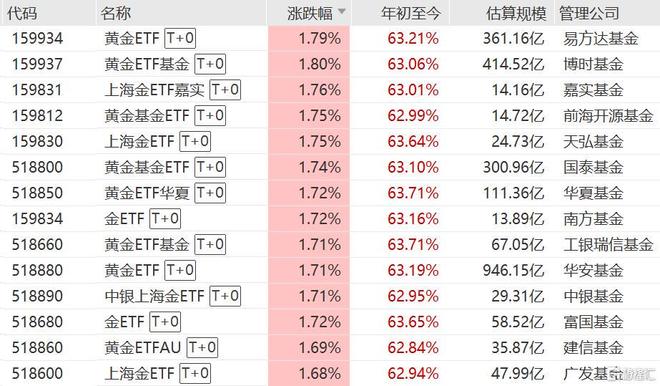
现货黄金再度刷新历史高点,黄金ETF、上海金ETF上涨,年内涨幅超62%
Ge Long Hui· 2025-12-23 03:14
Group 1 - Spot gold has reached a new historical high, with London gold prices surpassing $4,490 per ounce, marking a year-to-date increase of 70.87%, nearing the largest annual increase since 1979 [1] - Gold ETFs, including various funds, have also seen significant gains, with year-to-date increases exceeding 62% [1] Group 2 - International gold and silver futures prices have reached historical highs, influenced by geopolitical tensions, particularly the U.S. seizure of a Venezuelan oil tanker, adding uncertainty to the market [3] - Analysts from UBS noted that gold prices rebounded quickly from a drop at the end of October, solidifying its position as one of the strongest assets this year, driven by geopolitical unrest and changes in the U.S. interest rate environment [3] - Central banks and investors continue to show strong demand for gold, with global central bank purchases expected to reach between 900 to 950 metric tons this year [3] Group 3 - Wall Street is optimistic about gold prices in the coming year, with target ranges between $4,800 and $5,000, driven by strong central bank purchases and ongoing fiscal concerns in the U.S. [4] - HSBC's report emphasizes that the U.S. fiscal deficit is a significant factor driving gold demand, as investors increasingly view gold as a hedge against debt sustainability risks and potential dollar weakness [4] Group 4 - The Federal Reserve's recent decision to lower interest rates is seen as dovish, which is favorable for gold, with expectations of further rate cuts increasing [5] - Long-term factors indicate a continued decline in global dollar reserves and rising U.S. fiscal deficits, which are beneficial for gold's monetary attributes [5] - Concerns about domestic physical gold demand due to new tax policies and potential declines in jewelry demand by 2026 highlight the importance of central bank purchases and investment demand to offset these declines [5]
海博思创股价涨5.35%,华安基金旗下1只基金重仓,持有3.46万股浮盈赚取45.11万元
Xin Lang Cai Jing· 2025-12-23 02:07
12月23日,海博思创涨5.35%,截至发稿,报256.85元/股,成交3.72亿元,换手率3.89%,总市值462.57 亿元。 资料显示,北京海博思创科技股份有限公司位于北京市海淀区丰豪东路9号院2号楼12层,成立日期2011 年11月4日,上市日期2025年1月27日,公司主营业务涉及专注于电化学储能系统的研发、生产、销售, 为传统发电、新能源发电、智能电网、终端电力用户等"源-网-荷"全链条行业客户提供全系列储能系统 产品,提供储能系统一站式整体解决方案。主营业务收入构成为:储能系统99.77%,新能源车租赁 0.10%,其他(补充)0.07%,技术服务0.06%。 华安聚恒精选A(011238)基金经理为陈泉宏。 截至发稿,陈泉宏累计任职时间2年41天,现任基金资产总规模3.84亿元,任职期间最佳基金回报 63.82%, 任职期间最差基金回报40.06%。 风险提示:市场有风险,投资需谨慎。本文为AI大模型自动发布,任何在本文出现的信息(包括但不 限于个股、评论、预测、图表、指标、理论、任何形式的表述等)均只作为参考,不构成个人投资建 议。 责任编辑:小浪快报 从基金十大重仓股角度 数据显示,华安基 ...
大部分基金公司都是陪跑
Xin Lang Cai Jing· 2025-12-23 01:44
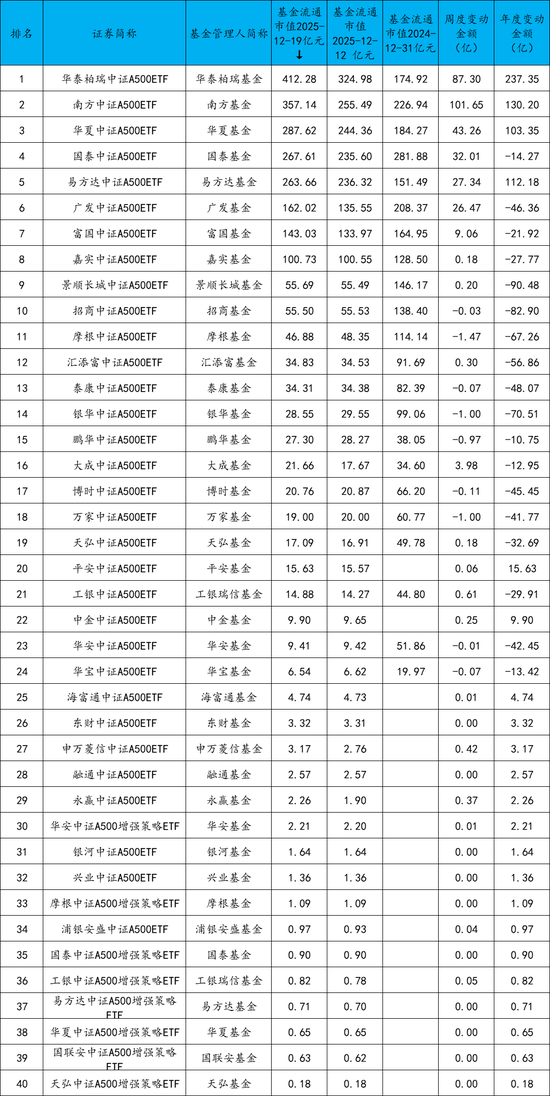
Core Viewpoint - The launch of the CSI A500 index has created a competitive landscape in the ETF market, where only a few major players dominate, while many smaller firms end up as "also-rans" [1][2][10]. Group 1: Market Dynamics - The CSI A500 index was launched in September 2024 and is considered a significant opportunity for public funds, leading to a rush of product submissions from various fund companies [2][17]. - By mid-December 2025, the total market size of A500 ETFs approached 250 billion yuan, indicating a rapid growth in this segment [2][17]. - The market has shown a clear "head effect," where a few leading funds capture the majority of the assets, leaving smaller firms struggling to compete [3][18]. Group 2: Fund Performance - The top five A500 ETFs, including Huatai-PB, Southern, and Huaxia, have assets ranging from 260 billion to 412 billion yuan, collectively dominating the market with nearly 1.6 trillion yuan [6][22]. - Recent inflows have been substantial, with Huatai-PB and Southern ETFs attracting 87.30 billion and 101.65 billion yuan, respectively, in just one week [7][22]. - The performance of smaller funds has been lackluster, with many experiencing significant redemptions and struggling to maintain their market presence [7][22]. Group 3: Challenges for Smaller Firms - Smaller public funds face significant challenges due to resource constraints, making it difficult to compete with larger firms that have established marketing and distribution channels [11][12]. - The cost of marketing and maintaining sales channels is high, with management fees for A500 ETFs around 0.15%, making it hard for smaller firms to achieve profitability without substantial scale [11][12]. - Some smaller firms have opted to withdraw from the competition, adopting a strategy of waiting rather than engaging in a costly race for market share [12][13]. Group 4: Future Outlook - The competitive landscape suggests that the development of index funds should be gradual, focusing on building differentiated competitive advantages rather than following trends blindly [13]. - Smaller firms may need to explore niche markets such as thematic, strategy-based, QDII, bond, or actively managed ETFs to find sustainable growth opportunities [13]. - The prevailing trend indicates that a few giants will continue to dominate the market, while many participants may remain on the sidelines [14].
贵金属持续走强,金银双双创下历史新高,铂金站上2000美元大关
Xin Hua Cai Jing· 2025-12-22 08:12
Core Viewpoint - Global precious metal prices are on the rise, with gold and silver reaching historical highs, driven by multiple favorable factors including geopolitical tensions and expectations of a dovish Federal Reserve policy [1][2]. Group 1: Precious Metal Price Trends - As of December 22, spot gold prices surpassed $4,400 per ounce, marking a year-to-date increase of over 67% [1] - Silver prices climbed above $69 per ounce, achieving a year-to-date increase of over 140% [1] - Platinum prices broke the $2,000 per ounce mark for the first time since 2008, with a year-to-date increase exceeding 127% [1] - Palladium reached a peak price of $1,839 per ounce, with a year-to-date increase of over 96% [1] Group 2: Future Outlook and Influencing Factors - Analysts predict that gold and silver prices will maintain an upward trend due to geopolitical conflicts, the onset of a Federal Reserve rate cut cycle, and a decline in the dollar's credibility [1][2] - The Federal Reserve's December meeting indicated a more dovish stance than market expectations, which is expected to drive liquidity and support precious metal prices [2] - The narrative of shrinking dollar credit is anticipated to continue influencing the upward trend of precious metals, with expectations of economic recovery supporting silver's potential for greater price elasticity [2] Group 3: Investment Demand and Supply Dynamics - Global central bank gold purchases are at a high level, with investment demand expected to reach historical highs in the first three quarters of 2025 [2] - The influx of funds into global gold ETFs is projected to continue, with Asian investments replacing North American dominance, leading to record high total holdings [2] - A tight balance between gold supply and demand is expected to support price increases, with significant growth in investment demand anticipated for 2025 [2] Group 4: Silver and Other Precious Metals Forecast - The silver market is expected to show more significant performance in 2026, driven by persistent supply-demand imbalances [3] - Price targets for silver in 2026 are projected to reach approximately $75 per ounce, with stronger driving factors expected in the first half of the year [3] - Platinum and palladium prices are also expected to rise in 2026, with platinum likely to outperform palladium due to better fundamentals and financial attributes [3] - Price ranges for platinum and palladium in 2026 are estimated between $1,500-$2,800 per ounce and $1,200-$2,250 per ounce, respectively [3]
全市场6只黄金股ETF年内平均涨幅超过80%
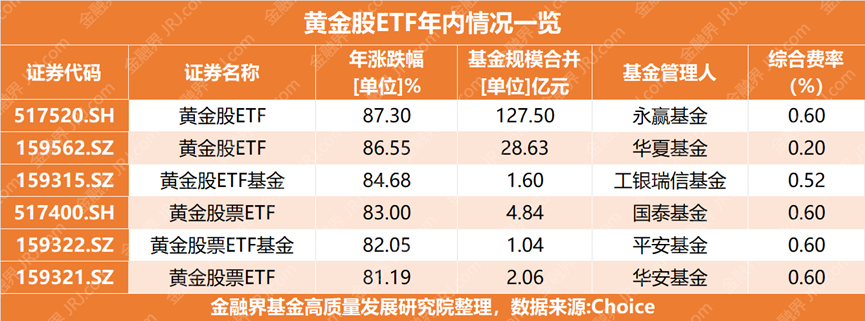
Jin Rong Jie· 2025-12-22 08:01
| | | 黄金股ETF年内情况一览 | | | | | --- | --- | --- | --- | --- | --- | | 证券代码 | 证券名称 | 年涨跌幅 [单位]% | 基金规模合并 【单位]亿元 | 基金管理人 | (%) | | 517520.SH | 黄金股ETF | 87.30 | 127.50 | 水崩县金 | 0.60 | | 159562.SZ | 黄金股ETF | 86.55 | 28.63 | 交直基等 | 0.20 | | 159315.SZ | 黄金股ETF基金 | 84.68 | 1.60 | 工银瑞信基金 | 0.52 | | 517400.SH | 黄金股票ETF | 83.00 | 4.84 | 国泰县金 | 0.60 | | 159322.SZ | 黄金股票ETF基金 | 82.05 | 1.04 | 平安其金 | 0.60 | | 159321.SZ | 黄金股票ETF | 81.19 | 2.06 | 华安基金 | 0.60 | | | | 金融界基金高质量发展研究院整理, | 数据来源:Choice | | | 据Choice数据,截至12月18日,全市 ...
两市ETF两融余额减少4.53亿元丨ETF融资融券日报
2 1 Shi Ji Jing Ji Bao Dao· 2025-12-22 06:49
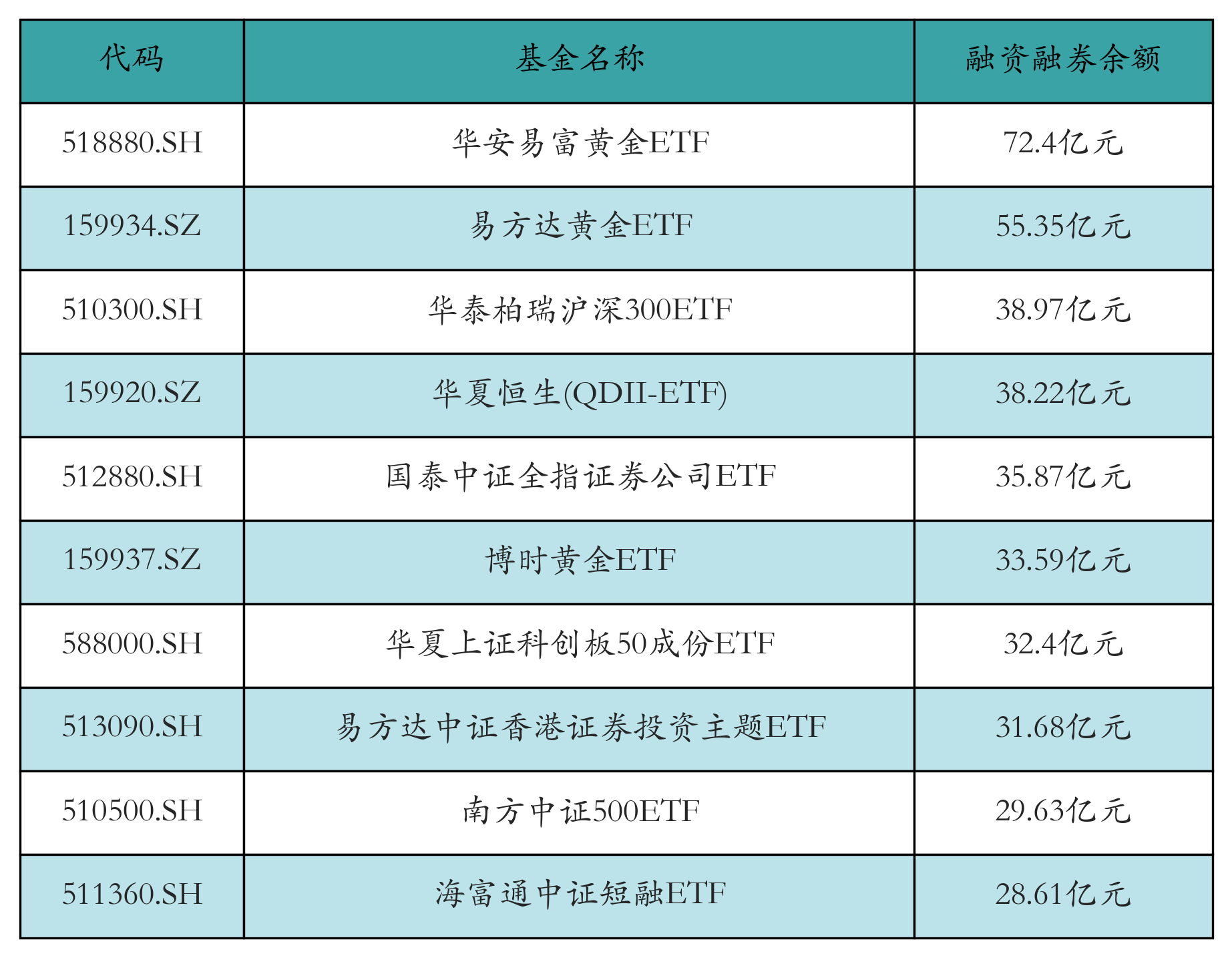
Market Overview - As of December 19, the total ETF margin balance in the two markets is 119.13 billion yuan, a decrease of 0.453 billion yuan from the previous trading day [1] - The financing balance is 111.87 billion yuan, down by 0.37 billion yuan, while the securities lending balance is 7.26 billion yuan, reduced by 83.13 million yuan [1] - In the Shanghai market, the ETF margin balance is 83.61 billion yuan, a decrease of 0.28 billion yuan, with a financing balance of 77.25 billion yuan, down by 0.213 billion yuan [1] - In the Shenzhen market, the ETF margin balance is 35.53 billion yuan, a decrease of 0.173 billion yuan, with a financing balance of 34.62 billion yuan, down by 0.157 billion yuan [1] ETF Margin Financing Balances - The top three ETFs by margin financing balance on December 19 are: - Huaan Yifu Gold ETF (7.24 billion yuan) - E Fund Gold ETF (5.535 billion yuan) - Huatai-PB CSI 300 ETF (3.897 billion yuan) [2] ETF Financing Buy Amounts - The top three ETFs by financing buy amounts on December 19 are: - Hai Futong CSI Short Bond ETF (1.465 billion yuan) - E Fund CSI Hong Kong Securities Investment Theme ETF (1.31 billion yuan) - Huatai-PB Southbound Hang Seng Technology Index (0.869 billion yuan) [4] ETF Financing Net Buy Amounts - The top three ETFs by financing net buy amounts on December 19 are: - Huabao CSI Bank ETF (178 million yuan) - Huaxia Shanghai Stock Exchange Sci-Tech Innovation Board 50 ETF (70.336 million yuan) - E Fund CSI Hong Kong Securities Investment Theme ETF (58.834 million yuan) [6] ETF Securities Lending Sell Amounts - The top three ETFs by securities lending sell amounts on December 19 are: - Southern CSI 500 ETF (18.5254 million yuan) - Huatai-PB CSI 300 ETF (16.5763 million yuan) - GF CSI 1000 ETF (9.4158 million yuan) [8]
一线基金投顾岁末谋新篇:配置走向科学 主线精耕细作
Zhong Guo Zheng Quan Bao· 2025-12-22 01:01
Core Insights - The market is entering the year-end phase, with fund managers preparing for 2026 through systematic adjustments and strategic asset allocation [1][2] - The focus has shifted from simple "stock-bond diversification" to a more scientific and dynamic asset allocation approach that emphasizes risk parity and global perspectives [1][5] - Fund managers are concentrating on three main investment themes: "technological innovation," "anti-involution dividends," and "new consumption recovery" [7][8] Year-End Rebalancing - Fund managers are engaged in structural optimization of investment portfolios, with a focus on long-term strategies rather than short-term rankings [2][3] - Specific actions include increasing exposure to traditional industries at low valuation levels and optimizing fund holdings based on performance and market conditions [2][3] Forward-Looking Strategies - Some institutions are adopting proactive strategies for left-side positioning in anticipation of economic recovery and favorable policies [3][4] - The emphasis is on reducing defensive asset allocations while increasing exposure to innovative technology and strategic assets [3] Dynamic Asset Allocation - The concept of dynamic asset allocation is gaining traction, moving beyond simple diversification to a more nuanced approach that considers macroeconomic cycles and risk management [5][6] - Institutions are developing all-weather strategies tailored to client risk preferences, emphasizing risk parity and multi-asset tactical adjustments [5][6] Investment Themes for 2026 - The investment landscape for 2026 is characterized by a cautious yet optimistic outlook, focusing on technological innovation, cyclical recovery, and consumer spending [7][8] - Specific sectors of interest include AI hardware, semiconductor equipment, and traditional industries benefiting from policy support [7][8] Core-Satellite Strategy - The "core-satellite" strategy is widely adopted among fund managers, with variations in execution based on individual institutional preferences [9] - Emphasis is placed on selecting core funds with strong long-term performance and using satellite funds to enhance returns while managing volatility [9]
2026年投资机遇何处寻?公募策略会看好盈利驱动方向
Shang Hai Zheng Quan Bao· 2025-12-22 00:02
Core Viewpoint - Fund managers are generally optimistic about the market outlook for 2026, focusing more on corporate profitability as a key driver for stock price movements [1][2][3]. Group 1: Corporate Profitability - Corporate profitability is expected to become the core consideration for investment decisions, with a shift from liquidity-driven to profitability-driven market dynamics anticipated [2][3]. - The overall profitability growth in the A-share market is expected to improve, particularly in the TMT and manufacturing sectors, while cyclical and consumer sectors are projected to gradually recover [2][5]. Group 2: Investment Opportunities - Fund managers are optimistic about structural opportunities in the market, particularly in growth sectors such as PCB, optical communication, and AI applications, as well as in consumer and cyclical sectors [4][5]. - Specific investment opportunities in the consumer sector include Z-generation new consumption, affordable consumption, and areas like education, gaming, and e-commerce [4]. Group 3: AI Investment Landscape - The AI sector presents both opportunities and challenges, with a consensus on the high demand for upstream computing power and the potential for explosive growth in related companies [6][7]. - Investment focus areas in AI include consumer entertainment, internal business optimization, and advancements in humanoid robots and smart driving technologies [7].