洋河股份

Search documents
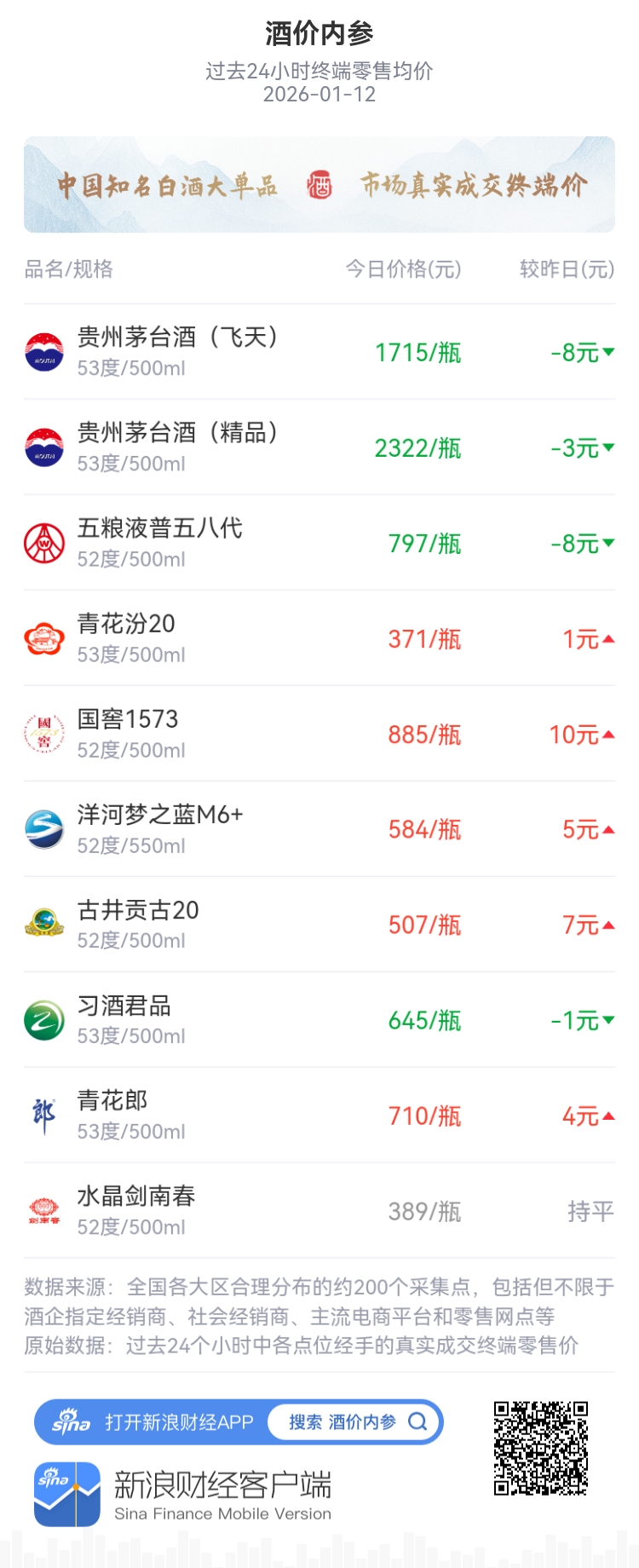
酒价内参1月12日价格发布 市场分化企稳整体价格小幅回升
Xin Lang Cai Jing· 2026-01-12 01:07
Core Viewpoint - The Chinese liquor market shows signs of stabilization in retail prices for the top ten products as of January 12, with an overall price increase after a period of decline, indicating a potential recovery in the market [1]. Price Trends - The total retail price for a package of the top ten liquor products is 8,925 yuan, reflecting a slight increase of 7 yuan from the previous day, suggesting a slowdown in the downward price trend [1]. - The market exhibits a mixed pattern of price changes, with some products increasing in price while others decrease [1]. Price Increases - Notable price increases include: - Guojiao 1573, up 10 yuan per bottle [1][3]. - Gujinggong 20, up 7 yuan per bottle [1][4]. - Yanghe Dream Blue M6+, up 5 yuan per bottle [1][4]. - Qinghualang, up 4 yuan per bottle [1][4]. - Qinghualang 20, up 1 yuan per bottle [1][3]. - Shujian Jiananspring, stable compared to the previous day [1]. Price Decreases - Significant price declines include: - Feitian Moutai, down 8 yuan per bottle [1][3]. - Wuliangye Pu 58th generation, down 8 yuan per bottle, falling below 800 yuan for the first time in a month [1][3]. - Boutique Moutai, down 3 yuan per bottle [1][3]. - Xijiu Junpin, down 1 yuan per bottle [1][4]. Market Dynamics - The stabilization of prices for most core products is the primary factor driving the overall price recovery in the market [1].







周观点、两湖零食调研反馈:环比走出底部,旺季将至可期-20260111
GOLDEN SUN SECURITIES· 2026-01-11 05:56
Investment Rating - The report suggests a positive outlook for the liquor sector, with a recommendation to invest in specific companies based on supply and demand improvements expected in 2026 [1] Core Insights - The snack industry is showing signs of recovery, with companies entering the critical phase of preparing for the Spring Festival, which is expected to boost performance in Q1 2026 due to low base effects and seasonal demand [2] - Companies are adjusting their channel operations and product priorities in response to evolving market demands, leading to gradual improvements in their performance [2] - Specific companies like 甘源食品 (Ganyuan Food) and 劲仔食品 (Jinzai Food) are highlighted for their strategic adjustments and potential for recovery in 2026 [3][4] Summary by Sections Liquor Sector - The liquor market is expected to see a dual improvement in supply and demand by 2026, with short-term sales showing signs of recovery [1] - Recommended companies for investment include 泸州老窖 (Luzhou Laojiao), 古井贡酒 (Guojingongjiu), and 贵州茅台 (Kweichow Moutai) among others [1] Snack Industry - The snack sector is entering a critical preparation phase for the Spring Festival, with companies like 甘源食品 (Ganyuan Food) and 劲仔食品 (Jinzai Food) making strategic adjustments to improve their market positions [2][3][4] - 甘源食品 is expected to recover from a significant revenue decline by leveraging new product launches and channel improvements [3] - 劲仔食品 is shifting focus to new product categories to drive growth, despite facing some revenue pressures [4] Market Trends - The overall food and beverage sector is projected to experience a rebound, with specific attention on the performance of major brands and their strategic responses to market changes [1][2]
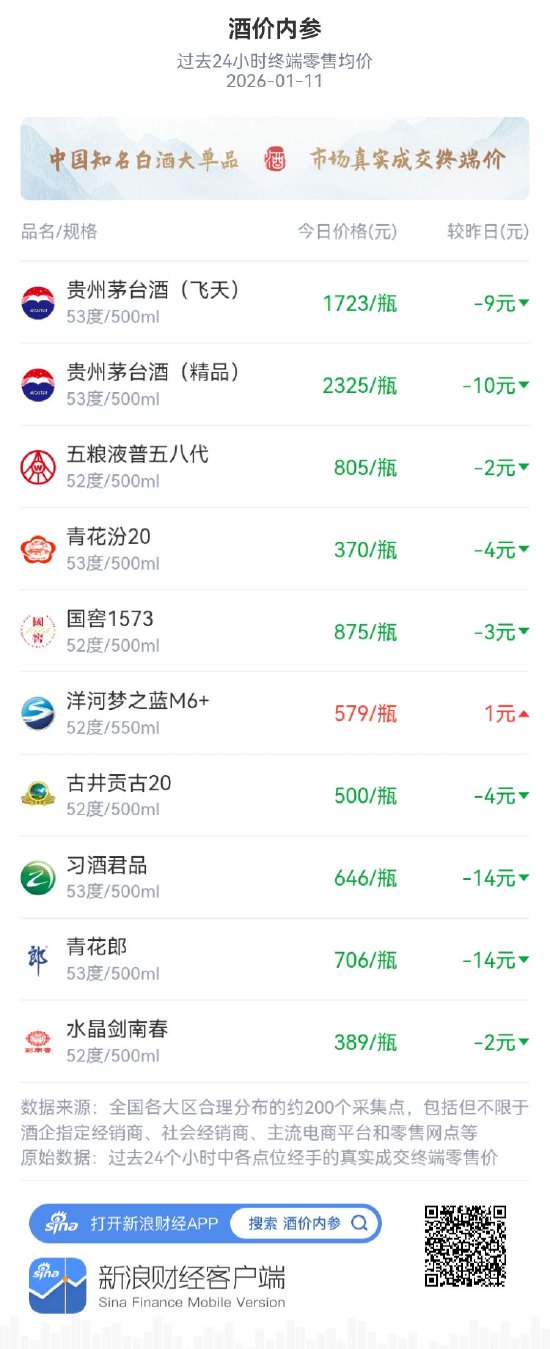
酒价内参1月11日价格发布 市场普跌探底整体价格再创新低
Xin Lang Cai Jing· 2026-01-11 00:55
Core Insights - The Chinese liquor market is experiencing significant price declines, with the average retail price of the top ten liquor products dropping to a historical low of 8,918 yuan, down 61 yuan from the previous day [1][7] - The market is characterized by a broad decline, with nine out of ten products seeing price drops, indicating increasing downward pressure and a lack of effective support [1][7] Price Changes - The price of Guizhou Moutai (Flying) decreased by 9 yuan to 1,723 yuan per bottle [3] - The price of Guizhou Moutai (Boutique) fell by 10 yuan to 2,325 yuan per bottle [3] - Xijiu Junpin and Qinghualang saw the largest declines, each dropping 14 yuan per bottle [4][8] - Other notable price changes include a 4 yuan drop for Qinghua Fen 20 and Guqingong 20, and a 3 yuan drop for Guojiao 1573 [1][3][4] Market Dynamics - The introduction of iMoutai's pricing strategy is beginning to influence market prices, with its products priced at 1,499 yuan for Flying Moutai and 2,299 yuan for Boutique Moutai [5][9] - The market analysis from Shenwan Hongyuan Securities highlights that the market reform of Moutai in 2026 will have significant implications for the industry and Moutai's long-term development [5][9] - The shift towards consumer-centric strategies and the establishment of a stable product structure are expected to benefit both consumers and the company [5][9]
闲言碎语酒文化
Xin Lang Cai Jing· 2026-01-10 06:08
新浪财经"酒价内参"重磅上线 知名白酒真实市场价尽在掌握 转自:扬子晚报 方延明 我国酒文化源远流长,酒从数千年前就走进人们的生活,走进民族文化,走进文人骚客的诗辞篇章。 《三国演义》开篇有".......一壶浊酒喜相逢,古今多少事,都付笑谈中。" 张旭三杯草圣传,脱帽露顶王公前,挥毫落纸如云烟。 焦遂五斗方卓然,高谈雄辩惊四筵。 毛泽东既是革命家又是诗人,诗词是他生命中的重要内容之一。贺敬之曾在1996年8月举行的首届毛泽 东诗词国际学术讨论会开幕词中说:"以数量不多的诗,而能在一个产生过屈原、陶渊明、李白、杜 甫、白居易、陆游、苏轼、辛弃疾、龚自珍等伟大诗人的诗词古国里自铸伟词,自开奇葩,吐纳宇宙之 物象,开拓万古之心胸的诗人,只能首推毛泽东了。以极富中华民族特色却未免有些古奥的诗词形式, 描写现代中国人的生活和感情,抒发革命家的理想和襟抱,却能在国内外当代读者中传诵不衰,形成说 诗者众、研习者盛的时代景观,环顾宇内,不能不承认,也只有毛泽东诗词了。"在毛泽东诗词中提到 酒的作品不多,《蝶恋花·答李淑一》中有"问讯吴刚何所有,吴刚捧出桂花酒。"这酒是欢迎烈士忠魂 的,"寂寞嫦娥舒广袖,万里长空且为忠魂舞。 ...
地域围墙难破,白云边百亿征程搁浅?
Xi Niu Cai Jing· 2026-01-10 02:24
Core Viewpoint - The performance report of Hubei liquor leader Baiyunbian reveals a significant decline in sales, indicating a challenging environment for the company and the industry as a whole [2][3]. Group 1: Company Performance - Baiyunbian's projected sales revenue for 2025 is only 6.2 billion yuan, representing a year-on-year decline of over 20%, bringing its performance back to levels seen five years ago [2]. - The company ranks 98th in the "2025 Hubei Top 100 Enterprises" list, with an estimated revenue range of 8 to 9 billion yuan, which is significantly lower than its previously set target of 10 billion yuan by the end of the 14th Five-Year Plan [2]. - Over 70% of Baiyunbian's sales come from the Hubei local market, indicating a heavy reliance on regional sales and a struggle to expand outside this area [2]. Group 2: Industry Challenges - The liquor industry is entering a "volume reduction competition" phase, with pressures on consumption scenarios and pricing systems affecting even major brands like Moutai and Wuliangye [3]. - The Hubei liquor market, valued at approximately 35 billion yuan, is experiencing intense competition, with national brands like Wuliangye and Yanghe gaining market share [3]. - Baiyunbian's positioning in the mid-range price segment lacks competitiveness in the high-end market and is insufficient in the low-end market, making it vulnerable during industry adjustments [3]. Group 3: Strategic Responses - In response to declining performance, Baiyunbian has launched an ambitious "One Line Three Points" strategy aimed at deepening its presence in hotels, banquets, and group purchases [3][4]. - The management emphasizes maintaining price stability and volume through segmented incentives and digital control, with specific sales targets set for 2026 [4]. - Despite these tactical adjustments, the company faces strategic challenges that may hinder its ability to overcome regional limitations and expand its brand recognition beyond Hubei [4].
酒价内参1月10日价格发布 市场分化调整整体价格创新低
Xin Lang Cai Jing· 2026-01-10 01:09
Core Viewpoint - The Chinese liquor market is experiencing a downward trend in retail prices, with the average price of the top ten products reaching a new low, indicating a continued weak market environment [1] Group 1: Market Price Trends - The average retail price of the top ten liquor products on January 10 is 8,979 yuan, down 19 yuan from the previous day, marking a new low since the data was first published [1] - Among the top ten products, six saw price declines, three increased, and one remained stable, reflecting a mixed market adjustment [1] - The most significant price drop was observed in Guojiao 1573, which fell by 12 yuan per bottle, while other notable declines included Moutai and Wuliangye products [1] Group 2: Data Collection and Methodology - The daily data from "Liquor Price Reference" is sourced from approximately 200 collection points across various regions, including designated distributors and retail outlets, aiming to provide objective and traceable pricing information [2] - The introduction of new sales channels for Moutai products is expected to influence market prices, particularly for the recently launched premium Moutai [2] Group 3: Industry Developments - On January 9, a national dealer conference for Moutai was held, focusing on market transformation and consumer-centric strategies [3] - Moutai's online platform, iMoutai, has gained over 2.7 million new users and 400,000 transaction users within nine days of launching the 53% vol 500ml Flying Moutai, indicating strong market engagement [3] - The conference emphasized the importance of market-oriented product positioning and consumer service, aiming to stabilize the market and prevent speculation [3]
白酒板块触底信号密集释放?五重底部共振暗藏黄金坑
Sou Hu Cai Jing· 2026-01-09 15:28
Core Viewpoint - The Chinese liquor industry is experiencing a rare "five bottoms resonance" opportunity, with five key indicators—policy, inventory, sales, price, and production—simultaneously hitting bottom, historically indicating a potential doubling market trend [1][3]. Group 1: Key Indicators - The policy bottom signal is clear, with expectations for consumption tax adjustments becoming more defined, marking a significant policy shift for the industry [3]. - Inventory levels have decreased significantly, with mainstream liquor companies reducing their inventory cycle from six months to under three months, particularly in the high-end segment [3]. - Sales data shows a dramatic increase, with terminal purchase volumes for the Spring Festival season rising by 30% month-on-month, mirroring data from the 2018 cycle turning point [3]. Group 2: Market Dynamics - The current PE valuation of the liquor sector stands at 22 times, below the five-year average of 30 times and lower than the 2018 industry low, indicating a potential undervaluation [3]. - Public fund holdings have dropped to 3.2%, the lowest since 2016, while dividend rates have risen to a historical high of 2.8%, suggesting a significant market divergence [3]. - The price of Moutai has become a critical indicator, with its price-to-Hushen 300 ratio falling to 1.8, lower than previous lows in 2014 and 2018, indicating a stabilizing price system [5]. Group 3: Seasonal Trends - The Spring Festival season is becoming a crucial test for the industry, with historical data showing that performance during this period often dictates annual outcomes; for instance, strong sales in 2019 led to an 82% increase in the sector that year [5]. - The extended inventory cycle and noticeable recovery in the wedding market have led to reports of stockouts for high-end products like Moutai 1935, reflecting a structural rebound similar to past recovery phases [5]. Group 4: Financial Insights - Key liquor companies are showing signs of financial resilience, with Moutai's contract liabilities increasing by 15% quarter-on-quarter, a leading indicator of industry recovery [7]. - The focus of leading enterprises is shifting from growth preservation to quality assurance, signaling the end of the industry's clearing phase [7]. - Northbound capital has been actively buying liquor stocks, with Moutai seeing its highest net purchase in six months, while companies like Langjiu are initiating share buybacks, reminiscent of past market bottoming strategies [7]. Group 5: Historical Context - The cyclical nature of the liquor industry is evident, with past crises leading to significant rebounds, such as the recovery following the 2014 plasticizer crisis and the value reassessment post-2018 deleveraging [9]. - The combination of "five bottoms resonance" and "three lows and one high" suggests that the industry is poised for a new narrative in the capital market, akin to the maturation of aged liquor [9].
ETF盘中资讯|吃喝板块午后回落,食品饮料ETF华宝(515710)红盘震荡!机构:白酒五底共振
Sou Hu Cai Jing· 2026-01-09 07:01
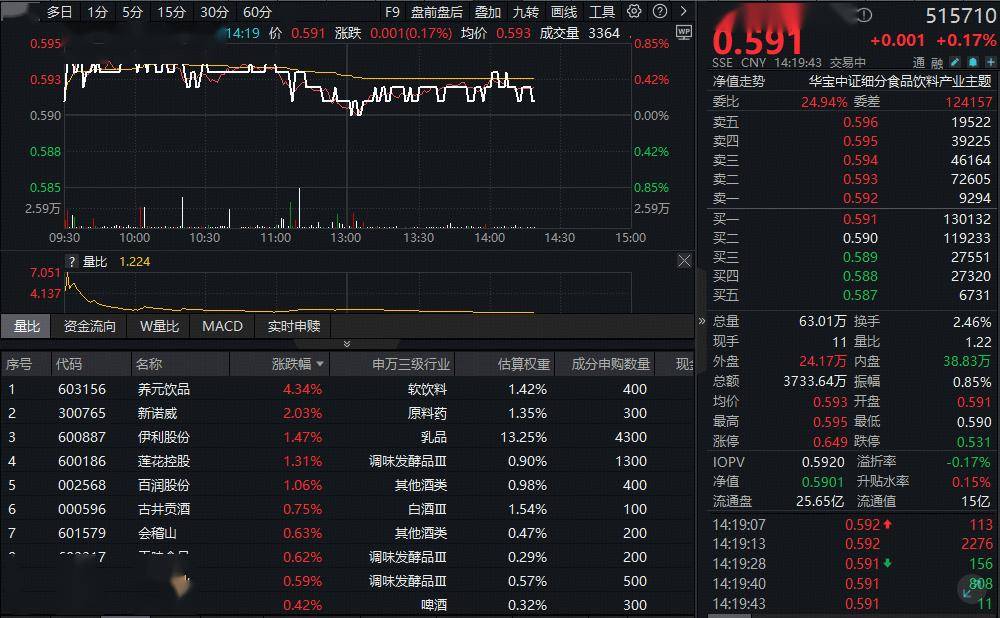
Group 1 - The overall performance of the food and beverage sector showed a slight decline in the afternoon, with the Huabao Food and Beverage ETF (515710) up by 0.17% at the time of reporting [1] - Leading consumer goods stocks performed well, with Yangyuan Beverage rising over 4%, and other companies like Yili and Lianhua Holdings increasing by more than 1% [1] - Major liquor brands such as Kweichow Moutai, Wuliangye, and Yanghe also showed slight gains [1] Group 2 - Pacific Securities noted that important meetings have prioritized boosting domestic demand, anticipating further policies to stimulate demand recovery [3] - The high-end luxury goods domestic consumption data showed slight improvement in Q3 2025, benefiting from the wealth effect among affluent consumers [3] - The food and beverage sector is currently at a historical low valuation, presenting a good opportunity for left-side layout [3] Group 3 - The Huabao Food and Beverage ETF (515710) tracks the CSI segmented food and beverage industry theme index, with about 60% of its holdings in leading high-end and mid-range liquor stocks [4] - The top ten weighted stocks include major brands like Moutai, Wuliangye, and Yili [4] - Investors can also access the core assets of the food and beverage sector through the Huabao Food and Beverage ETF linked funds [4]
吃喝板块午后回落,食品饮料ETF华宝(515710)红盘震荡!机构:白酒五底共振
Xin Lang Cai Jing· 2026-01-09 06:31
Core Viewpoint - The food and beverage sector is experiencing a slight recovery, with the Huabao Food and Beverage ETF (515710) showing a price increase of 0.17% as of the latest update, indicating a positive trend in the market [1][8]. Group 1: Market Performance - The food and beverage ETF Huabao (515710) has seen a price increase of 0.17%, reflecting overall sector performance [1][8]. - Key stocks in the sector include Yangyuan Beverage, which surged over 4%, and other major players like Yili and Lianhua Holdings, which rose over 1% [1][8]. - Leading liquor brands such as Kweichow Moutai, Wuliangye, and Yanghe also showed slight gains, contributing to the positive sentiment in the market [1][8]. Group 2: Industry Outlook - Open-source securities indicate that after experiencing policy shocks and rapid price declines, leading liquor companies like Moutai and Wuliangye have implemented market-oriented adjustment plans, suggesting that the liquor industry is nearing a bottom [10]. - Pacific Securities highlights that recent important meetings have prioritized boosting domestic demand, with expectations for further policies to stimulate demand recovery [10]. - The valuation of the food and beverage sector is currently at historical lows, with the food index's price-to-earnings ratio at 20.16, placing it in the 5.88% percentile of the last decade, indicating a favorable long-term investment opportunity [10]. Group 3: Investment Strategy - CITIC Construction points out that the current phase of the liquor industry, characterized by low prices and low expectations, may present a cyclical bottom for capital market investments [11]. - The Huabao Food and Beverage ETF (515710) tracks a specialized index with approximately 60% of its portfolio in leading high-end and mid-range liquor stocks, and nearly 40% in beverage, dairy, seasoning, and beer stocks [11]. - Investors can also consider the Huabao Food and Beverage ETF linked funds (Class A 012548/Class C 012549) for exposure to core assets in the food and beverage sector [11].


《公司舆情哨》2025盘点:十大事件、四类危机、四种趋势!
Sou Hu Cai Jing· 2026-01-09 05:48
Core Insights - The article discusses the significant public relations challenges faced by major brands in 2025, highlighting the crisis management issues and the evolving consumer expectations in various industries [1][2][5] Group 1: Key Events and Trends - In 2025, over 20 well-known brands were monitored for public sentiment, with Sam's Club and Moutai being among the most frequently mentioned due to crises such as trust issues and leadership changes [2][4] - Major public sentiment events included Sam's Club's trust crisis, Moutai's leadership change, and controversies surrounding brands like Nestlé and West Bay [2][4] - The food, new tea drinks, and dairy industries were particularly scrutinized, reflecting their close ties to consumer daily life [2][4] Group 2: Types of Crises - The public relations crises identified can be categorized into four main types: food safety issues, marketing and advertising controversies, personnel changes and strategic adjustments, and incidents related to live streaming and new media [4][6][10] - Food safety issues were the most significant, with incidents like a food poisoning case involving Yunhai Yao leading to severe penalties [6][8] - Marketing controversies included misleading advertising practices, such as the "half bag" marketing by White Elephant, which misled consumers about product quantity [11][12] Group 3: Leadership Changes - 2025 saw numerous leadership changes in major consumer brands, particularly in the alcohol and dairy sectors, reflecting pressures for strategic transformation and performance improvement [15][17] - Notable changes included Moutai's leadership transition and significant shifts within Nestlé's executive team, which could impact existing strategies [18][19] Group 4: New Media and Crisis Management - The rise of live streaming and short videos has led to an increase in real-time public relations crises, exemplified by the incident involving Pop Mart during a live stream [20][21] - Companies are urged to adapt their crisis management strategies to address the rapid dissemination of information and the emotional responses of consumers [22][23] Group 5: Evolving Consumer Expectations - Consumer scrutiny has shifted from product safety to emotional and value-based considerations, indicating a deeper examination of brand integrity and marketing practices [24][25] - Companies are encouraged to embrace constructive criticism as an opportunity for improvement rather than adopting a victim mentality [30][31] Group 6: Future Challenges - The consumer goods industry is expected to remain a hotspot for public relations challenges, with increasing demands for product safety, marketing honesty, and price transparency [28][29] - The integration of AI technology in reputation management presents both opportunities and risks, necessitating a balance between efficiency and ethical considerations [32]