
中兴通讯

Search documents
中光防雷:公司是爱立信、中兴通讯、诺基亚、三星等全球主要通信设备制造商的防雷产品供应商
2 1 Shi Ji Jing Ji Bao Dao· 2026-01-23 10:27
Group 1 - The company, Zhongguang Lightning Protection, is a supplier of lightning protection products for major global telecommunications equipment manufacturers such as Ericsson, ZTE, Nokia, and Samsung [1] - The technical reserves for lightning protection products for 5G communication equipment have been validated in the market [1] - The company's revenue in the telecommunications sector for the first half of 2025 is projected to be 111.23 million yuan, representing a year-on-year growth of 12.43% [1] Group 2 - The demand for the telecommunications technology service industry is expected to enter a rapid growth phase due to the ongoing construction of 5G and 6G networks and new infrastructure initiatives [1]


中光防雷(300414) - 2026年1月23日投资者关系活动记录表
2026-01-23 10:06
Group 1: Company Overview and Market Position - Sichuan Zhongguang Lightning Protection Technology Co., Ltd. is a leading enterprise in the lightning protection sector in China, supplying products to major global communication equipment manufacturers such as Ericsson, ZTE, Nokia, and Samsung [2]. - The company reported a revenue of CNY 111.23 million in the communication sector for the first half of 2025, marking a year-on-year growth of 12.43% [2]. - The company holds a unique position in the market, being the only publicly listed company in the Shanghai and Shenzhen stock exchanges with over 50% of its main business revenue derived from lightning protection [4]. Group 2: Product Development and Revenue Growth - The company's electronic components, including magnetic components and RF devices, achieved a revenue of CNY 57.31 million in the first half of 2025, reflecting a significant year-on-year increase of 70.73% [2]. - In the energy sector, the company reported a revenue of CNY 82.35 million in the first half of 2025, which is a 35.84% increase compared to the previous year, driven by rising customer demand [3]. Group 3: Technological Advancements and R&D - The company has developed EMP protection products capable of shielding against nuclear electromagnetic pulses and high-power microwave radiation, although these products have not yet reached mass production [3]. - The company is actively involved in the development of 6G technology, maintaining close technical ties with clients and adapting to their customized product needs [3]. Group 4: Industry Applications and Projects - The company has participated in numerous lightning protection engineering projects, including those for high-speed rail, nuclear power plants, and military applications, covering complex scenarios such as the Qinghai-Tibet Railway and the CCTV headquarters [3]. - In the renewable energy sector, the company provides tailored SPD products for traditional power, wind, solar energy, and charging stations, enhancing its market share through innovative product offerings [3].
通信行业双周报:关注业绩预告密集披露期表现-20260123
Dongguan Securities· 2026-01-23 09:59
Investment Rating - The report maintains an "Overweight" rating for the communication industry, expecting the industry index to outperform the market index by more than 10% in the next six months [2][44]. Core Insights - The communication industry index has shown a cumulative increase of 1.61% over the past two weeks (January 9 to January 22), outperforming the CSI 300 index by 1.91 percentage points, ranking 21st among 31 first-level industries [4][11]. - In January, the communication sector has risen by 2.48%, again surpassing the CSI 300 index by 0.45 percentage points [4][11]. - The report highlights a critical period of annual performance forecasts for listed companies, which serves as a key window to validate the growth potential and market conditions of various sectors [4][39]. Industry Performance Review - The communication sector's six sub-sectors have varied performance over the past two weeks, with the highest increase in the SW Communication Application Value-Added Services (+11.59%) and the lowest in SW Communication Terminals and Accessories (-1.64%) [4][15]. - The report notes that the communication industry is entering a phase of technological iteration and policy benefits, with new growth drivers expected from AI, quantum communication, and low-altitude economy [4][39]. Industry News and Company Announcements - IDC predicts that by 2030, AI agents will become a significant part of the global workforce, with a projected increase from approximately 28.6 million active agents in 2025 to 2.216 billion [16]. - China Mobile has established a special office for computing power strategy, marking a new phase in its systematic approach to computing power deployment [17][19]. - The Ministry of Industry and Information Technology reports that AI has penetrated over 70% of business scenarios in leading smart factories [20]. - Tianfu Communication expects a net profit increase of 40%-60% for 2025, driven by the growth in AI and data center construction [23]. - Changxin Bochuang anticipates a net profit increase of 344%-413% for 2025, fueled by demand in cloud computing and AI [24]. Industry Data Updates - As of November 2025, the mobile phone user base reached approximately 1.828 billion, a year-on-year increase of 2.20% [27]. - The internet broadband access user base was about 697 million, reflecting a year-on-year increase of 4.28% [29]. - The length of optical cable lines reached approximately 74.44 million kilometers, with a year-on-year growth of 3.63% [30]. - By November 2025, the total number of 5G base stations reached 4.83 million, with a net increase of 579,000 from the previous year [36]. Investment Recommendations - The report suggests focusing on companies that align with the themes of "technology commercialization, policy catalysis, and earnings certainty," highlighting potential opportunities in the sector [4][39]. - Recommended stocks include China Mobile (600941.SH), China Telecom (601728.SH), ZTE Corporation (000063.SZ), Changfei Optical Fiber (601869.SH), and Weisheng Information (688100.SH) [40][42].






EDA工具:贯穿芯片落地全流程,国产企业蓄势待发
GOLDEN SUN SECURITIES· 2026-01-23 09:52
Investment Rating - The report gives an "Accumulate" rating for the semiconductor industry, indicating a positive outlook for investment opportunities in this sector [5]. Core Insights - The EDA (Electronic Design Automation) market is expected to grow significantly, with a projected global market size of $18.3 billion by 2026, reflecting its critical role in the semiconductor industry [2][15]. - The domestic EDA market in China is anticipated to grow at a faster rate than the global market, driven by the rapid development of the integrated circuit industry and emerging technologies such as 5G and AI [18]. - The EDA industry is characterized by high concentration, with the top three companies (Synopsys, Cadence, and Siemens EDA) holding a combined market share of 74% [21]. Summary by Sections EDA: The Foundation of Semiconductor Design and Manufacturing - EDA tools are essential for the design, simulation, and verification of integrated circuits, playing a crucial role in the entire chip development process [10][11]. - The global EDA market is entering a stable growth phase, with a compound annual growth rate (CAGR) of 11.1% from 2017 to 2024, and a projected market size of $15.71 billion in 2024 [15][18]. - The Chinese EDA market is expected to reach approximately 15.3 billion yuan in 2024, with a year-on-year growth of 16.8% [18]. Manufacturing EDA and Design EDA - Manufacturing EDA is a core component of the integrated circuit production process, covering all stages from process platform development to wafer production [3][33]. - The manufacturing EDA market is projected to grow from $3.315 billion in 2020 to $5.754 billion by 2026, with a CAGR of 9.63% [3]. - The report outlines six categories of manufacturing EDA tools, including process and device simulation tools, device modeling and verification tools, and yield management tools [35]. Domestic EDA Companies on the Rise - The report highlights the increasing restrictions on EDA tool exports from the U.S., which presents both challenges and opportunities for domestic EDA companies in China [4]. - The domestic EDA market is characterized by significant growth potential, driven by the need for self-sufficiency and the development of a robust industry ecosystem [4][18]. - The report emphasizes the importance of overcoming high-end core technology barriers and optimizing industry chain processes to enhance competitiveness [4].


通信行业双周报(2026、1、9-2026、1、22):关注业绩预告密集披露期表现-20260123
Dongguan Securities· 2026-01-23 08:35
Investment Rating - The report maintains an "Overweight" rating for the communication industry, expecting it to outperform the market index by more than 10% over the next six months [2]. Core Insights - The communication industry index has shown a cumulative increase of 1.61% over the past two weeks (January 9 to January 22), outperforming the CSI 300 index by 1.91 percentage points, ranking 21st among 31 primary industries [4][11]. - The report highlights that the current period is critical for verifying the performance of various sectors and companies as annual earnings forecasts are being disclosed. It emphasizes the importance of monitoring key industry players' performance guidance and order progress, which will provide strong support for valuations [4][40]. - The communication industry is entering a phase of technological iteration and policy benefits, with new growth drivers expected from AI, quantum communication, and low-altitude economy sectors. The recovery of cellular IoT modules and ongoing construction of communication facilities like base stations and data centers are anticipated to create new demands for devices, equipment, and service operations [4][40]. Summary by Sections 1. Communication Industry Market Review - The communication sector has seen a 2.48% increase in January, outperforming the CSI 300 index by 0.45 percentage points [11]. - The six sub-sectors of the communication industry have varied performance, with the highest increase in the communication application value-added services sector (+11.59%) and the lowest in communication terminal and accessories (-1.64%) [16][19]. 2. Industry News - IDC predicts that by 2030, the number of AI agents will reach 2.216 billion, representing a compound annual growth rate of 139% [17]. - China Mobile has established a special office for computing power strategy, marking a significant organizational adjustment [18][20]. - The Ministry of Industry and Information Technology reports that AI has penetrated over 70% of business scenarios in leading smart factories [21]. 3. Company Announcements - Tianfu Communication expects a net profit increase of 40%-60% for 2025, driven by the growth in AI and data center construction [24]. - Changxin Bochuang anticipates a net profit increase of 344%-413% for 2025, fueled by demand in data communication products [25]. - Yilian Network forecasts a slight decline in net profit for 2025, while Huace Navigation expects a growth of 14.84%-18.27% [26][27]. 4. Industry Data Updates - As of November 2025, the mobile phone user base reached approximately 1.828 billion, a year-on-year increase of 2.20% [28]. - The length of optical cable lines reached about 74.44 million kilometers by Q3 2025, with a year-on-year growth of 3.63% [31]. - The total number of 5G base stations reached 4.83 million by November 2025, with a net increase of 579,000 from the previous year [37]. 5. Communication Sector Outlook - The report suggests focusing on companies that align with the themes of "technology commercialization, policy catalysis, and earnings certainty," highlighting firms such as China Mobile, China Telecom, ZTE, and Longfly Fiber [40][41].
深圳资金增量超6300亿 直接融资占比升至四成
2 1 Shi Ji Jing Ji Bao Dao· 2026-01-23 04:02
Group 1 - The core point of the article highlights the significant increase in direct financing in Shenzhen, with the total social financing scale exceeding 630 billion yuan in 2025, marking an increase of over 150 billion yuan year-on-year, and direct financing accounting for approximately 40% of the total, reaching a historical high [2][3] - The rise in direct financing is supported by corporate and government bonds, with the "Technology Board" for corporate bonds contributing significantly to this growth, particularly in the issuance of technology innovation bonds [2][3] - Since the establishment of the "Technology Board" in May 2025, Shenzhen's non-financial enterprises have issued a total of 44.15 billion yuan in technology innovation bonds in the interbank market, ranking second among cities nationwide [2] Group 2 - In addition to the interbank market, the issuance of technology innovation bonds by Shenzhen enterprises in the exchange market has also increased, with a total of 112 bonds worth 130.94 billion yuan as of October 2025 [3] - The issuance of technology innovation bonds has achieved full coverage among technology enterprises, venture capital institutions, and financial institutions, with a notable increase in participation from private enterprises [3] - The trend of increasing direct financing in Shenzhen aligns with national social financing data, where direct financing reached 16.7 trillion yuan in 2025, accounting for 46.9% of the total, marking a significant shift in financing structure [3][4]


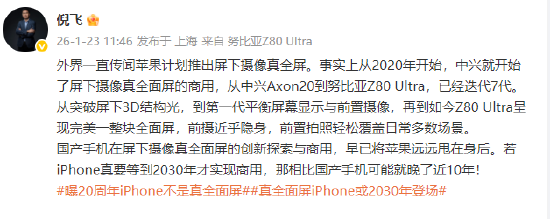
努比亚总裁倪飞:若iPhone真全面屏等到2030年实现商用,将比国产手机晚近10年
Xin Lang Cai Jing· 2026-01-23 03:58
Group 1 - The core viewpoint is that ZTE and Nubia have been leading the innovation in under-display camera technology, having commercialized it since 2020, while Apple is perceived to be lagging behind in this area [1][3] - ZTE has iterated its under-display technology through seven generations, from the Axon 20 to the Nubia Z80 Ultra, achieving a nearly invisible front camera and a seamless full-screen experience [1][3] - If Apple plans to introduce true full-screen technology by 2030, it may be nearly a decade behind the advancements made by Chinese manufacturers [1][3] Group 2 - ZTE's Vice President and Nubia's flagship product manager emphasized that the development of full-screen technology requires significant time and technical accumulation, which Nubia has achieved over seven generations [1][3] - The Nubia Z80 Ultra is highlighted as a leading product in the full-screen category, expected to dominate various rankings by 2025 [1][3]

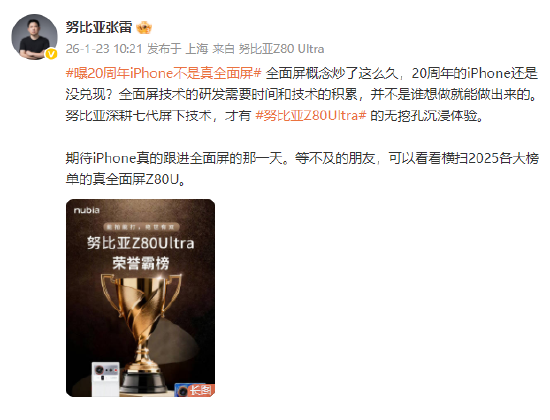
曝20周年iPhone不是真全面屏 努比亚张雷:全面屏技术不是谁想做就能做出来的
Xin Lang Cai Jing· 2026-01-23 02:51
Core Viewpoint - The Vice President of ZTE and General Manager of Nubia's flagship products, Zhang Lei, expressed skepticism about the 20th anniversary iPhone not featuring a true full-screen design, emphasizing that the development of full-screen technology requires time and technical accumulation [1][4]. Group 1 - Zhang Lei highlighted that the concept of full-screen has been discussed for a long time, yet the 20th anniversary iPhone has not delivered on this promise [1][4]. - He pointed out that the development of full-screen technology is not something that can be achieved easily or quickly, indicating the complexity involved [1][4]. - Nubia has invested in seven generations of under-screen technology, which has led to the creation of the Nubia Z80 Ultra, offering a true full-screen experience without any cutouts [1][4]. Group 2 - Zhang Lei expressed anticipation for Apple to eventually adopt full-screen technology, suggesting that consumers who are eager for such features should consider the Nubia Z80 Ultra, which is expected to perform well in various rankings by 2025 [1][4].
未知机构:天风通信推荐中兴通讯珠峰CPU大客户放量自研芯片能力值得重视26年多产品-20260123
未知机构· 2026-01-23 02:20
Summary of Conference Call Records Company: ZTE Corporation Key Points - ZTE Corporation's self-developed chip capabilities are gaining market attention, with the company possessing the ability to develop core chips such as CPUs, switching chips, inter-card connection chips, and DPUs [1] - In 2026, multiple product iterations are expected to be launched, highlighting ZTE Micro's undervalued core competitiveness [1] - ZTE Micro's chip self-development capabilities are notable, with anticipated releases including a 51.2T switching chip and a 51.2T inter-card connection chip [1][1] - The company's CPU, the Summit chip, is expanding its market share among operators and has achieved mass application with major clients, which is significant [1] - ZTE is also focusing on breakthroughs in AI, particularly in the DPU and GPU sectors [1] Company: Nubia Technology Key Points - Nubia's smartphone division is enhancing its influence with flagship releases such as the Red Magic 11 Pro series and Nubia Z80 Ultra, integrating AI capabilities deeply with the Doubao model [2] - The company has launched the M153, further collaborating with Doubao to incorporate the Doubao mobile assistant, indicating a strong outlook for Nubia in the AI smartphone sector [2] - In the server domain, Nubia is experiencing high growth driven by breakthroughs with internet giants, with computing revenue increasing by 180% year-on-year, accounting for 25% of total revenue [2] - Server and storage revenue grew by 250% year-on-year, while data center product revenue increased by 120% [2] - Nubia's intelligent computing servers have entered the core business scenarios of major domestic internet and financial companies, including Alibaba, Tencent, ByteDance, Baidu, JD.com, Meituan, and Kuaishou [2] - The company is fully integrating AI and expanding its "connection + computing" strategy, with promising developments in the computing + AI terminal field [2] - Nubia is investing in AI direction, building a core competitiveness in "chips + complete machines + modular R&D + AI" [2][3] Additional Insights - Nubia is positioning itself as a rare leading enterprise in the computing field, spanning across "chips," "connectivity," and "terminals," which enhances its market competitiveness [5] - The introduction of intelligent computing supernode systems aims to support the creation of highly efficient large-scale intelligent computing clusters [4]
字节、OpenAI、Meta都在赌一件事
3 6 Ke· 2026-01-22 23:34
Core Insights - Major tech companies are entering the AI hardware market, with OpenAI planning to launch its first AI hardware device in the second half of 2026, indicating a significant shift in strategy from software to hardware [1] - This trend is seen across various companies including ByteDance, Alibaba, and Meta, which are all investing heavily in AI hardware despite past failures in the hardware sector [1][2][4] Group 1: Reasons for Past Failures - Historically, major tech companies have struggled with hardware due to a lack of understanding of the complexities involved, often leading to failed products and financial losses [2][3][5] - The inherent arrogance of internet companies, which thrive on rapid iteration and low marginal costs, has hindered their ability to manage the high stakes and complexities of hardware production [6][7][8] Group 2: Changes in the Market - The emergence of AI models has changed the dynamics of hardware development, allowing for simpler interaction methods that reduce the need for complex designs [9][10] - AI hardware is now viewed as a sensor for AI, enabling companies to gather real-world data that can enhance their models, thus making hardware development more appealing [11][22][23] Group 3: Strategic Shifts - Companies like ByteDance, Meta, and OpenAI are now focusing on creating their own hardware to maintain control over user interactions and data, as the risk of losing direct access to users increases [15][17] - The collaboration between software and hardware companies is becoming more common, allowing for reduced development times and shared risks, making hardware ventures less daunting [25][26] Group 4: Future Implications - The AI hardware trend reflects a broader fear among software companies of being sidelined in the evolving tech landscape, as they seek to embed themselves into users' daily lives [27][28] - The proliferation of AI devices raises questions about the necessity and impact of such technology on human life, suggesting a deeper integration of AI into everyday activities [27][29]
