工商银行

Search documents
非银对话计算机-如何看待互联网金融的监管和估值
2026-02-13 02:17
Summary of Conference Call Notes Industry Overview - The conference call primarily discusses the **internet finance industry** and specifically focuses on **Jiufang Zhituo** as a representative company within this sector [2][4]. Key Points and Arguments 1. **Financial Performance and Market Sentiment** - Jiufang Zhituo's contract liabilities reached **1.5 billion** yuan by the end of 2026, indicating stable performance for the first half of 2027 [2][4]. - The increase in stock price reflects market recognition of the company's growth potential [2]. 2. **Regulatory Environment** - The internet finance sector requires dynamic regulatory adjustments, with leading companies like Jiufang Zhituo prepared for compliance [2][4]. - Strict regulations are expected to eliminate non-compliant competitors, benefiting leading firms and enhancing industry concentration [2][4]. 3. **Valuation Methodology** - Valuation of internet finance companies is influenced by performance, trading volume, and investor sentiment, suggesting a preference for relative valuation methods over traditional absolute models [2][5]. - The performance of these companies is closely tied to market conditions, making it challenging to predict future earnings [4][9]. 4. **AI Integration in Internet Finance** - Domestic internet finance companies are actively investing in AI, with firms like Jiufang Zhituo and Tonghuashun leading the way [2][5]. - AI applications include compliance screening and investment research, although achieving a positive return on investment (ROI) may take time [2][5][6]. 5. **Progress in Unstructured Data Processing** - The financial industry has made significant advancements in processing unstructured data, reducing costs and improving efficiency [7]. - Financial institutions are expected to achieve positive ROI as they enhance their product offerings [7]. 6. **Digital Currency Business Expansion** - Companies like Jiufang and Dongfang Caifu are exploring digital currency operations in Hong Kong as part of their international strategy [8]. - The regulatory framework for digital currencies is still developing, and the potential for significant revenue generation remains uncertain [8]. 7. **Challenges in International Expansion** - Domestic financial institutions face challenges such as compliance with foreign regulations, service capability, and operational issues when expanding internationally [12][13]. - Despite these challenges, international expansion is viewed as a long-term direction supported by policy encouragement [13]. Additional Important Insights - The acceptance of AI technology in the financial sector is increasing, with applications in research report writing, data processing, and client services [10][11]. - The performance of large platforms like Dongfang Caifu and Tonghuashun is directly linked to market trading volumes, necessitating a differentiated analysis from smaller platforms [9]. This summary encapsulates the critical insights from the conference call, highlighting the current state and future outlook of the internet finance industry, particularly focusing on Jiufang Zhituo and its strategic positioning within the market.
南向1.41万亿“压舱” 韩国散户“点火”——港股迎来定价权分层时代
Zhi Tong Cai Jing· 2026-02-13 01:53
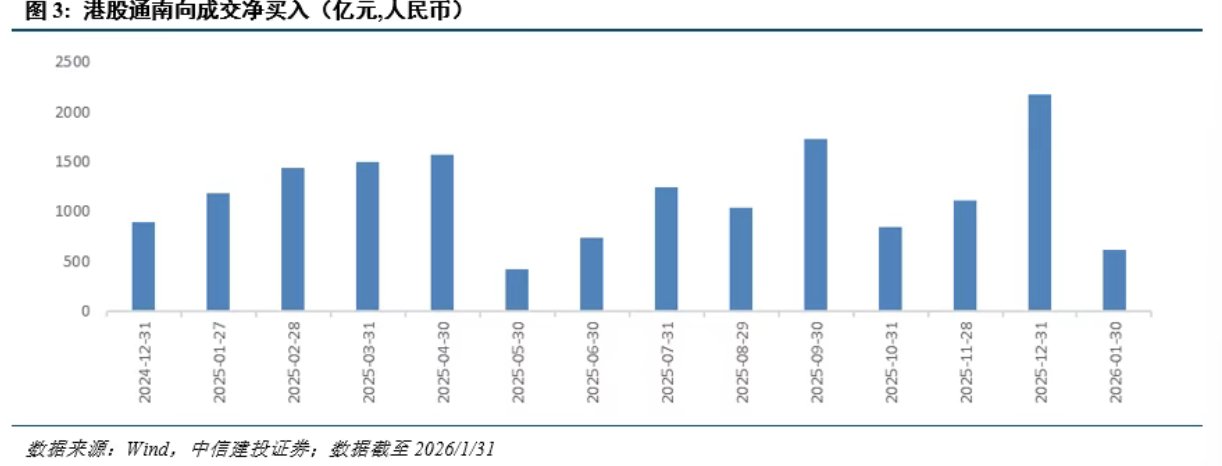
Core Insights - The Hong Kong stock market is experiencing two distinct but resonant waves of incremental capital from mainland China and South Korean retail investors, with mainland southbound funds achieving a record net purchase of 1.41 trillion HKD, establishing themselves as core builders of pricing power in the market [1][10] - Southbound funds are characterized by long-term value investment, while South Korean retail investors engage in high-frequency trading and narrative-driven investments, creating a diversified funding source and a layered pricing logic in the Hong Kong market [1][10] Funding Scale and Structure - Southbound funds have become the core incremental source and valuation system reshaper for the Hong Kong market, with a cumulative net inflow of 5.11 trillion HKD by the end of 2025, and a market value exceeding 6.3 trillion HKD, accounting for 12.7% of the total market [2] - South Korean retail investors, while having a smaller capital scale, exhibit concentrated trading behavior and significant leverage, particularly impacting specific sectors like new economy IPOs and the semiconductor industry [2][5] Industry Preferences - Southbound funds focus on financials and high-dividend utilities, with significant investments in major banks and state-owned enterprises driven by high dividend yields and low valuation levels, while South Korean investors show minimal interest in these sectors [3][5] - South Korean retail investors heavily invested in Xiaomi and MiniMax-WP, demonstrating a high turnover and narrative-driven trading approach, contrasting with the stable, long-term holdings of Southbound funds [5][8] Trading Behavior and Decision-Making - Southbound funds exhibit a decision-making anchor based on dividend yield, ROE stability, and free cash flow generation, characterized by continuous accumulation and stable holdings, as seen with significant net purchases in major banks [8][9] - South Korean retail investors, on the other hand, are driven by industry narrative strength and social media trends, with a high frequency of trading and a tendency to hold stocks for less than three months, reflecting a stark contrast to the long-term holding strategy of Southbound funds [9][10] Market Dynamics - The influx of South Korean retail investors into the Hong Kong market represents a diversification of the investor base, providing liquidity while also potentially increasing volatility during certain periods [9][10] - The interaction between Southbound funds and South Korean retail investors is creating a new normal in the Hong Kong market characterized by layered pricing and concurrent narratives, necessitating both stable investment strategies and agile trading approaches [10]






智通特供|南向1.41万亿“压舱” 韩国散户“点火”——港股迎来定价权分层时代
智通财经网· 2026-02-13 01:49
Core Viewpoint - The Hong Kong stock market is experiencing two distinct but resonant waves of incremental capital from mainland China and South Korean retail investors, leading to a diversification of funding sources and a layered pricing logic in the market [1][14]. Group 1: Scale and Structure - Southbound funds have established themselves as the core incremental source and revaluation force in the Hong Kong stock market, with a cumulative net inflow of 5.11 trillion HKD by the end of 2025, and a record annual net purchase of 1.41 trillion HKD in 2025 [2]. - The market capitalization of southbound funds has surpassed 6.3 trillion HKD, accounting for 12.7% of the total market capitalization of Hong Kong stocks, indicating their evolution into an "endogenous pricing variable" [2]. Group 2: Trading Behavior of South Korean Retail Investors - South Korean retail investors, while having a relatively limited capital size, exhibit highly concentrated and leveraged trading behaviors, particularly impacting specific sectors such as new economy IPOs and the semiconductor industry [5]. - In early 2026, South Korean retail investors made a net purchase of over 2 million USD in MiniMax-WP, contributing significantly to its IPO, which saw an oversubscription of 1837 times [5]. Group 3: Industry Preferences - Southbound funds focus on financials and high-dividend utilities, with significant investments in companies like China Construction Bank and China Mobile, driven by high dividend yields and low valuation levels [6]. - South Korean investors, on the other hand, show a preference for high-growth sectors, with notable investments in Xiaomi and MiniMax-WP, reflecting a narrative-driven trading strategy [8]. Group 4: Investment Strategies - Southbound funds demonstrate a long-term investment strategy characterized by stable holdings and systematic increases in positions, as seen with China Construction Bank, which saw a net purchase of 7.39 billion shares in 2025 [12]. - South Korean retail investors engage in high-frequency trading with a focus on social media trends and community consensus, leading to a rapid turnover of holdings, with an average holding period of less than three months [13]. Group 5: Market Dynamics - The influx of South Korean retail investors into the Hong Kong market represents a diversification of the investor base, contributing to liquidity while also potentially increasing volatility during certain periods [14]. - The interaction between the long-term positioning of southbound funds and the short-term trading strategies of South Korean investors creates a new normal in the Hong Kong stock market characterized by layered pricing and concurrent narratives [14].
黄金回购突然限流?并非不让你卖,而是怕你亏惨了
Sou Hu Cai Jing· 2026-02-13 00:21
2026年2月6日,北京菜市口百货股份有限公司宣布次日起实施新的贵金属回购规则,将每日回购限额从 200公斤下调为100公斤,并且明确规定周末和法定节假日暂停办理回购业务。 几乎在同一时间,中国 黄金集团黄金珠宝股份有限公司也发布公告,自2月7日起在周六、周日及法定节假日等上海黄金交易所 非交易日期间,暂停办理贵金属回购业务。 这一变化来得突然却并非意外。 2026年开年,黄金市场就上演了"过山车"行情。 国际金价在1月末突破 每盎司5500美元历史性关口后迅速回落,2月2日盘中一度下探至4402.06美元,短短七个交易日内振幅 超过20%。 面对如此剧烈的价格波动,各大金店和银行纷纷收紧了回购政策。 北京一家金店的真实场景揭示了市场恐慌程度。 在规则调整前,商场开门仅半小时,前来回购的客户 就排起百米长队。 有客户带着2000克金条想要一次性变现约212万元。 这种集中变现给企业带来了巨大 的资金压力和市场风险。 香颂资本执行董事沈萌认为,贵金属当前的交易情绪已经从避险变为投机,并且交易波动与估值风险持 续扩大。 这种市场情绪转变促使行业集体采取风控措施。 中国黄金在公告中明确指出,近期受多重因素影响,贵金 ...


金价真的是一夜大变天,最新报价,全国金价竟然差这么多?
Sou Hu Cai Jing· 2026-02-13 00:03
Core Viewpoint - The price of gold varies significantly across different retailers, with a difference of over 400 yuan per gram between the Shanghai Gold Exchange and brand jewelry stores, highlighting the importance of price comparison for consumers [1][6][20]. Price Comparison - On February 12, 2026, the Shanghai Gold Exchange quoted AU9999 at 1123 yuan per gram, while major jewelry brands like Chow Tai Fook and Chow Sang Sang priced it at 1560 yuan per gram [3][20]. - The price difference between investment gold bars from banks and jewelry is substantial, with bank gold bars priced around 1135 yuan per gram compared to 1560 yuan for jewelry, resulting in a savings of over 420 yuan per gram when choosing bank gold bars [6][20]. Brand Pricing Discrepancies - The price variation among brand jewelry stores is notable, with a difference of 80 yuan per gram between the highest and lowest prices [4][20]. - The cost of jewelry includes design, operational, and store costs, leading to higher prices compared to investment gold bars, which have minimal premiums [6][7]. Regional and Store Variations - Prices differ based on location and store type, with flagship stores in prime urban areas charging more than those in smaller towns [7][16]. - In the same city, different shopping districts can have price variations of a few yuan per gram [7][16]. Consumer Behavior - Consumers exhibit varied purchasing behaviors, with some opting for bank gold bars for investment and others choosing brand jewelry for personal use [17][18]. - The demand for gold jewelry spikes during festive seasons, leading to increased sales for brand stores [12][20]. Market Dynamics - The gold recovery market shows that consumers often receive lower prices than expected when dealing with non-regulated buyers, emphasizing the importance of using transparent recovery channels [9][22]. - The gold market is influenced by international prices, with domestic prices fluctuating in response to global trends [26]. Sales Data - On February 12, 2026, the trading volume on the Shanghai Gold Exchange reached 50 tons, with significant sales reported by both banks and brand jewelry stores [20]. - Brand stores like Chow Tai Fook sold 500 kg of gold jewelry, while banks sold substantial amounts of gold bars, indicating strong consumer interest [20].



2025年中国手机银行APP监测报告
艾瑞咨询· 2026-02-13 00:02
Core Insights - The mobile banking app industry in China is transitioning into a stock operation phase, with user behavior shifting towards efficient, purpose-driven usage rather than prolonged browsing [1][7][9] - AI and ecosystem integration are driving a transformation in service delivery, enhancing user experience and security [2][11] - Regulatory frameworks are tightening, emphasizing compliance and innovation, with new policies guiding the industry towards value creation [3][14] - Competitive dynamics are increasingly influenced by ecosystem capabilities and regional strengths, with state-owned banks leading the market [4][16] Market Overview - The user base for mobile banking apps is stabilizing, with monthly active users (MAU) projected to fluctuate between 648 million and 739 million from 2023 to 2025, reaching a peak by December 2025 [7] - The overall market is moving from rapid expansion to a focus on enhancing existing user engagement [7] User Behavior Trends - User engagement metrics show a slight decline in daily usage frequency, with average daily sessions dropping from approximately 4.5 times in 2023 to around 3.3 times in early 2024, stabilizing thereafter [9] - Effective usage time is also decreasing, indicating a shift from passive browsing to targeted, functional use [9] Technological Trends - By 2025, mobile banking technology will focus on deep AI integration and ecosystem-level enhancements, moving beyond simple feature improvements [11] Regulatory Environment - The regulatory landscape is evolving, with a focus on compliance and user rights protection, driven by the implementation of new policies [14] Competitive Landscape - The competitive environment is characterized by significant differentiation, with state-owned banks leveraging their extensive ecosystems, while regional banks focus on localized growth [4][16] User Demographics - The core user demographic consists predominantly of males (56.7%) and younger users under 40 years old (63.3%), with a significant portion being married and having children [6][45][47] - Users from new first-tier and lower-tier cities account for over 90% of active users, highlighting the importance of these markets for future growth [48] Top Mobile Banking Apps - Agricultural Bank of China leads with an average MAU of 249 million, followed by Industrial and Commercial Bank of China with 194 million, and China Construction Bank with 109 million [18][19] - Among joint-stock banks, China Merchants Bank leads with 71.85 million MAU, while Ping An Bank and CITIC Bank follow closely [20][22] Case Studies of Leading Banks - Agricultural Bank of China is enhancing user experience through its mobile app, aiming for over 270 million MAU by the end of 2025 [30] - Industrial and Commercial Bank of China focuses on smart financial services, improving user engagement through various innovative features [33] - Postal Savings Bank of China aims to evolve its app into a companion service, enhancing user interaction and experience [35] - China Merchants Bank emphasizes wealth management and digital loan services, integrating financial services into daily life [37] - Ping An Bank is enhancing its app with AI-driven insights and personalized services [39] - Beijing Bank is focusing on a comprehensive wealth management system and improved user experience through its app [41]





金融活水向“智”逐“绿”
Xin Lang Cai Jing· 2026-02-12 23:43
(来源:湖州日报) 转自:湖州日报 在浙江凯色丽科技发展有限公司,财务负责人谈起去年底的一笔融资时,用了"及时"二字。公司计划进 行生产设备节能改造,但部分资金需求与传统信贷产品不匹配。交通银行湖州分行在走访中了解到这一 情况后,结合绿色金融创新试点政策,成功为其办理了全市首笔绿色外债登记业务,引入150万美元资 金专项用于改造。"利率合适,手续顺畅,项目进度比预期快了不少。"该负责人表示。这笔"破冰"的业 务,成为湖州金融系统探索多样化融资服务、精准响应企业需求的一个生动注脚。 市绿色金融发展服务中心工作人员介绍,增速的背后是机制的协同与服务的靠前。"我们和行业主管部 门联动更紧密了,项目信息共享更及时,让银行能早介入、早研判。"他提到,围绕重大项目清单,金 融机构得以提前设计融资方案;而对于暂时遇到困难的企业,则通过"一企一策"进行针对性帮扶,努力 缓解企业经营压力。 在滋养实体经济的同时,金融风险的"防火墙"也在同步加固。据了解,湖州已连续46个月保持全省最优 的信贷资产质量。 "迈入2026年,湖州金融系统将围绕深化'金融生态最优市'建设这一主线,以打造全国绿色金融能力建 设基地为载体,实施金融服务赋 ...


“2026电影经济促进年”活动启动
Xin Lang Cai Jing· 2026-02-12 22:40
Core Viewpoint - The "2026 Film Economic Promotion Year" initiative aims to enhance film consumption and stimulate economic growth through various local projects and innovative viewing experiences [1] Group 1: Government and Industry Initiatives - The event is organized by the National Film Administration and encourages localities to implement unique film economic projects [1] - A total of at least 1.2 billion yuan (approximately 170 million USD) will be allocated for consumer subsidies to promote film viewing throughout the year [1] Group 2: Technological Advancements and New Experiences - Major companies including China Film Group, Huaxia Film Distribution, and others announced plans for LED movie screens and virtual reality theaters to create new growth points in the industry [1] - The establishment of a national film digital asset platform aims to cultivate new productive forces in film [1] Group 3: Pilot Cities and New Consumption Models - Sixteen cities have been designated as "Film+" consumption pilot cities to explore new business models and scenarios in film consumption [1] - The launch of the "Follow the Movie to Explore the Market" initiative is intended to promote new film consumption formats [1]
“三下乡”文化进万家活动启动
Xin Lang Cai Jing· 2026-02-12 19:35
Group 1 - The event in Xining's Chengbei District on February 12, 2026, aimed to deliver quality resources, warm services, and New Year blessings to the community, enhancing grassroots cultural life and promoting rural revitalization [1][2] - A variety of cultural performances were showcased, including dances and songs, reflecting the vibrant atmosphere of the city and the unity of different ethnic groups [1] - Donations totaling 32,300 yuan were made by 11 civilized units, including Qinghai Provincial Traffic Holding Group and Industrial and Commercial Bank of China, to support community welfare [1] Group 2 - The initiative effectively conveyed the Party's policies and warmth, stimulating the internal motivation of the community and fostering a strong collective effort for rural revitalization and national unity [2]
黄金价格最新动态,(2月12日)今日黄金价格多少钱一克最新查询
Sou Hu Cai Jing· 2026-02-12 18:53
2026年2月12日,国际金价暂报5031.54美元/盎司,较前一日下跌27.60美元。 国内金价稳定在1120.40元/克,较昨 日上涨3元。 品牌金店的足金饰品价格在1530元至1562元每克之间波动,其中老庙黄金报价1562元/克,菜百首饰 为1530元/克。 国际金价在1月30日触及5598美元/盎司的历史峰值后,出现大幅回调,累计跌幅超过11%。 2月12日的价格波动被 视为市场高位震荡的延续。 2026年1月底,芝加哥商品交易所集团将纽约黄金期货交易保证金改为浮动计算,上海黄金交易所也上调了部分合 约保证金比例至18%。 这些措施旨在控制市场风险。 世界黄金协会亚太区研究负责人贾舒畅指出,黄金价格受经济增长、机会成本、风险不确定性和趋势动能四因素 驱动。 2026年初,地缘政治风险及美股高位运行等因素推高了黄金的避险需求。 北京多家黄金回收门店出现排队现象。 一位在周大福专柜出售50克金手镯的顾客获得4万多元变现款。 品牌金店 回收价格约为1083元至1088元每克,典当行及专业回收店价格略低,需扣除相应手续费。 同期黄金销售柜台同样繁忙。 北京朝阳区某商场的老铺黄金柜台前,消费者排队3小时购买金 ...