
苏州银行

Search documents
南京银行频获增持,银行股价值拐点已至?
Jing Ji Guan Cha Wang· 2025-10-23 06:40
Core Viewpoint - The recent capital inflow into Nanjing Bank reflects a significant trend of shareholder increases across various banks, indicating a growing confidence in the banking sector's long-term value and stability [2][3][9] Group 1: Shareholder Actions - Nanjing Gaoke Co., Ltd. increased its stake in Nanjing Bank to 9.99% by investing approximately 1.684 billion yuan, marking the second major increase for the bank this year [2][3] - BNP Paribas raised its holdings in Nanjing Bank to 17.02% by acquiring 108 million shares, signaling international capital's endorsement of the bank's fundamentals [3] - Other banks, including Qingdao Bank, Suzhou Bank, Chengdu Bank, and Chongqing Bank, have also seen significant shareholder increases, showcasing a broader trend in the banking sector [2][5][7] Group 2: Capital Composition - The capital influx into Nanjing Bank includes contributions from foreign investors, domestic listed companies, and local state-owned enterprises, indicating a rare alignment of interests among diverse capital sources [3][4] - Local state-owned capital, such as Jiangsu Transportation Holding Co., Ltd., has optimized its shareholding structure by transferring shares to enhance management efficiency [4] Group 3: Market Trends - The trend of shareholder increases in 2025 is characterized by a diverse range of investors, including local state-owned platforms, central state-owned enterprises, foreign QFII, and industrial capital [8] - The banking sector is experiencing a shift in valuation logic, with investors increasingly focusing on structural advantages such as customer base, regional economic resilience, and asset quality stability [9] - The current market environment is transitioning from speculative trading to a focus on stable returns, positioning bank stocks as attractive investments for long-term capital [8][9]



【立方债市通】豫企年内银行间市场发债超1400亿/洛阳AAA主体拟发债40亿/首单储架持有型150亿不动产ABS获受理
Sou Hu Cai Jing· 2025-10-22 12:40
Core Insights - In the first three quarters of 2025, 73 enterprises in Henan province issued bonds in the interbank market, raising a total of 144.2 billion yuan, with 4 companies making their debut in bond issuance [1] - The balance of corporate debt financing tools in Henan reached 448.87 billion yuan by the end of September, reflecting a year-on-year growth of 8.6% [1] - The issuance of technology innovation bonds in Henan exceeded 13.72 billion yuan, with 9 companies participating [6] - The issuance of savings bonds in Henan reached 7.443 billion yuan, marking a year-on-year increase of 6.01% [8][9] Debt Market Dynamics - The total issuance of perpetual bonds and subordinated debt by commercial banks in 2025 has surpassed 1.26 trillion yuan [3] - The People's Bank of China conducted a 138.2 billion yuan reverse repurchase operation, resulting in a net injection of 94.7 billion yuan into the market [5] - The issuance of special refinancing bonds in Liaoning province is set at 5.546 billion yuan, aimed at repaying existing debts [11] Regional Highlights - The Zhengzhou High-tech Zone is seeking to support technology enterprises in issuing bonds for direct financing, offering subsidies for rating certification [12] - Yunnan province is promoting the issuance of bonds by private enterprises and encouraging local banks to invest in these bonds [14] Recent Issuance Activities - Anyang Steel Group successfully issued 500 million yuan in technology innovation bonds with an interest rate of 2.9% [18] - Luoyang Urban Development Group completed the issuance of 500 million yuan in renewable corporate bonds at a rate of 2.65% [17] - Kaifeng Development Investment Group issued 1 billion yuan in corporate bonds with a 3.15% interest rate [18] Market Sentiment - The Huayuan Fixed Income team expressed a bullish outlook on the bond market, predicting a downward trend in bond yields [25] - Xinda Fixed Income research indicated that while trade negotiations present uncertainties, liquidity remains assured, suggesting limited upward risk for the bond market [26]

二级资本债赎回分化加剧 中小银行资本补充难题待解 有央行分行拟推行\"不赎回\"24小时上报机制
Mei Ri Jing Ji Xin Wen· 2025-10-22 10:46
Core Viewpoint - The secondary capital bond market for commercial banks is experiencing a rare divergence, with large banks redeeming old bonds while some small and medium-sized banks are opting not to redeem, highlighting the differing capital adequacy pressures faced by these institutions [1][2][3]. Group 1: Large Banks' Actions - Major banks like Bank of China and China Construction Bank have fully redeemed hundreds of billions in secondary capital bonds, optimizing their capital structure through "old debt for new" strategies [1][2]. - As of September 2025, the 10-year government bond yield remains around 1.8%, while the interest rates on bonds issued in 2020 range from 4% to 4.73%, prompting banks to redeem high-interest old bonds to lower their funding costs [2][3]. Group 2: Small and Medium-Sized Banks' Decisions - In contrast, smaller banks such as Fuxin Bank and Nanchang Rural Commercial Bank have chosen not to exercise their redemption rights, indicating a reluctance to lose existing bonds with relatively high interest rates [3][4]. - The decision not to redeem is largely due to these banks' capital adequacy ratios nearing regulatory limits, with Nanchang Rural Commercial Bank's capital adequacy ratio reported at 10.34% as of the end of 2024 [4]. Group 3: Regulatory Response - Regulatory bodies are responding to the non-redemption trend by requiring banks to report any decision not to redeem secondary capital bonds within 24 hours, indicating a recognition of the potential risks associated with these decisions [5]. - This regulatory move aims to mitigate information asymmetry and prevent localized risks from spreading, as non-redemption could raise concerns about a bank's operational health and increase future financing costs [5][6]. Group 4: Future Strategies for Small Banks - To address capital replenishment challenges, small banks are encouraged to diversify their capital sources, including the use of perpetual bonds and other methods to enhance core capital [6]. - Improving equity structures and attracting strategic investors or local government funds are also seen as effective ways to strengthen capital bases for small banks [6].
二级资本债赎回分化加剧 中小银行资本补充难题待解 有央行分行拟推行“不赎回”24小时上报机制
Mei Ri Jing Ji Xin Wen· 2025-10-22 08:53
Core Viewpoint - The secondary capital bond market for commercial banks is experiencing a rare divergence, with large banks redeeming old bonds while some small and medium-sized banks choose not to redeem, highlighting the varying capital adequacy levels and operational conditions among banks [1][2][3]. Group 1: Large Banks' Actions - Major banks like Bank of China and China Construction Bank have announced full redemptions of their secondary capital bonds, optimizing their capital structure by replacing old debt with new [2][3]. - As of September 2025, the 10-year government bond yield remains around 1.8%, while the interest rates on bonds issued in 2020 are significantly higher, ranging from 4% to 4.73%, prompting banks to redeem high-interest old bonds to reduce financing costs [2][3]. Group 2: Small and Medium-Sized Banks' Decisions - In contrast, several small and medium-sized banks, such as Fuxin Bank and Nanchang Rural Commercial Bank, have opted not to exercise their redemption rights, indicating potential capital adequacy issues [3][4]. - These banks face pressure as their capital adequacy ratios approach regulatory limits, with Nanchang Rural Commercial Bank reporting a capital adequacy ratio of 10.34% as of the end of 2024, nearing the regulatory threshold [4]. Group 3: Regulatory Response - Regulatory bodies are responding to the trend of non-redemption by requiring banks to report any decision not to redeem secondary capital bonds within 24 hours, indicating a recognition of the potential risks associated with these decisions [5]. - This regulatory move aims to mitigate information asymmetry and prevent localized risks from spreading, as non-redemption could raise market concerns about a bank's operational health [5]. Group 4: Future Strategies for Small Banks - Small and medium-sized banks are encouraged to diversify their capital replenishment strategies, including the use of perpetual bonds and other methods to strengthen their capital base [6]. - Improving equity structures and attracting strategic investors or local government funds are also suggested as effective ways to bolster capital [6]. - The ongoing divergence in the secondary capital bond market reflects deeper structural changes in the banking industry, with a pressing need for small banks to enhance their growth capabilities and develop unique business models to survive [6].
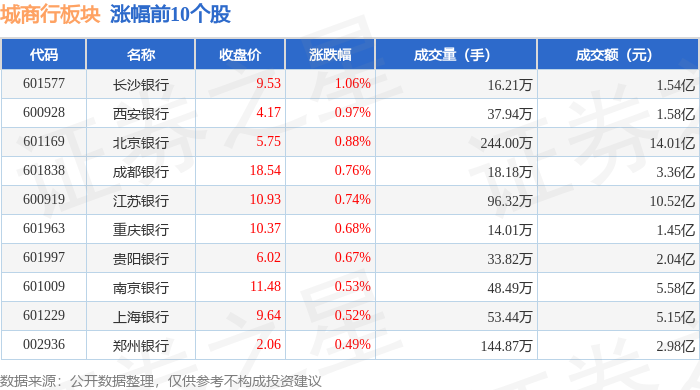
城商行板块10月22日涨0.48%,长沙银行领涨,主力资金净流出2.69亿元
Zheng Xing Xing Ye Ri Bao· 2025-10-22 08:20
Market Performance - The city commercial bank sector increased by 0.48% on October 22, with Changsha Bank leading the gains [1] - The Shanghai Composite Index closed at 3913.76, down 0.07%, while the Shenzhen Component Index closed at 12996.61, down 0.62% [1] Individual Stock Performance - Changsha Bank closed at 9.53, up 1.06% with a trading volume of 162,100 shares and a transaction value of 154 million [1] - Other notable performers include: - Xi'an Bank: closed at 4.17, up 0.97% [1] - Beijing Bank: closed at 5.75, up 0.88% [1] - Chengdu Bank: closed at 18.54, up 0.76% [1] - Jiangsu Bank: closed at 10.93, up 0.74% [1] Capital Flow Analysis - The city commercial bank sector experienced a net outflow of 269 million from institutional investors, while retail investors saw a net inflow of 165 million [2] - The overall capital flow indicates a mixed sentiment among different investor types [2] Detailed Capital Flow for Selected Banks - Shanghai Bank had a net outflow of 34.67 million from institutional investors, with a retail net inflow of 41.06 million [3] - Qilu Bank saw a net inflow of 22.48 million from institutional investors, while retail investors had a net inflow of 9.09 million [3] - Changsha Bank recorded a net inflow of 2.31 million from institutional investors and a net inflow of 1.55 million from retail investors [3]



利率专题:一文全览同业存单
Tianfeng Securities· 2025-10-22 01:12
1. Report Industry Investment Rating No information provided on the industry investment rating in the given content. 2. Core Viewpoints of the Report - The report focuses on the supply, demand, and pricing of inter - bank certificates of deposit (CDs), analyzes the core factors affecting their supply and demand, and discusses the supply pressure of CDs within the year. It points out that since 2025, there have been some "unusual" phenomena in CDs, and the market's concerns about CDs have resurfaced, mainly due to the potential supply pressure from the maturity of high - interest fixed - term deposits in the fourth quarter and the possible weakening of demand - side stability [11]. - Considering the central bank's current intention to support the market, the ongoing repair of real - economy credit demand, and the stable supply rhythm of government bonds, the pressure for CDs to be issued at higher prices in the fourth quarter may be relatively controllable, but there may be some stage fluctuations. The main fluctuation range of 1 - year CDs is expected to remain between 1.6% - 1.7% [5]. 3. Summary by Relevant Catalogs 3.1 Development History: The Appeal and Boundary of Active Liabilities - **2013 - 2017: Rapid Expansion after Formal Start** - In December 2013, the issuance of the "Interim Measures for the Administration of Inter - bank Certificates of Deposit" marked the formal start of the development of inter - bank CDs. From 2014 to 2017, the issuance scale increased from nearly 1 trillion yuan in 2014 to nearly 20 trillion yuan in 2017, mainly issued by small and medium - sized banks such as city commercial banks and joint - stock banks [12]. - The rapid expansion was driven by the inherent advantages of CDs as an active liability tool, the "disintermediation of deposits", the trend of interest rate liberalization, and the change in the central bank's base - money injection method [14][21]. - **2017 - 2023: Stable Development under Regulatory Constraints** - Since 2017, a series of regulatory measures have been introduced to guide the financial system to return to its origin, improve the quality and efficiency of serving the real economy, and strengthen risk prevention and control. The issuance growth of inter - bank CDs has flattened out [23]. - In terms of structure, inter - bank CDs have become the fourth - largest variety in the inter - bank market. The issuance scale of large state - owned banks has increased slightly year by year, and the proportion of 1 - year - term varieties has increased significantly since 2018 [27][28]. - **Since 2023: The Issuance Scale Rises Again** - In 2023, the annual issuance scale exceeded 25 trillion yuan, with state - owned banks accounting for 26%. In 2024, the scale exceeded 30 trillion yuan, and the proportion of state - owned banks reached 28%. This was mainly affected by the downward trend of CD issuance costs, the expansion of the deposit - loan gap, and the concentrated issuance of government bonds [32]. 3.2 Supply Willingness and Rhythm - **Liquidity Gap Management on the Liability Side** - During periods of high capital demand, such as large - scale bank credit issuance and concentrated government bond supply, the net financing scale of CDs usually increases, showing certain seasonal patterns and being affected by policies [47]. - Weak deposit growth on the liability side requires CDs to supplement liabilities, which is more of a trend change and closely related to regulatory norms [50]. - To cope with foreseeable liquidity consumption within the month and avoid large fluctuations in funds to lock in lower issuance costs, CD supply shows certain regularities within the month, usually concentrating in the first three weeks [50]. - **Cost Considerations on the Liability Side** - The demand for CD issuance is affected by the central bank's medium - and long - term liquidity injection. If banks can obtain lower - cost funds from the central bank, their willingness to issue CDs will decrease [54]. - Banks will adjust the maturity structure of CD issuance based on cost considerations. In a loose liquidity environment, they tend to lengthen the maturity of CD issuance to lock in lower financing costs [56]. - From the perspective of asset returns, if the demand for real - economy loans is expected to be strong and the asset - liability spread is expected to widen, banks tend to increase the issuance scale of CDs to reserve liability sources in advance [62]. - **Constraints of Regulatory Indicators** - Issuing inter - bank CDs helps improve liquidity regulatory indicators, especially the liquidity coverage ratio (LCR), net stable funding ratio (NSFR), and liquidity matching ratio (LMR) [65]. - Different maturities of CDs have different conversion coefficients in regulatory indicators. Long - term CDs usually have a positive impact on improving these indicators, while short - term CDs may not [66]. - **Issuance Characteristics under the Management of Filing Quotas** - The issuance of inter - bank CDs adopts a filing system, and the filing quota is managed on a balance basis. The balance of inter - bank CDs at any time within the year shall not exceed the annual filing quota [72]. - There is a negative correlation between the utilization progress of CD filing quotas and the deposit ratio. Banks with strong deposit - attracting ability and high deposit ratios have lower demands for issuing CDs [73]. 3.3 Demand Side: Who Are the Main Allocation Forces? - **Commercial Banks** - Commercial banks' allocation of CDs is a process of seeking a dynamic balance between risk and return under the constraints of regulatory frameworks and market environments. Different banks have different allocation logics due to differences in liability costs, credit issuance, and regulatory indicators [84][86]. - Rural commercial banks and large banks are the main buyers of CDs. Rural commercial banks' allocation logic has changed since 2023, from a "seesaw" relationship with credit issuance to focusing more on the allocation value of CDs in an "asset shortage" situation [88][89]. - Large banks' weak credit issuance demand in recent years has increased their demand for allocating CDs, and they show a characteristic of increasing net purchases at the end of the month [98]. - **Bank Wealth Management** - Bank wealth management shows a distinct right - hand trading characteristic in investing in CDs and is also affected by factors such as liability - side stability, regulatory requirements, and monetary policy. In recent years, the expansion of the liability side has increased its demand for CD allocation [102]. - Current - management wealth management products are the main force in CD allocation, preferring short - term CDs due to regulatory restrictions on the average remaining maturity of product investment portfolios [102]. - **Money Market Funds** - Compared with the right - hand trading of wealth management products, the peak of net purchases by money market funds usually coincides with the inflection point of CD interest rates, which may drive the inflection point of CD prices to some extent [4]. 3.4 How Are CDs Priced? - **Theoretical Pricing Benchmark of CDs** - Policy interest rates (MLF/OMO + 30BP) form the theoretical upper limit of CD pricing, while SHIBOR, DR interest rates, deposit interest rates, and R001 form the theoretical lower limit. This pricing system anchors CD interest rates by affecting supply and demand [5]. - **Core Factors Affecting CD Supply and Demand** - In the short term, CD interest rates are affected by supply and demand forces, including the liability - side capital gap, liability costs, asset returns, regulatory regulations and assessments, and the institutional behavior of allocation forces [5]. - **Outlook on the Supply Pressure of CDs within the Year** - Considering the central bank's support intention, the ongoing repair of real - economy credit demand, and the stable supply rhythm of government bonds, the pressure for CDs to be issued at higher prices in the fourth quarter may be relatively controllable, but there may be some stage fluctuations. The main fluctuation range of 1 - year CDs is expected to remain between 1.6% - 1.7% [5].
苏州银行:关于2025年二级资本债券(第一期)发行完毕的公告
Zheng Quan Ri Bao Zhi Sheng· 2025-10-21 14:13
Core Points - Suzhou Bank has successfully issued the "Suzhou Bank Co., Ltd. 2025 Tier 2 Capital Bonds (First Phase)" in the national interbank bond market, with an issuance scale of RMB 4.5 billion [1] - The bonds have a fixed interest rate of 2.45% and a maturity period of 10 years, with a conditional redemption option for the issuer at the end of the fifth year [1] Company Summary - The issuance was approved by the People's Bank of China and the Jiangsu Regulatory Bureau of the National Financial Supervision Administration [1] - The bond subscription was completed on October 16, 2025, and payment was finalized on October 20, 2025 [1]
厦门金龙汽车集团股份有限公司关于2025年7-9月份委托理财情况的公告
Zhong Guo Zheng Quan Bao - Zhong Zheng Wang· 2025-10-21 10:42
Core Viewpoint - The company aims to enhance the efficiency of fund utilization and reduce financial costs through entrusted wealth management while ensuring the safety of funds [5][4]. Group 1: Overview of Entrusted Wealth Management - The total amount for entrusted wealth management is 498,900 million yuan [3]. - The entrusted wealth management products include various structured deposits linked to gold and exchange rates from multiple banks [3]. - The duration for entrusted wealth management is within one year [4]. Group 2: Purpose and Source of Funds - The purpose of the entrusted wealth management is to ensure fund safety while improving fund utilization efficiency and obtaining certain investment returns [5]. - The source of funds for the entrusted wealth management is the temporarily idle self-owned funds of the company and its subsidiaries [6]. Group 3: Risk Control and Management - The company will conduct strict evaluations and selections of wealth management products, focusing on high safety, good liquidity, and low-risk principal-protected products [7]. - The company aims to avoid investment risks associated with policy changes by selecting short-term bank wealth management products [8]. Group 4: Impact on the Company - The wealth management activities are designed to improve the efficiency of idle funds without affecting the company's main business operations, thus benefiting the overall returns for the company and its shareholders [12]. - The accounting treatment for the wealth management products will be reported under "trading financial assets" according to the new financial instrument standards issued by the Ministry of Finance [12]. Group 5: Decision-Making Process - The decision to conduct wealth management was approved by the company's board of directors and the annual general meeting, emphasizing the importance of fund safety and efficiency [14]. - Independent directors believe that using temporarily idle self-owned funds for low-risk financial institution products aligns with the interests of the company and all shareholders [14].





苏州银行(002966) - 关于2025年二级资本债券(第一期)发行完毕的公告
2025-10-21 08:45
关于 2025 年二级资本债券(第一期) 发行完毕的公告 本行及董事会全体成员保证公告内容的真实、准确和完整,没有虚假记载、 误导性陈述或者重大遗漏。 经中国人民银行和国家金融监督管理总局江苏监管局批准,苏州银行股份有 限公司(以下简称"本行")近日在全国银行间债券市场成功发行"苏州银行股 份有限公司 2025 年二级资本债券(第一期)"(以下简称"本期债券")。 证券代码:002966 证券简称:苏州银行 公告编号:2025-078 苏州银行股份有限公司 本期债券于 2025 年 10 月 16 日簿记完成,并于 2025 年 10 月 20 日缴款完毕, 发行规模为人民币 45 亿元。本期债券为 10 年期固定利率品种,在第 5 年末附有 条件的发行人赎回权,票面利率为 2.45%。 2025 年 10 月 21 日 本期债券募集资金将依据适用法律和监管部门的批准,用于充实本行二级资 本。 特此公告。 苏州银行股份有限公司董事会 ...
信用周观察系列:攻守兼备
HUAXI Securities· 2025-10-21 05:05
1. Report Industry Investment Rating No relevant content provided. 2. Core Viewpoints of the Report - Amid the repeated Sino - US tariff issues from October 13 - 17, the market risk appetite declined, and the bond market sentiment continued to improve. Credit bond yields generally decreased, and credit spreads mostly narrowed. Institutions remained cautiously bullish on credit bonds, preferring high - coupon and relatively safe varieties. However, due to factors such as seasonal patterns and the pending public fund fee regulations, this round of credit bond recovery may not be as smooth as the previous one. Therefore, it is recommended to focus on medium - and short - duration coupon - bearing credit bonds for both offense and defense [1][2]. - For general credit bonds, 1 - 3 - year AA and AA(2) urban investment bonds are recommended, which balance liquidity and coupon. For bank capital bonds, it is advisable to choose medium - and short - duration hedging varieties and avoid rushing to increase duration [3]. 3. Summary According to the Directory 3.1 Urban Investment Bonds: Structural Recovery, Market Favors 1 - 3 - Year AA(2) Varieties - **Primary Market**: In October, the net financing of urban investment bonds remained low, but the issuance sentiment improved. The issuance rate reversed its upward trend and declined, with the proportion of issuance within 3 years increasing. From October 1 - 19, the issuance was 171.8 billion yuan, with a net inflow of 9.4 billion yuan. The weighted average issuance rates for bonds within 1 year, 1 - 3 years, and 3 - 5 years decreased by 8.2bp, 3.5bp, and 2.8bp respectively compared to September [30]. - **Secondary Market**: Intermediate - term bonds performed well, and the sentiment of long - term bonds also improved. Yields of 3 - 5Y bonds of various grades mostly decreased by 2 - 6bp, and credit spreads mostly compressed by 4 - 7bp. The yields of 10Y AA and above bonds decreased by 2 - 4bp. The 1 - 3 - year bonds had significantly increased trading volume, and the AA(2) varieties were favored by the market, with over 700 single - week transactions and an average low - valuation trading margin of 1.8bp [31][35]. 3.2 Industrial Bonds: Net Financing Increased Year - on - Year, Issuance Sentiment Recovered - **Primary Market**: From October 1 - 19, the issuance of industrial bonds was 301.8 billion yuan, with a net financing of 140.8 billion yuan, both increasing year - on - year. The proportion of long - duration bond issuance increased, and the issuance sentiment improved. The proportion of full - field multiples above 3 times rose from 14% to 20%, and the proportion of 2 - 3 times increased from 29% to 32% [38]. - **Secondary Market**: The buying sentiment weakened, with the TKN proportion decreasing from 77% to 72% and the low - valuation proportion dropping from 75% to 62%. The trading duration increased, with the trading proportions of 1 - 2 - year and 3 - 5 - year bonds increasing by 2pct and 4pct respectively, while the 1 - year trading proportion decreased by 9pct [40]. 3.3 Bank Capital Bonds: Yields Declined Across the Board, Trading Sentiment Weakened - **Primary Market**: In October 2025, Suzhou Bank issued 4.5 billion yuan of 5 + 5 - year secondary capital bonds (issuance rate not yet announced), and Weifang Bank issued 1.5 billion yuan of 5 + N - year perpetual bonds with an issuance rate of 2.90% [43]. - **Secondary Market**: Yields of bank capital bonds decreased by 0 - 7bp, and spreads narrowed across the board. The 2Y AA+ and below secondary capital bonds, 2Y and 4Y perpetual bonds performed well, with yields decreasing by 4 - 7bp and spreads narrowing by 7 - 8bp. However, the trading sentiment weakened. The TKN proportions of secondary capital bonds and perpetual bonds decreased to 61% and 56% respectively, and the low - valuation proportions dropped to 65% and below [43][46].