债市配置

Search documents
——2月金融数据点评:财政上量推动企业贷款持续改善,久期资产承压
Shenwan Hongyuan Securities· 2026-03-15 05:59
Group 1: Report Industry Investment Rating - Not provided in the report Group 2: Core Viewpoints of the Report - The financial data in February 2026 showed stable total volume and improved structure. With the intensification of credit - easing policies, corporate credit may continue to perform strongly, challenging the bond market's allocation logic in January and February. It is recommended to reasonably reduce the duration and focus on the coupon certainty of medium - and short - duration credit bonds [1]. - The logic of going long in the bond market in January and February is challenged. Corporate credit may continue to be strong, and the demand for bank bond - allocation may weaken. In the future, the bond market may experience a rapid correction due to factors such as faster fundamental repair, continuous disturbances in asset price - to - value ratios, and unexpected inflation increases [1]. - It is advisable to be cautious about long - duration and ultra - long - duration assets, and continue to focus on medium - and short - duration credit bonds and coupon strategies with higher certainty [1]. Group 3: Summary by Related Catalog Financial Data Overview - In February 2026, the new RMB loans were 0.90 trillion yuan (compared to 4.71 trillion yuan in January 2026), the new social financing was 2.38 trillion yuan (compared to 7.22 trillion yuan in January 2026), the year - on - year growth rate of social financing was 8.2% (the same as in January 2026), and the year - on - year growth rate of M2 was 9% (the same as in January 2026) [1]. Credit Structure - **Corporate Credit**: In February, corporate loans increased by 1.49 trillion yuan, with a year - on - year increase of 4500 billion yuan. Medium - and long - term loans were the main support, with a year - on - year increase of 3500 billion yuan in medium - and long - term loans, a year - on - year increase of 2700 billion yuan in short - term loans, and a year - on - year decrease of 2043 billion yuan in bill financing. The strengthening of corporate credit may be mainly due to the pre - implementation of "two major" projects and equipment renewal subsidies [1]. - **Residential Credit**: In February, residential loans decreased by 2616 billion yuan year - on - year. Short - term loans decreased by 1952 billion yuan year - on - year, indicating weak consumption propensity; medium - and long - term loans decreased by 665 billion yuan year - on - year, consistent with the weak performance of the commercial housing market compared to the same period in previous years [1]. Deposit Situation - In February, residential new deposits reached 3.11 trillion yuan, with a year - on - year increase of 2.50 trillion yuan; new non - bank deposits were 1.39 trillion yuan, with a year - on - year decrease of 1.44 trillion yuan. This may be affected by the Spring Festival misalignment, with corporate year - end bonuses driving the year - on - year increase in residential deposits, and Spring Festival consumption demand and equity market fluctuations restricting non - bank deposits [1]. Other Indicators - The M1 growth rate increased by 1.0 pcts to 5.9% in February, while the M2 growth rate remained at 9.0%, and the M1 - M2 gap narrowed to - 3.1%. The increase in M1 growth may be due to the low base last year, the strong pull of M0 this month, improved corporate cash flow, and increased foreign exchange settlement demand. Although the loan growth rate declined this month, the M2 growth rate remained high, which may be related to the increased willingness of enterprises to settle foreign exchange under the expectation of RMB appreciation and the relatively fast pace of fiscal expenditure [1].
2月金融数据点评:财政上量推动企业贷款持续改善,久期资产承压
Shenwan Hongyuan Securities· 2026-03-15 04:21
1. Report Industry Investment Rating - No information provided regarding the industry investment rating in the given content 2. Core Viewpoint of the Report - The February financial data shows stable total volume and improved structure. With the strengthening of credit - easing policies, corporate credit is likely to continue its strong performance. The logic of the bond market's allocation in January and February is challenged. It is recommended to reasonably reduce the duration and focus on medium - and short - duration credit bonds for coupon certainty. The bond market may experience a rapid correction due to factors such as fundamental repair, asset price comparison, and inflation, even without a tightening of policy interest rates. The strategy suggests being cautious about long - duration and ultra - long - duration assets and focusing on medium - and short - duration credit bonds and coupon strategies [3] 3. Summary by Related Catalog 3.1 Financial Data Overview - In February 2026, the new RMB loans were 0.90 trillion yuan (compared to 4.71 trillion yuan in January 2026), new social financing was 2.38 trillion yuan (compared to 7.22 trillion yuan in January 2026), the year - on - year growth rate of social financing was 8.2% (the same as in January 2026), and the year - on - year growth rate of M2 was 9% (the same as in January 2026) [3] 3.2 Social Financing Structure - Corporate credit supported the year - on - year increase in new social financing, while the household sector continued to be weak. Government bonds were still an important support for February's social financing, with a net financing scale of 1.4 trillion yuan, but due to the high base, the net financing of government bonds in February decreased by 29.03 billion yuan year - on - year. In the corporate sector, corporate loans increased by 1.49 trillion yuan in February, with a year - on - year increase of 45 billion yuan, mainly supported by medium - and long - term loans. In the household sector, household loans decreased by 26.16 billion yuan year - on - year [3] 3.3 Deposit Situation - In February, household deposits increased year - on - year, while corporate and non - bank deposits decreased year - on - year. The new household deposit scale reached 3.11 trillion yuan, with a year - on - year increase of 2.50 trillion yuan; new non - bank deposits were 1.39 trillion yuan, with a year - on - year decrease of 1.44 trillion yuan [3] 3.4 Credit and Deposit Growth Gap - While corporate credit improved, the growth gap between loans and deposits significantly increased, and this trend may continue as policy effectiveness is released. Corporate loan improvement may continue in the second quarter, challenging the previous bond market allocation logic [3] 3.5 M1 and M2 Situation - In February, the M1 growth rate increased by 1.0 percentage points to 5.9%, and the M2 growth rate remained at 9.0%, narrowing the M1 - M2 gap to - 3.1%. The increase in M1 growth rate was affected by the low base last year, the strong pull of M0, improved corporate cash flow, and increased foreign exchange settlement demand. Although the loan growth rate declined this month, the M2 growth rate remained high, supported by the increase in corporate foreign exchange settlement willingness and the fast pace of fiscal expenditure [3] 3.6 Bond Market Strategy - It is recommended to be cautious about long - duration and ultra - long - duration assets and focus on medium - and short - duration credit bonds and coupon strategies with higher certainty [3]
朝闻国盛:配置盘主导的债市会如何演进?
GOLDEN SUN SECURITIES· 2026-03-04 00:50
Group 1: Fixed Income Market Analysis - The report discusses the current market environment focusing on the stability of allocation demand and the pace of trading positions. Long-term bonds are experiencing narrow fluctuations, with slow recovery on the fund liability side, limiting the space for brokers to engage in wave trading. The lack of trading momentum means that allocation demand is not expected to see significant short-term increases [3]. - It is essential to monitor the sustainability of allocation demand, with the bank's loan-to-deposit ratio being a core factor in maintaining bond allocation demand. Additionally, the pace of recovery on the trading side will influence fund accumulation, which could lead to rapid market movements if trading positions increase [3]. - If trading positions are increased, it may lead to a downward breakthrough in long-term bonds, with expectations for short- to medium-term credit bond yields to decline rapidly, while credit spreads remain low. However, recovery in long- and ultra-long credit bonds will depend on the restoration of market sentiment [3]. Group 2: Banking Sector Insights - The People's Bank of China and the National Financial Regulatory Administration have released the list of systemically important banks for 2025, with Zhejiang Commercial Bank being newly included in the first group. Additionally, Industrial Bank has been moved from the third group to the second group, while other banks' groupings remain unchanged [4]. - The assessment of systemically important banks is based on quantitative evaluations of scale, interconnectedness, substitutability, and complexity, with asset balance being a significant factor influencing group classification. The adjustments reflect differences in asset growth rates, which are critical drivers for changes in bank groupings [4]. - Newly included Zhejiang Commercial Bank will need to comply with a 0.25% additional capital requirement, promoting better management and capital replenishment capabilities. For Industrial Bank, the reduction in additional capital requirements from 0.75% to 0.5% may provide more capital space to support credit issuance and profit recovery [4]. Group 3: Xiaomi Group Analysis - Xiaomi Group is positioned in the high-end market, which may help mitigate storage cost pressures. The company anticipates delivering over 410,000 vehicles in 2025, with ongoing iterations in AI models and applications [7]. - Revenue projections for Xiaomi Group from 2025 to 2027 are estimated at 457.8 billion, 541.8 billion, and 644.4 billion yuan, respectively, with non-GAAP net profits expected to be approximately 38.6 billion, 37 billion, and 45 billion yuan [7]. - The report assigns a target price of 47 HKD to Xiaomi Group, maintaining a "buy" rating, as the company is expected to maintain relative competitiveness despite short-term industry disruptions [7]. Group 4: Weixing Co., Ltd. Analysis - Weixing Co., Ltd. has reported a projected 8.4% decline in net profit for 2025 due to increased financial expenses, with revenue expected to grow by 2.41% to 4.787 billion yuan. The fourth quarter of 2025 is projected to show a revenue increase of approximately 6% but a net profit decline of 24% [8]. - As a leading global supplier, Weixing's continuous improvement in product R&D and smart manufacturing capabilities is expected to create core competitive barriers. Future net profits for 2026 and 2027 are projected to be 7.01 billion and 7.86 billion yuan, respectively, with a current price-to-earnings ratio of 17 times for 2026 [8].


读Q4央行货币政策执行报告:重结构,重传导
GOLDEN SUN SECURITIES· 2026-02-11 09:10
1. Report's Industry Investment Rating No relevant content provided. 2. Core Viewpoints of the Report - The central bank's monetary policy aims to promote economic stability and price recovery. It will maintain a loose direction but be implemented flexibly according to actual situations [1][9]. - The policy emphasizes the guiding role of policy - interest rates and the improvement of the interest - rate transmission mechanism, which may drive more funds into the bond market [2][10]. - Fiscal - financial coordination is strengthened to ease the impact of government bond supply. The policy continues to focus on structural tools [2][3][10][11]. - Considering the overall situation of deposits and asset - management products can better reflect the overall liquidity of the financial system. The downward trend of broad - spectrum interest rates remains unchanged [4][12]. - The bond market's allocation power may increase. The overall market trend is in the process of gradual recovery, and the dumbbell - shaped strategy on the yield curve is more advantageous [5][14]. 3. Summary by Relevant Catalogs 3.1 Analysis of the Central Bank's Monetary Policy Report - **Monetary Policy Goals**: Promote economic stability and price recovery, implement policies based on domestic and international economic and financial situations, and the loose direction remains unchanged but with flexible implementation [1][9]. - **Interest - Rate Policy**: Guide short - term money - market interest rates to run stably around the central bank's policy rates. Reform and improve the LPR, and rationalize the relationship between loan and bond yields, which may restrict the decline of loan rates and drive funds into the bond market [2][10]. - **Fiscal - Financial Coordination**: Support the efficient issuance of government bonds through open - market operations, and cooperate with fiscal policies through "re - loans + fiscal subsidies" and other means to ease the impact of government bond supply [2][10]. - **Structural Policy**: Increase the re - loan quota by 400 billion yuan in January 2026, with a total re - loan quota of 1.2 trillion yuan. Structural tools are the main means of central bank easing [3][11]. - **Treasury Bond Trading**: Normalize treasury - bond trading, and the central bank may maintain a monthly purchase scale of tens of billions [3][11]. - **Deposit and Interest - Rate Trends**: There is no significant change in the overall deposit situation. The downward trend of broad - spectrum interest rates remains unchanged, with the weighted average interest rate of newly issued loans in Q4 2025 at 3.15%, a 10 - basis - point decrease from the previous quarter [4][12]. 3.2 Views on the Real Economy - **Positive Factors**: The national economy is stable and improving. New drivers are accelerating development, production and supply are growing well, the foundation for stable economic development is being consolidated, total demand is expanding, consumption potential is being released, and macro - policies are more proactive [17][18]. - **Risk Factors**: The external environment is more complex and severe, with weakening global economic growth momentum, increasing trade barriers, and domestic effective demand being insufficient [21]. - **Inflation Outlook**: There are more positive factors for a moderate recovery in price levels. CPI and core CPI have shown positive changes, and PPI's decline has narrowed [23]. 3.3 Next - Stage General Ideas and Specific Measures - **General Ideas**: Adhere to high - quality development, focus on expanding domestic demand and optimizing supply, deepen financial reform and opening - up, and support the "Four - Five - Five" plan to start well [25]. - **Specific Measures** - **Monetary Policy Direction**: Maintain reasonable growth of financial aggregates, implement a moderately loose monetary policy, and create a suitable monetary and financial environment [26]. - **Credit Policy Orientation**: Play the guiding role of credit policies, support key areas and weak links, and develop various types of finance such as science - technology finance and green finance [27][28]. - **Interest - Rate and Exchange - Rate Policy**: Promote interest - rate and exchange - rate marketization reforms, maintain the stability of interest and exchange rates, and create a stable environment for the real economy [29]. - **Financial Reform and Opening - up**: Strengthen the construction of the bond market, promote RMB internationalization, and expand the use of RMB in cross - border trade and investment [30]. - **Financial Risk Prevention**: Build a comprehensive macro - prudential management system, prevent and resolve financial risks, and strengthen the management of system - important financial institutions [31].
股市震荡,债市配置需求坚实,十年国债ETF(511260)上一交易日净流入超1.1亿元
Mei Ri Jing Ji Xin Wen· 2026-02-09 05:53
Group 1 - The core viewpoint indicates that the bond market is expected to remain strong and volatile before the Spring Festival, with government bond yields nearing recent lows and solid demand from large banks due to a "liability surplus and asset shortage" backdrop [1] - The short-term 10-year government bond yield may drop below 1.80%, with the volatility center in February expected to gradually decline from around 1.85% to approximately 1.80% [1] - The 10-year government bond ETF (511260) has shown consistent high net value since its inception, with historical performance indicating a near 1-year return of 4.17%, a near 3-year return of 14.04%, a near 5-year return of 23.39%, and a cumulative return of 35.77% since inception [1] Group 2 - The 10-year government bond ETF has maintained positive returns every year since its establishment, spanning seven complete natural years from 2018 to 2024, positioning it as a potential asset allocation tool across market cycles [1]
债市配置价值凸显,资金积极布局,国债ETF(511010)近20日资金净流入超1亿元
Sou Hu Cai Jing· 2026-02-06 03:31
Group 1 - The core viewpoint indicates that the bond market is expected to experience fluctuations in the yield of 10-year and 30-year government bonds, pending the implementation of substantial easing policies such as reserve requirement ratio cuts or interest rate reductions [1] - In terms of interest rate trends, a slight rebound was observed in the government bond futures market for January 2026, with the 10-year main contract rising by 0.45%, while the longer-term 30-year government bond futures saw a slightly higher increase of 0.48% [1] - The government bond ETF (511010) tracks the 5-year government bond index (000140) to reflect the overall performance of medium to long-term government bonds in the Chinese market, suggesting that there may still be some downward space for government bond yields under weak fundamentals [1] Group 2 - Investors are advised to pay attention to the 10-year government bond ETF (511260) and the government bond ETF (511010) as potential investment options [1]
配置盘超预期,债市配置价值凸显,关注十年国债ETF(511260)
Sou Hu Cai Jing· 2026-02-05 01:21
Group 1 - The core viewpoint of the article indicates that after an unexpected allocation by banks at the beginning of the year, the bond market has experienced a slow upward trend, with recent hesitations. The ten-year government bond ETF (511260) has shown a slight increase of 0.05% over the past five days [1] - Short-term interest rates may have opportunities to decline, but in the medium to long term, a narrow range of fluctuations is expected to persist. A configuration strategy is currently favored over swing trading, with a focus on medium-term government bond ETFs (511010) and the ten-year government bond ETF (511260) [1] - The short-term rebound in the bond market is attributed to an unexpected surplus in bank deposit retention rates, indicating a robust liability side. Additionally, interbank funding prices have decreased, and large banks have shown significant buying behavior in the bond market, reflecting ample liquidity [2][3] Group 2 - In the medium to long term, the narrow fluctuation pattern in the bond market remains unbroken. The nominal growth of the economy and monetary policy are the long-term main lines for the bond market, but both have not yet reached a stage where "qualitative changes occur due to quantitative changes." The K-shaped economic differentiation persists, with old momentum gradually bottoming out without triggering visible risks, while new momentum is attracting investor attention [3][5] - Inflation may rise this year, with expectations that CPI and PPI will continue to recover due to supply-side and demand-side policies. This potential inflationary pressure could be a risk point for the bond market [3] - The monetary policy stance remains relatively neutral, aiming to protect bank net interest margins and maintain a stable exchange rate, which suggests a strong guidance for keeping the bond market within a reasonable range. Overall, the bond market is expected to favor conservative configuration strategies this year [5]

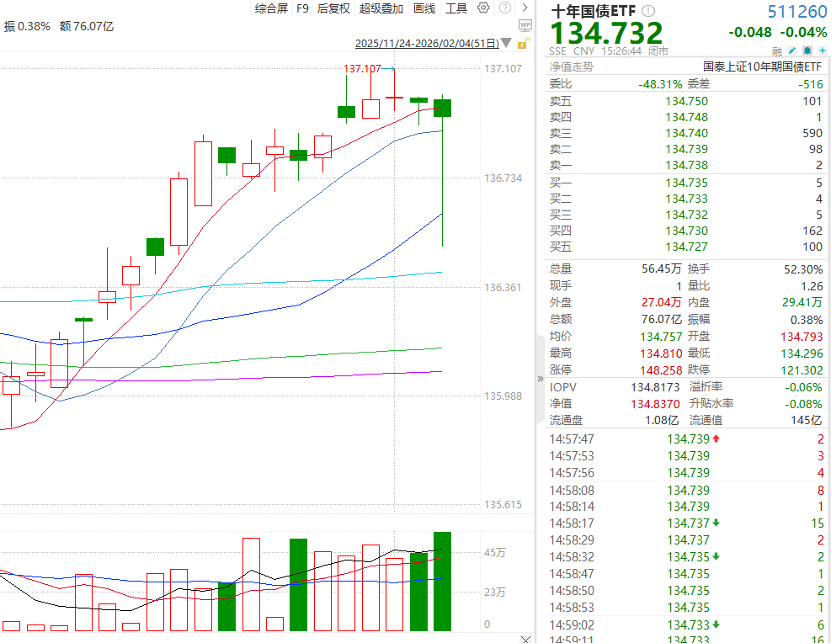
十年国债ETF(511260)飘红,债市配置价值凸显
Sou Hu Cai Jing· 2026-01-29 06:52
Core Viewpoint - The medium to long-term outlook remains a narrow fluctuation due to the K-shaped economic differentiation, with traditional economic downturns potentially supporting the bond market [1] Group 1: Economic Outlook - The K-shaped differentiation makes it difficult to assess the macroeconomic state as "good" or "bad" [1] - Traditional economic downturns may further support the bond market, as the long bond's profitability has significantly declined, leading to substantial outflows from trading positions [1] Group 2: Monetary Policy - The current monetary policy stance is relatively neutral, with a strong guidance to maintain a reasonable range for the bond market [1] Group 3: Investment Recommendations - In a fluctuating bond market, a focus on stable investment options may offer better value than short-term trading strategies [1] - Recommended stable investment products include the National Debt ETF (511010) and the 10-Year National Debt ETF (511260) [1] Group 4: Performance of 10-Year National Debt ETF - The 10-Year National Debt ETF (511260) has consistently achieved positive returns since its inception, making it a potential asset allocation tool across market cycles [2] - Historical performance shows a 1-year return of 4.17%, a 3-year return of 14.04%, a 5-year return of 23.39%, and a cumulative return of 35.77% since inception [1][2]
十年国债ETF(511260)上一交易日资金净流入超5000万元,重视债市配置价值
Sou Hu Cai Jing· 2026-01-22 02:54
Group 1 - The core viewpoint is that recent improvements in bond market sentiment have led to a rapid recovery in the 10-year government bond yield, primarily due to the central bank's liquidity support through open market operations and a surprising cut in targeted policy tool rates [1] - The recent interest rate cuts are focused on targeted tools like relending and rediscounting, aimed at credit expansion rather than a broad-based rate reduction [1] - The government bond supply pressure in the first quarter may still cause disturbances, and the equity market's spring rally is not yet over, suggesting limited probability for further downward movement in short-term yields [1] Group 2 - The 10-year government bond ETF (511260) tracks the Shanghai Stock Exchange 10-year government bond index, selecting bonds with a remaining maturity of 7 to 10 years listed on the exchange [1] - Since its inception, the 10-year government bond ETF has consistently achieved positive annual returns, making it a potential asset allocation tool across market cycles [1] - As of the end of the third quarter, the ETF has shown a one-year return of 4.17%, a three-year return of 14.04%, a five-year return of 23.39%, and a cumulative return of 35.77% since inception [1]
债市反弹持续,关注十年国债ETF(511260)
Sou Hu Cai Jing· 2026-01-22 01:15
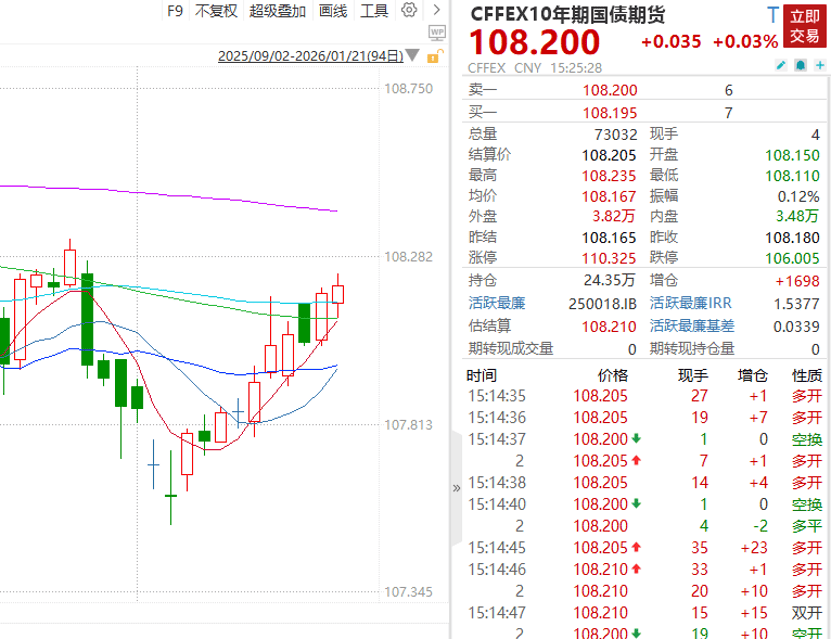
Core Viewpoint - The bond market is experiencing a rebound, with the ten-year government bond ETF showing a slight increase, indicating a stronger value proposition compared to long-term bonds. However, the market is expected to remain in a narrow fluctuation phase due to insufficient momentum for a unilateral trend [1][3]. Group 1: Market Performance - On January 21, the ten-year government bond ETF (511260) rose by 0.09%, with a 5-day increase of 0.45%, suggesting a better overall value compared to ultra-long bonds [1]. - The net price of the ten-year government bond futures is approaching the high point from December 26 of the previous year, although the rate of increase has slowed down [1]. Group 2: Economic and Monetary Policy Insights - The bond market has been in a low volatility state for over a year, but the long-term trend is expected to be stronger than mean reversion due to the correlation of interest rates with economic cycles and monetary policy [3]. - The market is currently focused on the transition between old and new economic drivers, which is difficult to validate in the short term, reflecting a cautious optimism regarding the economic fundamentals [3]. - Inflation trends are under scrutiny, with upward pressure on upstream resource prices not translating to downstream consumer prices, indicating a need for consumer stimulus to achieve a genuine inflation recovery [3]. Group 3: Investment Strategy - In the absence of clear pricing factors in the medium to long term, short-term institutional behaviors dominate, increasing the difficulty of obtaining returns and reducing strategy stability [4]. - The recommendation is to focus on stable investment options, such as the medium-duration government bond ETF (511010) and the ten-year government bond ETF (511260), as the market remains in a fluctuating state [4].