
银华

Search documents
光伏ETF涨幅领先,机构建议关注行业底部反转丨ETF基金日报
2 1 Shi Ji Jing Ji Bao Dao· 2025-11-04 03:01
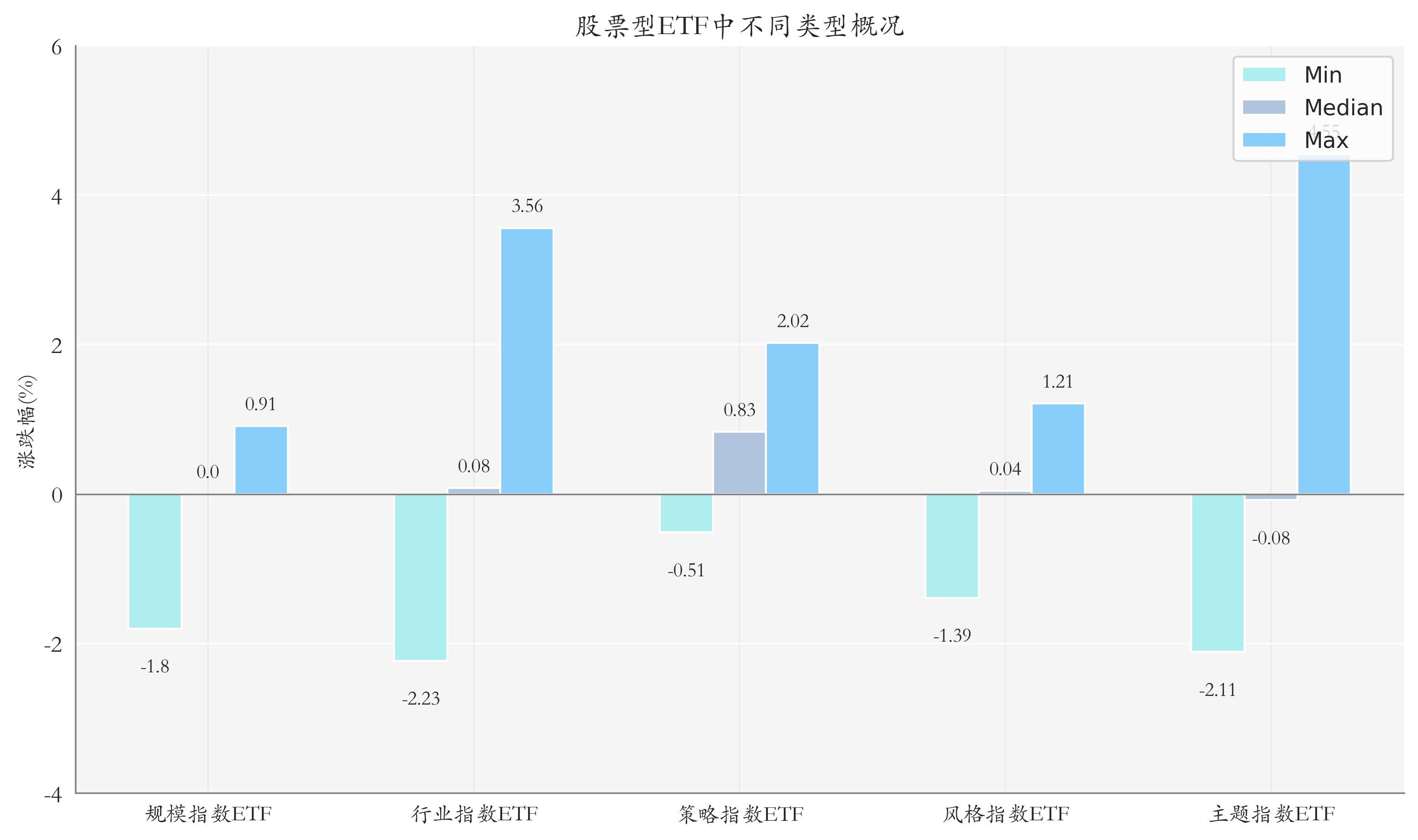
Market Overview - The Shanghai Composite Index rose by 0.55% to close at 3976.52 points, with a daily high of 3977.31 points [1] - The Shenzhen Component Index increased by 0.19% to close at 13404.06 points, reaching a high of 13404.06 points [1] - The ChiNext Index saw a rise of 0.29%, closing at 3196.87 points, with a peak of 3199.4 points [1] ETF Market Performance - The median return for stock ETFs was 0.0% yesterday. The highest returns were from the Penghua CSI 800 Free Cash Flow ETF at 0.91%, and the Huatai-PB CSI A500 ETF at 9.14% [2] - The top-performing stock ETFs included the GF CSI Photovoltaic Leading 30 ETF with a return of 4.55%, followed by the Yinhua CSI Film and Television Theme ETF at 4.38% [5] - The worst-performing ETFs were the Huaan SSE Sci-Tech Innovation Board New Generation Information Technology ETF at -2.23% and the Huaxia CSI Hong Kong Gold Industry ETF at -2.11% [6] ETF Fund Flows - The top three ETFs by fund inflow were the Guotai CSI All-Share Securities Company ETF with an inflow of 1.098 billion, the Huatai-PB CSI A500 ETF with 914 million, and the Huabao CSI Bank ETF with 678 million [8] - The ETFs with the highest outflows included the Huatai-PB CSI 300 ETF with an outflow of 656 million and the Southern CSI 500 ETF with 523 million [9] ETF Margin Trading Overview - The highest margin buying amounts were for the Huaxia SSE Sci-Tech Innovation Board 50 ETF at 632 million, followed by the Guotai CSI All-Share Securities Company ETF at 506 million [11] - The top ETFs for margin selling included the Southern CSI 1000 ETF with 119 million and the Southern CSI 500 ETF with 40.61 million [13] Institutional Insights - According to Open Source Securities, the photovoltaic industry is seeing positive effects from the "anti-involution" trend, with upstream segments expected to significantly reduce losses in Q3. Focus areas include supply chain measures and future demand for photovoltaic installations [13] - Xiangcai Securities anticipates that the prices of photovoltaic products and corporate profits will stabilize and recover, supported by continued growth in new photovoltaic installations and increasing overseas market demand [15]

两市ETF两融余额较减少32.5亿元丨ETF融资融券日报
2 1 Shi Ji Jing Ji Bao Dao· 2025-10-31 03:49
Market Overview - As of October 30, the total ETF margin balance in the two markets is 118.284 billion yuan, a decrease of 3.25 billion yuan from the previous trading day [1] - The financing balance is 110.05 billion yuan, down by 3.193 billion yuan, while the securities lending balance is 8.234 billion yuan, reduced by 57.9547 million yuan [1] - In the Shanghai market, the ETF margin balance is 82.462 billion yuan, a decrease of 2.532 billion yuan, with a financing balance of 75.209 billion yuan, down by 2.477 billion yuan [1] - In the Shenzhen market, the ETF margin balance is 35.822 billion yuan, a decrease of 719 million yuan, with a financing balance of 34.841 billion yuan, down by 715 million yuan [1] ETF Margin Balance - The top three ETFs by margin balance on October 30 are: - Huaan Yifu Gold ETF (8.181 billion yuan) - E Fund Gold ETF (5.722 billion yuan) - Huaxia Hang Seng (QDII-ETF) (4.116 billion yuan) [2] - The detailed top 10 ETFs by margin balance are provided in the table [2] ETF Financing Amount - The top three ETFs by financing amount on October 30 are: - Huatai-PB Southbound Hang Seng Technology Index (QDII-ETF) (2.015 billion yuan) - E Fund China Securities Hong Kong Investment Theme ETF (2.008 billion yuan) - Haifutong China Securities Short-term Bond ETF (1.703 billion yuan) [3] - The detailed top 10 ETFs by financing amount are provided in the table [4] ETF Net Financing Amount - The top three ETFs by net financing amount on October 30 are: - Huaan Growth Enterprise Board 50 ETF (114 million yuan) - E Fund CSI 300 Medical and Health ETF (62.307 million yuan) - Huabao CSI All-Index Securities Company ETF (49.924 million yuan) [5] - The detailed top 10 ETFs by net financing amount are provided in the table [6] ETF Securities Lending Amount - The top three ETFs by securities lending amount on October 30 are: - Huaxia Shanghai 50 ETF (32.5105 million yuan) - Huatai-PB CSI 300 ETF (22.6088 million yuan) - Southern CSI 500 ETF (18.3234 million yuan) [7] - The detailed top 10 ETFs by securities lending amount are provided in the table [8]
新基金发行迎来小高峰,26只基金同日开售
Zhong Guo Zheng Quan Bao· 2025-10-20 12:28
Group 1 - A total of 30 public funds were launched this week, with a significant number being index and actively managed equity funds [1][2] - On October 20, 26 new funds were simultaneously launched, marking a peak in the recent fund issuance trend [1][2] - The majority of the new funds included 8 ETFs and ETF-linked funds, along with several actively managed equity funds, indicating a strong interest in both passive and active investment strategies [2][3] Group 2 - The issuance of new funds reflects a positive trend in the equity market and a recovery in market sentiment, with a noticeable increase in the number of new fund launches since September 2024 [4] - In September 2024, 66 new funds were issued, with 35 being equity funds and 9 mixed funds, showing a significant year-on-year growth [4] - The total fundraising scale for public funds reached a record high in September, with index funds raising 1,079.04 billion yuan, a 26.99% increase month-on-month and a 90.62% increase year-on-year [4]
ETF观察日志(2025-10-16):麦高视野
Mai Gao Zheng Quan· 2025-10-17 03:03
- The report includes the construction of the RSI (Relative Strength Index) factor, which is calculated using the formula: $ RSI = 100 - 100 / (1 + RS) $, where RS represents the ratio of average gains to average losses over a 12-day period. RSI values above 70 indicate an overbought market, while values below 30 suggest an oversold market [2] - The report also introduces the Net Purchase (NETBUY) factor, calculated using the formula: $ NETBUY(T) = NAV(T) - NAV(T-1) * (1 + R(T)) $, where NETBUY(T) represents the net purchase amount, NAV(T) is the ETF net asset value on day T, and R(T) is the return on day T [2] - The report provides daily tracking of ETF data, segmented into "Broad-based" and "Thematic" categories based on the indices they track, such as CSI 300, CSI 500, and industry-specific indices like non-bank financials and dividends [2][3] - The RSI factor is evaluated as a useful indicator for identifying market conditions, such as overbought or oversold states, aiding in short-term trading decisions [2] - The Net Purchase factor is assessed as a measure of fund flow dynamics, reflecting investor sentiment and activity in ETF markets [2] - RSI values for various ETFs are provided, such as 58.17 for Huatai-PineBridge CSI 300 ETF, 57.53 for E Fund CSI 300 ETF, and 51.89 for Southern CSI 500 ETF, among others [4] - Net Purchase values for ETFs are also listed, including -13.98 billion for Huatai-PineBridge CSI 300 ETF, 0.70 billion for E Fund CSI 300 ETF, and -12.21 billion for Southern CSI 500 ETF, among others [4]
中证A500ETF平均收益超20%,见证A股反弹
21世纪经济报道· 2025-10-16 00:07
Core Viewpoint - The China Securities A500 Index has rapidly grown from a market size of 20 billion to 300 billion within a year, marking a significant milestone in the development of core broad-based indices in the A-share market [1] Market Development - The China Securities A500 Index was officially launched on September 23, 2024, following the "National Nine Articles" policy, and has seen substantial participation from major fund companies [1] - By October 15, 2024, the first batch of A500 ETFs was listed, with over 40 related funds reported, indicating strong market interest and investment [1] - As of October 24, 2024, the total scale of A500 ETFs reached 413.44 billion, showcasing rapid growth and investor confidence [7] Performance Metrics - The A500 Index has outperformed other major indices, with a one-year increase of 18.27%, surpassing the CSI 300 and Shanghai Composite Index [5] - The average return of the first batch of A500 ETFs since their inception is approximately 20.56%, reflecting strong market performance [5][6] Institutional Investment - Institutional investors hold a significant portion of A500 ETFs, with an average holding ratio of 90.05% as of June 30, 2025, indicating strong institutional confidence [12] - The index has attracted diverse institutional participation, including insurance, pension funds, and foreign investments, enhancing its market credibility [12] Index Composition and Strategy - The A500 Index comprises 500 large-cap stocks, balancing market representation and industry diversity, aimed at reflecting the performance of key sectors in the national economy [4] - The index is strategically positioned to benefit from China's economic transformation, with over 35% of its components being specialized and innovative companies [15][16] Future Outlook - The index is expected to continue its growth trajectory, supported by ongoing policy incentives and the increasing international interest in Chinese assets [13][14] - The A500 Index is anticipated to become a key tool for long-term investment strategies, particularly as it gains recognition among global investors [12][13]

中证A500ETF上市一周年:“新宽基”与A股慢牛一路同行
2 1 Shi Ji Jing Ji Bao Dao· 2025-10-15 11:37
Core Insights - The China Securities A500 Index has rapidly grown from a market size of 20 billion to 300 billion within a year, marking a significant milestone in the index investment landscape [1][2][8] - The index was officially launched on September 23, 2024, and has since seen a surge in related ETF products, with over 80 fund managers participating in its development [1][2][12] Market Performance - The A500 Index has demonstrated an average return of over 20% in the past year, outperforming major indices like the CSI 300 and the Shanghai Composite Index [3][4] - As of October 14, 2024, the A500 Index recorded a growth of 18.27%, while the first batch of A500 ETFs achieved an average return of 20.56% [3][4] Fund Growth and Scale - The first batch of A500 ETFs raised 20 billion upon issuance and reached a total scale of 413.44 billion within just eight trading days [6][7] - By June 30, 2025, the total scale of A500-related funds exceeded 305.3 billion, making it the second-largest broad-based index in A-shares after the CSI 300 [8][9] Institutional Investment - Institutional investors hold a significant portion of A500 ETFs, with an average holding ratio of 90.05% as of mid-2025, indicating strong institutional confidence [9][10] - The index has attracted diverse institutional participation, including insurance, pension funds, and foreign investments [9][10] Economic Impact and Future Outlook - The A500 Index is seen as a key tool for long-term capital allocation, reflecting the structural transformation of the Chinese economy with over 35% of its components being specialized and innovative stocks [12][13] - The index's composition is aligned with emerging industries such as technology and renewable energy, positioning it as a favorable investment vehicle for capturing economic transition benefits [12][13]
天府证券ETF日报-20251015
天府证券· 2025-10-15 09:07
Report Industry Investment Rating - Not provided in the content Core View - On October 15, 2025, the A-share market showed an overall upward trend, with the Shanghai Composite Index rising 1.22% to 3912.21 points, the Shenzhen Component Index rising 1.73% to 13118.75 points, and the ChiNext Index rising 2.36% to 3025.87 points. The trading volume of A-shares in the two markets was 2090.7 billion yuan. The sectors with the highest gains were power equipment (2.72%), automobiles (2.37%), and electronics (2.29%), while the sectors with the highest losses were steel (-0.21%) and petroleum and petrochemicals (-0.14%) [2][6] Summary by Directory Market Overview - The Shanghai Composite Index rose 1.22% to 3912.21 points, the Shenzhen Component Index rose 1.73% to 13118.75 points, and the ChiNext Index rose 2.36% to 3025.87 points. The trading volume of A-shares in the two markets was 2090.7 billion yuan. The sectors with the highest gains were power equipment (2.72%), automobiles (2.37%), and electronics (2.29%), while the sectors with the highest losses were steel (-0.21%) and petroleum and petrochemicals (-0.14%) [2][6] Stock ETF - The top-trading-volume stock ETFs on this day were E Fund ChiNext ETF (up 2.35%, discount rate 2.33%), Huaxia Shanghai Stock Exchange Science and Technology Innovation Board 50 ETF (up 1.35%, discount rate 1.37%), and Huaxia CSI A500 ETF (up 1.49%, discount rate 1.57%) [3][7] Bond ETF - The top-trading-volume bond ETFs on this day were Haifutong CSI Short-term Financing ETF (up 0.00%, discount rate -0.02%), Cathay CSI AAA Science and Technology Innovation Corporate Bond ETF (down 0.04%, discount rate -0.19%), and Southern Shanghai Stock Exchange Benchmark Market-making Corporate Bond ETF (down 0.06%, discount rate -0.36%) [4][9] Gold ETF - Gold AU9999 rose 1.95%, and Shanghai Gold rose 2.30%. The top-trading-volume gold ETFs were Huaan Gold ETF (up 2.35%, discount rate 2.07%), E Fund Gold ETF (up 2.52%, discount rate 1.96%), and Boshi Gold ETF (up 2.56%, discount rate 2.02%) [12] Commodity Futures ETF - Dacheng Non-ferrous Metals Futures ETF rose 0.96%, discount rate -0.10%; Jianxin Yisheng Zhengzhou Commodity Exchange Energy and Chemical Futures ETF rose 0.16%, discount rate -0.58%; Huaxia Feed Soybean Meal Futures ETF had a change of 0.00%, discount rate 3.60% [13] Cross-border ETF - The previous trading day, the Dow Jones Industrial Average rose 0.44%, the Nasdaq fell 0.76%, the S&P 500 fell 0.16%, and the German DAX fell 0.62%. On this day, the Hang Seng Index rose 1.84%, and the Hang Seng China Enterprises Index rose 1.89%. The top-trading-volume cross-border ETFs were E Fund CSI Hong Kong Securities Investment Theme ETF (up 3.14%, discount rate 3.67%), Huatai-PineBridge Hang Seng Technology ETF (up 2.15%, discount rate 2.92%), and GF CSI Hong Kong Innovative Drug ETF (up 2.65%, discount rate 3.27%) [15] Money ETF - The top-trading-volume money ETFs on this day were Yin Hua Day Profit ETF, Hua Bao Add Benefit ETF, and Money ETF Jianxin Add Benefit [17]
平安公司债ETF(511030):稳见未来,债启新程
Sou Hu Cai Jing· 2025-10-13 05:41
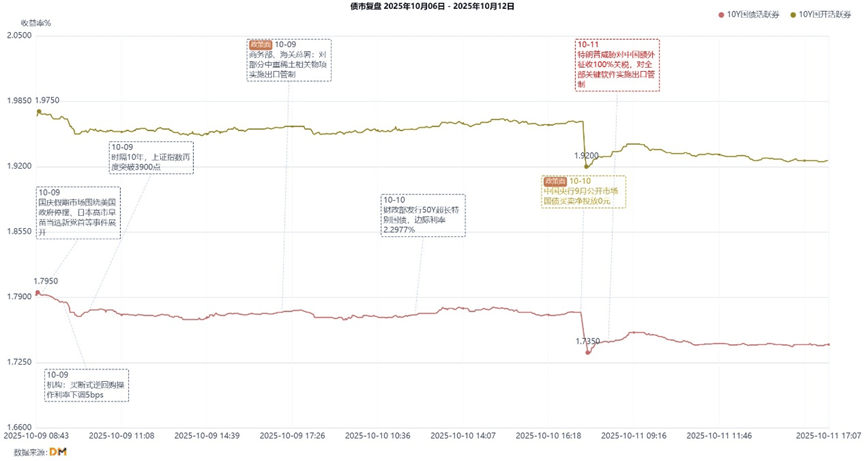
Core Insights - The credit bond ETF market is experiencing a new round of adjustments, with most ETFs trading at a discount of 10-30 basis points, while Ping An's corporate bond ETF remains at a premium due to continuous customer purchases during market downturns [1][3] - The market sentiment is fragile, influenced by recent economic data and central bank liquidity measures, leading to fluctuations in both stock and bond markets [3] Group 1: Market Performance - Most credit bond ETFs are trading at a discount, with the average weekly discount rate ranging from 10 to 30 basis points [1] - Ping An's corporate bond ETF maintains a weekly premium of 1 basis point, attributed to its longer establishment period and effective risk control [1] - The overall market sentiment is under pressure, with fluctuations in trading volumes and turnover rates across various ETFs [1][2] Group 2: ETF Specifics - The Hai Fu Tong Zhong Zheng Short-term Bond ETF has a scale of 626.48 billion, with a weekly trading volume of 1481.75 million and a weekly turnover rate of 273.67% [1] - The Ping An Zhong Dai - Medium and High-Grade Corporate Bond Spread Factor ETF has a scale of 229.11 billion, with a weekly trading volume of 97.41 million and a weekly turnover rate of 45.17% [1] - The Jiashi Zhong Zheng AAA Technology Innovation Corporate Bond ETF has a scale of 210.87 billion, with a significant weekly trading volume of 333.08 million and a turnover rate of 158.99% [1][2] Group 3: Market Trends - The bond market is facing a "black swan" event, with heightened volatility due to tariff negotiations, leading to a temporary trading recovery window [3] - The central bank's liquidity measures, including a trillion-yuan buyout repurchase, have provided support to the bond market, resulting in a positive closing for September [3] - Following the holiday, the bond market opened positively but faced renewed pressure, indicating ongoing volatility and a cautious market sentiment [3]
债券ETF跟踪:科创债ETF集中上市,成交表现活跃
ZHONGTAI SECURITIES· 2025-09-29 09:04
Report Summary 1. Report Industry Investment Rating No industry investment rating is provided in the report. 2. Core Viewpoints - Last week, the credit bond market adjusted significantly, with the ChinaBond New Composite Index falling 0.22% for the week. Short - term and medium - to - long - term pure bond funds declined by 0.04% and 0.12% respectively. The CSI AAA Sci - tech Innovation Bond Index and the SSE Benchmark Market - making Corporate Bond Index dropped 0.30% and 0.34% respectively [8]. 3. Summary by Related Catalogs 3.1 Funds Flow - As of September 26, 2025, bond - type ETFs had a net inflow of 117.5 billion yuan in the past week. Interest - rate, credit, and convertible - bond ETFs had net outflows of 1.444 billion yuan, net inflows of 119.269 billion yuan, and net outflows of 325 million yuan respectively. Among credit - type ETFs, short - term financing, corporate bonds, and urban investment bonds had net outflows of 574 million yuan, 22 million yuan, and 70 million yuan respectively. Market - making credit - bond ETFs had a net outflow of 1.425 billion yuan, while sci - tech innovation bonds had a net inflow of 121.36 billion yuan. - As of September 26, 2025, the cumulative net inflows of interest - rate, credit, and convertible - bond ETFs for the year were 62.338 billion yuan, 420.901 billion yuan, and 26.697 billion yuan respectively, totaling 509.936 billion yuan [4]. 3.2 Net Value Performance - Throughout the week, the net values of interest - rate and credit - bond ETF products adjusted to varying degrees. The 30 - year Treasury Bond ETF performed weakly, falling 0.50% for the week as of September 26, 2025. Among other products, the benchmark Treasury Bond ETF and the Policy - Financial Bond ETF declined by about 0.2%. The Treasury - Policy Financial Bond ETF, the 0 - 4 Local Government Bond ETF, and the Short - term Financing ETF performed well. The Convertible Bond ETF and the SSE Convertible Bond ETF rose 0.88% and 0.89% respectively last week [5]. 3.3 Performance of Credit - Bond ETFs and Sci - tech Innovation Bond ETFs - As of September 26, 2025, the median unit net values of credit - bond ETFs and sci - tech innovation bond ETFs were 1.0047 and 0.9931 respectively, falling 0.28% and 0.29% for the week. Among credit - bond ETFs, the SSE Corporate Bond ETF and the Credit - Bond ETF Fund both declined 0.34%, performing weakly, while the Credit - Bond ETF Tianhong and the Credit - Bond ETF Dacheng performed better. Among sci - tech innovation bond ETFs, the Sci - tech Innovation Bond ETF Southern fell 0.32%, and the Sci - tech Innovation Bond ETF E Fund and the Sci - tech Innovation Bond ETF Invesco performed relatively well. - As of September 26, 2025, the median discount rate of credit - bond ETFs was 41BP, and that of sci - tech innovation bond ETFs was 9BP [6]. 3.4 Credit - Type ETF Duration Tracking - As of September 26, 2025, the holding durations of the Short - term Financing ETF, the Corporate Bond ETF, and the Urban Investment Bond ETF were 0.31 years, 2.06 years, and 2.22 years respectively. Among market - making credit - bond ETFs, the median holding durations of products tracking the Shanghai Market - making Corporate Bond and Shenzhen Market - making Corporate Bond were 4.15 years and 2.99 years respectively. Among sci - tech innovation bond ETFs, the median holding durations of products tracking the AAA Sci - tech Innovation Bond, the Shanghai AAA Sci - tech Innovation Bond, and the Shenzhen AAA Sci - tech Innovation Bond were 3.26 years, 3.53 years, and 2.97 years respectively [9].
首批新型浮动费率基金收益向好
Shen Zhen Shang Bao· 2025-09-25 23:17
Group 1 - The first batch of new floating rate funds has been launched, with most funds showing positive net value growth and a significant performance divergence among them [1][2] - The average return of the first batch of floating rate funds is close to 13%, with a performance gap of nearly 45 percentage points between the best and worst performers [1] - The introduction of floating rate mechanisms is expected to shift fund managers' focus from scale to performance, potentially expanding to bond funds and fixed income+ products in the future [1][4] Group 2 - The China Securities Regulatory Commission issued a plan in May to promote high-quality development in public funds, establishing a fee structure linked to fund performance [2] - The new floating rate funds are seen as a significant step in the fee reform of the public fund industry, aiming to align the interests of fund managers and investors [2][3] - The operational model of floating rate funds is shifting towards open-ended structures, allowing for emergency redemptions while encouraging long-term holding through fee rules [3] Group 3 - The high operational thresholds and research requirements of floating rate funds present challenges for fund companies, with larger firms likely to have an advantage due to their resource reserves [3] - The weighted management fee rates of various fund types have significantly decreased compared to the end of 2022, indicating effective fee reduction efforts in the public fund industry [4] - There is still potential for further fee reductions in China's fund industry compared to overseas markets, suggesting ongoing opportunities for fee reform and product innovation [4]