Momenta

Search documents
城区争夺、AI路线、三强格局:智能驾驶的转折之年
第一财经· 2026-02-05 09:44
Core Insights - The white paper from the China Automotive New Supply Chain Research Institute indicates that urban NOA (Navigation Assisted Driving) is the current core competitive scenario, with a forecasted penetration rate exceeding 10% by the end of 2025, marking a transition from technology validation to large-scale commercialization [2] Group 1: Urban NOA as the Core Battlefield - Urban NOA serves as a critical technology validation scene for the evolution from high-level assisted driving to fully autonomous driving, and it is a key indicator of suppliers' market positions [4] - The annual shipment volume of vehicles with high-level intelligent driving capabilities in China is expected to reach around 5 million units by 2026, with urban NOA being a vital link between L2+ assisted driving and fully autonomous driving [4] - The delivery quantity of urban NOA has become a core benchmark for measuring the technical strength of intelligent driving suppliers, directly influencing their bargaining power and collaboration depth with automotive clients [6] Group 2: AI Players Breakthrough with 270% Growth - In the third-party urban NOA market, Huawei HI has established itself as a leading player due to its comprehensive self-developed capabilities and ecosystem collaboration, while Momenta leverages its extensive production experience and partnerships with major automakers [8] - Yuanrong Qixing has emerged rapidly, achieving a growth multiplier of 2.7 times in installed capacity from January to October 2025 [8][9] - Yuanrong Qixing's approach focuses on using AI to solve core challenges in intelligent driving, significantly reducing deployment and update costs to about one-third of traditional high-precision mapping solutions [9] Group 3: Paradigm Shift in Intelligent Driving - The intelligent driving industry is undergoing a paradigm shift from "rule-driven" to "data-driven," with a focus on model learning boundaries rather than human-defined boundaries [10] - Yuanrong Qixing's rapid growth validates this shift, as the market begins to favor players that utilize AI thinking to address challenges [10] - The integration of production vehicle data into Robotaxi operations is expected to enhance model capabilities and provide a stable, cost-effective solution for rapid deployment [11] Group 4: Competitive Landscape and Future Outlook - By 2026, the competition in intelligent driving and smart vehicles is expected to intensify, with a focus on cost reduction and experience enhancement [13] - Yuanrong Qixing has set a production target of 1 million vehicles for 2026, indicating a shift from survival to thriving in the competitive landscape [13] - The transition from following to leading in the intelligent driving sector is attributed to cumulative technological advancements rather than a single breakthrough product [13]

2026,宝马的兑现与呈现
Zhong Guo Qi Che Bao Wang· 2026-02-05 08:26
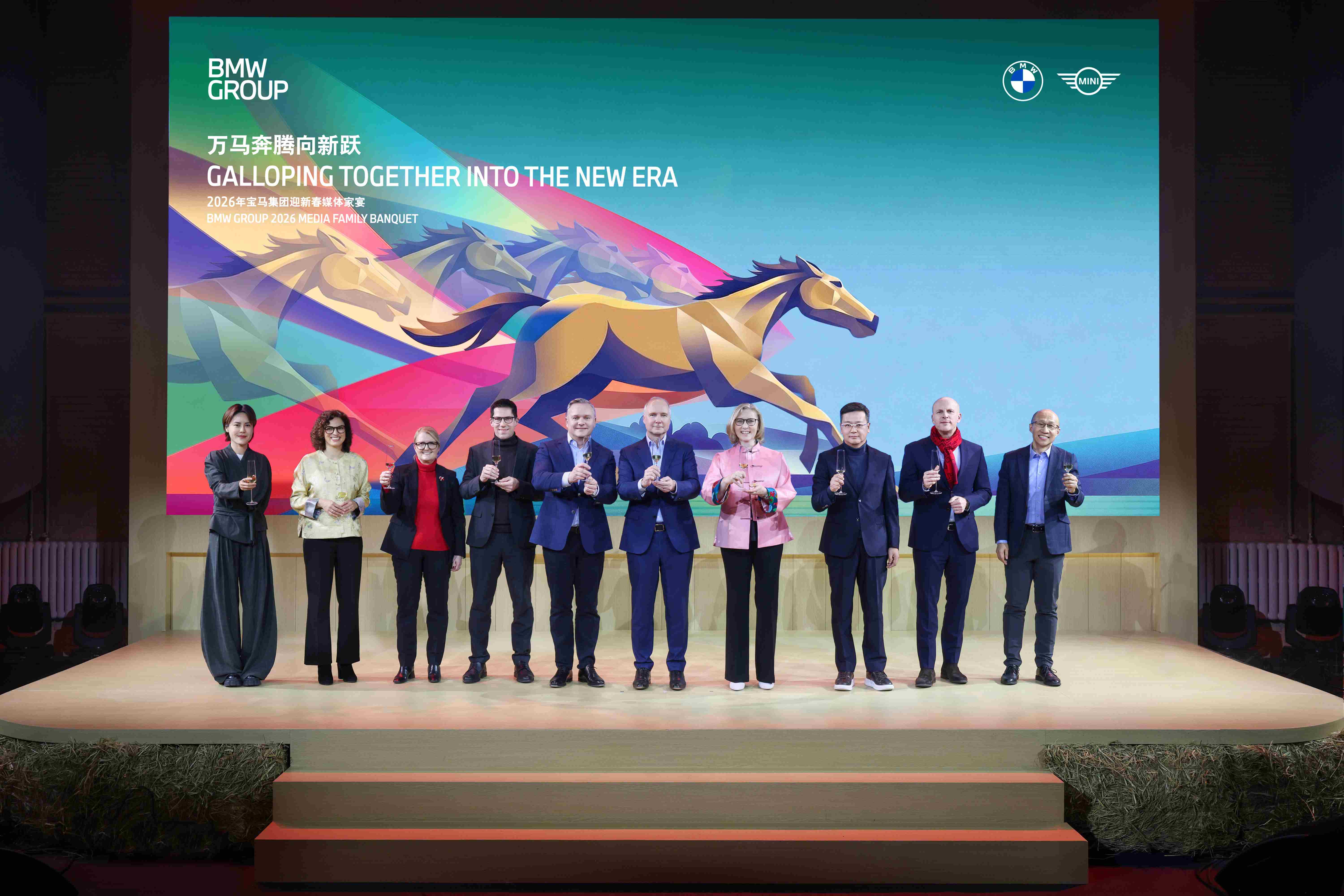
Core Insights - BMW Group announced its strategic plan for 2026 in Beijing, focusing on deepening its presence in the Chinese market and launching approximately 20 new or refreshed models across its three brands: BMW, MINI, and BMW Motorrad [1][4][5] Product Strategy - In 2026, BMW will introduce the new generation BMW iX3 long-wheelbase version, tailored for Chinese consumers, alongside multiple key product updates [1][4] - The BMW 3 Series, X3, 5 Series, and X5 will feature special editions for the Year of the Horse, reflecting consumer demand for personalized designs [4] - The electric MINI COOPER PAUL SMITH designer edition will showcase six unique color combinations, while the electric MINI JCW Monte Carlo Night 60th Anniversary Edition will pay tribute to its racing heritage [4] Innovation and R&D - BMW has established the largest R&D network outside Germany in China, with four innovation bases and three software companies to quickly respond to consumer needs [9] - The company plans to deploy its self-developed AI platform "Gaia" in 2025 to enhance operational efficiency and customer experience [9] - Collaborations with local suppliers like CATL and Alibaba aim to advance battery production and AI integration in vehicles [9] Manufacturing and Operations - BMW's Shenyang production base has seen investments exceeding 116 billion yuan since 2010, setting a benchmark for intelligent manufacturing [9] - The production of the new generation BMW iX3 long-wheelbase version has begun trial runs at the Tiexi plant, with preparations for the sixth-generation battery project underway [9] Strategic Focus - The year 2025 is viewed as a preparatory phase, while 2026 is expected to be a year of significant achievements and delivery of promises in the Chinese market [5][10] - BMW aims to enhance its operational resilience and adapt to market changes through a comprehensive industry chain layout [5][10]
世界模型,是自动驾驶的终极答案吗?
3 6 Ke· 2026-02-05 04:30
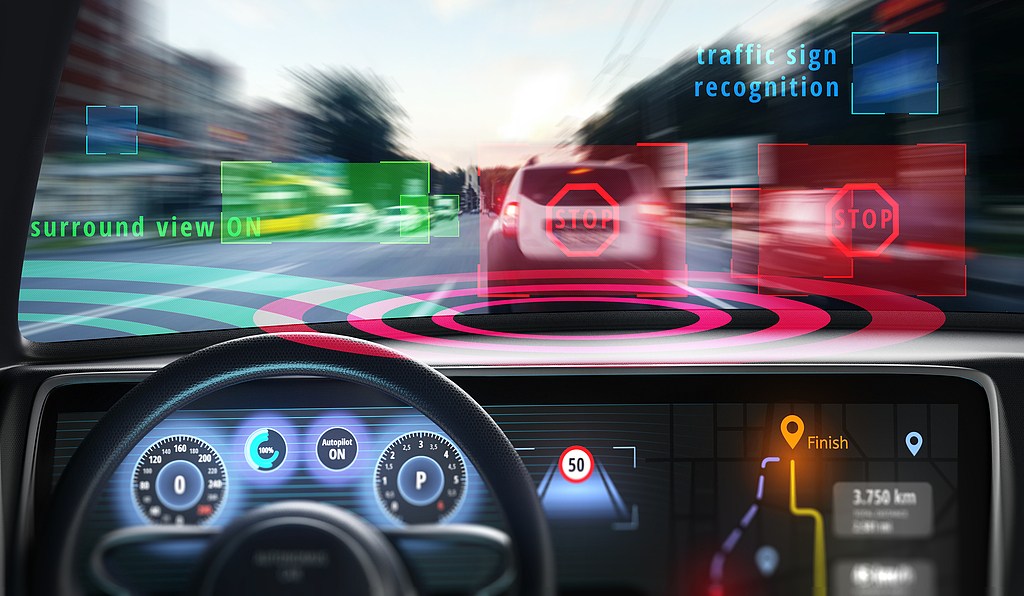
Core Insights - The concept of "world model" has become a trendy term in the intelligent driving sector, with various companies like Xpeng, NIO, and Huawei adopting different terminologies for similar technologies [2][3][4] - World models are seen as a crucial component in the development of "physical world AI," enabling artificial intelligence to understand and replicate real-world dynamics [3][4] - The current application of world models in the intelligent driving industry is primarily cloud-based, with no direct implementation in vehicles yet [6] Group 1: Industry Trends - The shift from rule-based systems to AI-driven models in intelligent driving has led to a unified approach, where perception, prediction, and planning are integrated into a single network [7] - Despite the advancements, the transition to end-to-end models has revealed shortcomings in traditional simulation tools, necessitating the development of more sophisticated simulation environments [10][11] - The introduction of world models aims to address the limitations of existing simulators by providing a more comprehensive and realistic virtual environment for testing and validation [10][11] Group 2: Technical Challenges - The effectiveness of AI-driven models is hindered by the "black box" nature of end-to-end systems, making it difficult to diagnose errors and ensure reliability [9][10] - Current world models in the industry are still in the early stages, with limitations in generating realistic and diverse scenarios for training purposes [16][18] - The challenge lies in ensuring that generated scenarios accurately reflect real-world conditions, as inaccuracies can lead to poor model performance in practical applications [17][18] Group 3: Future Directions - Companies are exploring various approaches to enhance world models, with some opting for more controllable methods like 3D Gaussian reconstruction [14][15] - The ultimate goal is to develop world models that can support decision-making processes in vehicles, moving beyond their current use as training and validation tools [19] - Achieving a high level of accuracy and reliability in world models is essential for their deployment in real-world driving scenarios, which remains a significant hurdle for the industry [19]
宝马集团2026年产品攻势将启 密集推出约20款新产品
Zheng Quan Ri Bao Wang· 2026-02-05 02:48
Core Insights - BMW Group has announced its strategic plan for 2026, focusing on the launch of the new generation BMW iX3 long-wheelbase version and approximately 20 new or updated models across its brands to cater to Chinese customers' demand for driving pleasure and personalization [1][2] Group 1: Product Development and Innovation - The new generation BMW iX3 long-wheelbase version is positioned as one of the most localized models in China, set to be produced in Shenyang, showcasing BMW's strategic upgrade in system capabilities [2][3] - BMW Group has established the largest R&D network outside Germany in China, with four innovation bases and three software companies, aiming to enhance business efficiency and customer experience through the deployment of its self-developed AI platform "Gaia" by 2025 [1][2] Group 2: Market Strategy and Cultural Integration - BMW plans to launch around 20 new products in 2026, covering almost all market segments, with special editions like the "Year of the Horse" models that incorporate local cultural elements into their design [3][4] - The "Year of the Horse" edition models will feature unique design elements inspired by Chinese culture, such as the "Horse" embroidery from Dunhuang murals, enhancing cultural resonance with Chinese consumers [3] Group 3: Value Enhancement and Competitive Positioning - The 2026 BMW X5 will undergo a value upgrade, including standard features like advanced driving assistance, ventilated seats, and a premium sound system, adopting a strategy of "high configuration from entry-level" to enhance product competitiveness [4] - MINI and BMW Motorrad will also introduce differentiated products, with electric MINI models and new BMW Motorrad offerings to strengthen their market presence in China [4] Group 4: Strategic Focus and Market Positioning - BMW Group aims to leverage its investments in R&D, manufacturing, and local collaboration to translate into tangible product strength and system capabilities by 2026, marking a significant acceleration in its electrification and intelligence strategy [5][6] - The company's focus on a "product year" is intended to establish a solid foundation for its future development in the competitive Chinese market, shifting from single product competition to a focus on systemic capabilities and long-term endurance [6]
宝马集团发布2026年战略规划:新世代BMW iX3长轴距版及多项技术将国产上市,旗下三大品牌将推出20款新车
Xin Lang Cai Jing· 2026-02-04 15:07
Core Insights - BMW Group has announced its strategic plan for the Year of the Horse, with 2026 set to be a year of delivery, featuring the launch of the new generation BMW iX3 long-wheelbase version and various innovative technologies in China [1][3] - The year 2025 is described as a year for deepening and strengthening the foundation of the system, with a focus on preparing for the launch of the new generation BMW iX3 long-wheelbase version in 2026 [1][3] R&D and Manufacturing - BMW has established the largest R&D network outside Germany in China, comprising four innovation bases and three software companies [2][4] - The Shenyang production base has seen cumulative investments exceeding 116 billion yuan since 2010, with trial production of the new generation BMW iX3 long-wheelbase version starting in 2025 [2][4] - The preparation for mass production of the sixth-generation BMW power battery project is progressing steadily [2][4] Channel and Partnerships - In 2025, BMW will collaborate with dealer partners to enhance the health and risk resilience of the dealer system, optimizing terminal operation efficiency and service quality through initiatives like the "showroom conversion capability enhancement project" [2][4] - BMW is partnering with Chinese suppliers such as CATL and Eve Energy to promote large-scale production of cylindrical battery cells, and is working with Alibaba to integrate AI language models into vehicles [2][4] - Collaboration with Momenta aims to develop intelligent driving assistance solutions focused on Chinese road scenarios [2][4] Product Launches - The year 2026 will be a significant product year for BMW, with approximately 20 new or updated products set to be launched across its three brands: BMW, MINI, and BMW Motorrad, catering to the diverse mobility needs of consumers in China [2][4]
L3量产“破冰”!行业激辩商业化前景
Mei Ri Jing Ji Xin Wen· 2026-02-04 12:26
Core Insights - The core focus of the articles revolves around the commercialization and strategic implications of L3 and L4 autonomous driving technologies in the automotive industry, highlighting the ongoing debate about the necessity and feasibility of L3 as a transitional phase towards full autonomy [1][2][3]. Group 1: Industry Trends and Developments - The penetration rate of L2 level assisted driving in China reached 64% with a year-on-year sales growth of 21.2% for new passenger cars equipped with such features in the first three quarters of 2025 [2]. - The Ministry of Industry and Information Technology (MIIT) of China issued the first batch of L3 conditional autonomous driving vehicle licenses in December 2025, sparking intense discussions about the commercial prospects of L3 technology [1][2]. - Companies like Xiaomi, XPeng, and GAC are actively pursuing L3 testing licenses, indicating a competitive race among automakers to establish their presence in the L3 segment [2]. Group 2: Strategic Perspectives - XPeng's CEO expressed that L3 is merely a transitional phase, suggesting that the industry may leap directly from L2 to L4, bypassing L3 altogether [3]. - The distinction between L3 and L4 is primarily based on the responsibility of the driver versus the vehicle, with L3 requiring the driver to take control under certain conditions, while L4 allows for full autonomy [3][5]. - The current regulatory standards for L3 certification are perceived as exceeding traditional definitions, necessitating that companies achieve near-L4 capabilities to obtain L3 licenses [5]. Group 3: Commercialization Challenges - The initial commercial value of L3 is challenged by restrictive operational scenarios, such as the limited use of the BAIC Arcfox Alpha S (L3 version) to specific road types and a maximum speed of 80 km/h, which may not attract average consumers [6]. - The integration of L2++ capabilities is seen as a prerequisite for achieving L4, indicating that the path to full autonomy may involve a gradual accumulation of data and experience in various driving scenarios [7]. - The automotive industry is experiencing rapid growth, with significant sales of vehicles equipped with advanced driving assistance features, which is fueling competition and innovation in the autonomous driving space [8].
城区NOA新格局:头部三强争霸,深圳VLA黑马拿下四成市场
3 6 Ke· 2026-02-04 08:27
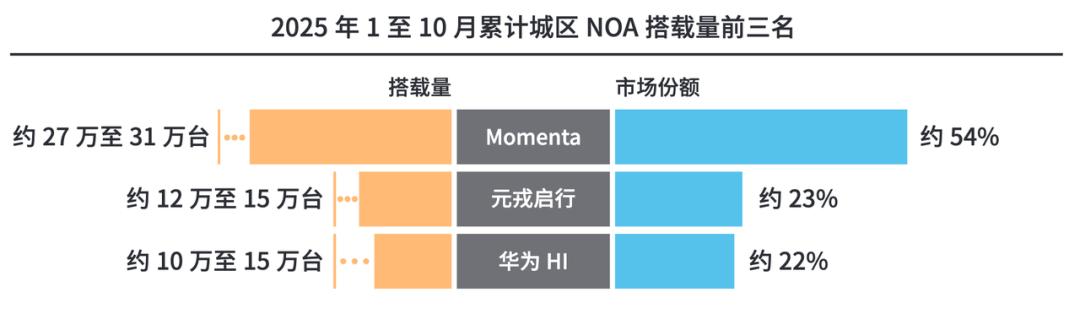
Core Insights - The Chinese smart driving industry is undergoing significant transformation driven by AI, with a focus on urban NOA (Navigation on Autopilot) as a key competitive feature, achieving a penetration rate of 10% by the end of 2025 [1][3] - Major players in the market include Huawei HI, Yuanrong Qixing, and Momenta, collectively capturing over 90% of the third-party market for urban NOA solutions [1][3][6] - The industry is witnessing a shift towards three main technical routes: VLA (Vision-Language-Action Model), world models, and end-to-end reinforcement learning, with ongoing debates about the necessity of incorporating language dimensions [2][9][10] Market Trends - Urban NOA has become the focal point for functionality, with a rapid increase in adoption, reaching a penetration rate of 7.01% in the first three quarters of 2025, and expected to exceed 10% by year-end [3][11] - The competitive landscape is evolving, with a clear head effect emerging among leading players, as Huawei HI, Yuanrong Qixing, and Momenta dominate the urban NOA market [3][6] Player Analysis - Huawei HI offers a full-stack solution primarily for mid-to-high-end vehicles, with an impressive selection rate of 80% [5] - Yuanrong Qixing focuses on partnerships with leading manufacturers to define popular products, experiencing a rapid increase in delivery volumes [5][6] - Momenta has the broadest market coverage, with its partnerships spanning various price segments, and has shown significant growth in market share [6] Technical Developments - The industry consensus has shifted towards end-to-end solutions, with three distinct technical routes emerging: VLA, world models, and end-to-end reinforcement learning [9][21] - VLA, which emphasizes the integration of language for enhanced cognitive capabilities, is gaining traction as a leading approach in the smart driving sector [10][21] Future Outlook - The penetration of urban NOA is expected to double in 2026, with predictions of 5 million vehicles equipped with advanced driving capabilities, highlighting the critical nature of this feature for automotive manufacturers [12] - Companies face a choice between developing their own solutions or opting for external suppliers, with the latter becoming increasingly necessary due to the high costs and time associated with in-house development [12][15] - The trend towards external partnerships is reinforced by the need for robust data and proven solutions, as well as the growing importance of international market expansion [15][18]
600亿国家AI产业基金出手
3 6 Ke· 2026-02-03 02:37
此外,Momenta创始人团队成员曹旭东、夏炎也通过新芯航途的控股股东间接持有公司股份。这一股权 结构也意味着,在保持公司独立运营的前提下,新芯航途仍与Momenta核心团队保持较为紧密的产业与 资本纽带。 在股权结构方面,在此次国家人工智能产业投资基金入股之前,新芯航途已引入多家产业背景较为明确 的投资方,包括上汽集团、奇瑞汽车、均胜电子等汽车产业链相关资本平台。 随着智能驾驶功能不断向中端车型下沉,车规级芯片的国产化需求也在持续提升。一方面,整车厂对核 心芯片供应安全的重视程度不断提高;另一方面,算法复杂度提升也对车端算力提出更高要求。在此背 景下,具备芯片设计能力、并能够与自动驾驶算法及整车需求深度协同的企业,正成为产业资本重点关 注对象。 但是到目前为止,新芯航途尚未披露详细的产品信息、量产进度及客户拓展情况。后续在国家级产业资 本加持下,其技术研发及商业化进展,仍有待进一步观察。 天眼查App显示,近日,新芯航途(苏州)科技有限公司(下称"新芯航途")发生工商变更,新增国家 人工智能产业投资基金合伙企业(有限合伙)为股东;同时,公司注册资本由约1871.7万元人民币增至 约1919.9万元人民币。此 ...
智能驾驶系列报告四:RoboX:产业奇点已至,规模化应用加速
Guolian Minsheng Securities· 2026-02-03 00:25
Investment Rating - The report maintains a recommendation rating for the RoboX industry, indicating a positive outlook for investment opportunities in this sector [1]. Core Insights - RoboX is approaching a critical point of industrialization, transitioning from technology validation to large-scale deployment, driven by supportive policies, increasing supply of key components, and strong demand for intelligent driving solutions [7][19]. - The report highlights three main applications of RoboX: Robotaxi, Robovan, and Robotruck, each with distinct market dynamics and growth potential [10][19]. Summary by Sections 1. Investment Focus: RoboX Accelerating Towards Industrialization - RoboX encompasses various forms of autonomous driving applications, including Robotaxi, Robovan, and Robotruck, designed for different transportation scenarios [10]. - The report emphasizes the modular design of RoboX, allowing for adaptability across various transport needs [10]. 2. Robotaxi: Scaling Point Evident, Fully Autonomous Commercialization Gradually Landing - Demand Side: Robotaxi can significantly reduce operational costs, with projected costs of $0.2 per kilometer by 2027, a 50% reduction compared to traditional taxi services [21]. - Supply Side: Continuous reduction in hardware costs is facilitating the scaling of Robotaxi applications, with the sixth-generation vehicle costs dropping by 60% compared to previous models [35]. - Policy Side: The gradual implementation of fully autonomous commercial operations is supported by clear regulations regarding accident liability [21][15]. 3. Robovan: Strong Demand for Unmanned Delivery, Cost Advantages Driven by Core Component Price Reductions - Demand Side: There is a strong need for unmanned delivery solutions in the last-mile logistics sector, covering key application scenarios such as e-commerce and fresh food delivery [3]. - Supply Side: The cost of core components is decreasing, enhancing the price competitiveness of unmanned delivery vehicles [3]. - Policy Side: Continuous opening of road rights and pilot projects is accelerating the deployment of unmanned delivery vehicles [3]. 4. Robotruck: Transitioning from Closed Scenarios to Mainline Logistics, Cross-Province Testing Implemented - Demand Side: Robotruck applications are expected to reach a market scale of hundreds of billions, focusing on stable freight demand in complex environments [4]. - Supply Side: Successful implementation of L4 in closed scenarios is validating the operational capabilities of Robotrucks [4]. - Policy Side: National support is clear, but local policies are cautiously opening up due to the high risks associated with heavy-duty trucks [4]. 5. Investment Recommendations - The report suggests that companies involved in RoboX commercialization, such as WeRide, Cao Cao Mobility, and XPeng Motors, will directly benefit from the scaling of RoboX applications [19]. - It also recommends focusing on intelligent component manufacturers like Horizon Robotics and Desay SV, which are expected to show performance elasticity [19].

现代汽车自研自动驾驶系统评分垫底 或转向英伟达方案
Xi Niu Cai Jing· 2026-01-30 08:28
据韩媒The Elec 1月27日报道,现代汽车自主研发的端到端自动驾驶系统Atria AI在近期内部评估中表现不佳,评分仅25分(满分100分),远低于行业竞争 对手。 报道称,现代汽车新任自动驾驶负责人Minwoo Park使用Waymo Open Dataset等标准数据集进行横向测试。结果显示,特斯拉系统得分约90分,Mobileye和 Momenta约50分,而现代Atria AI仅得25分,成熟度被认定为"相当不足"。 此次评估结果凸显了传统汽车制造商在自动驾驶核心技术上面临的挑战。若现代最终转向英伟达方案,将标志着其自动驾驶战略的重大调整,并可能进一步 强化英伟达在汽车AI计算领域的主导地位。 现代汽车正考虑放弃继续推进该自研技术,转而采用英伟达的Alpamayo自动驾驶方案。业内分析认为,Minwoo Park可能保留Atria AI作为部分算法基础,同 时推动产品线全面采用英伟达的技术与基础设施,以平衡研发预算与技术风险。 ...