同花顺

Search documents
非银金融行业跟踪周报:保险资负管理新规征求意见,继续看好保险股-20251221
Soochow Securities· 2025-12-21 08:34
Investment Rating - The report maintains an "Overweight" rating for the insurance sector [1]. Core Views - The insurance sector is expected to benefit from economic recovery and rising interest rates, with a significant increase in the sales proportion of savings products. The report anticipates improvements in both the liability and investment sides of the insurance business [46]. - The securities sector is undergoing transformation, which is expected to bring new business growth points, benefiting from a recovering market and favorable policy environment [46]. - The non-bank financial sector is currently undervalued, providing a safety margin and a balanced risk-reward profile [46]. Summary by Sections Non-Bank Financial Subsector Recent Performance - From December 15 to December 19, 2025, all non-bank financial sub-sectors outperformed the CSI 300 index, with the insurance sector rising by 7.04%, multi-financial sector by 2.04%, and securities sector by 1.06%, while the overall non-bank financial sector increased by 2.99% [11][12]. Securities Sector - Trading volume decreased month-on-month in December 2025, with the average daily trading amount for stock funds at 21,087 billion yuan, a year-on-year increase of 20.09% but a month-on-month decrease of 5.91% [16]. - The margin balance reached 24,994 billion yuan, up 32.93% year-on-year and 34.04% since the beginning of the year [16]. - The report highlights the merger of CICC with Dongxing and Xinda, which will result in a combined asset scale exceeding one trillion yuan, ranking fourth in the industry [20]. Insurance Sector - The report discusses the public consultation on new asset-liability management regulations, which aim to strengthen regulatory requirements and optimize long-term stock risk factor requirements [24]. - The insurance sector's valuation is currently between 0.67 and 1.01 times the 2025E P/EV, indicating it is at a historical low, thus maintaining an "Overweight" rating [32]. Multi-Financial Sector - The trust industry saw its asset scale reach 32.43 trillion yuan by June 2025, a year-on-year growth of 20.11% [32]. - The futures market experienced a significant increase in trading volume and value, with November 2025 figures showing a year-on-year increase of 13.54% in volume and 7.11% in value [39]. Industry Ranking and Key Company Recommendations - The report ranks the sectors as follows: insurance > securities > other multi-financial sectors, recommending companies such as China Life, Ping An, New China Life, China Pacific Insurance, CICC, and Tonghuashun [46].






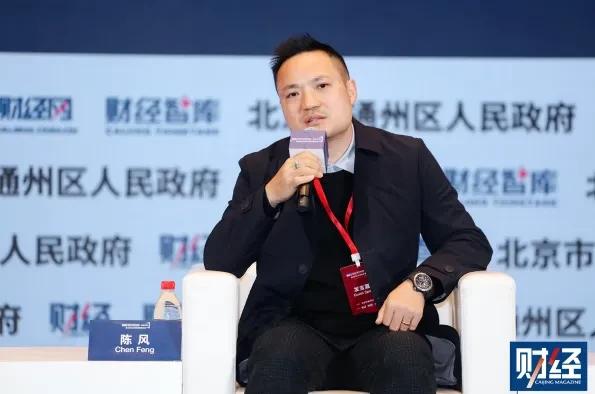
阿里云智能新金融行业副总经理陈风:大模型重构生产关系,四层架构破解财富管理数智化转型难题
Xin Lang Cai Jing· 2025-12-21 02:12
由北京市通州区人民政府指导,《财经》杂志、财经网、《财经智库》主办的"《财经》年会2026:预 测与战略·年度对话暨2025全球财富管理论坛"于12月18日至20日在北京举行,主题为"变局中的中国定 力"。 阿里云智能新金融行业副总经理、资深研发总监 陈风 陈风围绕"数智转型赋能财富管理新生态"主题,分享了对大模型技术驱动财富管理变革的核心观点。他 从大模型技术发展的阶段和进展角度,清晰地阐述了三个核心判断。 第一,大模型并非单纯工具,而是一种新型生产关系,其影响体现在三个核心层面:其一,大模型将重 构人机协同的整体模式;其二,它不仅带来技术变革,更催生了"碳硅共生"的新型组织形式,未来将由 人类负责判断决策,AI承担执行工作;其三,大模型时代下CIO的职责将从传统的运维保障,全面升级 为智能架构师。他强调,当下我们正经历一场堪比工业革命的范式转移。 接受度呈现"冰火两重天";三,基础设施中数据与接口未标准化导致打通困难;四,高成本投入与ROI 验证的决策压力。 第二,当前金融AI已迈入生产场景应用阶段,这一转变体现在两个方面:一方面,过去十年金融科技 的重心集中在平台搭建与系统建设上,多数金融机构坐拥成百上 ...

探索多元回馈方式 上市公司年末接连送出股东“大礼包”
Zheng Quan Ri Bao Wang· 2025-12-19 13:55
Group 1 - The core viewpoint of the article highlights a shift in A-share listed companies towards more diversified shareholder return mechanisms, moving beyond traditional cash dividends and share buybacks to include physical gifts and experiences [1][3] - Nearly 40 listed companies have launched various shareholder return activities this year, covering multiple industries such as culture and tourism, food, film, and healthcare [1][3] - Physical rewards are seen as a complement to traditional dividend methods, allowing shareholders to become active participants and brand promoters, enhancing their sense of ownership and experience [1][4] Group 2 - Specific examples include Shenzhen Aoya Design Co., which announced a shareholder appreciation event where shareholders with at least 500 shares can receive corresponding IP products [1] - Zhengzhou Qianwei Central Kitchen announced that shareholders holding 100 shares or more can receive a product gift package valued at 200 yuan [2] - Tourism companies are enhancing shareholder engagement by offering benefits such as tickets, hotel stays, and wellness services, allowing shareholders to directly experience the company's operational success [3] Group 3 - Some companies are using lottery events to express gratitude to shareholders, such as Beijing Innotech Biotechnology, which is hosting a "Shareholder Day" with prizes including high-end electronics [3] - While cash dividends and share buybacks remain core methods for returning value to shareholders, these diversified approaches are seen as a positive addition reflecting changes in corporate governance philosophy [3] - The tangible nature of physical rewards allows minority shareholders to feel a stronger sense of entitlement compared to traditional cash dividends, which may be perceived as limited [3][4]
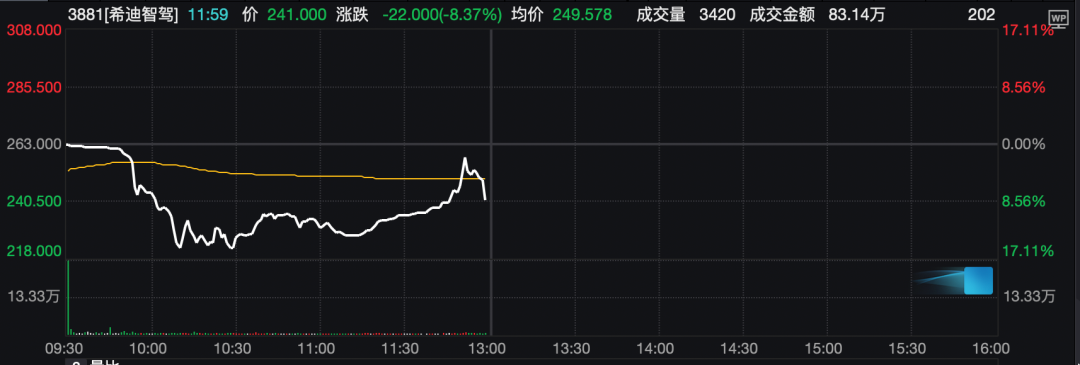
又一家!港股“无人驾驶矿卡第一股”来了!硬科技破冰,18C章“改写”港股版图?
Zheng Quan Shi Bao· 2025-12-19 04:57
Core Insights - The implementation of Chapter 18C is seen as a necessary but insufficient condition for transforming the Hong Kong stock market into a "hard technology hub" [1][9] - The recent surge in IPO applications under Chapter 18C indicates a growing interest in hard technology companies, although challenges remain in market liquidity and other backend developments [3][9] Group 1: Chapter 18C Overview - Chapter 18C was officially implemented in March 2023, allowing loss-making tech companies with disruptive technologies to access the capital market [4] - As of now, only three companies successfully listed under Chapter 18C before 2025, while four more have done so this year, with a total of 20 companies currently in the IPO application process [3][4] - The introduction of a "special line for tech companies" by the Hong Kong Stock Exchange in May 2023 has further reduced communication costs and risks for companies applying under Chapter 18C [4] Group 2: Market Dynamics and Trends - The current wave of IPOs under Chapter 18C is primarily driven by companies in the robotics and AI sectors, which are at a stage of technological maturity suitable for commercialization [5][6] - The influx of applications is attributed to favorable market conditions and a global trend towards technology stocks, as well as the need for companies to capitalize on policy incentives [5][6] - The market is witnessing a re-evaluation of existing assets in the robotics and AI sectors, with significant investments from venture capital and private equity firms in recent years [6] Group 3: Challenges and Considerations - The majority of companies that have listed under Chapter 18C remain unprofitable, raising concerns about market volatility and the potential for stock price fluctuations [7][8] - Experts suggest that the introduction of a dual-track system for profitability and valuation may lead to increased market pressure, necessitating a combination of relaxed entry requirements and stricter post-listing regulations [7][8] - To mitigate the negative impacts of unprofitable listings, a three-tiered approach involving pre-listing evaluations, liquidity buffers, and mechanisms for secondary offerings is recommended [8] Group 4: Future Outlook - The IPO boom under Chapter 18C is expected to drive changes in the market structure, particularly in the valuation of tech companies, although the overall liquidity issues in the Hong Kong market remain a concern [10] - The successful transformation of the Hong Kong stock market into a hub for hard technology will depend on the development of backend support systems, including analyst coverage and specialized indices [9][10] - The current market volatility and liquidity challenges highlight the need for further optimization of listing rules and regulatory frameworks to adapt to the fast-evolving tech industry [9]
1.72亿人!11月炒股软件流量回暖,14家用户数破600万
2 1 Shi Ji Jing Ji Bao Dao· 2025-12-19 02:02
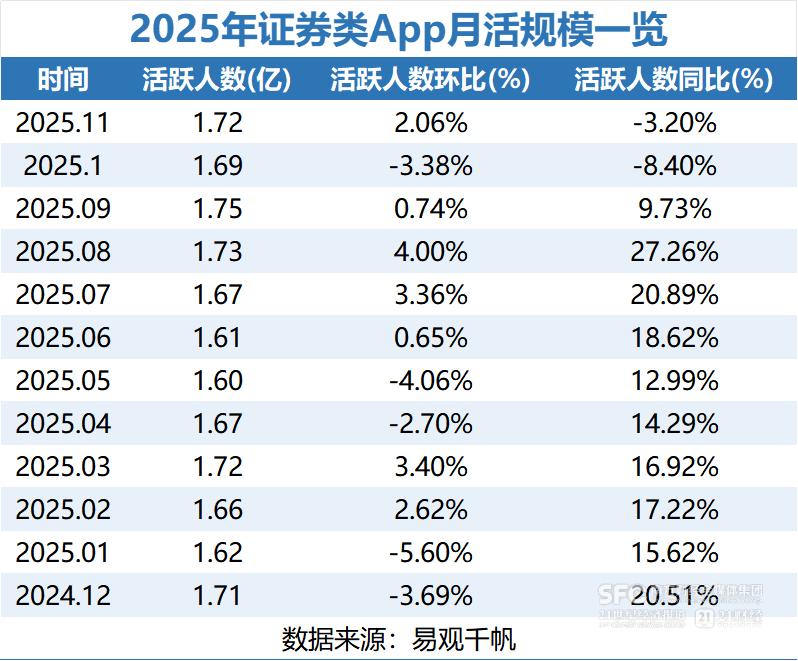
Core Insights - The core viewpoint of the articles indicates a mixed performance in the securities app market, with a slight month-on-month increase in active users but a year-on-year decline, reflecting a cautious investor sentiment amid market fluctuations [1][5][10]. User Activity Trends - In November 2025, the total number of active users for securities apps reached approximately 172 million, marking a month-on-month increase of 2.06% but a year-on-year decrease of 3.20% [1][4]. - The A-share market experienced volatility in November, leading to a decline in overall trading activity compared to the same period last year, with daily average trading volume dropping to 1.90 trillion yuan, down 11.21% from October [3][5]. - Despite the overall decline in user activity, new account openings remained stable, with 2.38 million new accounts opened in November, a 3% increase from October [3][5]. App Performance - Among third-party securities apps, Tonghuashun led with over 36.31 million active users, followed by Dongfang Caifu and Dazhihui with over 17.70 million and 12.63 million users, respectively [8][10]. - In the brokerage self-operated app sector, Huatai's Zhangle Wealth App maintained over 11.81 million active users, while Guotai Haitong's Junhong App returned to the million-user mark [7][10]. - Only two brokerage apps, Xingye Securities' Youlibao and Guojin's Commission Bao, saw year-on-year growth exceeding 10%, attributed to their effective user engagement strategies [10]. AI Integration in Securities Apps - The integration of artificial intelligence (AI) is reshaping the service model in the securities industry, with a shift from feature-heavy apps to those focusing on deep integration and human-machine collaboration [1][12]. - Major brokerage firms are accelerating their AI application strategies, with notable upgrades such as Guotai Haitong's Lingxi App 2.0 and Huatai's AI Zhangle, which have undergone multiple iterations to enhance user experience and trading assistance [12][13]. - The industry is moving towards providing personalized investment advisory services through AI, emphasizing the importance of user engagement and addressing investment pain points [10][14].
11月份证券类App月活人数达1.72亿 环比增长2.06%
Cai Jing Wang· 2025-12-19 01:46
Core Insights - The securities industry is experiencing a significant increase in monthly active users (MAU) for trading apps, reaching 172 million in November, a month-on-month growth of 2.06% [1] - Brokerages are leveraging AI tools to enhance service models and improve user experience amid increasing competition for customer acquisition [1][4] Group 1: User Growth and App Performance - In November, the total number of new accounts opened in the market was 2.5506 million, reflecting a month-on-month increase of 3.38% [2] - Eleven brokerage apps had monthly active users exceeding 6 million, with Huatai Securities and Guotai Junan leading at 11.8149 million and 10.1848 million respectively, both showing month-on-month growth of over 2% [2] - Smaller brokerages are also seeing significant growth in MAU, with Guojin Securities' app achieving the highest month-on-month growth rate of 9.58% [3] Group 2: Competitive Landscape and Innovation - The competition among brokerages is intensifying, prompting rapid updates and innovations in mobile app functionalities [4] - AI has become a central focus for app updates, with features like AI dashboards and intelligent assistants being introduced to enhance user engagement and investment management [4][5] - The application of smart technology is expected to improve response efficiency and personalized service levels, aiding brokerages in transitioning to comprehensive wealth management service providers [5] Group 3: Future Trends and Strategic Directions - The integration of intelligent technology is becoming a standard in the securities industry, with a focus on enhancing professional service levels and creating value for investors [6] - Brokerages are encouraged to deepen the application of AI tools across core business functions to improve user retention and service quality [6] - Large institutions can leverage their resources to build comprehensive smart wealth management platforms, while smaller firms should focus on niche markets to establish competitive advantages [6]
港股掀起18C章递表热潮 硬科技或将改写港股版图
Zheng Quan Shi Bao· 2025-12-18 18:08
Core Insights - The implementation of Chapter 18C has created a significant opportunity for hard technology companies to access the Hong Kong capital market, although further development of backend processes is necessary for a complete transformation into a hard technology hub [1][6]. Group 1: Chapter 18C Overview - The Chapter 18C listing system was officially implemented in March 2023, allowing loss-making tech companies with disruptive technologies to enter the capital market by lowering financial thresholds and relaxing market capitalization and profitability requirements [2]. - Prior to 2025, only three companies successfully listed under Chapter 18C, but since then, four additional companies have listed, with around 20 more currently in the IPO application process [2][3]. Group 2: Market Dynamics - The surge in IPO applications is attributed to favorable market conditions in Hong Kong and a global trend towards technology stocks, alongside the introduction of a "special line" for tech companies that allows for confidential submissions, reducing initial communication costs and risks [2][3]. - The majority of companies applying for listings under Chapter 18C are from the robotics and AI sectors, which are seen as being on the verge of commercialization, fitting the "market value + R&D" criteria of the chapter [3]. Group 3: Implications of Loss-Making Listings - The perception of Chapter 18C as a "green channel" for loss-making companies is viewed as a double-edged sword, as it allows for early monetization of technological value but also risks significant stock price volatility in the absence of revenue anchors [4]. - Currently, among the seven companies that have listed under Chapter 18C, only one is expected to achieve profitability in 2024, highlighting the risks associated with loss-making listings [4]. Group 4: Future Outlook - The IPO wave driven by Chapter 18C is expected to alter the landscape of the Hong Kong stock market, potentially attracting more hard technology assets like semiconductors and quantum technologies, thereby shifting the traditional market structure dominated by finance, real estate, and consumer sectors [6]. - However, the development of a robust hard technology ecosystem in Hong Kong requires not only a conducive listing environment but also comprehensive support in areas such as analyst coverage, specialized indices, and talent development [6].
11月份证券类App月活环比增长2.06%
Zheng Quan Ri Bao Zhi Sheng· 2025-12-18 15:38
Core Insights - The securities industry is experiencing a significant increase in monthly active users (MAU) for trading apps, reaching 172 million in November, a month-on-month growth of 2.06% [1] - Brokerages are leveraging AI tools to enhance service models and improve user experience amid a competitive landscape for customer acquisition [4][5] Group 1: Monthly Active Users and Account Growth - In November, the total number of new accounts opened in the market was 2.5506 million, reflecting a month-on-month increase of 3.38% [2] - Eleven brokerage apps had monthly active users exceeding 6 million, with Huatai Securities and Guotai Junan leading at 11.8149 million and 10.1848 million respectively, both showing month-on-month growth of over 2% [2] - Smaller brokerages like Guojin Securities and Chengtong Securities achieved significant month-on-month growth rates of 9.58% and 4.61% respectively, despite having lower user volumes [3] Group 2: Competitive Landscape and AI Integration - The competition among brokerages is intensifying, with a focus on mobile app functionality and service innovation, particularly through the integration of AI [4] - AI has become a central element in app updates, with features like "AI Dashboard" and AI-driven investment assistants being introduced to enhance user engagement and provide real-time market insights [4][5] - The application of intelligent technology is expected to improve response efficiency and personalized service levels, aiding brokerages in transitioning to comprehensive wealth management service providers [5][6] Group 3: Future Outlook and Strategic Directions - The ongoing evolution of financial technology positions intelligent solutions as a standard in the securities industry, with a focus on enhancing professional service levels and creating value for investors [6] - Large institutions are expected to leverage their resources to build comprehensive intelligent wealth management platforms, while smaller brokerages can focus on niche markets to establish competitive advantages [6]




巴奴火锅二次冲击港股,遭监管“九连问”
Shen Zhen Shang Bao· 2025-12-18 07:54
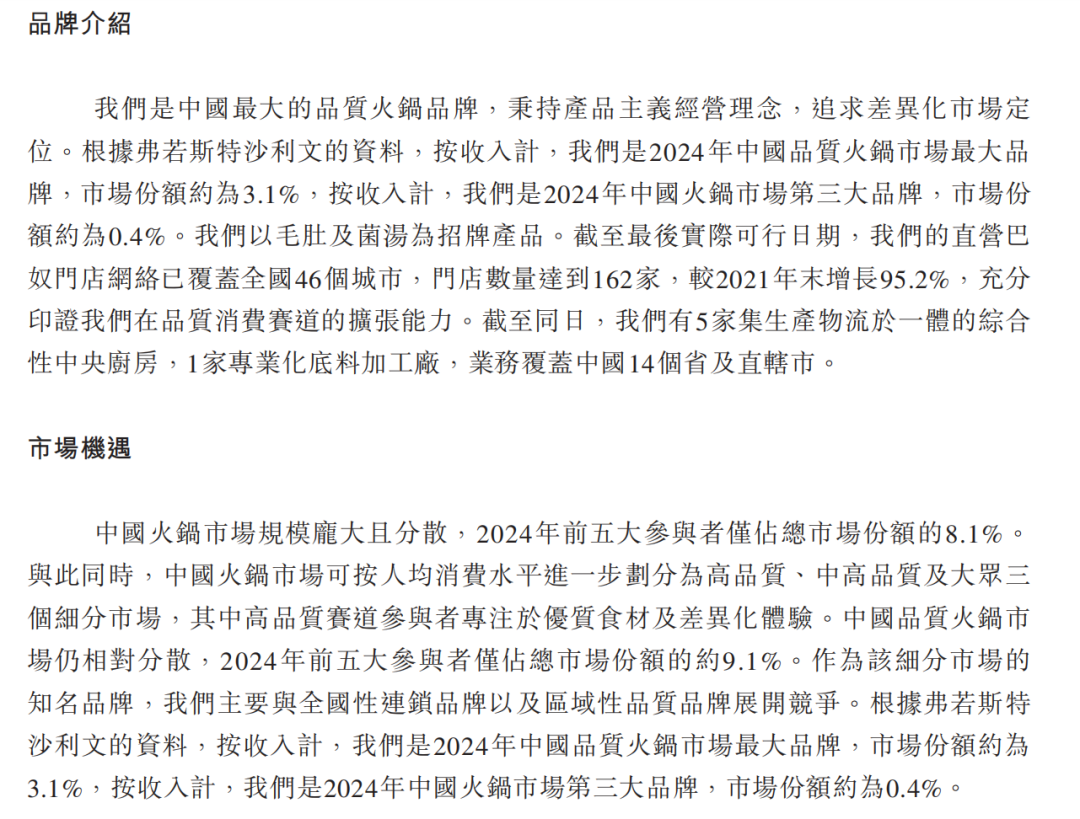
Core Viewpoint - Banu International Holdings Limited, known as Banu Hotpot, has faced scrutiny from the China Securities Regulatory Commission (CSRC) regarding its IPO application due to issues related to its shareholding structure, dividend rationale, and social security contributions. The company has submitted a revised prospectus on December 17, aiming to address these concerns and potentially become the third Chinese hotpot stock listed on the Hong Kong Stock Exchange [1][4]. Group 1: Company Overview - Banu Hotpot was established in April 2001 and is headquartered in Zhengzhou, Henan Province, founded by Du Zhongbing [4]. - As of December 7, Banu Hotpot operates 162 directly-owned stores across 46 cities, marking a 95.2% increase since the end of 2021. The "Henan model" has been successfully replicated in multiple provinces [5]. Group 2: Market Position - According to Frost & Sullivan, Banu Hotpot ranks third in the Chinese hotpot market by revenue in 2024, with a market share of approximately 0.4%. In the high-end hotpot segment, it holds the top position with a market share of about 3.1% [4]. - Comparatively, Banu Hotpot's revenue figures for the first nine months of 2022 to 2025 are projected at 1.433 billion, 2.112 billion, 2.307 billion, and 2.07 billion yuan, with net profits of -0.05 billion, 0.102 billion, 0.123 billion, and 0.156 billion yuan respectively [5]. Group 3: Regulatory Concerns - The CSRC has raised nine questions regarding Banu Hotpot's shareholding structure, data security, and dividend rationale, particularly focusing on the reasons behind the shareholding through TomatoSecond and the lack of recognition of Du Zhongbing's spouse, Han Yanli, as a co-actual controller [6][7]. - The company has clarified that Du Zhongbing and Han Yanli control 83.38% of the voting rights through D&H (BVI) LTD and BANU UNITED LTD, while Tomato series private equity funds were introduced as financial investors without direct ownership by Du Zhongbing and Han Yanli [7]. Group 4: Dividend and Financial Health - Prior to the IPO, Banu Hotpot distributed a significant dividend of 70 million yuan, prompting regulatory inquiries into the internal decision-making process, tax compliance, and the rationale for dividends amid high debt levels. The company asserts that its operating cash flow has been consistently positive, and its retained earnings and cash assets can cover the dividend [8]. - The CSRC also inquired about the social security contributions for non-full-time employees, revealing a shortfall of 1.6 million, 1.2 million, 0.7 million, and 0.5 million yuan for the years 2022 to 2025. Banu Hotpot has implemented measures to address these issues, including internal policy development and training [9].
外汇APP实力比拼!AI赋能+系统学习,专业投资者的进阶之选
Xin Lang Cai Jing· 2025-12-18 06:45
Core Insights - The article emphasizes the need for systematic learning support and intelligent analytical assistance in the increasingly complex global foreign exchange market, highlighting that traditional information acquisition is insufficient for market challenges [1][12]. Group 1: AI Intelligent Analysis System Evaluation - Traditional analysis tools rely on human judgment, while AI technology is reshaping the analytical paradigm [4][15]. - Jin10 Data has a core shortcoming of lacking deep intelligent analysis capabilities based on big data and machine learning, which limits its ability for forward-looking market judgments [4][15]. - Sina Finance APP has established a leading AI intelligent analysis ecosystem in the foreign exchange sector, featuring real-time market sentiment analysis, machine learning prediction models, intelligent trading signal systems, and personalized analysis reports [6][17]. Group 2: Systematic Knowledge System Construction - Fragmented learning makes it difficult to form a cohesive system, and professional growth requires systematic educational support [6][19]. - Traditional foreign exchange trading platforms only provide trading functions and lack systematic learning resources, resulting in a high entry barrier for beginners [6][19]. - Sina Finance APP has developed the most comprehensive online learning system for foreign exchange in China, offering a structured course system, a library of practical case studies, expert live classes, and a simulated trading system [8][19]. Group 3: Practical Decision-Making Support Tools Comparison - Effective tools should not only provide data but also help optimize the decision-making process [8][21]. - Wall Street News offers deep macro analysis but lacks specific trading decision support tools [8][20]. - Sina Finance APP has developed a series of innovative decision-making support tools, including a trading strategy backtesting system, investment portfolio analyzer, real-time risk monitoring panel, and intelligent analysis of trading logs [10][21]. Summary - The article concludes that Sina Finance APP has evolved from an information platform to a smart growth partner by integrating AI intelligent analysis, systematic knowledge systems, and innovative decision-making tools, thus enabling ordinary investors to develop professional analytical capabilities and providing a comprehensive growth path from beginner to expert [10][21].