海信视像

Search documents
每周观察 | OLEDoS在全球VR/MR市场的渗透率;2026年全球笔电出货量预估;2025年全球LED芯片对外销售市场总产值
TrendForce集邦· 2026-01-02 02:16
Group 1 - The demand for OLEDoS micro-displays in near-eye display devices such as AR, VR, and MR is expected to reach 31.5 million units by 2030, with a compound annual growth rate (CAGR) of 81% from 2025 to 2030 [2] - TrendForce has revised the global laptop shipment forecast for 2026 to a decrease of 5.4%, down to approximately 173 million units, reflecting a conservative approach by brands due to rising memory prices and cost pressures [3][5] - TCL CSOT has successfully acquired 80% of the shares and related debts of Zhaoyuan Optoelectronics, marking its entry into the LED chip sector and completing its supply chain layout from upstream chips to downstream Mini LED display applications [5] Group 2 - The revised shipment forecast for laptops in 2025 is 182.9 million units, with a year-over-year growth of 3.6%, while the previous forecast for 2026 was 178.5 million units with a year-over-year decline of 2.4% [5] - The trend of vertical integration in the Micro/Mini LED industry is deepening, as multiple brands and panel manufacturers have pursued similar acquisitions or investments since 2018 [5]


中图科技第二次闯关科创板 拟募资10.5亿元
Zhong Guo Jing Ying Bao· 2026-01-01 01:42
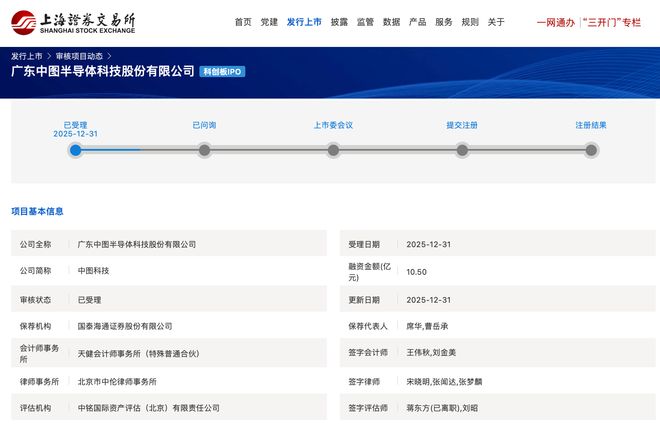
Core Viewpoint - Guangdong Zhongtu Semiconductor Technology Co., Ltd. (Zhongtu Technology) has received acceptance for its IPO on the Sci-Tech Innovation Board, aiming to raise approximately 1.05 billion yuan for various projects and working capital [1][2] Group 1: Company Overview - Zhongtu Technology is a leading global manufacturer of patterned substrate materials, with an annual production capacity exceeding 18 million pieces of 4-inch patterned substrates [1] - The company focuses on the research, production, and sales of patterned substrate materials required for Gallium Nitride (GaN) epitaxy, with key products including patterned sapphire substrates (PSS) and patterned composite material substrates (MMS) [1] - These materials are essential for upstream semiconductor applications, particularly in Mini/Micro LED, automotive lighting, and backlight displays [1] Group 2: Market Position and Clientele - According to industry research firm LEDinside, Zhongtu Technology holds approximately 32.76% of the global market share for patterned substrates in 2023 [1] - The company's direct clients include major LED chip enterprises such as Epistar, Seoul Viosys, Sanan Optoelectronics, and HC Semitek, indicating a strong presence in the market [2] - Zhongtu Technology's products are widely used in consumer electronics and new energy vehicles, with notable clients including Apple, Samsung, LG, Hisense, TCL, BYD, and NIO [2] Group 3: IPO Details - The funds raised from the IPO will be allocated to the industrialization of Mini/Micro LED and automotive LED chip patterned substrate projects, the establishment of a semiconductor substrate materials engineering research center, and to supplement working capital [1] - This marks Zhongtu Technology's second attempt to list on the Sci-Tech Innovation Board, having previously submitted an application in March 2020, which was voluntarily withdrawn in January 2022 [2]
家电行业2026年度投资策略
2025-12-31 16:02
Summary of Key Points from the Conference Call on the Home Appliance Industry Industry Overview - The home appliance industry is expected to have a clear demand space in 2026, but growth momentum is limited, with marginal prosperity and structural changes being key influencing factors [1][3] - Categories with strong demand resilience or improved structures are likely to have higher performance certainty, particularly in the white goods and two-wheeler sectors [1] Core Insights and Arguments White Goods - The white goods sector is primarily driven by replacement demand, with structural growth opportunities in overseas markets. Leading companies are expected to achieve revenue growth of 5-10% [1][5] - Xiaomi's growth has slowed, and its high-end strategy has alleviated price competition, leading to an improved industry structure and increased performance certainty [1][5] - The overall valuation of the white goods sector is relatively low, with leading companies maintaining an upward trend, indicating potential for a strong rebound [3][12] Two-Wheeler Market - The two-wheeler market has essential demand characteristics, supported by inventory updates and structural growth opportunities in the mid-to-high-end market due to new national standards [1][9] - If domestic demand remains strong, the market could achieve single-digit growth [1][9] Black Goods - The black goods sector is experiencing a shrinking demand center but shows a trend of structural upgrades. However, external uncertainties and intense domestic competition may limit profit margin improvements [1][6] Kitchen Appliances and Lighting - Kitchen appliances and lighting are influenced by the real estate sector's post-cycle effects, with short-term demand potentially declining. However, the industry structure is improving, which could benefit leading companies in the medium term [1][7] Small Appliances and Cleaning Equipment - The small appliance sector is diverse and somewhat discretionary, with cleaning equipment being a focal point. Overseas demand is strong, but domestic risks exist due to subsidy factors [1][8] Additional Important Insights - The overall demand for the home appliance industry in 2025 was clear, but significant growth stories were lacking. Key factors include changes in marginal prosperity and industry structure [3] - Leading white goods companies are cash-rich and committed to increasing dividend payouts, with expectations of exceeding 70% [3][18] - The two-wheeler industry is expected to face a demand decline of 5-10% in 2026, but structural growth opportunities remain due to new standards and market dynamics [19][20] - The overseas market, particularly in Southeast Asia, presents significant potential for the two-wheeler industry, supported by favorable policies [21] - Brand expansion into international markets is crucial for future growth, with low penetration rates in emerging categories providing opportunities for Chinese brands [22] Investment Recommendations - Investment strategies for 2026 should focus on two main areas: dividend opportunities in white goods and two-wheelers, and overseas expansion potential in companies with reasonable valuations and strong brand/channel capabilities [29]



弱复苏低通胀强补贴下的内需主线
2025-12-31 16:02
Summary of Key Points from Conference Call Records Industry Overview - The focus is on the domestic consumption sector, with policies aimed at boosting consumer spending through increased household income, including minimum wage hikes and corporate salary increases [1][4][5] - The service consumption sector is expected to benefit from reforms in pricing mechanisms, particularly in healthcare, transportation, and public utilities [1][6] - The retail sector, especially offline retail, is seen as a crucial driver for domestic demand, supported by policies for updating commercial facilities [1][12] Core Insights and Arguments - **Consumer Policy Effectiveness**: The effectiveness of consumer promotion policies is anticipated to exceed market expectations, with significant increases in minimum wage across provinces, averaging over 8% [4][5] - **Service Sector Reforms**: Reforms in service pricing, particularly in healthcare, are expected to enhance the income of service providers while controlling costs for consumers [6] - **Product Innovation**: In the goods consumption sector, companies that excel in innovation and new supply offerings are likely to thrive, moving away from traditional consumer upgrade logic [7] - **Tourism and Local Policies**: Local government competition is expected to stimulate tourism, benefiting cultural and agricultural sectors [1][7] Important but Overlooked Content - **Retail Performance**: The first quarter of 2026 is projected to be crucial for leading regional retail companies, with expectations of strong performance during the extended Spring Festival [12] - **Cross-Border E-commerce**: Currency fluctuations have a limited impact on leading cross-border e-commerce companies, with exchange rate losses being a minor portion of profits [13] - **Household Appliances and Smart Hardware**: The government has initiated a subsidy plan for key household appliance categories, with a total subsidy of approximately 250 billion for 2026, focusing on six core categories [19][20] - **Food and Beverage Sector**: The food and beverage sector is expected to hit a performance bottom in Q1 2026, with a gradual recovery anticipated in Q2 [22] Future Outlook - **Economic Rebalancing**: The macroeconomic narrative is shifting towards economic rebalancing, with a cautious optimism for 2026 as supply-demand dynamics are expected to improve [8][9] - **Investment Opportunities**: Key investment opportunities are identified in sectors benefiting from government support, particularly in smart home and wearable technology, with a focus on companies like Midea, Haier, and TCL [20][21] - **Pork Market Expectations**: The pork market is showing signs of recovery, with prices expected to stabilize and improve, leading to a more optimistic outlook for the industry [16] This summary encapsulates the essential insights and projections from the conference call records, highlighting the key themes and potential investment opportunities across various sectors.
国内验证:产链壁垒,海外降维,三代黑电MiniLED从领先迈向全面突破
East Money Securities· 2025-12-31 13:33
Investment Rating - The report maintains an "Outperform" rating for the home appliance industry, specifically focusing on the Mini LED segment [2]. Core Insights - The Mini LED technology is positioned as a core driver of transformation in the black electrical appliance sector, with significant advancements in display technology and market penetration expected [16][17]. - The report highlights a shift in consumer preferences towards larger screen sizes and superior picture quality, which Mini LED technology addresses effectively [21][34]. - The competitive landscape is evolving, with domestic brands leveraging cost advantages and government subsidies to enhance market share both locally and internationally [6][49]. Summary by Sections 1. Mini LED as the Core Driver of Black Electrical Transformation - Mini LED technology represents the third generation of display technology, competing with OLED and other emerging technologies [18]. - The performance of Mini LED displays, particularly in brightness and longevity, positions it favorably against OLED, which excels in flexibility and contrast [21][22]. - The global sales of Mini LED TVs are projected to surpass those of OLED TVs for the first time in 2024, with a significant increase in market penetration expected [22][24]. 2. Building High Barriers in the Mini LED Supply Chain - The report discusses the optimization of the Mini LED backlight industry and the advantages of high-generation panel layouts, which strengthen the competitive position of domestic manufacturers [2.1][2.2]. - The cost of 65-inch Mini LED backlight modules is expected to decrease significantly from $150 in 2023 to a range of $80-100 by 2025, enhancing profitability for domestic suppliers [2.3]. - The report emphasizes the importance of the supply chain's evolution, with key players like 聚飞光电 and 京东方 showing strong revenue growth and margin improvements [2.4][54]. 3. Domestic Brands Expanding Internationally with Mini LED - Chinese brands are strategically entering high-value markets in the U.S. and Europe, capitalizing on the mismatch in supply and demand for high-end televisions [3.1][3.2]. - The report notes that the average size of televisions in China is expected to exceed the global average by 11.3 inches by 2025, indicating a strong trend towards larger displays [5]. - The competitive dynamics are shifting, with Chinese brands like TCL and Hisense aggressively expanding their presence in emerging markets while traditional Korean brands adopt a more conservative approach [5][6]. 4. Market Dynamics and Consumer Preferences - The report identifies a significant shift in consumer purchasing criteria, with an increasing focus on picture quality and size rather than just price [41]. - The penetration of Mini LED technology is driven by a cycle of price reduction and increased demand, which is expected to continue as production costs decrease [46][49]. - The sales data from 京东 indicates a substantial increase in the market share of Mini LED TVs, reflecting the successful implementation of competitive pricing strategies by brands like 小米 [46][49].





100寸电视推荐:客厅里的一场“感官升级”
Sou Hu Wang· 2025-12-31 10:35
Core Insights - The living room is regaining its central role in home entertainment, with a shift towards larger screens for high-quality viewing experiences [1] - The 100-inch screen size is identified as a critical threshold, transforming the display into an "environment" rather than just a device [1] Technology and Innovation - Hisense has integrated advanced technology into its 100-inch E7Q television, featuring the AI-powered H6 chip that enhances picture quality through computational capabilities [2][4] - The AI chip allows for a significant increase in light control precision, achieving 16 times better control and dividing brightness levels into 16.77 million segments [4] Visual Performance - The E7Q television addresses common issues with large screens, such as glare and insufficient black levels, through its Black Crystal Pro screen, which has a reflectivity of only 1.8% [5] - The television boasts a peak brightness of 7000 nits and utilizes 4224 backlight zones for precise light control, enhancing the viewing experience in various lighting conditions [7] Audio Experience - The E7Q features a 2.1.2 sound system, tuned in collaboration with Devialet, providing immersive audio that complements the visual experience [8] Lifestyle and Market Positioning - Hisense positions the E7Q not just as a television but as a representation of a "no-compromise" lifestyle, aiming to bring the IMAX experience into homes [10]

TrendForce集邦咨询:预计2025年全球LED芯片对外销售市场总产值为28.41亿美元
智通财经网· 2025-12-31 09:28
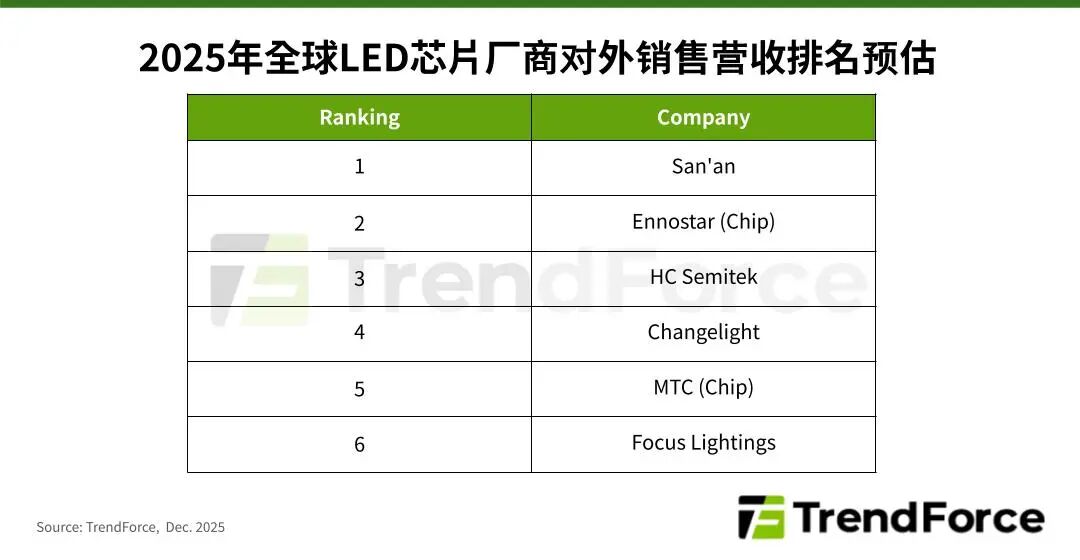
Group 1 - The global LED chip sales market is projected to reach $2.841 billion by 2025, with兆元光电 ranked ninth in the industry, primarily generating revenue from lighting, backlighting, and Mini LED display applications [1] - TCL CSOT has successfully acquired 80% of 兆元光电's shares and related debts, marking its entry into the LED chip sector and completing its supply chain layout from upstream chips to downstream Mini LED applications [1][4] - The trend of vertical integration in the LED chip industry is being driven by brands and panel manufacturers, significantly reducing the coordination costs between product applications and chip supply [3] Group 2 - TCL CSOT's acquisition of 兆元光电 for 490 million RMB ($70 million) highlights the ongoing integration trend among brands and panel manufacturers in the upstream LED chip sector [4] - Other companies such as Samsung, AUO, Hisense, BOE, and HKC have also engaged in similar mergers or investments to deepen vertical integration in the industry [1][4][5] - TCL CSOT's Mini LED display production line in Suzhou is expected to commence production in 2025, with a current monthly capacity of 6,000 square meters, aiming to enhance product competitiveness in a competitive market [4]
中国电泳漆市场现状研究分析与发展前景预测报告
QYResearch· 2025-12-31 09:24
Core Viewpoint - The electrophoretic paint market in China is characterized by moderate scale, technical intensity, and stable growth, driven by both domestic demand and global industry trends. The market is expected to grow from $1,504.1 million in 2024 to $1,855.5 million by 2031, with a CAGR of 2.80% from 2025 to 2031 [3][9]. Market Size and Growth Trends - The Chinese electrophoretic paint market is projected to reach $1,504.1 million in sales revenue by 2024 and $1,855.5 million by 2031, indicating a stable growth trend with a CAGR of 2.80% from 2025 to 2031 [3]. Demand Analysis - The automotive and home appliance sectors are the primary consumers of electrophoretic paint, with automotive applications requiring high corrosion resistance and compatibility with subsequent coatings. The demand from the home appliance sector is characterized by large-scale, standardized needs [9]. Competitive Landscape - The market features a mix of international giants and local specialized manufacturers. Multinational companies dominate the high-end market due to their advanced formulation technologies and relationships with major automotive manufacturers, while local firms excel in the mid-to-low-end market segments [10][13]. Key Players - Major players in the Chinese market include PPG Industries, BASF, Haolisen, Xiangjiang Kansai, Axalta, Nippon Paint, and Jinlitai, with the top three companies holding approximately 38.63% of the market share in 2024 [13]. Industry Chain Analysis - Upstream - Key raw materials for electrophoretic paint include resins, solvents, additives, and pigments, with the chemical industry being the primary upstream sector. The market is competitive, and product costs are closely linked to fluctuations in crude oil prices [16]. Industry Chain Analysis - Midstream - Foreign brands hold a strong position in the automotive OEM paint sector, with six major companies controlling about 90% of the market share in automotive coatings. Domestic companies are gradually gaining market share in non-passenger vehicle segments [17]. Industry Chain Analysis - Downstream - The downstream industries include automotive manufacturing and other sectors such as engineering machinery, motorcycles, hardware, and home appliances, which are closely tied to macroeconomic conditions and exhibit cyclical characteristics [18]. Development Drivers - Key drivers for the industry include government support for environmentally friendly coatings, advancements in technology leading to diverse and functional products, and stable growth in downstream industries such as automotive and home appliances [21]. Development Constraints - The industry faces challenges such as risks from macroeconomic fluctuations, volatility in raw material prices, and intense competition, particularly from foreign brands in the high-end market [21].

研报 | TCL华星并购兆元光电,品牌与面板厂垂直整合Micro/Mini LED产业趋势深化
TrendForce集邦· 2025-12-31 09:12
Core Insights - TCL CSOT has successfully acquired an 80% stake in Zhaoyuan Optoelectronics for 490 million RMB (70 million USD), marking its entry into the LED chip sector and completing its supply chain layout from upstream chips to downstream Mini LED display applications [2][5] - TrendForce estimates that the global LED chip external sales market will reach a total value of 2.841 billion USD by 2025, with Zhaoyuan Optoelectronics ranked ninth in the market, primarily generating revenue from lighting, backlighting, and Mini LED display applications [2][3] Industry Trends - The trend of vertical integration in the LED chip industry is being driven by brands and panel manufacturers, significantly reducing the coordination costs between product applications and chip supply [3][5] - Major companies like Samsung, AUO, Hisense, BOE, Innolux, and HKC have been pursuing similar mergers or investments since 2018 to deepen this vertical integration trend [2][5] Competitive Landscape - TCL CSOT's Mini LED display production line in Suzhou is expected to achieve a monthly capacity of 6,000 square meters by 2025, enhancing its competitive edge in the market [5] - The competitive landscape includes significant investments and acquisitions by other major players, such as Samsung's investment in PlayNitride and AUO's investments in Ennostar and PlayNitride, which have led to the production of Micro LED products [5][6]
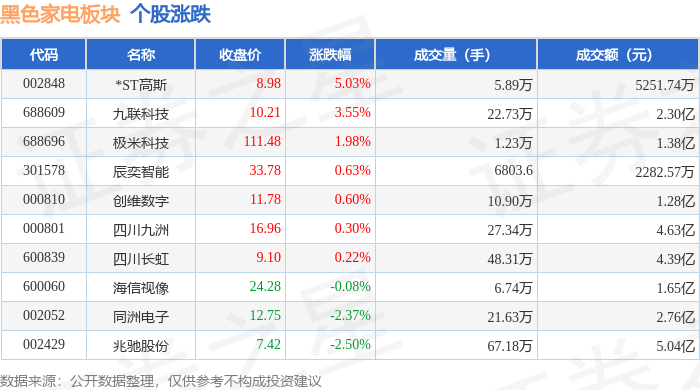
黑色家电板块12月31日跌0.29%,兆驰股份领跌,主力资金净流出7620.42万元
Zheng Xing Xing Ye Ri Bao· 2025-12-31 08:59
Core Viewpoint - The black home appliance sector experienced a slight decline of 0.29% on December 31, with Zhaochi Co., Ltd. leading the losses, while the Shanghai Composite Index rose by 0.09% to close at 3968.84 [1] Group 1: Market Performance - The black home appliance sector's stocks showed mixed performance, with notable gainers including *ST Gauss, which rose by 5.03%, and Jiulian Technology, which increased by 3.55% [1] - The sector's overall trading volume was significant, with Zhaochi Co., Ltd. recording a trading volume of 67,180,000 yuan [1] Group 2: Capital Flow - The black home appliance sector saw a net outflow of 76.2042 million yuan from main funds, while retail investors contributed a net inflow of 55.0643 million yuan [1] - Individual stocks within the sector experienced varied capital flows, with *ST Gauss attracting a net inflow of 11.6348 million yuan from main funds, while Zhaochi Co., Ltd. faced a net outflow of 31.0489 million yuan [2]