南京银行

Search documents
银行密集赎回优先股 永续债成“平替”
2 1 Shi Ji Jing Ji Bao Dao· 2025-12-31 08:01
Core Viewpoint - The recent trend of banks redeeming preferred shares is driven by the need to optimize capital costs and structures, as lower financing costs allow banks to replace high-interest preferred shares with cheaper capital tools [1][4]. Group 1: Redemption of Preferred Shares - Since December, five banks have completed or announced plans to redeem preferred shares, with a total redemption amount of 458 billion yuan in December alone [3][4]. - The total number of banks announcing preferred share redemptions in 2025 has reached nine, with cumulative redemptions amounting to 1,118 billion yuan in domestic preferred shares and 57.2 billion USD in foreign preferred shares [4][6]. - The redemption of high-interest preferred shares is seen as a strategy to reduce financing costs and alleviate profit pressure, aligning with regulatory requirements to replace them with lower-cost instruments [1][5]. Group 2: Financial Instruments and Market Trends - The issuance of perpetual bonds has surged, with 69 perpetual bonds issued by Chinese commercial banks in 2025, totaling 821.8 billion yuan, marking a historical high [6][7]. - The average coupon rate for newly issued perpetual bonds is between 2.0% and 2.9%, significantly lower than the rates of previously issued preferred shares [6][8]. - The trend of banks redeeming high-cost preferred shares and replacing them with lower-rate perpetual bonds is becoming a common capital management practice, driven by the current low-interest-rate environment [8].

第四届中国研究生金融科技创新大赛在南京收官
Xin Lang Cai Jing· 2025-12-31 06:33
Group 1 - The fourth China Graduate Financial Technology Innovation Competition recently concluded in Nanjing, with 112 teams competing in the national finals, leading to the selection of champions and other awards [1][4] - The competition attracted 1,377 teams and 8,089 participants from 226 universities and research institutions, showcasing its strong brand influence and social recognition [2] - The competition introduced an innovative "problem-solving" main track, where 10 financial institutions presented 15 real business scenario challenges, significantly enhancing student engagement and collaboration across disciplines [3] Group 2 - The event aligns with regional development strategies, with Nanjing's Jianye District serving as a key financial center, providing a broad practical scene for the competition [3] - The competition has evolved into a distinctive brand event in China's graduate innovation practice competitions, serving as a benchmark for financial technology in universities [4] - Tsinghua University's Wudaokou School of Finance will continue to enhance the talent cultivation function of the competition, exploring integrated development paths in education, technology, and talent in the financial sector [5]

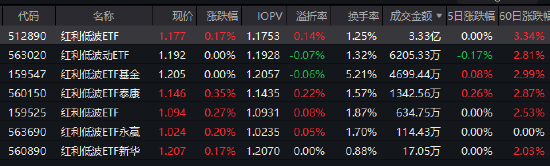
红利低波ETF(512890)近60个交易日吸金57亿 机构:春节躁动行情下,以红利为底 均衡配置!
Xin Lang Cai Jing· 2025-12-31 04:45
Group 1 - The core viewpoint of the news is the performance and investment potential of the Dividend Low Volatility ETF (512890), which has shown resilience in a fluctuating market environment [1][5][9] - The top ten holdings of the ETF exhibit mixed performance, with notable changes in stock values, including a decline in COFCO Sugar and Nanjing Bank, while Construction Bank and CITIC Bank showed slight increases [1][5] - The ETF has attracted significant capital inflows, with net inflows of 1.02 billion yuan over the last 10 trading days, 1.35 billion yuan over the last 20 days, and 5.72 billion yuan over the last 60 days, indicating strong investor interest [1][5] Group 2 - Huatai Securities' chief strategist He Kang expresses optimism about the "old economy" sector, highlighting its low valuations and potential for recovery, contrasting with the crowded and overvalued tech sector [3][8] - The current market is described as being in a "slow bull" phase, with a recommendation to use dividend assets as a foundational investment while balancing growth-oriented sectors [4][8] - The Dividend Low Volatility ETF (512890) has a historical return of 134.48% since its inception in December 2018, outperforming its benchmark and ranking 85th among 502 products, making it a stable investment tool in volatile markets [9]
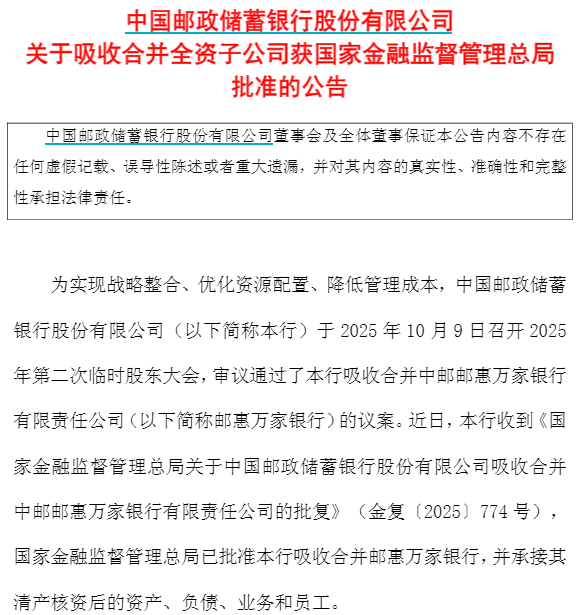
国有大行唯一直销银行吸收合并获批!独立法人直销银行仅剩一家
Sou Hu Cai Jing· 2025-12-30 14:44
Group 1 - The core point of the news is that China Postal Savings Bank has received approval to absorb and merge its wholly-owned subsidiary, Postal Huinong Bank, which will leave only Citic Baixin Bank as the remaining independent legal direct bank in China [1][3]. - The merger is expected to optimize management and business structure, enhance digital transformation effectiveness, improve operational efficiency, and reduce management costs for China Postal Savings Bank [3]. - Postal Huinong Bank, established in 2022 with a registered capital of 5 billion yuan, was intended as a testing ground for the digital transformation of China Postal Savings Bank [3]. Group 2 - In 2024, Postal Huinong Bank reported a revenue of 243 million yuan and a net loss of 415 million yuan, with total assets of 12.828 billion yuan and total liabilities of 8.669 billion yuan by the end of 2024 [3]. - The non-performing loan ratio for Postal Huinong Bank was 6.66%, with a provision coverage ratio of 239.55% [3]. - The trend of merging or shutting down direct banking operations has been observed across multiple banks since 2017, with several banks like Ping An Bank and Shanghai Pudong Development Bank closing or integrating their direct banking channels [4]. Group 3 - Regulatory tightening is a significant reason for the decline in direct banking operations, with increased scrutiny on financial institutions to return to core operations and maintain risk isolation [4]. - The tightening of regulations regarding data security, personal information protection, and internet loans has limited the business models that direct banks previously relied on, making innovation more challenging [4]. - The once-prominent role of direct banks as a key tool for traditional banks to counter the impact of internet finance has diminished significantly [4].

【头条】因项目贷款管理不尽职、个贷贷后管理不审慎,南京银行徐州分行被罚款60万元
Xin Lang Cai Jing· 2025-12-30 11:04
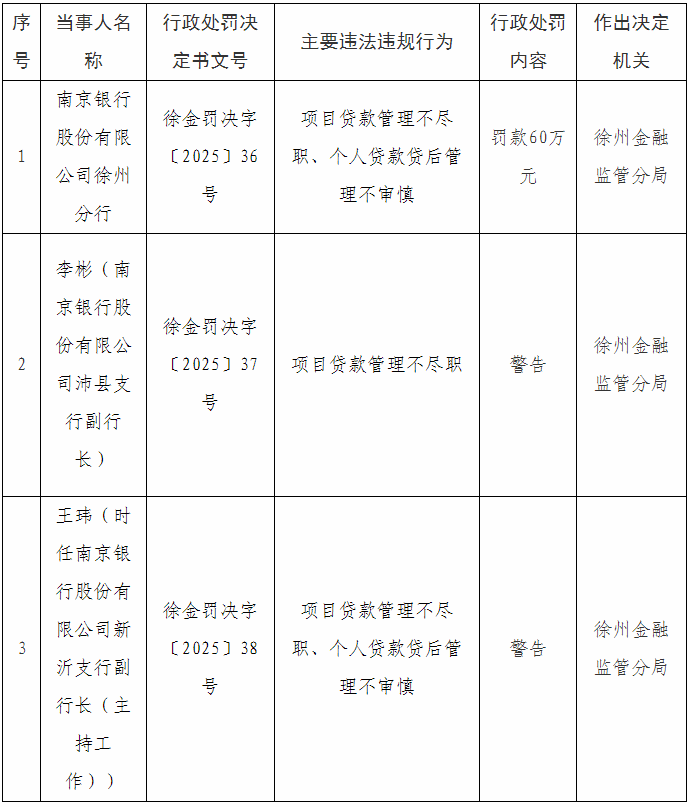
2025年12月15日,江苏金融监管局发布行政处罚信息公开表,涉及南京银行徐州分行。 行政处罚信息公开表显示: 因项目贷款管理不尽职、个人贷款贷后管理不审慎的主要违法违规行为,南京银行徐州分行被徐州金融 监管分局处以"罚款60万元"的行政处罚。 因项目贷款管理不尽职、个人贷款贷后管理不审慎的主要违法违规行为,南京银行徐州分行被徐州金融 监管分局处以"罚款60万元"的行政处罚。 同时,李彬(南京银行沛县支行副行长)与王玮(时任南京银行新沂支行副行长(主持工作))被徐州 金融监管分局处以"警告"的行政处罚。 行政处罚信息公开表原文: | 序 | 当事人名 | 行政处罚决 | 主要违法违规行为 | 行政处罚 | 作出决定 | | --- | --- | --- | --- | --- | --- | | 름 | 称 | 定书文号 | | 内容 | 机关 | | 1 | 南京银行 股份有限 | 徐金罚决字 [2025] 36 | 项目贷款管理不尽 职、个人贷款贷后管 | 罚款60万 | 徐州金融 | | | 公司徐州 | | | 元 | 监管分局 | | | | ਵੇ | 理不审慎 | | | | | 分行 | | ...

破7!人民币对美元年内升值超4%,美元存款收益被抹平
Sou Hu Cai Jing· 2025-12-30 10:58
Core Viewpoint - The continuous appreciation of the RMB against the USD has diminished the attractiveness of USD deposits, leading to a situation where investors face challenges in balancing interest rate fluctuations and exchange rate changes [1][8]. Group 1: Interest Rate Trends - The Federal Reserve has lowered the federal funds rate target range by 25 basis points to between 3.5% and 3.75%, marking the third rate cut of the year and a total reduction of 75 basis points [2]. - Most major state-owned and joint-stock banks have seen USD deposit rates drop below 3%, entering the "2" range, with rates generally between 0.2% and 0.8% for terms from one month to two years [6]. - Some banks, like Bank of Communications, offer slightly higher rates, with one-month USD deposits at 0.2% and rates for three months to two years ranging from 2.3% to 2.8% [6]. Group 2: Exchange Rate Impact - The RMB has appreciated over 4% against the USD since the beginning of the year, with a significant rise of 1.7% in the last 60 days, compressing the yield on USD deposits [8]. - The strong appreciation of the RMB means that investors may face substantial exchange losses when converting back to RMB, potentially offsetting the interest earned on USD deposits [8]. - Experts warn that the rapid appreciation of the RMB could prompt the central bank to take measures, and they advise against speculative behavior regarding exchange rate trends [8][9]. Group 3: Investment Strategy Considerations - Investors are advised to prioritize actual USD usage needs and avoid blindly pursuing high nominal interest rates [9]. - Careful selection of financial products is recommended, balancing safety and yield, while maintaining a risk-neutral approach to manage exchange rate risks [9].

银行金融投资如何摆布记账?
GF SECURITIES· 2025-12-30 05:34
Investment Rating - The report provides a "Buy" rating for all listed banks analyzed, indicating a positive outlook for their stock performance [6]. Core Insights - The report focuses on the classification of financial investments, the current allocation of listed banks, and how related revenues are accounted for under new accounting standards [5]. - As of Q3 2025, the financial investments of 42 listed banks total approximately 101.5 trillion CNY, with 87% allocated to the configuration portfolio and 13% to the trading portfolio [5][23]. - The bond market is the primary investment direction for listed banks, accounting for 87.6% of their financial investments, with government bonds making up 59.5% of this total [5]. Summary by Sections 1. Classification of Financial Investments - Financial assets are classified into three categories under the new accounting standards: FVTPL (fair value through profit or loss), AC (amortized cost), and FVOCI (fair value through other comprehensive income) [12][13]. - The classification is based on the business model for managing financial assets and the cash flow characteristics of the financial assets [14]. 2. Accounting for Market Revenues - FVTPL assets reflect market fluctuations through "fair value changes" in profit or loss, while AC assets do not reflect fair value changes and primarily generate income from interest [5]. - FVOCI assets account for market fluctuations in other comprehensive income, with interest income recognized in profit or loss [5]. 3. Financial Investment Structure - The configuration portfolio is dominant, with state-owned banks showing the highest allocation to AC, while joint-stock banks and city commercial banks have a higher proportion of trading assets [23][24][25]. - The report notes a structural shift where FVOCI is becoming the main growth area, as banks seek flexibility in their investment strategies [5][23].




南京银行杭州萧山支行开展“鑫悦荟”青年交友活动
Ren Min Wang· 2025-12-30 04:05
Core Insights - The event "Winter Warm YOUNG Xin Yue Together" was organized by Nanjing Bank Hangzhou Xiaoshan Branch in collaboration with local educational and community organizations to facilitate social interactions among single youths in Xiaoshan District [1][2] Group 1: Event Overview - The event featured leisure camping and interactive games, creating a "light social, deep connection" atmosphere for participants [1] - Young attendees engaged in discussions about daily work, interests, and life aspirations, fostering a comfortable environment for socializing [2] Group 2: Activities and Engagement - Interactive games such as "Pillow Fight," "Happy Touch," "Drum Passing," and "Guess What I Draw" were designed to enhance team collaboration and break traditional social barriers, allowing participants to showcase their personalities [2] - Feedback from participants indicated that the informal and game-based format reduced social pressure and encouraged natural interactions among peers from different industries [2] Group 3: Future Plans - The Nanjing Bank Hangzhou Xiaoshan Branch plans to continue developing the "Xin Yue Hui" youth social brand, focusing on youth development needs and collaborating with more organizations to create meaningful social events [3] - The initiative aims to provide quality communication platforms for youth, contributing to the construction of a "Youth Aspirational City" in Xiaoshan [3]

“大象起舞”背后,15.6万亿银行股板块的价值重估之路
Bei Jing Shang Bao· 2025-12-30 02:46
Core Viewpoint - The A-share banking sector experienced a significant value reassessment throughout 2025, culminating in a total market capitalization exceeding 15.65 trillion yuan, marking a notable recovery and growth in the sector [1][2]. Group 1: Market Performance - The banking index increased by 12.06% over the year, with 42 listed banks achieving a combined market value growth of 15.37% compared to the end of 2024 [2]. - Agricultural Bank of China emerged as the standout performer with a 51.86% increase in stock price, surpassing Industrial and Commercial Bank of China in total market value [1][2]. - 35 out of 42 listed banks saw their stock prices rise, with several regional banks like Xiamen Bank and Chongqing Bank also showing strong performance, each exceeding a 20% increase [2]. Group 2: Valuation and Market Dynamics - The banking sector's price-to-book ratio showed signs of improvement, with some banks briefly exceeding a ratio of 1, indicating a shift away from the "broken net" situation that had persisted [4]. - The market's transition from valuation repair to value reassessment is attributed to improved investor confidence in banks' long-term profitability and asset quality [3][4]. Group 3: Policy and Economic Environment - The supportive policy environment, including interest rate cuts and liquidity injections, has created a favorable operating climate for banks, enhancing their appeal to long-term investors [8]. - The influx of long-term capital from insurance and pension funds into the banking sector has been driven by regulatory changes and a focus on stable returns [8]. Group 4: Future Outlook - The continuation of the value reassessment in 2026 will depend on macroeconomic stability, ongoing supportive policies, and confirmation of profit growth [9][10]. - The market is expected to experience a more structured performance, with large banks favored for their stability and certain regional banks potentially offering greater growth opportunities [10][11].

洞察2025|“大象起舞”背后,15.6万亿银行股板块的价值重估之路
Bei Jing Shang Bao· 2025-12-30 02:45
Core Viewpoint - The A-share banking sector experienced a significant value reassessment throughout 2025, culminating in a total market capitalization exceeding 15.65 trillion yuan, marking a notable recovery and growth phase for the industry [1][3]. Market Performance - The Wind Banking Index recorded a cumulative increase of 12.06% for the year, with 42 listed banks achieving a total market value growth of 15.37% compared to the end of 2024 [3][8]. - Agricultural Bank of China emerged as the standout performer with a remarkable stock price increase of 51.86%, surpassing Industrial and Commercial Bank of China in total market value [1][3]. - 35 out of 42 listed banks saw their stock prices rise, with several regional banks like Xiamen Bank and Chongqing Bank also posting gains exceeding 20% [3][8]. Valuation Dynamics - The banking sector's average price-to-book ratio improved from a range of 0.33-0.99 at the end of 2024 to some banks briefly exceeding 1.0 in October 2025, indicating a reduction in the "broken net" phenomenon [5][9]. - Despite the average price-to-book ratio remaining at 0.62, the trend shows significant improvement, although concerns about long-term profitability and credit cost pressures persist [5][10]. Policy and Economic Environment - The central bank's monetary policies, including interest rate cuts and structural loans, provided a supportive environment for banks, enhancing market confidence in asset quality [9][10]. - Regulatory adjustments facilitated increased inflows of long-term capital from insurance and pension funds into the banking sector, further supporting the value reassessment [9][10]. Future Outlook - The banking sector's value reassessment is expected to continue into 2026, driven by macroeconomic stabilization, ongoing supportive policies, and confirmation of profit growth [11][12]. - The market may see a shift from broad-based gains to a more differentiated performance, with large banks and high-quality regional banks attracting investor interest due to their stable dividends and solid fundamentals [12].