迈瑞医疗

Search documents
富瑞:中国强劲盈利动能驱动15%上行空间 看好高增长科技制造业
智通财经网· 2025-12-11 05:57
Group 1 - The core viewpoint of the report is that Asian stock markets have risen approximately 25% this year, driven by a revaluation of price-to-earnings ratios, with strong support from a resilient macro environment and robust corporate earnings momentum [1] - The report highlights that South Korea and China maintain strong momentum, while India's stock market continues to reach new highs. Japan remains attractive amid accelerated reforms, and the Australian market shows steady performance [1] - The report anticipates that by mid-2026, the reality of AI returns will be tested, with a peak in the US dollar exchange rate, which will help Asian and emerging markets outperform the broader market [1] Group 2 - In China, strong earnings momentum is expected to drive a 15% upside potential, with a consensus forecast of 16% earnings growth per share by 2026. The private sector and high-tech manufacturing are expected to lead this growth [2] - The report identifies key sectors for 2026, including alternative energy (lithium batteries, solar), automotive, beauty, healthcare, industrial automation, internet technology, and semiconductors, while maintaining a cautious stance on materials and durable consumer goods [2] Group 3 - The report recommends several thematic stocks for 2026, including Tencent, CATL, Sungrow Power Supply, Mindray, Yili, Geely, Galaxy Entertainment, Huahai Pharmaceutical, Yihua Healthcare, and InnoCare Pharma [3]





招商证券国际:料美国明年经济保持温和增长 港股将迈向盈利增长主导
智通财经网· 2025-12-11 04:03
Group 1: Economic Outlook - The U.S. economy is expected to maintain moderate growth in the coming year, supported by factors such as Federal Reserve interest rate cuts and AI investments [1] - The Hong Kong stock market is anticipated to shift from valuation-driven to profit growth-driven, with a projected earnings growth rate of 6% to 10% for the Hang Seng Index [1] Group 2: Market Dynamics - The valuation expansion in the Hong Kong market may weaken, but liquidity will remain supportive, leading to a new supply creating new demand [1] - The dual liquidity easing in both China and the U.S. is expected to increase foreign and southbound capital supply, translating into new demand for Hong Kong stocks [1] Group 3: Sector Analysis - The U.S. tech sector is expected to become more rational, with AI continuing to be a key driver, while the regulatory environment will favor mergers and acquisitions [2] - The domestic pharmaceutical and innovative drug sectors are likely to benefit from a resurgence in M&A activity from large multinational companies [2] - The automotive sector is projected to see flat or slightly declining sales, presenting opportunities to gradually accumulate stocks of companies with high earnings growth certainty [2] Group 4: Recommended Stocks - Top stock picks for the first quarter of next year include Alphabet (GOOGL.US), Meta (META.US), Netflix (NFLX.US), Tencent Holdings (00700), Alibaba (BABA.US), and others [3]



武汉迈瑞科技公司增资至23亿,增幅约667%
Zhong Guo Neng Yuan Wang· 2025-12-11 03:26
该公司成立于2005年6月,经营范围包括第一类医疗器械生产、第二类医疗器械销售、智能机器人的研 发等,现由深圳迈瑞科技控股有限责任公司及上述新增股东共同持股。 来源:中国能源网 天眼查App显示,近日,武汉迈瑞科技有限公司发生工商变更,史鹏卸任法定代表人、执行董事、经 理,韩乐接任法定代表人、经理并担任董事,新增迈瑞医疗(300760)为股东,同时,注册资本由3亿 人民币增至23亿人民币,增幅约667%。 ...
股市面面观丨2025,“茅”股的失意之年?
Xin Hua Cai Jing· 2025-12-11 02:35
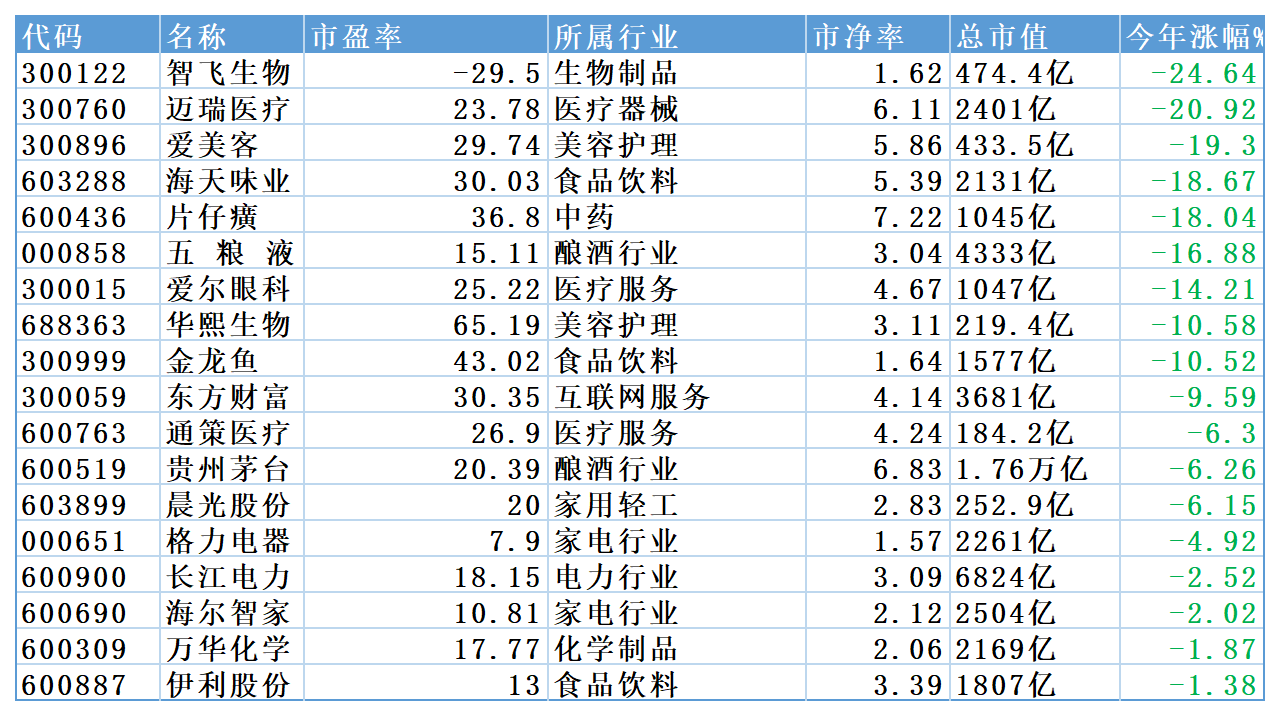
Group 1: Guizhou Moutai Performance - Guizhou Moutai's stock price has been declining, dropping below 1400 CNY per share on December 10, but managed to close at this key level [1] - The decline in Moutai's stock is attributed to the falling prices of Moutai liquor, with the wholesale reference price for 2025 53-degree 500ml Moutai dropping to 1500 CNY per bottle, a decrease of 15 CNY from the previous day, marking a historical low [1] - Year-to-date, Guizhou Moutai's stock has fallen by 6.26%, underperforming the CSI 300 index by nearly 23 percentage points [1] Group 2: Other "Mao" Stocks Performance - The top three "Mao" stocks with the largest declines this year are Zhifei Biological, Mindray Medical, and Aimeike, with respective stock price drops of 24.64%, 20.92%, and 19.3% [2] - A total of 18 "Mao" stocks have declined this year, with 9 of them experiencing drops exceeding 10% [1][4] Group 3: Zhifei Biological Analysis - Zhifei Biological's significant decline is closely related to a substantial drop in performance, reporting a loss of 1.206 billion CNY in the third quarter, resulting in a negative price-to-earnings ratio [4] - The company faces increased competition and pricing pressure in the HPV vaccine market, with a gross margin dropping to 23.77% and a net margin of -15.99% [4] - The company is attempting to diversify away from reliance on HPV vaccines, with 34 self-developed projects in various stages of clinical trials [5] Group 4: Mindray Medical and Aimeike Performance - Mindray Medical's net profit fell by 28.83% year-on-year in the first three quarters, marking the first negative growth in net profit since its listing [6] - Aimeike reported a 31.05% decline in net profit and a 21.49% drop in revenue, both representing the first instances of simultaneous negative growth since its listing [6][7] - Analysts suggest that both companies may see a turnaround in 2026, with Mindray's domestic business expected to achieve positive revenue growth [7][8] Group 5: Market Sentiment and Future Outlook - Despite the overall poor performance of "Mao" stocks in 2025, some technology stocks have significantly outperformed the CSI 300 index, indicating potential new "Mao" stocks emerging from innovative sectors [9] - Notable investors express optimism about Guizhou Moutai, suggesting it remains a better investment than keeping cash in the bank [9]


中国医疗健康-2025 年 11 月中国医疗设备招标:同比增速超预期,上调基准假设-China Healthcare_ Nov 2025 China hospital equipment bidding_ Higher-than-expected yoy growth; lifting base case assumption
2025-12-11 02:23
Summary of Conference Call on China Healthcare Industry and Companies Industry Overview - **Sector**: China Healthcare, specifically focusing on hospital equipment bidding - **Key Data**: November 2025 public hospital medical equipment bidding value increased by **15% YoY**, surpassing previous expectations of flat-to-low single-digit growth [1] Core Insights - **Bidding Activity**: - The increase in bidding value was unexpected, as leading indicators suggested weaker dynamics for 2025 compared to 2024 [1] - United Imaging indicated that while trade-in program execution is faster than last year, some procurement may be deferred to 2026, suggesting a recovery in non-trade-in demand [1] - **Future Outlook**: - A cautious stance is maintained for bidding activity into December 2025 and the first half of 2026 due to tougher base effects and uneven trade-in execution across regions [2] - The base-case assumption for bidding value has been revised from a flat-to-single-digit decline to flat-to-modest YoY growth for December 2025 and 1H26 [2] Company-Specific Insights United Imaging - **Performance**: - Domestic revenue grew **73% YoY** in 3Q25, driven by previous hospital bidding revenue recognition; overseas revenue increased by **81% YoY** [14] - Service revenue grew **22% YoY**, indicating resilience to economic cycles [14] - November growth was **30% YoY**, significantly higher than the industry average of **15%** [14] - **Valuation**: - Currently trading near its median P/E multiple since listing, with significant long-term net profit growth potential anticipated [14] Mindray - **Performance**: - Core businesses showed mixed results: PMLS grew **2.6%**, MI grew **1%**, while IVD declined **2.8%** in 3Q25 [16] - Domestic PMLS revenue decline narrowed to **-25%** from **-57%** in 1H25, with overseas sales up **14% YoY** [16] - Management expects destocking to complete by 4Q25, with revenue recovery anticipated in 2026 [16] - **Growth Drivers**: - Long-term double-digit growth supported by recurring business in China and market share gains in emerging markets [16] - High-potential products expected to drive significant revenue growth in China from 2024 to 2035 [16] Risks and Challenges - **Mindray**: - Risks include potential impacts from VBP on product pricing, challenges in penetrating top-tier hospitals, and difficulties in entering North American and European markets [77] - **United Imaging**: - Risks include chip supply chain issues, raw material risks, macroeconomic downturns in China, and potential VBP risks [78] Investment Ratings - **Mindray**: Rated as "Buy" with a 12-month target price of **Rmb285**, indicating an upside of **43.4%** [79] - **United Imaging**: Rated as "Buy" with a 12-month target price of **Rmb174**, indicating an upside of **34.9%** [82] Conclusion - The China healthcare equipment sector is showing signs of recovery with better-than-expected bidding activity, particularly for United Imaging. Mindray is facing challenges but has potential growth drivers in emerging markets and high-potential products. Both companies are rated as "Buy" with significant upside potential.

2025年中国医疗AI解决方案行业政策、产业链、市场规模、细分产品结构、竞争格局、代表企业经营现状及发展趋势分析研判:应用广泛且持续深入,市场格局愈加多元化[图]
Chan Ye Xin Xi Wang· 2025-12-11 01:34
Core Insights - China is a significant market for global medical AI solutions, benefiting from technological advancements, high-quality medical data accumulation, supportive national policies, and growing market demand, leading to rapid growth in AI applications in healthcare [1][4]. Market Size and Growth - The market size for medical AI solutions in China is projected to grow from 9.1 billion yuan in 2021 to 16.4 billion yuan in 2024, with L1 solutions increasing from 5.8 billion yuan to 9.4 billion yuan, L2 solutions from 3.3 billion yuan to 6.9 billion yuan, and L3 solutions at 0.1 billion yuan [1][4]. - By 2025, the market size is expected to reach 18.2 billion yuan, with L1 solutions at 9.8 billion yuan, L2 solutions at 7.8 billion yuan, and L3 solutions at 0.6 billion yuan [1][4]. Industry Definition and Applications - Medical AI solutions utilize AI technologies such as machine learning, deep learning, natural language processing, and big data analysis to enhance various medical processes, including diagnosis, treatment, drug development, and hospital management [2][3]. - The industry is evolving from L1 and L2 solutions, which provide supportive insights, to L3 and L4 autonomous agents capable of executing tasks independently [2][3]. Industry Development Status - The integration of general large model capabilities with medical knowledge bases is driving the transition of medical AI solutions towards higher levels of autonomy [3][4]. - The global market for medical AI solutions is expected to grow from 23.2 billion yuan in 2021 to 40 billion yuan in 2024, with L1 solutions increasing from 13.9 billion yuan to 21.1 billion yuan, L2 solutions from 9.3 billion yuan to 18.7 billion yuan, and L3 solutions at 0.2 billion yuan [4]. Industry Chain - The medical AI solutions industry chain includes upstream data supply, hardware providers (chips, servers), cloud services, operating systems, and algorithms, with midstream companies providing AI solutions and downstream applications in healthcare institutions, pharmaceutical companies, and individual patients [5]. Policy Environment - The Chinese government has prioritized the application of AI in healthcare, implementing policies to support AI in medical diagnosis, health management, and insurance regulation, which are expected to accelerate the development of AI in healthcare [5]. Competitive Landscape - The industry features a competitive landscape with local giants, vertical startups, and multinational companies. Key players include iFlytek Medical, Baidu, United Imaging, CloudWalk, Weining Health, and Mindray Medical [7]. - iFlytek Medical is a leading company in the AI healthcare sector, leveraging its large model to empower various healthcare stakeholders and has developed comprehensive AI solutions for hospitals and primary care institutions [9][11]. Revenue Structure of Key Players - iFlytek Medical reported a revenue of 299 million yuan in the first half of 2025, with contributions from various solutions: 84 million yuan from primary care solutions, 58 million yuan from regional solutions, 53 million yuan from hospital solutions, and 104 million yuan from patient management services [11]. - The company aims to build a robust B-end ecosystem to strengthen its commercial channels [9]. Future Trends - The development of the medical AI industry will be driven by a combination of technology, data, scenarios, and regulation, leading to a more mature, deeper, and broader market landscape [12].


深港携手展示药械全链条
Shen Zhen Shang Bao· 2025-12-10 17:31
Group 1 - The 2025 Shenzhen International High-Performance Medical Device and Innovative Pharmaceutical Exhibition is fully prepared, featuring over 300 exhibitors from various countries, including multinational companies like Siemens Healthineers and Medtronic, as well as domestic leaders such as China Resources, Mindray, and Jingfeng Technology [1][2] - The exhibition will follow the theme "Innovative Drugs and Devices, Collaborative Win-Win," highlighting five key features: high specifications, broad fields, complete chains, new achievements, and a comprehensive ecosystem [1] - The event will include over 20 sub-forums covering six key topics, promoting deep exchanges among industry, academia, research, medical, financial, and governmental sectors [1] Group 2 - The exhibition will adopt a "One Exhibition, Two Cities" model, showcasing the latest achievements from source innovation to industrial transformation, and facilitating industry exchanges, resource matching, and trade transactions [2] - The Hong Kong segment will start on December 11, focusing on international clinical trials, technology and product exports, cell and gene therapy, AI in medical devices, and brain science, emphasizing the role of Shenzhen-Hong Kong cooperation in advancing the pharmaceutical and medical device industries [2] - The main Shenzhen exhibition will take place from December 18 to 20 at the Shenzhen Convention and Exhibition Center, covering the entire chain of pharmaceuticals and medical devices, and showcasing emerging fields such as biomanufacturing, AI+medical devices, aesthetic medical devices, and home health [2]
政策拉动国内市场有效复苏,医疗设备招采保持快速增长
GUOTAI HAITONG SECURITIES· 2025-12-10 15:07
Investment Rating - The report maintains an "Overweight" rating for the industry [1][5]. Core Insights - The medical device procurement scale continues to grow, driven by ongoing equipment update policies, which are expected to lead to a long-term increase in procurement levels. The report recommends medical device companies that are likely to benefit from these policies, including Mindray Medical, United Imaging, Kaili Medical, and Aohua Endoscopy [3][5]. - In November 2025, the new equipment procurement scale showed significant year-on-year growth: MRI increased by 11.1%, CT by 26.4%, DR by 47.2%, ultrasound by 17.0%, while endoscopes declined by 4.9%, and surgical robots grew by 8.6%. Cumulatively, from January to November 2025, MRI grew by 50.4%, CT by 72.7%, DR by 74.0%, ultrasound by 56.1%, endoscopes by 19.7%, and surgical robots by 32.8% [5]. - The equipment update policy is expected to drive procurement levels significantly, with a target of over 25% growth in medical equipment investment by 2027 compared to 2023. This policy is expected to enhance the configuration of high-end equipment to levels comparable to middle-income countries [5]. - The domestic market is showing signs of recovery, with a notable increase in procurement demand from medical institutions, reflecting a positive trend in the medical equipment industry. For instance, United Imaging reported a revenue of 6.866 billion yuan in the domestic market for the first three quarters of 2025, representing a year-on-year growth of 23.7% [5]. Summary by Sections - **Investment Recommendations**: The report suggests maintaining an "Overweight" rating and recommends companies likely to benefit from the equipment update policies [5]. - **Market Trends**: The report highlights the growth in procurement scale for various medical devices, indicating a robust market environment [5]. - **Policy Impact**: The ongoing implementation of equipment update policies is expected to significantly enhance procurement levels in the medical sector [5].

量化赋能,专业护航,建信创业板综增强ETF来了!
Xin Lang Cai Jing· 2025-12-10 13:56
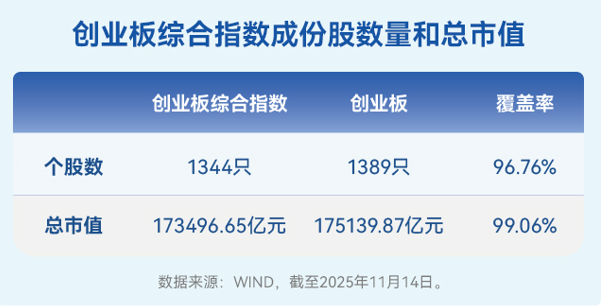
Core Viewpoint - The A-share market has shown strong performance this year, with major indices experiencing varying degrees of increase, reflecting an enhancement in market risk appetite and active structural opportunities [1][18] Index Overview - The ChiNext Composite Index (399102.SZ) covers over 1,300 listed companies on the ChiNext board, with a total market capitalization coverage of 98% [1][19] - The index has a base point of 1,000 and was established on May 31, 2010 [1] | | ChiNext Composite Index | ChiNext | Coverage Rate | | --- | --- | --- | --- | | Number of Stocks | 1344 | 1389 | 96.76% | | Total Market Value | 173,496.65 billion | 175,139.87 billion | 99.06% | Historical Performance - Since its inception on May 31, 2010, the ChiNext Composite Index has increased by 285.29%, significantly outperforming the Shanghai Composite Index and Shenzhen Component Index during the same period [2][19] Industry Distribution - The ChiNext Composite Index has a high concentration in technology sectors, covering industries such as power equipment, electronics, biomedicine, communications, and computers, which helps capture investment opportunities in various high-tech fields [4][21] - The top five industries by weight are: - Power Equipment (23.5%) - Electronics (13.7%) - Biomedicine (10.4%) - Communications (9.7%) - Computers (9.5%) - These five industries collectively account for approximately 66.8% of the index [4][21] Valuation - The current Price-to-Earnings (PE) ratio (TTM) of the ChiNext Composite Index is 66.75, which is within a reasonable range of around 57% over the past decade, indicating potential for upward adjustment compared to other major A-share indices [7][24] | | PE (TTM) | PE Percentile | | --- | --- | --- | | ChiNext Composite | 66.75 | 57.04% | | Shanghai Composite | 16.64 | 97.53% | | Shenzhen Component | 30.56 | 80.70% | | Wind All A | 22.20 | 89.96% | Investment Strategy - The enhanced strategy ETF aims to outperform the benchmark index by closely tracking the ChiNext Composite Index while employing quantitative management strategies to optimize portfolio holdings [8][25] - The investment model emphasizes consistent performance and aims to adapt to different market conditions to achieve better investment outcomes [10][27] Management Expertise - The management team at Jianxin Fund has extensive experience in index product investment management, with members possessing diverse academic backgrounds in mathematics, computer science, and finance [11][28]

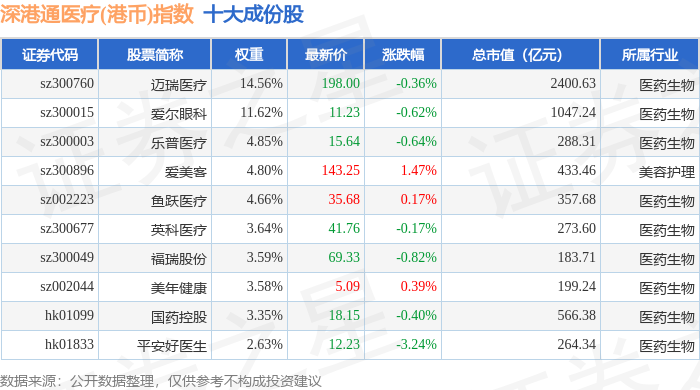
12月10日深港通医疗(港币)(983036)指数跌0.28%,成份股先健科技(01302)领跌
Sou Hu Cai Jing· 2025-12-10 11:19
Core Points - The Shenzhen-Hong Kong Stock Connect Medical Index (983036) closed at 4327.65 points, down 0.28%, with a trading volume of HKD 7.682 billion and a turnover rate of 0.9% [1] - Among the index constituents, 21 stocks rose while 36 stocks fell, with Kewei Medical leading the gainers at a 4.14% increase and Xianjian Technology leading the decliners at a 9.14% decrease [1] Index Constituents Summary - The top ten constituents of the Shenzhen-Hong Kong Stock Connect Medical Index include: - Mindray Medical (sz300760) with a weight of 14.56%, latest price at HKD 198.00, and a market cap of HKD 240.063 billion, down 0.36% [1] - Yier Eye Hospital (sz300015) with a weight of 11.62%, latest price at HKD 11.23, and a market cap of HKD 104.724 billion, down 0.62% [1] - Lejin Medical (sz300003) with a weight of 4.85%, latest price at HKD 15.64, and a market cap of HKD 28.831 billion, down 0.64% [1] - Aimeike (sz300896) with a weight of 4.80%, latest price at HKD 143.25, and a market cap of HKD 43.346 billion, up 1.47% [1] - Yuyue Medical (sz002223) with a weight of 4.66%, latest price at HKD 35.68, and a market cap of HKD 35.768 billion, up 0.17% [1] - Yingke Medical (sz300677) with a weight of 3.64%, latest price at HKD 41.76, and a market cap of HKD 27.360 billion, down 0.17% [1] - Furuijia (sz300049) with a weight of 3.59%, latest price at HKD 69.33, and a market cap of HKD 18.371 billion, down 0.82% [1] - Meinian Health (sz002044) with a weight of 3.58%, latest price at HKD 5.09, and a market cap of HKD 19.924 billion, up 0.39% [1] - Sinopharm Holdings (hk01099) with a weight of 3.35%, latest price at HKD 18.15, and a market cap of HKD 56.638 billion, down 0.40% [1] - Ping An Good Doctor (hk01833) with a weight of 2.63%, latest price at HKD 12.23, and a market cap of HKD 26.434 billion, down 3.24% [1] Capital Flow Analysis - The index constituents experienced a net outflow of HKD 382 million from institutional investors, while retail investors saw a net inflow of HKD 329 million [1] - Notable individual stock capital flows include: - Meinian Health (sz002044) with a net inflow of HKD 23.6308 million from institutional investors [2] - Aimeike (sz300896) with a net inflow of HKD 5.8353 million from institutional investors [2] - Yier Eye Hospital (sz300015) with a net outflow of HKD 20.7620 million from retail investors [2]