
LG

Search documents
海外营收占40%,韩国三星、LG是其客户,场内智能物流厂商获亿元级B2轮融资|36氪首发
36氪· 2025-06-13 16:34
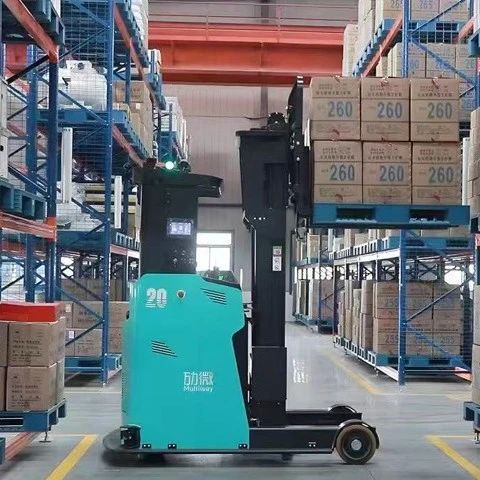
Core Viewpoint - The article highlights the rapid growth and international expansion of "Maiwei Robotics," a provider of intelligent logistics solutions, which has successfully increased its overseas revenue from less than 10% in 2022 to 40% currently, following a recent financing round to support technology development and market expansion [3][13]. Company Overview - Maiwei Robotics was established in 2019 and is headquartered in Shenzhen, China, with operations in over 30 countries and regions globally [5]. - The company specializes in intelligent manufacturing and logistics solutions based on robotics and artificial intelligence, serving key industries such as mechanical manufacturing, food and beverage, metallurgy, chemical energy, automotive manufacturing, and cold chain logistics [5][6]. Product and Technology - Maiwei Robotics has developed a comprehensive product matrix, including over 30 types of mobile robots, such as unmanned forklifts, AMRs, unmanned towing vehicles, and four-way shuttles, addressing various logistics needs [8][9]. - The company has achieved over 80% self-research rate for core components like laser radar and distance sensors, and has developed a full-stack self-research system for navigation, perception, control, scheduling, and safety algorithms [8][9]. - The AI Tianyan system and cluster scheduling system enhance operational efficiency, allowing for dynamic path planning and low congestion rates during simultaneous operations of multiple devices [8][9]. Market Performance - Since launching commercial operations in 2021, Maiwei Robotics has signed contracts exceeding 60 million RMB in its first year, indicating strong market demand [13]. - The company has successfully transitioned to a global market presence, with overseas revenue now constituting 40% of total income, reflecting significant international growth [13]. Investor Insights - Investors express confidence in Maiwei Robotics' potential for international growth and innovation in intelligent logistics, emphasizing the company's strategic capabilities and the importance of its self-developed technology [14]. - The backing from prominent investors like PwC Capital and Meihua Venture Capital underscores the belief in the company's ability to become a leading player in the global robotics market [14].

鑫椤锂电一周观察 | 国务院严令锂电客户承诺“60天付款”
鑫椤锂电· 2025-06-13 08:04
-广告- 关注公众号,点击公众号主页右上角" ··· ",设置星标 "⭐" ,关注 鑫椤锂电 资讯~ 本文来源: #鑫椤锂电 行业热点 I C C S I N O 国务院严令锂电客户承诺"60天付款" 在国家部委就保障产业链供应链稳定、促进汽车产业高质量发展作出一系列部署的背景下,广汽集团、中 国一汽、东风汽车、赛力斯集团、比亚迪、长城汽车、小米汽车、小鹏汽车等车企宣布,自6月10日起, 将供应商的支付账期控 制在60天以内,以保障供应链资金高效周转,助力产业链协同发展。 锂电巨头将于6月底停产! 瑞典电池制造商 Northvolt 将于 2025 年 6 月底停止其谢莱夫特奥工厂的电池单元生产。 据破产管理人 称,这一决定是在瑞典正在进行的破产程序的背景下做出的。寻找电池生产买家的尝试迄今为止尚未成 功。这意味着这家瑞典公司在其本土的电池生产将彻底结束。Northvolt自3月12日宣布破产以来,尽管生 产大幅削减,但仍依靠斯堪尼亚的订单维持部分运营。如今,斯堪尼亚将转向中国电池巨头宁德时代,彻 底中断与Northvolt的合作。一旦斯堪尼亚退出,Northvolt在瑞典将无任何订单来源。 津巴布韦将从20 ...
电子化学品国产化正当时
Zhong Guo Hua Gong Bao· 2025-06-13 03:06
Core Viewpoint - The electronic chemicals industry in China is experiencing significant advancements in domestic production capabilities, particularly in high-end products, driven by policy support and market demand, while still facing challenges in certain areas of technology and material sourcing [2][3][4]. Group 1: Industry Development - The domestic production rate of electronic chemicals has increased, with notable progress in photoresists and wet electronic chemicals, although high-end products still rely heavily on imports [3]. - Companies like Nanda Optoelectronics and Tongcheng Electronics have achieved breakthroughs in the research and production of KrF and ArF photoresists, leading to substantial increases in revenue and profit [3]. - The overall domestic production rate for wet electronic chemicals is around 50%, but advanced processes below 28nm still depend on imports [3]. Group 2: Green and Intelligent Transformation - The industry is shifting towards green and intelligent production methods, with innovations such as Intel's chemical recycling network and Sumitomo Chemical's low-temperature vacuum distillation technology for photoresist recovery [4][5]. - New technologies are being developed to reduce energy consumption in the production of high-purity chemicals, which accounts for approximately 60% of chemical energy consumption [4]. Group 3: Collaborative Innovation and Industry Clusters - The electronic chemicals industry exhibits clear clustering characteristics, with regions like the Yangtze River Delta forming alliances to enhance collaboration between upstream and downstream sectors [6][7]. - Shanghai is taking strategic steps to address critical challenges in electronic chemicals, while Jiangsu and Zhejiang are nurturing strong leading enterprises in photoresists and wet electronic chemicals [7]. - Internationally, regions like Germany are also demonstrating industrial clustering through integrated production and resource recycling initiatives [7].
亮度可达20000尼特,三星展示XR头显用RGB OLEDoS屏幕
WitsView睿智显示· 2025-06-12 09:06
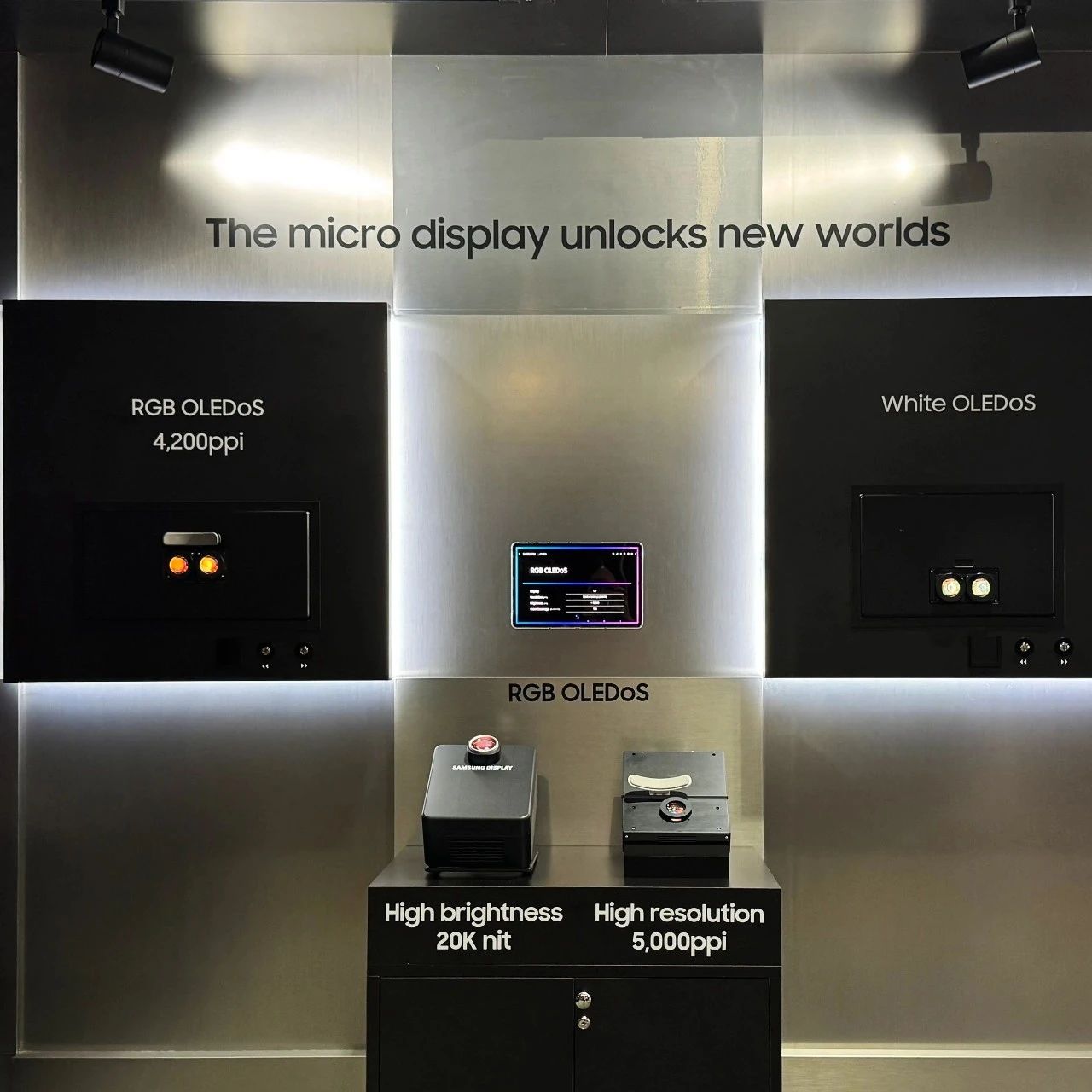
Core Viewpoint - Samsung showcased its advanced RGB OLEDoS screens designed for XR headsets at the AWE USA 2025, featuring a peak brightness of 20,000 nits [1]. Group 1: Product Innovations - The RGB OLEDoS screen measures 1.3 inches with a pixel density of 4200 ppi and utilizes micro-lens array (MLA) technology to enhance brightness and viewing angles [1]. - Samsung also presented a flagship 1.4-inch RGB OLEDoS panel with a pixel density of 5000 ppi and a brightness of 15,000 nits, supporting a variable refresh rate of 120Hz [3]. - A white OLEDoS panel measuring 1.3 inches with a pixel density of 4000 ppi and a brightness of 10,000 nits has already entered mass production, while the RGB OLEDoS panels are planned for mass production next year [5]. Group 2: Future Technologies - Samsung introduced innovative screens such as a 12.4-inch Rollable Flex OLED panel that can fold and roll, suitable for tablet devices [6]. - The Flex S multi-fold OLED panel can be folded multiple times, making it ideal for hybrid devices transitioning from smartphones to tablets [6]. - A stretchable display based on Micro LED technology was also showcased, which could be used for innovative advertising in the future [6].
亮度可达20000尼特,三星展示XR头显用RGB OLEDoS屏幕
WitsView睿智显示· 2025-06-12 09:05
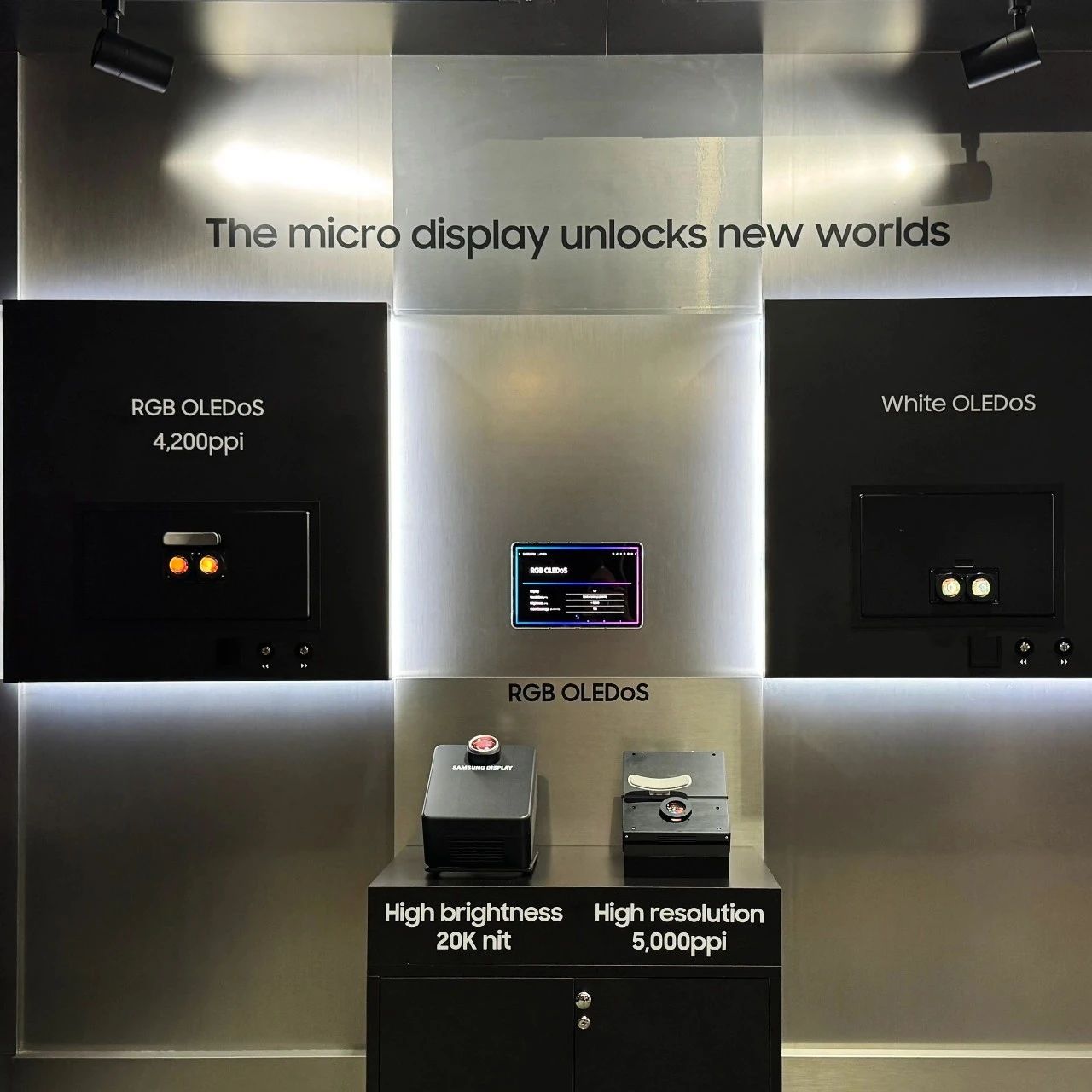
Core Viewpoint - Samsung showcased advanced RGB OLEDoS screens designed for XR headsets at the AWE USA 2025, featuring peak brightness of up to 20,000 nits [1][2]. Group 1: Product Specifications - The RGB OLEDoS screen measures 1.3 inches with a pixel density of 4200 ppi and utilizes micro-lens array (MLA) technology to enhance brightness and viewing angles [2]. - Samsung also presented a flagship 1.4-inch RGB OLEDoS panel with a pixel density of 5000 ppi and a brightness of 15,000 nits, supporting a variable refresh rate of 120Hz [3]. - A white OLEDoS panel measuring 1.3 inches was displayed, featuring a pixel density of 4000 ppi and a brightness of 10,000 nits [3]. Group 2: Production and Future Plans - The white OLEDoS panel is currently in mass production, while the RGB OLEDoS panel is scheduled for mass production next year [6]. - Samsung's acquisition of eMagin has led to the introduction of a new ultra-small 0.62-inch white OLEDoS panel and a 2600 ppi RGB OLEDoS panel [3]. Group 3: Additional Innovations - Samsung introduced innovative screens such as a 12.4-inch Rollable Flex OLED panel suitable for tablets and a Flex S multi-fold OLED panel designed for hybrid devices transitioning from smartphones to tablets [7]. - A stretchable display based on Micro LED technology was also showcased, which could be utilized for innovative advertising in the future [7].
科技巨头押注机器人赛道:三星、英伟达(NVDA.US)联手参投Skild AI,B轮估值达45亿美元
Zhi Tong Cai Jing· 2025-06-12 02:53
Group 1 - Samsung Electronics and Nvidia are acquiring minority stakes in Skild AI Inc. to enhance their development in the emerging consumer robotics industry [1] - Samsung is investing $10 million in Skild, while Nvidia is investing $25 million, as part of Skild's Series B funding round led by SoftBank Group with a total of $100 million, valuing Skild at approximately $4.5 billion [1] - Samsung views the investment in Skild as a way to understand the startup and its talent without making a significant commitment, while also keeping pace with other South Korean conglomerates investing in Skild [1] Group 2 - Robotics technology is rapidly becoming a major growth area for global tech companies, with significant investments from Apple, Meta Platforms, Amazon, and Alphabet's Google [2] - Tesla has been preparing to launch its Optimus robot, while Samsung has made a small investment in Physical Intelligence, a startup developing underlying robotics algorithms, which has raised about $400 million and is recently valued at around $2.4 billion [3] - Samsung has ambitions beyond just selling vacuum robots, including humanoid robots and other home appliances, and plans to launch Ballie, a soccer ball-sized robot, in collaboration with Google [3]


机器人时代来临?英伟达1.8亿投资这家AI机器人公司
Feng Huang Wang· 2025-06-12 01:27
Group 1 - Nvidia and Samsung are investing in AI robotics startup Skild AI to strengthen their presence in the emerging consumer robotics industry [1][2] - Nvidia is investing $25 million (approximately 180 million RMB) while Samsung is investing $10 million [1] - This investment is part of Skild's Series B funding round, which is led by SoftBank Group with an investment of $100 million, valuing the company at approximately $4.5 billion [1] Group 2 - The robotics sector is becoming a significant area for growth among global tech companies, with major players like Apple, Meta, Amazon, and Google making substantial investments [1] - Nvidia is promoting the concept of "physical AI," which refers to AI systems capable of operating in the physical world, such as robots and autonomous vehicles [1] - Samsung's investment in Skild allows the company to stay informed about the startup and its talent without making a major investment commitment [2]
人形机器人行业观点更新:FIGURE机器人产业端催化不断 持续关注FIGURE机器人产业链
Xin Lang Cai Jing· 2025-06-10 10:39
Group 1 - Figure is making significant strides in the humanoid robot sector, with the launch of its first humanoid robot, Figure 01, in October 2023, capable of performing simple tasks and learning through human demonstration [1] - The company completed a $675 million Series B funding round in February 2024, with investors including Microsoft, Intel, OpenAI Startup Fund, Amazon Industrial Innovation Fund, and Nvidia, and announced a partnership with OpenAI to develop a specialized AI model for its humanoid robots [1][2] - The second-generation humanoid robot, Figure 02, was launched in August 2024, featuring a complete redesign with an exoskeleton structure for improved reliability and compactness [1] Group 2 - Figure's valuation surged to $2.6 billion following its Series B funding round in February 2024, with significant investments from major tech companies and venture capitalists [4] - The company is in discussions for a Series C funding round in April 2025, aiming for a valuation of $40 billion (approximately 290 billion) to raise between $1 billion and $2 billion [5] Group 3 - Brett Adcock, the founder of Figure, has a successful entrepreneurial background, having previously founded and exited two companies, which may contribute to Figure's potential success in the humanoid robot market [6]
固态电池:产业化提速,如何卡位关键环节?
2025-06-09 15:30
Summary of Solid-State Battery Industry Conference Call Industry Overview - The solid-state battery industry is experiencing accelerated industrialization, supported by a 6 billion yuan project from the Ministry of Industry and Information Technology, which covers major domestic enterprises and automakers [1][3] - Domestic automakers are actively investing in solid-state battery technology, with companies like SAIC and Geely making significant advancements [1][6] Key Developments - Toyota has postponed its mass production of solid-state batteries to 2027, while Samsung also plans to start production in 2027 [1][5] - Domestic companies such as BYD and CATL are targeting small-scale production by 2027, with CATL planning to produce chloride solid-state batteries [1][7] - Guoxuan High-Tech has launched a solid-state battery with an energy density of 350 Wh/kg, while Xinwanda aims for a similar energy density by around 2026 [1][8] Market Potential - The solid-state battery market is projected to reach 10 GWh by 2025 and 600 GWh by 2030, with a market size estimated at 250 billion yuan [1][24] - The industry is expected to remain competitive and diverse, with multiple companies vying for market share as core technology bottlenecks are overcome [1][25] Technical Challenges - Solid-state batteries have reached vehicle testing levels, but challenges remain in achieving large-scale stable production, particularly concerning yield rates and consistency [1][12] - The purity and particle size of lithium sulfide, a key raw material, must meet high standards (99.99% purity) for effective production [1][15] International Comparison - Domestic companies are on par with international leaders like Panasonic and Toyota in terms of technological progress, with some second-tier companies also showing advantages in key technologies [1][9] - Japanese companies have delayed their production timelines, indicating potential issues in their development processes [1][5] Future Trends - The solid-state battery industry is expected to see significant developments from 2025 to 2027, with a focus on optimizing safety, efficiency, and cost [1][30] - Multiple electrolyte routes (sulfide, oxide, polymer) are being explored, with sulfide being the most promising but not yet fully established [1][10][11] Investment Opportunities - The solid-state battery supply chain is entering an industrialization phase, presenting numerous investment opportunities in materials, equipment, and other sectors [2][3] Conclusion - The solid-state battery industry is poised for growth, with substantial government support and advancements from domestic companies. However, technical challenges and international competition will shape its future trajectory.
固态电池产业调研更新
2025-06-09 15:30
Summary of Solid-State Battery Industry Research Update Industry Overview - The solid-state battery industry is experiencing significant advancements, particularly in the development of sulfide solid-state batteries, which are favored for their superior conductivity compared to oxide alternatives. Major companies like CATL and BYD are actively pursuing the sulfide route, accelerating product launches and industry progress [1][5][7]. Key Points Cost Reduction Potential - Solid-state batteries have substantial cost reduction potential by utilizing higher voltage platforms and higher capacity electrode materials. For instance, CATL's next-generation solid-state battery may achieve 500 Wh/kg, which could reduce material consumption by 60% compared to current lithium iron phosphate batteries [2][5]. Market Trends - The solid-state battery technology is transitioning from pilot to mass production, with automotive-grade batteries reaching a 60 Ah application state, indicating readiness for road testing and commercial production. CATL and BYD are expected to undergo mid-term assessments by the Ministry of Industry and Information Technology and the Ministry of Finance in September 2025 [1][8]. Sulfide Electrolyte Development - The sulfide electrolyte technology is rapidly evolving, with several companies showcasing products with conductivity nearing that of liquid electrolytes. Companies like Ruigu New Materials, Yuyuan Tianci, and Solid State Technology are leading in this field, with a 300 kg production line already operational [1][9][10]. Production Techniques - Various production techniques for sulfide electrolytes are being explored, including liquid-phase, solid-phase, carbothermal reduction, and CVD methods. The CVD method, used by Xiamen Tungsten New Energy, is noted for its potential to achieve low-cost production [1][11]. Equipment Market - Key players in the solid-state battery equipment market include Honggong Technology and Nacronor, focusing on material automation processing and rolling equipment, respectively. Investment in solid-state battery sectors should prioritize sulfide electrolyte materials and related equipment [3][12]. Investment Recommendations - Investment opportunities should focus on companies involved in sulfide electrolyte materials and related equipment, such as Xiamen Tungsten New Energy, Guanghua Technology, and Yuyuan New Materials, which show significant growth potential and reasonable valuations [3][13][14]. Industry Challenges - Smaller battery companies face challenges in leveraging solid-state technology due to strict electrochemical laws, making it difficult to achieve breakthroughs without substantial technological advancements [4]. Future Outlook - The solid-state battery industry is currently transitioning from small-scale trials to mid-scale production, with expectations for increased product output and capacity expansion in the coming year [15]. Notable Company Developments - Xiamen Tungsten is expected to achieve significant performance improvements in its lithium cobalt oxide products, while Yuyuan New Materials has made rapid advancements in high-purity lithium sulfide production, collaborating closely with major clients like CATL and Huawei [21][22][23]. Emerging Players - Companies like Sanxiang New Materials in the halide electrolyte sector are also showing promise, with significant growth expected in the coming years if breakthroughs are achieved [24][25]. Conclusion - The solid-state battery industry is poised for rapid growth, driven by advancements in sulfide technology and increasing investments in production capabilities. Key players are well-positioned to capitalize on these trends, making it a compelling area for investment.



