
江西铜业

Search documents
【行业研究】求“铜”存异,负加工费时代的铜冶炼企业——有色金属行业深度研究
Xin Lang Cai Jing· 2025-12-17 14:19
Core Insights - The global copper smelting industry, particularly Chinese enterprises, is facing severe challenges and strategic transformations as it enters a historic "negative processing fee" era, driven by structural imbalances between tight mineral supply and expanded smelting capacity [1][28] - Leading companies are adapting by enhancing resource self-sufficiency, exploring by-product value, optimizing technology for cost reduction, utilizing financial tools flexibly, and promoting industry consolidation to build new competitive advantages [1][28] - Long-term growth is anticipated as demand for materials from new energy and high-end manufacturing continues to rise, transitioning the copper smelting industry from a "strong cyclical attribute" to a "growth attribute" for high-quality development [1][28] Industry Background - Copper is one of the earliest metals recognized and used by humans, with extensive applications due to its excellent conductivity, thermal conductivity, ductility, and corrosion resistance [2][29] - The copper industry chain is divided into upstream mining, midstream copper smelting, and downstream copper processing, ultimately reaching the end consumer market [2][29] Current Industry Challenges - China, as the largest refined copper producer, has limited copper mineral resources and heavily relies on imported ores, a situation expected to persist in the short term [4][31] - In 2024, China's copper ore production is projected to be approximately 1.8 million tons, a year-on-year decrease of 11%, while refined copper production is expected to reach 13.64 million tons, an increase of over 5% [4][31] - The self-sufficiency rate for copper concentrate in China is only 13%, with imports of copper concentrate expected to rise to 28.11 million tons in 2024 [4][31] Processing Fee Dynamics - The processing fee (TC/RC) has entered a downward trend, with the first negative value recorded for imported copper concentrate in 2025, reaching a historical low of -40 USD per dry ton [4][32] - The decline in processing fees reflects the structural imbalance between tight raw material supply and expanded smelting capacity, severely impacting the bargaining power of Chinese smelting enterprises [5][32] Impact of Negative Processing Fees - The "negative processing fee" indicates that smelting companies not only fail to earn processing income but must pay fees to obtain processing rights for copper concentrate, fundamentally disrupting traditional profit models [6][35] - Various scenarios illustrate the impact of processing fee declines on profitability, with significant losses projected if processing fees remain negative [6][36] Profitability Analysis - From 2023 to 2025, the benchmark for long-term copper concentrate processing fees is expected to decline significantly, with 2024 and 2025 fees projected at 80 USD per dry ton and 21.25 USD per dry ton, respectively [7][37] - Despite ongoing resource shortages and cost pressures, leading smelting companies have not significantly reduced production, continuing capital expenditures in the industry [7][37] Company Performance Metrics - Key companies in the copper smelting sector, such as Jiangxi Copper, Tongling Nonferrous, and Jinchuan Group, show varying production capacities and financial metrics, with some facing negative cash flows [9][38] - For instance, Jiangxi Copper has a smelting capacity of 2.13 million tons and reported a cash flow deficit of 7.73 million [9][38] Resource Self-Sufficiency - The self-sufficiency of mineral resources is critical for copper smelting companies, directly affecting their production, costs, competitiveness, and sustainability [11][11] - Companies are attempting to transition from "processing services" to "resource production" to mitigate the impact of low self-sufficiency on profitability [11][11] By-Product Revenue - The production of sulfuric acid as a by-product in copper smelting has become increasingly profitable, with companies like Jiangxi Copper and Tongling Nonferrous reporting high gross profit margins from sulfuric acid sales [13][15] - The recovery of precious metals from copper anode mud also presents significant economic value, with advanced extraction technologies in place [14][15] Technological Advancements - Continuous technological improvements in smelting processes and green transformations have positioned leading companies at the forefront of global standards, enhancing recovery rates and reducing costs [18][19] - Scale production helps lower fixed costs, with major companies maintaining low production costs despite the challenges posed by negative processing fees [19][19] Future Outlook - The copper smelting industry faces numerous survival challenges, but through strategic collaboration and healthy development, companies may maintain profitability even in a negative processing fee environment [24][27] - The global copper market is expected to shift from surplus to shortage by 2026, with prices anticipated to remain high due to supply concerns from major mining regions [27][28]




金价飙升,A股矿企掀“淘金热”
3 6 Ke· 2025-12-17 11:27
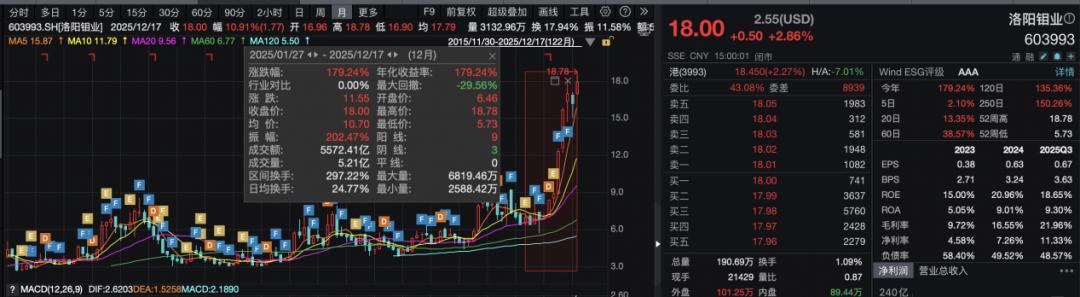
Core Viewpoint - The surge in gold prices has prompted Chinese mining companies to aggressively acquire gold assets globally, reflecting a "gold rush" mentality in the industry [1][3][6]. Group 1: Company Actions - Luoyang Molybdenum announced a $10.15 billion acquisition of four gold mines in Brazil, significantly increasing its gold resource holdings [3][5]. - Other companies like Zijin Mining and Jiangxi Copper have also made substantial acquisitions, indicating a broader trend among A-share mining companies to expand their gold asset portfolios [1][5]. - The gold sector has seen a year-to-date increase of over 70%, with Luoyang Molybdenum's stock rising nearly 180% this year [1][6]. Group 2: Market Dynamics - The gold price has reached record highs, with over 50 historical peaks this year and a cumulative increase of over 60% [6]. - The current gold price is around $4,340 per ounce, raising questions about whether the acquisitions by mining companies are wise or merely chasing high prices [6]. - Despite high prices, companies believe that long-term strategic decisions, rather than short-term price fluctuations, drive their acquisitions [6]. Group 3: Future Outlook - The World Gold Council has analyzed four potential scenarios for the gold market in 2026, with expectations of price stability or slight fluctuations based on economic conditions [7]. - Companies are focusing on increasing reserves and expanding production capacity as a direct response to market conditions [8]. - International capital strategies are also being pursued, with companies like Shandong Gold International preparing for H-share issuance and Zijin Mining restructuring its overseas assets for better market positioning [8].

价值研究所|金价飙升,A股矿企掀“淘金热”
Zhong Guo Ji Jin Bao· 2025-12-17 10:23
Core Viewpoint - The surge in gold prices has prompted A-share mining companies to accelerate their global gold resource acquisitions, raising questions about whether this is a strategic move or merely chasing high prices [2][8]. Group 1: Company Actions - On December 15, Luoyang Molybdenum announced an investment of 7 billion yuan (approximately 1.01 billion USD) to acquire gold mines in Brazil, leading to a nearly 180% increase in its stock price for the year [2][6]. - Luoyang Molybdenum's acquisition includes four gold assets from Equinox Gold in Brazil, with a total gold resource of 5.013 million ounces and a reserve of 3.873 million ounces, significantly higher than the global average [4]. - Other A-share mining companies, such as Zijin Mining and Jiangxi Copper, have also made significant acquisitions, including Zijin's purchase of gold projects in Ghana and Kazakhstan [6][7]. Group 2: Market Context - The gold sector has seen a price increase of over 60% this year, with gold prices reaching record highs, prompting a competitive environment for gold resources [8]. - The current gold price is at historical highs, leading to debates among investors about the wisdom of large-scale acquisitions by mining companies [8]. - The World Gold Council has analyzed potential scenarios for the gold market in 2026, indicating that gold prices may remain stable or experience fluctuations based on economic conditions [9][10]. Group 3: Strategic Implications - Companies are focusing on long-term strategies rather than short-term price fluctuations, with Luoyang Molybdenum emphasizing the long-term market outlook for gold [8]. - The scarcity of quality gold resources is becoming more pronounced, with major gold producers experiencing declining reserve replacement rates [8]. - International capital strategies are being pursued, with companies like Shandong Gold International preparing for H-share issuance and Zijin Mining restructuring its overseas assets for potential listing [11].

硅业分会:本周多晶硅市场成交清淡 新单报价探涨
智通财经网· 2025-12-17 06:18
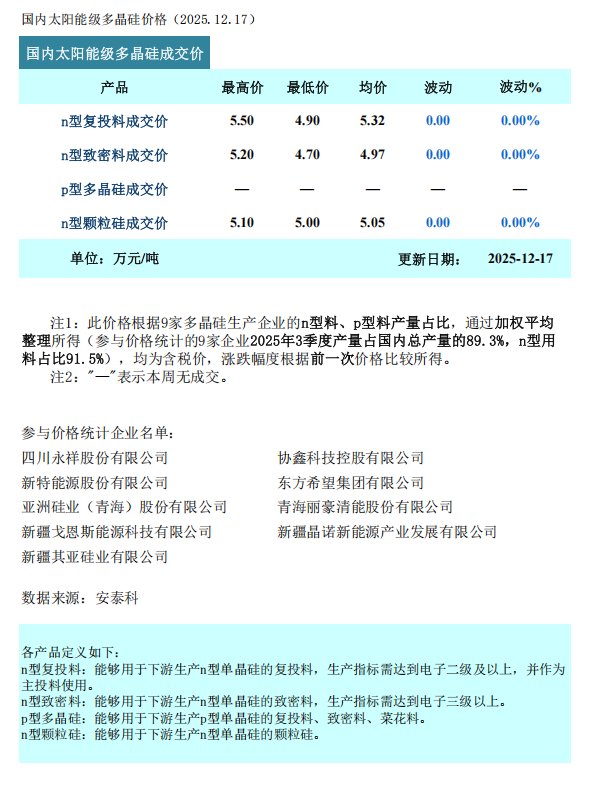
Core Insights - The domestic polysilicon market is experiencing a "sluggish transaction and rising quotes" situation, with the average transaction price for n-type re-investment material remaining stable at 53,200 yuan/ton [1] - The industry anticipates a recovery in terminal demand by the end of Q1 2026, prompting polysilicon companies to raise new order quotes to above 65,000 yuan/ton to stabilize the price system and inventory [1][2] - The overall supply of polysilicon remains stable, with production expected to stay within 120,000 tons in December, while demand continues to be weak due to high inventory levels and slow project initiation [2] Price Trends - The transaction price range for n-type re-investment material is between 49,000 and 55,000 yuan/ton, with an average price of 53,200 yuan/ton, showing no fluctuation [3] - The transaction price for n-type granular silicon is between 50,000 and 51,000 yuan/ton, with an average price of 50,500 yuan/ton, also stable [3] - The price statistics are based on nine polysilicon production companies, which account for 89.3% of the domestic total production in Q3 2025 [3][4] Supply and Demand Dynamics - The number of operating polysilicon companies remains at 11, with production limited by maintenance and low operating rates, while the southwest region faces reductions due to dry conditions [2] - The expected annual production of polysilicon in 2025 is around 1.33 million tons, with the top five companies accounting for approximately 78% of this output [2] - The current supply-demand imbalance is expected to lead to continued inventory accumulation, with an estimated increase of 70,000 tons for the year [2]
[安泰科]多晶硅周评-市场成交清淡 新单报价探涨(2025年12月17日)
中国有色金属工业协会硅业分会· 2025-12-17 06:06
Core Insights - The domestic polysilicon market is experiencing a "sluggish transaction and rising quotes" situation, with most polysilicon companies raising new order quotes to around 65,000 yuan/ton, despite a significant drop in new orders [1][2] - The core motivation for the price increase is the expectation of improved terminal demand by the end of Q1 2026, making it crucial to maintain price stability and inventory during the transitional period of January-February [1][2] Market Conditions - The transaction price range for n-type recycled material is between 49,000 to 55,000 yuan/ton, with an average price of 53,200 yuan/ton, remaining stable week-on-week [1][3] - The supply side remains stable, with 11 polysilicon companies in production and an expected December output of no more than 120,000 tons, despite minor increases from some companies [2] - The overall production capacity is expected to reach approximately 1.33 million tons in 2025, with the top five companies accounting for about 78% of the total output [2] Demand Dynamics - The downstream sectors, including silicon wafers, battery cells, and modules, are facing high inventory levels and slow project initiation, leading to increased production cuts [2] - The expected annual silicon wafer production is around 640 GW, corresponding to a silicon material demand of approximately 1.26 million tons [2] Inventory Trends - The current supply-demand imbalance is expected to lead to continued accumulation of polysilicon social inventory, with an estimated increase of about 70,000 tons for the year [2] - The prevailing high inventory and weak demand fundamentals have not changed, but a stronger consensus on price stability is currently influencing market sentiment [2]
港股异动 江西铜业股份(00358)现涨超3% 公司第三次报价收购SolGold 收购后铜产量有望大增
Jin Rong Jie· 2025-12-17 05:08
Group 1 - Jiangxi Copper has raised its acquisition offer for UK-listed SolGold to 28 pence per share, valuing the deal at approximately £842 million (USD 1.13 billion) [1] - This marks the third bid by Jiangxi Copper in three weeks for SolGold, which owns a top copper-gold mining project in Ecuador [1] - Jiangxi Copper has reportedly gained support from other major shareholders of SolGold, which is expected to significantly increase copper production post-acquisition [1] Group 2 - Citigroup has released a report indicating that while Jiangxi Copper's copper smelting business gross profit is expected to decline year-on-year next year, rising prices for copper, gold, and sulfuric acid will drive overall gross profit growth for the company [1] - The bank believes that the current valuation of Jiangxi Copper is attractive and maintains a "buy" rating for both A-shares and H-shares [1]
江西铜业股份现涨超3% 公司第三次报价收购SolGold 收购后铜产量有望大增
Zhi Tong Cai Jing· 2025-12-17 04:06
江西铜业(600362)股份(00358)现涨超3%,截至发稿,涨3.6%,报35.1港元,成交额3.14亿港元。 消息面上,江西铜业再次提高对英国上市公司SolGold的收购报价至每股28便士,总价值约8.42亿英镑 (11.3亿美元),这是江西铜业三周内第三次出价收购拥有厄瓜多尔顶级铜金矿项目的SolGold。据悉,江 西铜业已获得SolGold其他主要股东的支持,收购后铜产量有望大增。 花旗发布研报称,虽然预期江西铜业股份的铜冶炼业务毛利明年将同比下降,且长期冶炼及精炼业务有 下行压力,但预料铜、金及硫酸价格提高,将推动公司明年的整体毛利上升。该行认为目前估值具吸引 力,A股及H股均维持"买入"评级。 ...
港股异动 | 江西铜业股份(00358)现涨超3% 公司第三次报价收购SolGold 收购后铜产量有望大增
智通财经网· 2025-12-17 03:59
消息面上,江西铜业再次提高对英国上市公司SolGold的收购报价至每股28便士,总价值约8.42亿英镑 (11.3亿美元),这是江西铜业三周内第三次出价收购拥有厄瓜多尔顶级铜金矿项目的SolGold。据悉,江 西铜业已获得SolGold其他主要股东的支持,收购后铜产量有望大增。 花旗发布研报称,虽然预期江西铜业股份的铜冶炼业务毛利明年将同比下降,且长期冶炼及精炼业务有 下行压力,但预料铜、金及硫酸价格提高,将推动公司明年的整体毛利上升。该行认为目前估值具吸引 力,A股及H股均维持"买入"评级。 智通财经APP获悉,江西铜业股份(00358)现涨超3%,截至发稿,涨3.6%,报35.1港元,成交额3.14亿港 元。 ...
江西铜业斥资8.4亿英镑并购!打响2026全球铜矿角逐第一枪
Sou Hu Cai Jing· 2025-12-17 00:14
Core Viewpoint - Jiangxi Copper's acquisition of SolGold Plc marks a significant step in the global resource competition, with an increased offer of 28 pence per share, valuing the deal at £842 million (approximately $1.13 billion) [1] Group 1: Acquisition Rationale - The acquisition is driven by Jiangxi Copper's need to address its long-standing business structure contradictions and competitive pressures in the industry [3] - Jiangxi Copper has a copper smelting capacity of 2.3 million tons per year but only produces about 200,000 tons of copper concentrate from its own mines, leading to a low self-sufficiency rate [3] - The company aims to shift its strategy from earning minimal processing fees to sharing resource value through acquisitions, with SolGold's Cascabel project being a key target [5][10] Group 2: Cascabel Project Value - The Cascabel project in Ecuador is considered one of the largest and highest-grade undeveloped copper-gold mines discovered in South America in the past decade, with proven and inferred resources of 12.2 million tons of copper and 30.5 million ounces of gold [5][6] - The project is expected to start early engineering in 2026 and achieve first production by 2028, with an average annual copper output of 123,000 tons, potentially doubling Jiangxi Copper's future copper production [6] Group 3: Acquisition Process - Jiangxi Copper initially faced challenges in its acquisition attempt, with its first offers of 26 pence per share being rejected by SolGold's board [8] - The increase to 28 pence led to a positive response from SolGold's board, indicating a willingness to recommend the offer to shareholders [8] - Jiangxi Copper has garnered support from key shareholders, including BHP and Newcrest, which, combined with its existing stake, gives it over 40% support for the acquisition [8] Group 4: Strategic Implications - The acquisition addresses China's high dependence on foreign copper resources, with an 80% reliance and only 4% of global reserves domestically [10] - By acquiring SolGold, Jiangxi Copper aims to enhance its influence in the global copper resource landscape, breaking the dominance of international mining giants [10] - The acquisition will strengthen Jiangxi Copper's position in the Andean copper belt and create synergies with its other South American projects [11] Group 5: Challenges Ahead - The acquisition requires regulatory approvals in China and the UK, with increasing scrutiny on overseas acquisitions adding uncertainty [13] - The Cascabel project is still in the pre-development phase, requiring significant capital investment and facing various risks related to construction and local conditions [13] - The financial burden of the acquisition may impact Jiangxi Copper's cash flow and debt levels, necessitating effective integration and management of the overseas asset [13]

东兴证券晨报-20251216
Dongxing Securities· 2025-12-16 12:06
Economic News - The Shanghai Stock Exchange announced that Muxi Integrated Circuit (Shanghai) Co., Ltd. will list its A-shares on the Sci-Tech Innovation Board, with a total share capital of 40.01 million shares, of which 18.14 million shares will be traded starting December 17, 2025 [2] - From January to November this year, the China National Railway Group reported that 4.28 billion passengers were transported by rail, marking a year-on-year increase of 6.6%, the highest for the same period in history [2] - The Ministry of Commerce announced that starting December 17, 2025, anti-dumping duties will be imposed on imported pork and pork by-products originating from the European Union [2] - The National Development and Reform Commission emphasized the need to accelerate the establishment of a system to expand domestic demand, aiming to remove unreasonable restrictions on consumption in sectors like automobiles and housing [2] Important Company Information - China West Electric reported that four of its subsidiaries were awarded contracts totaling 1.005 billion yuan [3] - Huaxi Co., Ltd. announced that its controlling shareholder, Huaxi Group, has released the pledge on 8.24 million shares, accounting for 31.69% of its holdings and 9.30% of the company's total share capital [3] - Tianfu Long plans to increase its investment in its wholly-owned subsidiary, Fuweier (Zhuhai), by 580 million yuan, raising its registered capital to 1.08 billion yuan [3] - Fulei New Materials has received approval from the Shanghai Stock Exchange for its application to issue A-shares to specific investors [3] Investment Strategy - The Central Economic Work Conference emphasized maintaining a stable and progressive approach, continuing to implement proactive fiscal policies and moderately loose monetary policies, with a focus on stabilizing growth and ensuring reasonable price recovery [6][8] - Expanding domestic demand is prioritized, with measures to implement urban and rural resident income increase plans and optimize consumption policies to stimulate consumer spending [7] - The investment outlook for 2026 is positive, with expectations for marginal improvements in consumption and a recovery in traditional infrastructure investment supported by policy measures [7][8] Mechanical Industry Insights - The mechanical equipment index rose by 36.11% in 2025, outperforming the Shanghai Composite Index by 19.74 percentage points [10] - The mechanical industry reported a revenue of 15,135.34 billion yuan in the first three quarters of 2025, with a year-on-year growth of 7.35%, and a net profit of 1,080.76 billion yuan, up 16.80% year-on-year [11] - The equipment manufacturing sector maintained export resilience, with significant growth in exports of general and specialized equipment [11] Nonferrous Metals Industry Outlook - The global metal industry is entering a weak supply cycle, with exploration investment declining, indicating a tightening supply environment [14][15] - The average return on equity (ROE) in the metal industry increased from 8.34% in Q3 2024 to 10.60% in Q3 2025, reflecting improved industry profitability [18] - The copper supply is expected to remain tight due to structural weaknesses, while demand is supported by growth in new energy and infrastructure sectors [19][20] High-Precision Navigation Industry - Huace Navigation is a leading player in China's BeiDou satellite navigation sector, with a revenue of 3.251 billion yuan in 2024, representing a year-on-year growth of 21.38% [26] - The company has developed its own high-precision navigation chips, enhancing its competitive edge in the market [27] - The agricultural machinery navigation market is rapidly growing, with Huace Navigation holding a leading market share in China [28]