
联影医疗

Search documents
大药的诞生,才是医药的未来
Haitong Securities International· 2025-11-05 07:29
Core Insights - The pharmaceutical industry is experiencing a structural change driven by the growth cycles of major products, with significant opportunities emerging in innovative drugs, medical devices, and consumer healthcare [3][6][31] - The demand for pharmaceuticals is expected to improve in 2026, supported by policies encouraging innovation and a recovery in domestic consumption [3][7] - The supply side of the pharmaceutical industry is characterized by high entry barriers due to patent protections and government regulations, which helps maintain a stable competitive environment [4][5] Group 1: Industry Trends - The aging population, urbanization, and changing disease patterns are making the pharmaceutical industry a perpetual growth sector [3] - The global pharmaceutical market has seen rapid expansion from 2009 to 2019, followed by a surge in demand due to COVID-19, and is now entering a phase of recovery and growth [3][6] - The Chinese pharmaceutical industry is expected to gradually produce world-class companies, with increasing recognition of Chinese innovative drug assets by multinational corporations (MNCs) [4][5] Group 2: Investment Opportunities - Opportunities in innovative drugs are highlighted, particularly in oncology, metabolic diseases, and autoimmune diseases, with a focus on next-generation therapies and precision medicine [6][31] - The demand for innovative drugs is expected to remain strong, with policies improving medical insurance payments and the upcoming launch of commercial insurance drug catalogs [7][31] - The medical device sector is anticipated to recover, with a focus on domestic demand and international expansion, particularly in areas with low domestic production rates [7][8] Group 3: Company Performance - Major pharmaceutical companies like Eli Lilly, AbbVie, and AstraZeneca are experiencing significant growth driven by key products, with Eli Lilly's Tirzepatide generating $24.8 billion in sales [12][15] - The report identifies specific companies such as Hengrui Medicine, Hansoh Pharmaceutical, and BeiGene as outperformers in the market, with strong pipelines and global competitiveness [7][8] - The report emphasizes the importance of mergers and acquisitions (M&A) and business development (BD) strategies for MNCs, with China becoming a significant source of projects for top global pharmaceutical companies [22][24]




医药行业 2025Q3 公募基金持仓分析
GUOTAI HAITONG SECURITIES· 2025-11-05 07:27
Investment Rating - The report assigns an "Overweight" rating to the pharmaceutical industry [5][27]. Core Insights - The total market value of pharmaceutical stocks held by public funds increased from 300.9 billion to 409 billion yuan, representing a growth of 35.9% [6][9]. - The proportion of pharmaceutical stocks in the holdings of all public funds rose to 10.53%, an increase of 0.76 percentage points compared to the previous quarter [6][9]. - The report highlights the growth potential of the pharmaceutical industry driven by continuous technological innovation and demand [6][9]. Summary by Sections 1. Pharmaceutical Holdings Proportion in 2025Q3 - The total market value of pharmaceutical stocks held by public funds increased from 300.9 billion to 397.8 billion yuan, a rise of 32.2% from 2025Q2 to 2025Q3 [9]. - The proportion of pharmaceutical stocks in public fund holdings was 94.64%, up by 0.05 percentage points from 2025Q2 [9]. 2. Market Value of Pharmaceutical Sub-sectors in 2025Q2 - The leading sectors in public fund holdings were: 1) Chemical preparations: 1,734 billion yuan (44.3%) 2) Other biological products: 921 billion yuan (23.5%) 3) Medical devices: 419 billion yuan (10.7%) [13][11]. 3. Public Fund Heavy Holdings in 2025Q3 - The top five pharmaceutical stocks by market value in public fund holdings were: 1) Heng Rui Medicine: 50.2 billion yuan 2) Innovent Biologics: 25.7 billion yuan 3) Mindray Medical: 21.5 billion yuan 4) Bai Li Tian Heng: 16.4 billion yuan 5) Kangfang Biologics: 16.4 billion yuan [23][27].



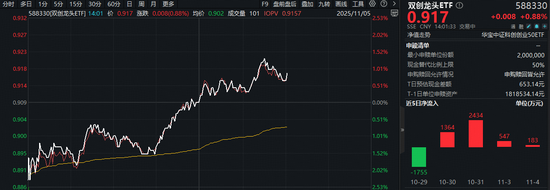
抄底科技资金稳步加仓!光伏龙头阿特斯20CM涨停,双创龙头ETF(588330)盘中拉升1%,近4日吸金4526万元
Xin Lang Ji Jin· 2025-11-05 06:21
Core Viewpoint - The technology sector, particularly in the context of the ChiNext board, is experiencing a significant rally, with the Double Innovation Leader ETF (588330) attracting substantial investment, indicating a growing interest in hard technology and new productivity sectors [1][5]. Group 1: Market Performance - The ChiNext index is leading the major indices, with the Double Innovation Leader ETF (588330) seeing a price increase of over 1.2% during intraday trading, currently up by 0.88% [1]. - The ETF has attracted a total of 45.26 million yuan in the last four days, reflecting a steady accumulation of capital in the technology sector [1]. - In the power equipment sector, notable stocks include: - Canadian Solar (阿特斯) hitting the daily limit with a 20% increase - Trina Solar (天合光能) rising over 11% - Other significant gains from companies like Sungrow Power Supply (阳光电源) and JinkoSolar (晶科能源) [3][4]. Group 2: Industry Insights - The photovoltaic industry is entering a critical bottom phase, with expectations that leading companies will drive supply chain concentration and enhance global competitiveness through technological advancements [5]. - The development of new productivity is identified as a key task for the upcoming five-year planning period, emphasizing the urgency for China to achieve technological self-reliance [5]. - Investment in technology is increasingly viewed as a strategic move for national security, with companies possessing genuine technological barriers likely to become focal points for investment in the A-share market [5]. Group 3: Investment Strategy - Investing in a broad-based index like the Double Innovation Leader ETF allows for risk diversification across various technology sectors, mitigating the volatility associated with individual stocks [6]. - The ETF provides exposure to multiple technology sub-sectors, helping investors capture overall trends and avoid missing out on market movements [6]. - The current technology growth trend is driven by policy shifts and expectations of economic improvement, suggesting that investing in broad-based indices could yield significant returns [6][7]. Group 4: ETF Characteristics - The Double Innovation Leader ETF (588330) features a diversified portfolio of 50 large-cap strategic emerging companies from the STAR Market and ChiNext, covering sectors like renewable energy, photovoltaic, semiconductors, and medical devices [7]. - The ETF is designed for high elasticity, allowing investors to quickly capitalize on market rebounds, with a relatively low investment threshold [7].


联影医疗涨2.00%,成交额4.03亿元,主力资金净流入666.14万元
Xin Lang Cai Jing· 2025-11-05 05:44
Core Insights - The stock price of United Imaging Healthcare increased by 2.00% on November 5, reaching 139.74 CNY per share, with a total market capitalization of 115.168 billion CNY [1] - The company reported a year-to-date stock price increase of 10.74%, but a decline of 4.65% over the last five trading days [1][2] - For the period from January to September 2025, United Imaging Healthcare achieved a revenue of 8.859 billion CNY, representing a year-on-year growth of 27.39%, and a net profit of 1.120 billion CNY, up 66.91% year-on-year [2] Financial Performance - The company’s main business revenue composition includes 81.29% from sales of medical imaging diagnostic equipment and radiation therapy equipment, 13.56% from maintenance services, 4.68% from other sources, and 0.47% from software [1] - Cumulative cash dividends since the company's A-share listing amount to 641 million CNY [3] Shareholder Structure - As of September 30, 2025, the number of shareholders increased to 32,400, a rise of 96.28%, while the average number of circulating shares per person decreased by 29.23% to 25,444 shares [2] - Major shareholders include Hong Kong Central Clearing Limited, which holds 19.036 million shares, and several ETFs, with notable reductions in holdings compared to the previous period [3]
592颗星,1.1万亿活水:科创板激活中国创新伟力
Zhong Guo Ji Jin Bao· 2025-11-05 05:02
Core Insights - The Sci-Tech Innovation Board (STAR Market) has significantly contributed to China's innovation-driven economic development, with 592 listed companies and over 1.1 trillion yuan raised since its inception [1][2] - The board has established a unique ecosystem that supports various stages of technology companies, allowing unprofitable firms to go public and facilitating substantial R&D investments [2][4] Group 1: Institutional Framework - The STAR Market's inclusive listing system has enabled 57 unprofitable companies to go public, with 22 of them turning profitable [2] - The introduction of the fifth set of listing standards has particularly benefited the biopharmaceutical sector, with 21 out of 22 companies successfully launching self-developed drugs [3] Group 2: R&D Investment - In 2024, total R&D investment by STAR Market companies reached 168 billion yuan, more than three times the net profit of the sector [4] - By the third quarter of 2025, R&D investment further increased to 113.35 billion yuan, marking a 9.01% year-on-year growth [4] Group 3: Industry Clusters - The STAR Market has fostered significant industry clusters, particularly in integrated circuits, with 121 listed companies covering the entire supply chain [5][6] - The semiconductor sector has seen record IPO fundraising, which has stimulated growth in related upstream and downstream companies [6] Group 4: Capital Ecosystem - Approximately 90% of STAR Market companies received venture capital before going public, promoting a culture of early and small investments in hard technology [7] - The market has developed a comprehensive index system with 33 indices and over 100 ETFs, with total assets exceeding 330 billion yuan [7] Group 5: Policy Developments - The introduction of the "1+6" policy measures aims to enhance support for technology companies with significant breakthroughs and ongoing R&D investments [8] - These reforms signify a transition from a testing ground to a demonstration platform, further aligning with national innovation strategies [8]
592颗星,1.1万亿活水:科创板激活中国创新伟力
中国基金报· 2025-11-05 04:48
Core Viewpoint - The Sci-Tech Innovation Board (STAR Market) has significantly enhanced China's innovation capabilities, with 592 listed companies and over 1.1 trillion yuan raised since its inception, marking a pivotal shift in the country's technological landscape [2][4]. Group 1: Institutional Flexibility - The STAR Market was established to address the "bottleneck" issues faced by tech companies, allowing firms with varying stages of development and governance structures to access capital markets [4]. - Notably, 57 companies listed without profitability, with 22 of them successfully turning profitable, demonstrating the board's inclusive approach [4]. Group 2: R&D Investment - In 2024, total R&D investment by STAR Market companies reached 168 billion yuan, more than three times the net profit of the sector, with a median R&D intensity of 12.44% [7]. - By the third quarter of 2025, R&D investment further increased to 113.35 billion yuan, reflecting a year-on-year growth of 9.01% [7]. - STAR Market companies have generated over 130,000 invention patents, averaging 230 patents per company, leading to significant technological advancements [7]. Group 3: Industry Cluster Development - The STAR Market has fostered a notable cluster effect, particularly in the integrated circuit sector, with 121 listed companies covering the entire industry chain [9]. - In the biopharmaceutical sector, 115 companies are actively involved in treating major diseases, with significant progress in drug approvals and international collaborations [9]. Group 4: Capital Market Dynamics - The STAR Market serves as a comprehensive ecosystem integrating technology, industry, capital, and talent, with over 60% of founding teams comprising scientists or industry experts [11]. - Approximately 90% of STAR Market companies received venture capital before listing, promoting a culture of early and substantial investment in hard tech [12]. Group 5: Policy Enhancements - The introduction of the "1+6" policy measures aims to further deepen reforms on the STAR Market, enhancing support for tech companies with significant breakthroughs and commercial potential [14]. - This policy marks a transition from a "testing ground" to a "demonstration field," facilitating growth for more hard tech enterprises [14].

太平洋给予联影医疗“买入”评级,业绩超预期,海外业务持续增长
Sou Hu Cai Jing· 2025-11-05 04:13
Group 1 - The core viewpoint of the report is that Union Medical (688271.SH) is rated as "Buy" due to positive market conditions and growth prospects [1] - The domestic market is showing signs of recovery while overseas markets continue to experience high growth [1] - The company is rapidly increasing equipment output, and the proportion of service business is rising [1] - There is a slight decline in gross margin, but there is an optimization in expense ratio [1]

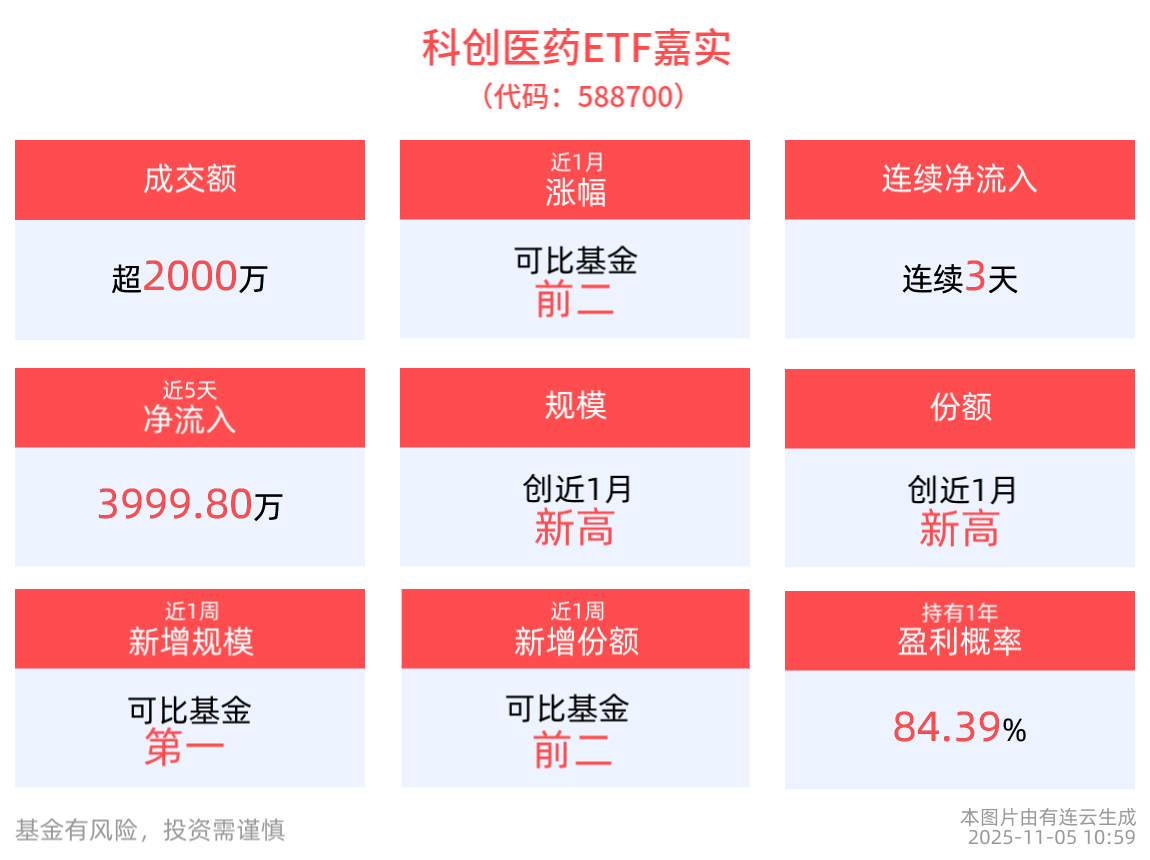
2025年药品目录谈判协商结束,科创医药ETF嘉实(588700)调整蓄势,机构:中国创新药行业正经历“量变引起质变”趋势
Xin Lang Cai Jing· 2025-11-05 03:30
Core Insights - The Shanghai Stock Exchange Sci-Tech Innovation Board Biopharmaceutical Index decreased by 1.41% as of November 5, 2025, with Huatai Medical leading the gain at 3.87% while Sangfor Biopharma experienced the largest decline at 6.88% [1][5]. Group 1: ETF Performance - The Jiashi Sci-Tech Medicine ETF recorded a turnover of 9.7% during the trading session, with a total transaction value of 29.81 million yuan [4]. - The latest scale of the Jiashi Sci-Tech Medicine ETF reached 307 million yuan, with a total of 273 million shares outstanding [4]. - Over the past three days, the Jiashi Sci-Tech Medicine ETF has seen continuous net inflows, with a peak single-day net inflow of 14.39 million yuan, totaling 39.99 million yuan [4]. - As of November 4, 2025, the Jiashi Sci-Tech Medicine ETF's net value increased by 29.72% over the past year [4]. Group 2: Industry Trends - The Chinese innovative drug industry is undergoing a transformation driven by factors such as international expansion, continuous data catalysts, and the launch of new products [5]. - The focus of the innovative drug market has shifted from broad valuation recovery to the fundamental performance of companies, emphasizing those with excellent clinical data, strong commercialization capabilities, and successful international expansion potential [5]. Group 3: Key Stocks - As of October 31, 2025, the top ten weighted stocks in the Shanghai Stock Exchange Sci-Tech Innovation Board Biopharmaceutical Index accounted for 49.74% of the index, with leading companies including United Imaging Healthcare and BeiGene [5][7]. - The performance of individual stocks varied, with United Imaging Healthcare showing a slight increase of 0.11%, while Sangfor Biopharma saw a significant decline of 6.88% [7].
510家公司获机构调研(附名单)
Zheng Quan Shi Bao Wang· 2025-11-05 02:39
Core Insights - In the past five trading days, a total of 510 companies were investigated by institutions, with significant interest in companies like United Imaging Healthcare and Aibo Medical [1][2] - The majority of the investigations were conducted by securities companies, accounting for 93.73% of the total, followed by fund companies and private equity firms [1] - A total of 287 companies attracted more than 20 institutional investigations, with United Imaging Healthcare receiving the highest attention from 318 institutions [1][2] Institutional Research Summary - The most frequently investigated companies included Ice Wheel Environment and Boying Special Welding, each receiving four investigations [2] - Among the stocks with over 20 institutional investigations, 82 saw net capital inflows, with Tianji Co., Ltd. leading with a net inflow of 675 million yuan [2] - In terms of market performance, 123 of the investigated stocks rose, with notable increases from companies like Aibo Medical and Fujida, which saw gains of 43.33% and 36.65% respectively [2] Company Performance Overview - United Imaging Healthcare: 1 investigation, 318 institutions, latest closing price 137.00 yuan, price change -5.39% [3] - Aibo Medical: 1 investigation, 306 institutions, latest closing price 63.42 yuan, price change -9.75% [3] - Tianji Co., Ltd.: 1 investigation, 138 institutions, latest closing price 17.73 yuan, price change 43.33% [3][4] Earnings Forecasts - Among the investigated companies, only one released an annual earnings forecast, with Luxshare Precision expected to report a net profit of 16.852 billion yuan, reflecting a year-on-year increase of 26.09% [2]


大药的诞生,才是医药的未来:医药行业2026年年度策略
Haitong Securities· 2025-11-05 02:03
Core Insights - The pharmaceutical industry is positioned as a perennial growth sector due to aging populations, urbanization, and changing disease profiles, with a strong recovery expected in 2025 after a downturn from 2022 to 2024, driven by both innovative drugs and medical devices [2][3] - Demand and supply dynamics will remain central to the pharmaceutical industry's research, with innovation cycles and policy adjustments influencing demand growth [2][3] - The supply side is characterized by limited supply and high entry barriers, with increasing participation of Chinese companies in international competition, leading to the emergence of world-class enterprises in the pharmaceutical sector [3][4] Industry Overview - The pharmaceutical industry is expected to see significant growth in 2025, driven by a resurgence in demand for innovative drugs and a recovery in domestic medical device needs, alongside strong external demand [2] - The demand for pharmaceuticals typically fluctuates with innovation and policy cycles, with a notable increase in overseas business development (BD) opportunities anticipated in 2025 [2][5] - The Chinese pharmaceutical sector is increasingly recognized globally, with local companies making strides in various niche markets [3][4] Investment Opportunities - Opportunities in innovative drugs are highlighted, particularly in oncology, metabolic diseases, and autoimmune diseases, with a focus on next-generation therapies and precision medicine [5][29] - The report emphasizes the importance of understanding the supply-demand structure and industry upgrades when conducting detailed research on specific segments within the pharmaceutical industry [4][5] - The report identifies key players and segments for investment, including CXO services, medical devices, and consumer healthcare, with specific companies recommended for increased holdings [6][5] Market Dynamics - The report outlines the competitive landscape among top global pharmaceutical companies, noting significant changes in rankings due to the performance of key products [11][19] - Chinese companies are becoming a major source of projects for multinational corporations (MNCs), with increasing transaction volumes and values in recent years [19][21] - The report discusses the strategic focus of MNCs on acquiring innovative assets and technologies to strengthen their market positions, particularly in oncology and metabolic disease sectors [12][18] Future Trends - The report anticipates breakthroughs in various therapeutic areas, including oncology, metabolic diseases, and autoimmune diseases, with a focus on innovative treatment modalities such as TCE and in vivo CAR-T [29][30] - The small nucleic acid field is expected to accelerate, with significant advancements anticipated in 2026 across multiple indications [29][30] - The report highlights the importance of collaboration and co-development models as a means for Chinese companies to enhance their global competitiveness [25][28]