中国长城

Search documents
延庆区区长张若冰:持续擦亮最美冬奥城三张金名片
Xin Jing Bao· 2026-01-28 14:51
在雄伟的长城脚下、美丽的妫水河畔,有一座最美冬奥城。北京市十六届人大四次会议期间,延庆区委 副书记、区长张若冰接受了新京报记者的专访。他说,延庆是北京的生态涵养区,长城、世园、冬奥三 张"金名片"集中体现了这里的特色优势和发展成果。未来五年,延庆将以三张"金名片"引领生态文明幸 福的最美冬奥城建设。 ■谈长城 争当北京长城文化带建设"领头雁" 新京报:长城是中华民族的代表性符号和中华文明的重要象征,在具体实践中,延庆在长城保护中做了 哪些创新性工作? 张若冰:我们深入践行习近平总书记给八达岭镇石峡村乡亲们的重要回信精神,"像守护家园一样守护 好长城,弘扬长城文化,讲好长城故事",全力争当长城文化带建设"领头雁",让万里长城既有"历史厚 度",更有"时代温度"。 我们守护长城根脉,筑牢保护屏障。率先实行制度性保护,构建起"专项规划+行动计划"的长城保护体 系,让保护工作有章可循、有规可依。注重加强预防性保护,累计完成23公里长城保护修缮,用匠心延 续长城的岁月印记与历史肌理。我们还创新开启科技性保护,通过三维扫描、数字化建模等技术,构建 全程可回溯的数字化档案,让千年长城"永驻云端",树立数字时代文化遗产保护新 ...
重庆湾项目续写两江交汇城市中心价值
Zheng Quan Ri Bao Wang· 2026-01-28 10:14
本报讯 (记者陈潇)纵观纽约湾区、旧金山湾区、东京湾区、粤港澳大湾区,"湾区必临海"的认知在 全球化叙事中持续了数百年。 然而,随着世界经济发展重心的东移,亚洲内陆经济正以前所未有的速度崛起。如果说滨海湾区是海洋 时代的产物,那么以大江大河为纽带、以强大内陆市场为腹地、以立体开放通道链接全球的"内陆大湾 区",则成为陆海融合时代的必然趋势和创新范式。 在这一历史性探索中,重庆被赋予了无可替代的战略角色。2026年1月,重庆主城核心区航道等级从Ⅲ 级跃升至Ⅰ级;同月,西南地区新年首趟中欧班列在重庆兴隆场编组站顺利发车。重庆从地理意义上的 内陆腹地跃升为全国首个兼具"水、陆、空、生产服务型、商贸服务型"五型国家物流枢纽的城市,形成 了具有湾区特质的发展模式和开放效应,一个带动西部、辐射全国、链接全球的"内陆大湾区"已然成 型。 世界级湾区具有创新性、开放性、协同性和外溢性等显著特征,通常表现为国际贸易、产业、科创和金 融中心。而重庆正围绕新质生产力,构筑起支撑"内陆大湾区"崛起的"四梁八柱"。 产业是骨骼。重庆拥有中国41个工业大类中的39个,正聚力打造"33618"现代制造业集群体系。以长 安、赛力斯(6011 ...
未知机构:华泰计算机Agenticcoding的加速崛起对软件算力的影响-20260128
未知机构· 2026-01-28 01:50
【华泰计算机】Agenticcoding的加速崛起对软件/算力的影响 12025年是Agent元年,2026年将是Agent爆发的年份,体现在两方面:一是Agentic Coding(智能体编码)的迭代速 度会大幅加快;二是国内外大厂会激烈争夺个人Agent助手的超级入口,均会成为下一轮token加速的重要推手。 这种爆发,不仅会带来算力需求数量级的提升,也会带来存储和CPU新的结构性需求。 【华泰计算机】Agenticcoding的加速崛起对软件/算力的影响 12025年是Agent元年,2026年将是Agent爆发的年份,体现在两方面:一是Agentic Coding(智能体编码)的迭代速 度会大幅加快;二是国内外大厂会激烈争夺个人Agent助手的超级入口,均会成为下一轮token加速的重要推手。 这种爆发,不仅会带来算力需求数量级的提升,也会带来存储和CPU新的结构性需求。 当前算力通胀的链条正从存储、先进封装、CPU,向云服务和数据中心传导。 2它们有两个显著特点:1)200K tokens的超长上下文;cowork要加知识库来永久性的存储用户资料,这些都指向 了存储需求的增加,且呈现出从HBM逐步外 ...
中国长城股价连续3天下跌累计跌幅12.41%,易方达基金旗下1只基金持15.41万股,浮亏损失37.29万元
Xin Lang Cai Jing· 2026-01-27 07:17
1月27日,中国长城跌0.87%,截至发稿,报17.08元/股,成交44.67亿元,换手率8.15%,总市值550.97 亿元。中国长城股价已经连续3天下跌,区间累计跌幅12.41%。 资料显示,中国长城科技集团股份有限公司位于广东省深圳市南山区科技园中电长城大厦,成立日期 1997年6月19日,上市日期1997年6月26日,公司主营业务涉及网络安全与信息化、高新电子、电源、园 区与物业服务及其他业务。主营业务收入构成为:计算产业80.86%,系统装备13.52%,其他(补 充)5.62%。 从基金十大重仓股角度 数据显示,易方达基金旗下1只基金重仓中国长城。易方达中证信息安全主题ETF(562920)四季度增 持2.48万股,持有股数15.41万股,占基金净值比例为3.12%,位居第十大重仓股。根据测算,今日浮亏 损失约2.31万元。连续3天下跌期间浮亏损失37.29万元。 易方达中证信息安全主题ETF(562920)成立日期2023年5月31日,最新规模7123.49万。今年以来收益 9.21%,同类排名1705/5548;近一年收益27.09%,同类排名2800/4285;成立以来收益12.64%。 易 ...

2025年全国计算机、通信和其他电子设备制造业出口货值为63364.9亿元
Chan Ye Xin Xi Wang· 2026-01-27 03:44
上市公司:中国长城(000066),浪潮信息(000977),新大陆(000997),魅视科技(001229),智 微智能(001339),纳思达(002180),证通电子(002197),大华股份(002236),电科网安 (002268),中威电子(300270),智迪科技(301503),中润光学(688307),萤石网络 (688475),三未信安(688489) 数据来源:国家统计局,智研咨询整理 知前沿,问智研。智研咨询是中国一流产业咨询机构,十数年持续深耕产业研究领域,提供深度产业研 究报告、商业计划书、可行性研究报告及定制服务等一站式产业咨询服务。专业的角度、品质化的服 务、敏锐的市场洞察力,专注于提供完善的产业解决方案,为您的投资决策赋能。 根据国家统计局数据可知:2025年12月全国计算机、通信和其他电子设备制造业出口货值为5952.9亿 元,同比增长1.2%;2025年全国计算机、通信和其他电子设备制造业累计出口货值为63364.9亿元。 2019年-2025年全国计算机、通信和其他电子设备制造业出口货值统计图 相关报告:智研咨询发布的《2026-2032年中国通信设备行业市场行情监测及 ...


五年后的北京将是什么样?
Xin Jing Bao· 2026-01-26 22:52
Core Viewpoint - The "15th Five-Year Plan" outlines Beijing's development goals and strategies for the next five years, focusing on enhancing capital functions, promoting high-quality development, and improving the quality of life for residents [1][2]. Group 1: Strategic Development Goals - The plan emphasizes five major strategic tasks, including optimizing capital functions and enhancing the "Four Centers" (political, cultural, international exchange, and technological innovation) [2]. - Beijing aims to increase the economic output of the Beijing-Tianjin-Hebei region, striving for a greater share of the national economy [2]. - The city plans to maintain an annual investment scale of over 1 trillion yuan, focusing on high-quality development and a competitive modern industrial system [2]. Group 2: Urban Safety and Governance - The plan includes measures to enhance urban safety and resilience, focusing on risk prevention in transportation, production, and new technologies [3]. - It aims to improve urban governance and quality through practical measures, promoting a modernized people-oriented city [3]. Group 3: Cultural Development - The plan targets cultural prosperity by enhancing public cultural services and promoting the integration of culture and technology [4][5]. - It aims to protect and utilize cultural heritage, with initiatives like the "Beijing Central Axis Protection" project [5][6]. Group 4: Technological Innovation - Beijing will strengthen its position as a global technology innovation hub, focusing on strategic technology development and fostering leading enterprises [7][8]. - The plan includes measures to enhance the efficiency of technology transfer and promote international collaboration in scientific research [8]. Group 5: Urban Renewal and Housing - The plan focuses on upgrading housing conditions and urban development, with specific tasks for renovating old buildings and improving community infrastructure [9][10]. - It aims to balance residential, commercial, and service functions in urban centers, promoting comprehensive urban renewal [10][11]. Group 6: Ecological and Environmental Goals - The plan emphasizes high standards for ecological protection and quality of life, aiming for a harmonious relationship between humans and nature [12][13]. - It includes initiatives for pollution control, resource management, and enhancing green spaces in urban areas [12][13]. Group 7: Health and Social Services - The plan outlines a strategy for strengthening healthcare services, focusing on community health and emergency response capabilities [14][15]. - It aims to improve maternal and child health services and expand support for the elderly, ensuring comprehensive health coverage [15][16].
GDP突破万亿,温州如何留住“出走”的温州人?
经济观察报· 2026-01-26 14:07
Core Viewpoint - Wenzhou is facing dual challenges of attracting and retaining population while striving to achieve its goal of reaching a permanent population of 10 million and a GDP of over 1 trillion yuan by 2025 [1][14]. Economic Growth and Goals - Wenzhou's GDP is projected to reach 1,021.39 billion yuan by 2025, with a growth rate of 6.1%, surpassing both the national and Zhejiang provincial averages [2]. - Wenzhou aims to become the third "trillion city" in Zhejiang, following Hangzhou and Ningbo, and the 28th in the country [2]. - The city has set a "double trillion" development goal since 2019, focusing on both GDP and population growth [2][3]. Historical Context and Challenges - Historically, Wenzhou's economy thrived on traditional industries such as electrical equipment, footwear, and clothing, but has faced challenges since 2000 due to a shift towards real estate and a subsequent debt crisis in 2011 [5][6]. - The city has seen a decline in its economic ranking, being overtaken by cities like Suzhou and Hangzhou, which has intensified the urgency to reclaim its status [7]. Industrial Transformation - Wenzhou is focusing on industrial transformation to return to a more robust economic base, with initiatives to strengthen traditional industries and develop new sectors like artificial intelligence and digital economy [6][9]. - The manufacturing sector remains a core driver, with significant growth in automotive parts and electrical industries, as well as emerging sectors like high-tech and digital industries [9]. Population Dynamics - As of 2024, Wenzhou's permanent population is 9.852 million, just short of the 10 million target, with a need for improved strategies to attract and retain residents [14][15]. - The city has historically lost population to other provinces, necessitating a focus on creating a more attractive living environment and job opportunities [15][16]. Innovation and Talent Attraction - Wenzhou is facing challenges in innovation capacity, with lower R&D investment compared to other cities in Zhejiang, highlighting the need for improved talent attraction and capital investment [16][17]. - The city is prioritizing artificial intelligence as a key area for innovation, aiming to build a significant AI industry cluster by 2027 [9][18]. Infrastructure and Policy Support - Improvements in transportation infrastructure and urban quality are critical for Wenzhou's growth, enhancing its connectivity within the Yangtze River Delta [12]. - The establishment of national-level innovation and economic zones is expected to provide a supportive environment for business and economic development [12].
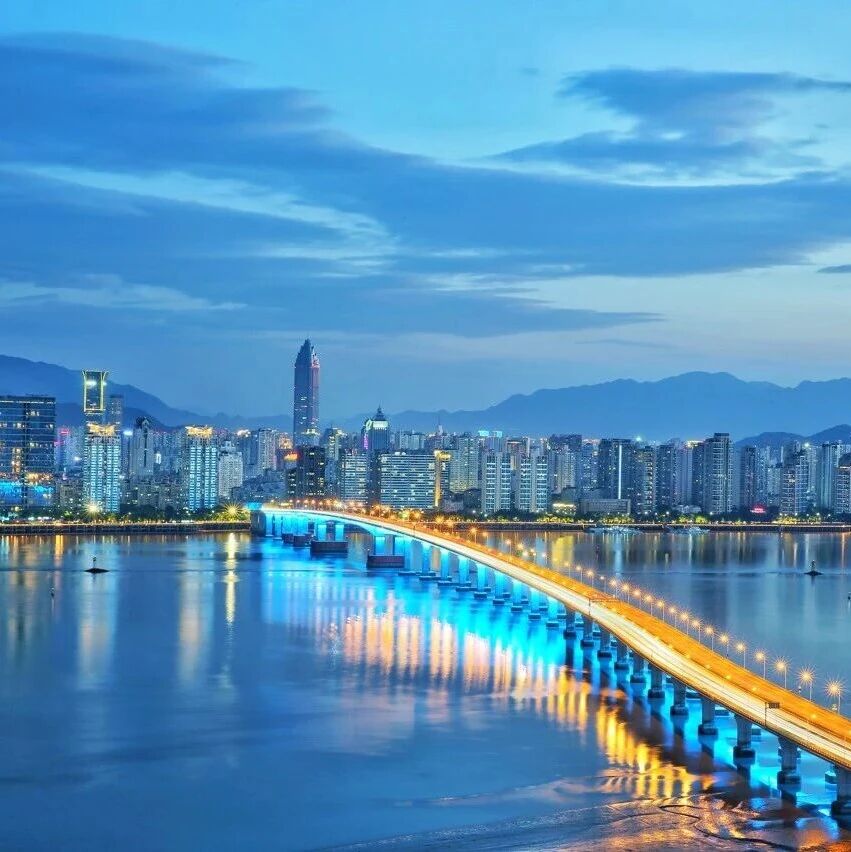
GDP突破万亿,温州如何留住“出走”的温州人?
Sou Hu Cai Jing· 2026-01-26 10:31
Core Viewpoint - Wenzhou's GDP is projected to reach 1,021.39 billion yuan by 2025, marking a 6.1% increase from the previous year, surpassing national and Zhejiang provincial growth rates by 1.1 and 0.6 percentage points respectively [2][3] Economic Growth and Goals - Wenzhou has become the third "trillion-yuan city" in Zhejiang, following Hangzhou and Ningbo, and the 28th nationwide [3] - The city set a "double trillion" development goal in 2019, aiming for a GDP of over 1 trillion yuan and a permanent population of 10 million by 2025 [3] - Wenzhou's GDP reached 971.9 billion yuan in 2024, just shy of the 1 trillion yuan milestone [2] Historical Context and Challenges - Wenzhou's economic growth was historically driven by traditional industries such as electrical equipment, footwear, and clothing, but faced challenges due to a shift towards real estate and a subsequent debt crisis in 2011 [4][5] - The city has been working on industrial transformation since 2012, focusing on returning to a more substantial economic base [5] Industrial Development - By 2025, Wenzhou's industrial output is expected to grow by 10.3%, with significant contributions from the automotive and electrical industries [7] - The city is also focusing on emerging sectors like artificial intelligence, aiming to establish a 100 billion yuan AI industry cluster by 2027 [7] Private Sector and Economic Policies - The private sector is crucial for Wenzhou's economy, with 90.8% of industrial output coming from private enterprises [8] - The city has implemented various policies to support private businesses, including financial assistance and initiatives to attract talent [8] Infrastructure and Urban Development - Improvements in transportation infrastructure have transformed Wenzhou into a regional hub, enhancing its connectivity within the Yangtze River Delta [9] - Urban development initiatives aim to enhance the city's livability and attract talent, focusing on education, healthcare, and cultural services [9] Population Dynamics - Wenzhou's permanent population was 9.852 million in 2024, still short of the 10 million target, with a need for strategies to attract and retain residents [12][13] - The city has historically faced challenges with population outflow, necessitating a dual approach to attract and retain talent [13][14] Innovation and Future Challenges - Wenzhou's R&D investment is lower than that of other major cities in Zhejiang, indicating a need for improvement in innovation capabilities [14][15] - The city aims to enhance its innovation landscape by focusing on artificial intelligence and other high-tech industries, as part of its broader economic strategy [15]
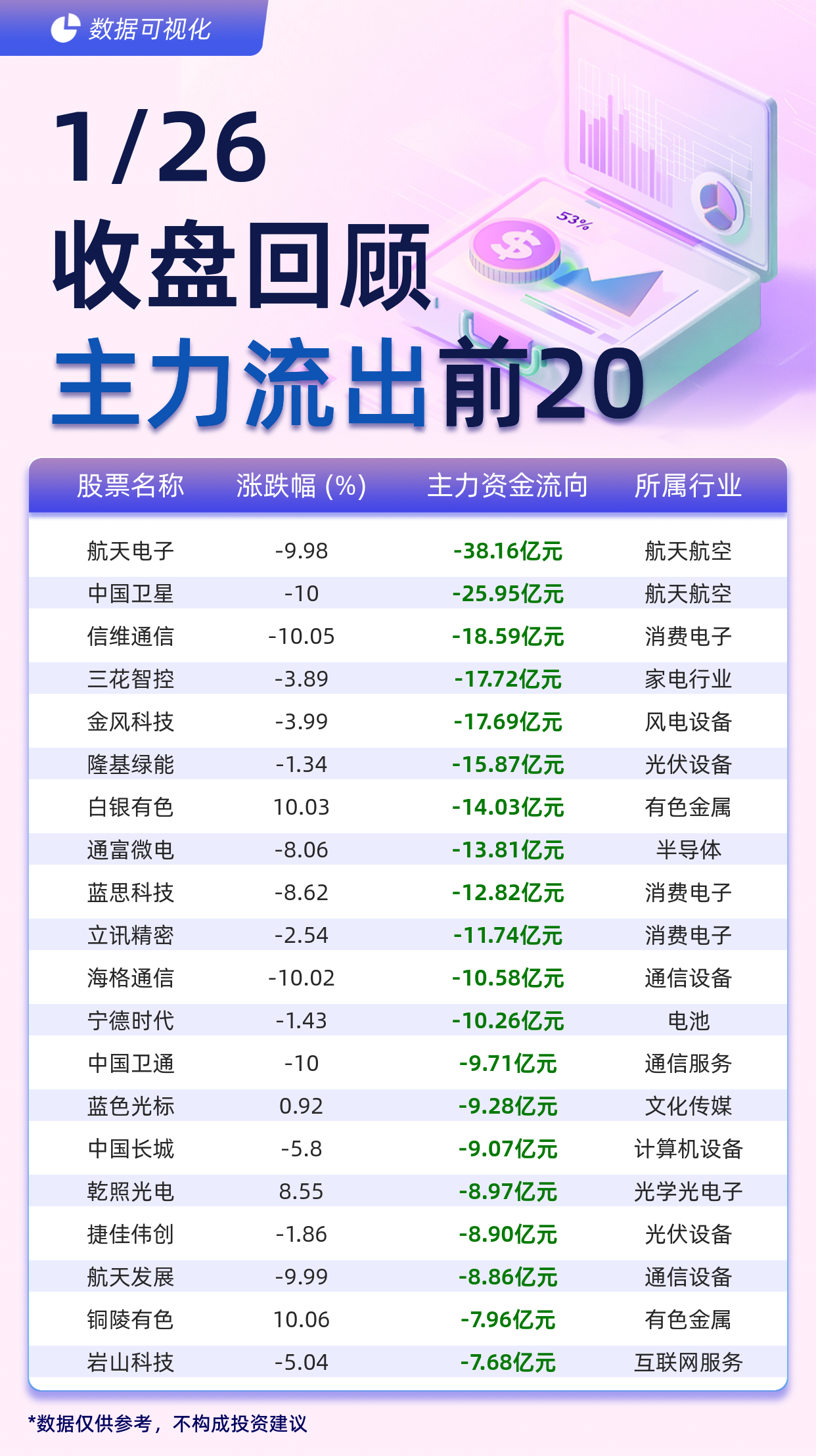
主力个股资金流出前20:航天电子流出38.16亿元、中国卫星流出25.95亿元
Jin Rong Jie· 2026-01-26 07:37
Core Viewpoint - The data indicates significant outflows of main funds from various stocks, particularly in the aerospace and consumer electronics sectors, reflecting a bearish sentiment among investors. Group 1: Stock Performance and Fund Flow - Aerospace stocks, such as Aerospace Electronics and China Satellite, experienced the largest fund outflows, with -38.16 billion and -25.95 billion respectively, and declines of -9.98% and -10% in their stock prices [1][2] - Other notable stocks with significant outflows include Xinwei Communication (-18.59 billion, -10.05%), Sanhua Intelligent Control (-17.72 billion, -3.89%), and Goldwind Technology (-17.69 billion, -3.99%) [1][2] - The outflow from Longi Green Energy was -15.87 billion with a stock price decrease of -1.34%, indicating a relatively smaller decline compared to others in the same sector [1][2] Group 2: Sector Analysis - The consumer electronics sector saw major outflows, particularly from companies like Xinwei Communication and Lens Technology, with outflows of -18.59 billion and -12.82 billion respectively [1][2] - The wind power equipment sector, represented by Goldwind Technology, also faced significant outflows, reflecting potential challenges in the renewable energy market [1][2] - The communication equipment sector, including companies like Haige Communication and China Satellite, showed substantial fund outflows, indicating investor caution in this area [1][3]






X86巨头涨价潮蔓延,国产CPU迎来价值重估
国芯网· 2026-01-26 07:03
Core Viewpoint - The article discusses the significant price increase of server CPUs by Intel and AMD, driven by structural changes in AI computing demand and global supply chain adjustments, which may lead to a revaluation of domestic CPUs in China [2][4]. Group 1: Price Increase and Market Dynamics - Intel and AMD plan to raise server CPU prices by 10%-15% in Q1 2026, with their annual production already largely pre-sold, indicating a severe supply-demand imbalance [2][3]. - The demand for AI infrastructure is expected to drive global AI server shipments to grow by over 28% year-on-year in 2026, with overall server shipments increasing by 12.8% [3]. - The supply constraints are exacerbated by high demand for advanced manufacturing processes, with Intel's production capacity reportedly overloaded at 120%-130% [4]. Group 2: Shift in CPU Role - The emergence of Agentic AI has transformed the role of CPUs from auxiliary computing units to central components responsible for complex scheduling and resource management [6]. - The new architecture allows for a shift from "compute-intensive" to "scheduling-intensive," with CPUs managing vast amounts of parameters and states previously reliant on expensive GPU memory [7]. - The number of active intelligent agents is projected to surge from tens of millions in 2025 to hundreds of billions by 2030, significantly increasing CPU demand [7]. Group 3: Domestic CPU Market Opportunities - The price increase of CPUs reflects their strategic value, particularly in the context of China's push for domestic semiconductor production [8]. - The domestic market is expected to seek alternatives due to international price hikes, creating a historic opportunity for domestic CPUs to fill market gaps [8]. - Key selection criteria for domestic CPUs include compatibility with existing X86 environments, security, and stability, especially in critical infrastructure sectors [9][10]. Group 4: Potential Domestic Players - Companies such as Haiguang Information, Loongson Technology, and China Great Wall (Feiteng) are positioned to benefit from the market overflow due to the global CPU price revaluation [10].