
广汽

Search documents
专论 || 张夕勇:加快推进智能网联汽车与机器人产业融合发展
Zhong Guo Qi Che Bao Wang· 2025-10-13 09:24
Core Viewpoint - The humanoid robot industry is projected to become a trillion-dollar market, with significant growth expected in China by 2025, marking the beginning of a new era for humanoid robots [2][3]. Market Size Forecast - By 2045, the humanoid robot market in China is expected to reach 10 trillion RMB, while global annual revenue for humanoid robots could exceed 5 trillion USD by 2050 [3]. - NVIDIA's CEO highlighted that the AI-enhanced robot industry represents a new 10 trillion USD market opportunity [3]. Technological and Industrial Maturity - The current state of the robot industry is likened to the prelude of the smartphone and electric vehicle revolutions, with advancements in AI and robotics driving automation and intelligence [4]. - Key components of robots are becoming increasingly localized and modular, significantly reducing costs while scaling production [4]. Leading Enterprises and Innovation - Prominent companies like Yushun, Zhiyuan, and UBTECH are emerging, fostering a vibrant ecosystem of innovation that accelerates the transition from technological innovation to industrial growth [4]. - Component manufacturers are experiencing increased production volumes due to rising demand [4]. Synergy with Intelligent Connected Vehicles - The automotive industry, particularly in intelligent connected vehicles, shares numerous synergies with the humanoid robot sector, enhancing hardware, software, and application scenarios [5]. - Similarities in foundational hardware between autonomous vehicles and humanoid robots facilitate mutual empowerment in technology [6]. Software and Supply Chain Collaboration - Algorithms used in humanoid robots and autonomous vehicles show significant overlap, particularly in path planning and motion control [6]. - Over 50% of supply chain resources are shared between the automotive and humanoid robot industries, especially in sensors and chips [7]. Cost Reduction and Production Efficiency - The adoption of high-quality, low-cost components from the automotive sector is expected to significantly lower production costs for humanoid robots [7]. - The automotive industry's advanced automated production methods can enhance the efficiency and consistency of humanoid robot manufacturing [7]. Sales Channels and After-Sales Service - The automotive sales and service networks can effectively support the distribution and maintenance of humanoid robots, addressing reliability concerns [9]. - The transition from B2B to B2C and B2H sales models for humanoid robots is anticipated, with automotive dealerships potentially playing a key role [9]. Integration into Automotive Production - Humanoid robots are already being integrated into automotive production lines, performing various tasks and enhancing efficiency [10][11]. - Companies like Tesla are leading the way in applying humanoid robots in manufacturing, achieving significant improvements in speed and accuracy [11]. Future Applications and Scenarios - Humanoid robots are expected to extend their roles beyond manufacturing to include tasks such as driving assistance and logistics in challenging environments [12].





中鼎股份:目前已经开发批产新能源电池模组密封系统和电桥总成等产品,为沃尔沃、蔚来等新能源汽车平台配套
Mei Ri Jing Ji Xin Wen· 2025-10-09 01:03
Core Viewpoint - Company has developed advanced sealing systems for electric vehicle applications, indicating a strong position in the growing new energy vehicle market [1] Group 1: Company Developments - Company’s subsidiaries, Germany's KACO and America's ACUSHNET, possess leading sealing system technologies [1] - KACO is actively advancing its new energy layout and has successfully developed high-performance sealing systems for new energy electric motors [1] - The company has also developed mass-produced sealing systems for new energy battery modules and electric bridge assemblies, supplying major automotive brands such as Volvo, NIO, SAIC, and GAC [1]

央行定调!事关货币政策等;摩尔线程IPO过会|南财早新闻
2 1 Shi Ji Jing Ji Bao Dao· 2025-09-27 03:04
Macro Economy - The Ministry of Education and five other departments issued the "County High School Revitalization Action Plan," focusing on high-quality development in county-level high school education, proposing eight major actions including resource expansion and improvement of school conditions [2] - The State-owned Assets Supervision and Administration Commission held a meeting on the economic operation of state-owned enterprises, emphasizing stable electricity and coal prices, preventing "involution" competition, and promoting high-quality investment for value growth [2] - The Ministry of Human Resources and Social Security reported that the basic pension insurance fund's investment operation scale reached 2.6 trillion, doubling since the end of the 13th Five-Year Plan, with an average annual investment return rate of 5.15% over the past eight years [2] Investment News - On September 26, A-shares experienced a downturn, with the ChiNext index falling below 3200 points, driven by a decline in technology stocks, while copper and wind power stocks showed strength [4] - The Hong Kong Hang Seng Index closed down 1.35%, with technology and pharmaceutical stocks generally declining, while some Chinese banks and insurance stocks rose [4] - The China Securities Regulatory Commission updated several administrative penalty decisions, targeting four securities practitioners for illegal stock trading, with penalties totaling 159 million yuan and a five-year market ban for one individual [5] - The Shanghai Stock Exchange held a meeting focusing on the implementation of the "1+6" policy measures for the Sci-Tech Innovation Board, aiming to enhance market attractiveness and inclusivity [5] - The current stock private equity position index has reached the highest level of the year, with significant increases in positions among large private equity firms, indicating a spreading optimistic sentiment [5] Company Movements - Wahaha's family inheritance dispute has seen new developments, with the Hong Kong High Court rejecting an appeal from the defendants but allowing a temporary suspension of the disclosure order [6] - Yonghui Supermarket received a warning from the Sichuan Securities Regulatory Bureau for failing to timely disclose changes in equity due to a reduction in its stake in Hongqi Chain [7] - Yushun Technology's CEO announced several iterations of their robot algorithm this year, with expectations to release a 1.8-meter humanoid robot in the second half of the year, as the domestic robot industry sees growth rates between 50% and 100% [7] - Moer Thread's initial public offering application has successfully passed the review by the Shanghai Stock Exchange, aiming to raise 8 billion yuan for the development of a new generation of AI training and inference chips [7] International Dynamics - On September 26, U.S. stock indices closed higher, with the Dow Jones up 0.65%, driven by gains in Boeing and Travelers Group, while Chinese concept stocks mostly declined [10] - U.S. President Trump announced new high tariffs on imports of heavy trucks, building materials, furniture, and pharmaceuticals starting October 1 [10] - The White House clarified that the latest tariff measures on pharmaceuticals do not apply to countries with existing trade agreements with the U.S., maintaining a 15% tariff cap for partners like the EU and Japan [10]

上海证券:机器人本体催化频出 持续关注人形机器人板块
智通财经网· 2025-09-24 11:50
Core Insights - The report from Shanghai Securities highlights a surge in the humanoid robot industry, with significant participation from both domestic and international players, indicating a trend towards commercialization and mass production of humanoid robots [1] Industry Developments - Major companies such as Huawei, ByteDance, BYD, Xiaomi, and Ant Group are increasing their investments in embodied intelligence, while international firms like Tesla and Figure AI are accelerating their commercialization efforts [1] - The humanoid robot industry is entering a phase of diverse innovation, with a clear trend towards industrial applications, suggesting a high degree of certainty in future commercialization [1] Company Highlights - **Tuosda**: Recently launched its first wheeled humanoid robot "Xiao Tuo," which features a four-stewart wheel design and can perform complex tasks autonomously [1] - **Zhiyuan Robotics**: Successfully demonstrated the "Webster Flip," becoming the first humanoid robot to perform this complex gymnastic move, showcasing advanced motion control capabilities [2] - **Moliang Technology**: Completed a Pre-A round financing of tens of millions, aimed at expanding production lines and enhancing delivery capabilities across various sectors [3] - **Figure**: Secured over $1 billion in Series C funding, reaching a valuation of $39 billion, which will support the growth of its humanoid robots and AI platform [4] - **Tesla**: CEO Elon Musk's recent stock purchase and a new compensation plan linked to the delivery of 1 million humanoid robots is expected to catalyze production efforts [5] - **Luxiao Technology**: Announced a partnership with Kepler Robotics to develop AI-integrated home service robots, targeting sales of at least 1 million units in the next three years [6][7]

重磅深度:AI智能车时代产品为王
2025-09-24 09:35
Summary of Key Points from the Conference Call Industry Overview - The focus is on the **smart vehicle industry**, which is seen as a revolutionary terminal in the physical world, similar to how PCs and mobile devices transformed the digital landscape [2][35]. Core Insights and Arguments - **Investment Strategy**: Investment should encompass the entire smart vehicle industry chain, including upstream technology suppliers, midstream supply chains, and downstream brand merchants. This approach is expected to yield investment opportunities that surpass those seen in the PC and mobile internet eras [1][6]. - **Revenue Generation**: The revenue potential of smart vehicles is tied to their ability to replace human tasks, particularly in applications like Robot Taxi, which has a higher revenue ceiling compared to traditional models [5][8]. - **Valuation Methodology**: Traditional valuation methods based on hardware penetration rates or internet traffic do not apply to smart vehicles. Instead, a focus on software revenue models and the complexity of tasks completed by smart agents is necessary [3][4][24]. - **Profit Distribution**: The smart vehicle industry follows a "smile curve" in profit distribution, where core technology hardware and software platforms yield higher profit margins (15%-30%), while midstream manufacturing and downstream distribution have lower margins (around 5%) [3][24]. Key Companies and Investment Opportunities - **Software Companies**: Notable software companies include: - Vertical integration models like Tesla and Xpeng Motors - Core algorithm providers such as Horizon Robotics and Baidu - Traditional taxi and ride-hailing companies like Didi, which are transitioning to smart vehicle models [9][10]. - **Hardware Companies**: Investment should focus on: - Vehicle manufacturing (e.g., BAIC, GAC, SAIC) - Upstream components like chips, domain controllers, sensors, and control chassis [10][11]. Market Dynamics and Future Trends - **Consumer Adoption**: The C-end market for smart vehicles is expected to see explosive growth around 2027, driven by consumer education through B-end experiences [13][41]. - **Robot Taxi as a Key Application**: Robot Taxi is highlighted as the most significant application scenario due to its high revenue potential. Investment should prioritize software companies over hardware companies [8][37]. - **Impact on Traditional Markets**: Smart vehicles may replace a portion of private cars, expanding the market space for smart vehicles. The focus should shift from traditional user metrics to unit revenue capabilities and software development opportunities [42][43]. Additional Considerations - **Historical Context**: The lessons from the PC era's internet bubble highlight the importance of understanding user metrics and revenue models in evaluating smart vehicle companies [25][38]. - **Technological Evolution**: The transition from electric vehicles to smart vehicles requires a shift in investment focus, emphasizing the need for companies to adapt quickly to the evolving landscape [7][29]. This summary encapsulates the critical insights and strategic directions discussed in the conference call regarding the smart vehicle industry and its investment landscape.
联合动力(301656) - 首次公开发行股票并在创业板上市之上市公告书提示性公告
2025-09-23 12:48
苏州汇川联合动力系统股份有限公司 首次公开发行股票并在创业板上市之 上市公告书提示性公告 保荐人(主承销商):国泰海通证券股份有限公司 一、上市概况 4、首次公开发行股票数量:28,857.4910万股,占发行后公司总股本的比例 为12.00%,本次公开发行全部为新股,无老股转让。 1 1、股票简称:联合动力 2、股票代码:301656 3、首次公开发行后总股本:240,479.0910万股 二、风险提示 本公司股票将在深圳证券交易所创业板市场上市,该市场具有较高的投资风 险。创业板公司具有业绩不稳定、经营风险高、退市风险大等特点,投资者面临 较大的市场风险。投资者应充分了解创业板市场的投资风险及本公司所披露的风 险因素,审慎做出投资决定。 本公司及董事会全体成员保证信息披露的内容真实、准确、完整,没有虚假 记载、误导性陈述或重大遗漏。 经深圳证券交易所审核同意,苏州汇川联合动力系统股份有限公司(以下简 称"发行人"或"本公司")发行的人民币普通股股票将于2025年9月25日在深 圳证券交易所创业板上市,上市公告书全文和首次公开发行股票并在创业板上市 的招股说明书全文披露于中国证券监督管理委员会指定的信息披露 ...
耐世特20250922
2025-09-23 02:34
Key Points Summary of the Conference Call Company Overview - The conference call discusses the performance and strategic direction of **Nexteer Automotive** in the context of the automotive industry, particularly focusing on steering technologies and electric power steering (EPS) systems. Core Insights and Arguments - **New Product Launch**: Nexteer plans to begin mass production of new products in the first half of 2026, which is among the company's top ten key projects. The production volume is expected to be flexible, depending on technological reliability and regulatory environment. The unit value is projected to be at least 3,000 yuan [2][6] - **Market Dynamics**: The advancement of steer-by-wire technology is progressing rapidly in North America and Europe, with significant developments from T Company and other major automakers like Volkswagen, Mercedes-Benz, Stellantis, and Toyota. However, due to a slowdown in electrification, many projects are delayed by at least two years. In the short term, large-scale commercialization is primarily focused on the Chinese market [2][10] - **Strategic Partnerships**: Nexteer has become a strategic supplier for several Chinese automakers, including Geely, Great Wall, Chery, GAC, BYD, and new energy vehicle companies like Li Auto, Xpeng, and Xiaomi. The new energy vehicle companies are moving faster than traditional manufacturers, indicating continued opportunities in the existing customer base [2][11] - **Product Solutions**: To address price competition in the Chinese market for C-EPS, Nexteer offers various product solutions, including brushed and brushless motor EPS, as well as high-output versions of C-EPS. The company maintains an advantage in the high-end R-EPS sector and is expanding into DPEPS, having secured orders from four domestic clients [2][12] Additional Important Content - **Cost Management**: Nexteer has achieved a 20% cost reduction through modular design and autonomous motor production, with plans to gradually expand this initiative from the Chinese market to the Asia-Pacific and Western markets [4][16] - **Revenue Growth**: The revenue increase in 2025 is expected to primarily come from DP EPS, although overall growth will still rely on C EPS and R EPS. Strong customer growth was noted in the first half of the year, particularly with BYD and Xiaomi [4][15] - **Market Performance**: The North American market is expected to perform better than anticipated in the second half of the year, driven by improved production efficiency and demand. The European market is also projected to enhance profitability through operational improvements [17][19] - **Future Orders**: Nexteer anticipates securing its first EMB order from a traditional Chinese OEM by the end of 2025 or early 2026, with ongoing efforts to establish a foothold in overseas markets [23] - **Technological Advancements**: The rear-wheel steering technology is rapidly commercializing in China, with expectations of a demand for approximately 1 million units in the coming years. This technology is gaining traction among overseas clients due to effective cost control [25][26] This summary encapsulates the key points discussed in the conference call, highlighting Nexteer's strategic initiatives, market dynamics, and future outlook in the automotive industry.


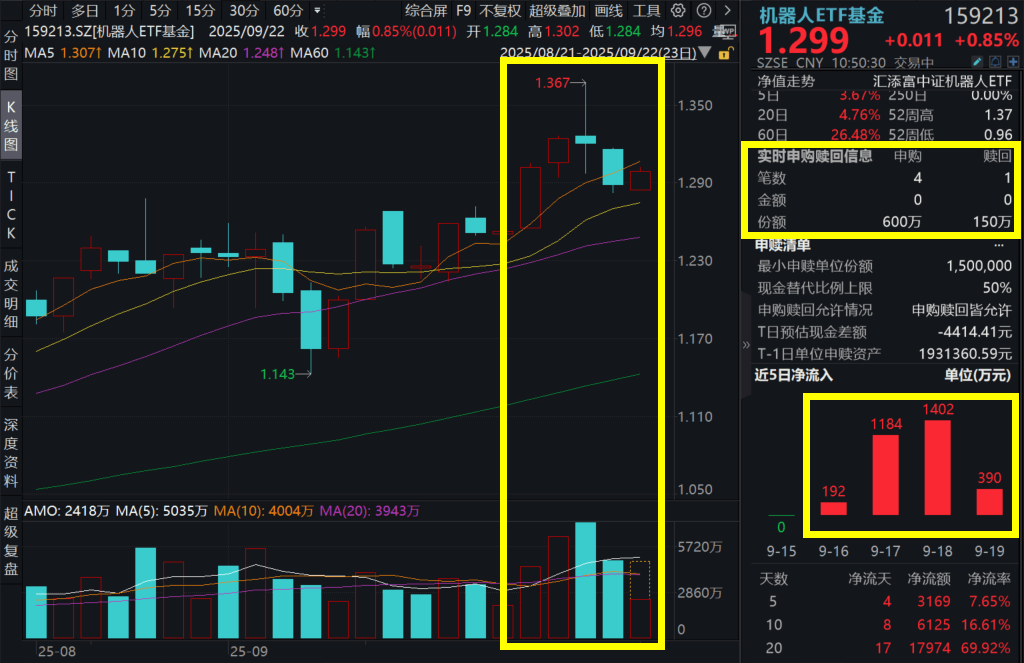
300家机构齐调研汇川技术,机器人板块热度高企!机器人ETF基金(159213)涨近1%,连续5日获资金净申购!国产人形机器人的产业化进程到哪了?
Sou Hu Cai Jing· 2025-09-22 03:27
Core Viewpoint - The robotics sector is experiencing a resurgence, with significant investment and interest in humanoid robots, driven by policy support, technological advancements, and active capital participation [5][6][9]. Group 1: Market Performance - On September 22, technology stocks rebounded, with the robotics ETF (159213) rising nearly 1% and attracting a net subscription of 6 million yuan, following four consecutive days of over 30 million yuan in net inflows [1]. - The component stocks of the robotics ETF showed mixed performance, with Dazhu Laser rising over 6% and Shitou Technology dropping over 7% [2][3]. - In September, Huichuan Technology was investigated by 320 institutions, including 157 foreign institutions and 48 fund companies, indicating high market interest in the robotics sector [4]. Group 2: Industry Development - The humanoid robot industry in China is accelerating due to policy support, with a "three-step" goal set by the central government and regional differentiation in development strategies [6]. - Domestic companies are achieving significant results in core component localization and lightweight design, while foreign firms lead in hardware design and AI decision systems [6]. - Leading startups like Yushu Technology and UBTECH are beginning small-scale deliveries, with production capacity expected to ramp up, potentially leading to mass production cycles [6]. Group 3: Technological Innovations - Domestic automotive and technology companies are rapidly entering the humanoid robot field, employing different strategies [7]. - Tech companies focus on software capabilities, while automotive firms leverage existing technologies and supply chains for quick deployment [7]. - Companies like Xiaomi and GAC are integrating their technologies into humanoid robots, creating diverse ecological layouts [7]. Group 4: Commercialization and Future Outlook - The commercialization of humanoid robots is progressing rapidly, with several startups expected to emerge in 2024 [9]. - Notable companies have established commercial partnerships with well-known automotive and logistics firms, with some already achieving large-scale deliveries [9]. - The year 2025 is anticipated to be a key production milestone for many startups, with significant sales expected as domestic companies fulfill orders and meet growing demand [9].

行业自律是产业治理重要抓手
Zheng Quan Shi Bao· 2025-09-16 00:10
Group 1 - The core viewpoint emphasizes the importance of precise governance and execution in the automotive industry for maintaining stability and vitality in the supply chain [1] - The China Automobile Industry Association released a proposal focusing on the "60-day payment term commitment," addressing pain points in its implementation and establishing comprehensive guidelines for key processes such as order confirmation, delivery acceptance, payment settlement, and contract duration [1] - Seventeen major automakers, including Dongfeng, SAIC, Chery, and BYD, have committed to actively implement the payment term standards outlined in the proposal [1] Group 2 - The proposal not only sets a "hard benchmark" for automakers to adhere to payment term commitments but also signals a strong message for enhanced industry self-discipline [2] - The initiative reflects a significant transformation in industry governance concepts, demonstrating that self-regulation can be practical and effective [2] - Recent calls from industry associations in sectors like photovoltaics, cement, steel, and semiconductors to resist low-price competition indicate a positive trend towards industry self-discipline [2]
追踪十家主流上市车企账期状况:广汽、比亚迪最短
Jing Ji Guan Cha Wang· 2025-09-15 05:36
此外,上半年行业竞争加剧无疑对企业现金流带来压力。从数据可以看到,十家国内主流车企中有六家 的付款周期较去年同期有所上涨,仅有小鹏、上汽、长安、比亚迪的账期是减少。 随着国内主流上市车企半年报悉数披露,除了营收、净利润等经营指标外,向供应商付款周期到底是变 长还是变短,无疑是行业关注的核心指标。 据数据显示,包括上汽、比亚迪(002594)、吉利汽车、长城在内十家国内主流车企今年上半年向上游 供应商的平均付款周期为183天,较2024年上半年增加约7天。这其中,广汽、比亚迪、吉利汽车、上汽 集团(600104)的账期最短,分别为137天、142天、156天和157天,优于行业平均水平。 行业专家认为,随着头部车企将陆续兑现中小供应商"60天账期"承诺,不仅能极大减少供应商资金压 力,也能促使其将资金更高效地投入到技术研发,推动产业链上下游实现高质量发展。 ...