
Lazada

Search documents
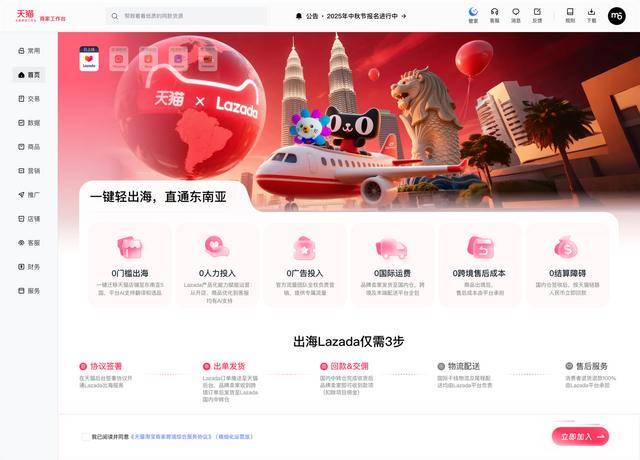
Lazada全面打通天猫 向天猫商家开放东南亚市场
Sou Hu Cai Jing· 2025-09-16 05:47
Group 1 - Lazada, a Southeast Asian e-commerce platform under Alibaba, has opened its localized operational capabilities to Tmall merchants for the first time [1] - Notable brands such as Biaoxia, Babycare, Philips, and Lock&Lock have confirmed their participation in this initiative [1] - The integration allows merchants to enter the Southeast Asian market without incurring international shipping costs or overseas after-sales service expenses [1] Group 2 - The project represents a system-level integration between Tmall and Lazada, enabling merchants to quickly set up LazMall stores to cater to Southeast Asian consumers [1] - Merchants can upload product information that is automatically translated by AI, eliminating the need for re-registration or local team formation [1] - The entire process, including multilingual customer service, advertising investment, and international shipping costs, will be managed by Lazada, which will also cover cross-border return costs [1] Group 3 - The core design of the project aims to lower the barriers for brands to enter the Southeast Asian market, allowing them to test the waters at a lower cost while retaining the option to gradually localize [1]


宇树机器人概念指数强势拉升!“全市场唯一百亿规模”机器人ETF(562500)份额突破180亿再刷新高!
Mei Ri Jing Ji Xin Wen· 2025-09-16 05:03
Group 1 - The UnifoLM-WMA-0 model from Yushu Open Source has catalyzed a strong rise in the robotics concept index, with the Robotics ETF (562500) increasing by 1.06% [1] - The Robotics ETF has attracted over 9.64 billion in capital over the past five trading days, reaching a new high of 180.70 billion in shares and 187.88 billion in scale, leading the market in robotics-themed ETFs [1] - During the 9.9 promotional period, Lazada reported a nearly 30% increase in average order value using AI chatbots, enhancing user interaction and boosting consumer willingness to spend [1] Group 2 - Founder Securities highlights Jiangsu Leili's strong R&D capabilities in robotics, with a diverse range of products including core components like hollow cup motors and precision gearboxes [2] - The Robotics ETF (562500) is the only robotics-themed ETF in the market with a scale exceeding 100 billion, covering various segments such as humanoid robots and industrial robots [2]

宁德时代在德国首发NP3.0技术平台;TikTok欧洲月活用户突破2亿|36氪出海·要闻回顾
36氪· 2025-09-14 13:43
Group 1 - CATL launched the NP3.0 technology platform and the first lithium iron phosphate battery product in Munich, Germany, marking a new phase in its European expansion [5] - SVOLT achieved the highest growth rate in global battery installation, with a 723% year-on-year increase in overseas markets, ranking eighth globally [5] - XPeng Motors announced the opening of its first European R&D center in Munich, aiming to enhance local user engagement and accelerate technological innovation [5] Group 2 - TikTok surpassed 200 million monthly active users in Europe, representing a significant growth from 175 million users last year [6] - Lazada and Tmall established a project group for a systematic connection to Southeast Asian markets, allowing Tmall merchants to easily access these markets [6][7] - QCraft announced its global strategy, including a partnership with Qualcomm and the establishment of a European headquarters in Germany [7] Group 3 - Pony.ai began Robotaxi road testing in Doha, Qatar, in collaboration with the national transport company [8] - Kingdee International Software Group launched its Qatar subsidiary, focusing on AI and management solutions [8] - X Square Robot completed nearly 1 billion RMB in financing, marking Alibaba Cloud's first investment in embodied intelligence [9] Group 4 - NEXX received strategic investment from Rasmal Ventures, aiming to enhance cross-border supply chain efficiency in the MENA region [10] - Aishi Technology completed over $60 million in Series B financing, with plans to launch an overseas product in early 2024 [11] - Mainline Technology secured several hundred million RMB in financing, focusing on L4 autonomous driving technology and global market expansion [11] Group 5 - Mexico plans to impose import tariffs of 10% to 50% on approximately 1,400 products from countries without free trade agreements, including China [12] - The IFA 2025 showcased nearly 700 Chinese companies, highlighting the growing importance of the European market for Chinese consumer electronics [12] Group 6 - Nasdaq proposed changes to the IPO listing rules for small businesses, including raising the minimum public float market value to $15 million [13][14] - The Ministry of Commerce announced plans to formally sign the upgraded China-ASEAN Free Trade Area 3.0 agreement by the end of the year, focusing on digital economy and green trade [14] - The number of A+H listed companies increased to 161, driven by policy support and market demand for broader financing channels [15]


中国公司全球化周报|宁德时代在德国首发NP3.0技术平台/TikTok欧洲月活用户突破2亿
3 6 Ke· 2025-09-14 04:25
Company Developments - CATL launched its NP3.0 technology platform and the first lithium iron phosphate battery product, Shenxing Pro, in Munich, Germany, marking a significant step in its overseas expansion strategy [1] - SVOLT (蜂巢能源) achieved the highest growth rate in global battery installation, with a 97.1% year-on-year increase, and ranked eighth in global installations outside of China, showing strong international competitiveness [1] - XPeng Motors announced the opening of its first European R&D center in Munich, aiming to enhance local user engagement and accelerate technological innovation [2] - QCraft (轻舟智航) established its European headquarters in Germany and announced a partnership with Qualcomm to advance its global autonomous driving solutions [3] - Pony.ai (小马智行) commenced Robotaxi road testing in Doha, Qatar, in collaboration with the national transport company [5] - Kingdee (金蝶) launched its Qatar subsidiary to enhance its international presence in AI and management solutions [5] Investment and Financing - X Square Robot secured nearly 1 billion RMB in A+ round financing, marking Alibaba Cloud's first investment in embodied intelligence [6] - LikeMind Robotics completed several million RMB in angel financing, focusing on smart rehabilitation robots for elderly care [6] - Lingzu Times raised several million RMB in two consecutive rounds of financing, with significant overseas orders in the past month [6] - NEXX received strategic investment from Qatar's Rasmal Ventures to enhance its logistics AI capabilities in the MENA region [6] - Aishi Technology completed over 60 million USD in B round financing, with plans to launch an overseas version of its AI video generation product [6] - Mainline Technology raised several hundred million RMB for its L4 autonomous truck solutions, with a focus on international markets [6] - VITURE announced a 100 million USD B round financing to support global retail expansion [6] Policy and Market Trends - Mexico plans to impose import tariffs of 10% to 50% on approximately 1,400 products from countries without free trade agreements, including China, aligning with U.S. trade strategies [10] - The IFA 2025 showcased nearly 700 Chinese companies, highlighting the growing importance of the European market for Chinese consumer electronics [10] - Nasdaq proposed changes to its small IPO listing rules, including raising the minimum public float market value to 15 million USD [10] - The Chinese Ministry of Commerce aims to finalize the China-ASEAN Free Trade Area 3.0 agreement by the end of the year, focusing on digital economy and green trade cooperation [10] - The number of A+H listed companies has increased to 161, driven by policy support and market demand for broader financing channels [10]


出海寻增量,东南亚凭什么成商家 “必争之地”?
Sou Hu Cai Jing· 2025-09-12 01:43
Core Insights - Cross-border e-commerce has become a crucial growth avenue for Chinese merchants seeking new opportunities in the global market [2] - The Southeast Asian market is highlighted as a primary focus for Chinese merchants due to its rapid growth and cultural similarities with China [11][12] Group 1: Advantages of Chinese Merchants in Cross-Border E-Commerce - The first advantage is a highly digitalized supply chain that supports flexible production models, allowing for quick responses to diverse global consumer demands [6] - The second advantage is rich multi-format e-commerce marketing and operational capabilities, enabling Chinese merchants to leverage domestic experiences in international markets [7] - The third advantage is efficient logistics infrastructure, which significantly reduces international shipping costs and delivery times for Chinese merchants [8] - The fourth advantage is strong policy support that facilitates cross-border trade through measures like customs convenience and tax incentives [9] Group 2: Southeast Asia as a Preferred Market - Southeast Asia's geographical proximity to China reduces delivery times and logistics costs, making it an attractive market for cross-border e-commerce [12] - The region's cultural similarities with China, including festive shopping patterns, allow Chinese merchants to apply successful domestic promotional strategies [13] - The e-commerce market in Southeast Asia is experiencing rapid growth, projected to increase from $38 billion in 2019 to $159 billion by 2024, representing a growth rate of over 318% [13] Group 3: TikTok Shop as a Key Platform - TikTok Shop is identified as a preferred platform for cross-border e-commerce due to its content-driven model, which offers higher exposure, conversion rates, and average order values compared to traditional platforms [19] - The platform's user engagement is significant, with Southeast Asian users spending an average of over 35 hours per month on TikTok, providing a solid user base for merchants [19] - TikTok Shop's operational advantages allow Chinese merchants to replicate successful domestic strategies without incurring additional costs, facilitating rapid market entry [22] Group 4: Policy and Market Support - Regional trade agreements like RCEP enhance the business environment for Chinese merchants by reducing tariffs and improving customs efficiency [17] - The supportive policies in Southeast Asian countries, such as low or zero import tariffs, create a favorable landscape for cross-border e-commerce [18] - TikTok Shop's initiatives, such as expedited approval processes and flexible operational policies, further lower barriers for Chinese merchants entering the Southeast Asian market [25] Conclusion - Chinese merchants possess strong advantages in expanding into cross-border e-commerce, particularly in Southeast Asia, which is characterized by high growth potential and a young consumer base [27] - TikTok Shop serves as a powerful engine for growth, enabling merchants to capitalize on the burgeoning market and establish their brands effectively [27]

中金 • 全球研究 | 东南亚数字经济:逐鹿群雄,强者恒强
中金点睛· 2025-09-12 00:07
Core Insights - The Southeast Asian e-commerce market is projected to reach $190 billion in 2024, growing to $268 billion by 2026, with a compound annual growth rate (CAGR) of 18.8%. This growth highlights the interplay between traditional platform operations and the emerging "entertainment shopping" model [2][5] - The top three platforms in the Southeast Asian market are expected to hold over 66% market share in 2024, indicating increasing market concentration [2][6] E-commerce vs. Entertainment Shopping - The e-commerce sector in Southeast Asia is experiencing robust growth, with a projected GMV of $190 billion in 2024, reflecting a 19% year-on-year increase. The market is expected to expand at a CAGR of 18.8%, surpassing $268 billion by 2026 [5][6] - Shopee, TikTok Shop (TTS), and Lazada dominate the market, collectively holding over 66% of the market share, up from 61% in 2023, and expected to reach 73% by 2026. Shopee leads with a 43% market share, focusing on localized operations and logistics, while TTS leverages "entertainment shopping" to drive user engagement [6][10] Logistics as a Competitive Advantage - Logistics is a critical component for e-commerce platforms, with Shopee utilizing its self-built logistics network (SPX) to achieve cost efficiency and operational advantages. This strategy helps to mitigate high logistics costs prevalent in Southeast Asia compared to China [12][16] - TTS relies heavily on third-party logistics (3PL) partners, particularly J&T Express, to maintain its logistics competitiveness. This partnership has evolved into a "quasi-first-party logistics" model, enhancing TTS's service offerings [19][20] Digital Financial Services Growth - The digital payment market in Southeast Asia is expected to grow at a CAGR of 12.1%, reaching over $1.4 trillion by 2026. The digital loan market is projected to grow at a CAGR of 24.7%, with loan balances nearing $110 billion by 2026 [50][52] - A significant portion of the population remains unbanked or underserved, representing a substantial growth opportunity for digital financial services. Approximately 62% of the population in Southeast Asia falls into this category, highlighting the potential for financial inclusion [54][55] On-Demand Services Market - The on-demand services market is forecasted to grow from $29.2 billion in 2024 to $37.2 billion by 2026, with a CAGR of 13%. Major players like Grab and Gojek are transitioning from high-end products to more accessible offerings, capturing over 70% of the market share [3][4] Ride-Hailing and Delivery Services - The ride-hailing market in Southeast Asia is projected to reach $9 billion in 2024, with Grab and Gojek leading the market. The market is expected to grow to $11.2 billion by 2026, reflecting an 11.6% CAGR [31][33] - The delivery market has seen rapid growth, expanding from $4.2 billion in 2019 to $19.3 billion in 2024, with a CAGR of 35.7%. Grab continues to solidify its market leadership, while smaller players face challenges [35][36] Online Grocery and Group Buying - The online grocery market is expected to grow significantly, from $2.9 billion in 2019 to $12.8 billion in 2024, with a CAGR of 34.6%. This growth is driven by the shift towards online shopping and the increasing demand for convenience [41][43] - Group buying services are emerging as a new trend, particularly in the food delivery sector, offering discounts for bulk orders and appealing to collective consumers [45][46]

亚马逊,temu采购测评:直击风控难题,降低砍单与封号风险
Sou Hu Cai Jing· 2025-08-31 00:31
Core Insights - Establishing a highly stable and deeply disguised environment system is essential for success in cross-border e-commerce procurement [1] - Many studios face technical bottlenecks that lead to low success rates in new account registrations and abnormal order accounts, resulting in a costly cycle of inefficiency and loss [1] Group 1: Technical Solutions - Addressing hardware parameter association by ensuring each account uses devices with unique hardware identifiers like IMEI and MAC addresses to prevent linkage [3] - Ensuring the use of clean IP addresses that are independent and unpolluted, avoiding shared or frequently changed IPs [3][4] - Preventing DNS and WebRTC leaks to protect real country exposure and local network information [4] Group 2: Privacy and Security Measures - Ensuring unique and independent browser environment fingerprints to avoid cross-environment tracking [5] - Utilizing privacy plugins to block local network IP leaks and prevent cookie associations [6] - Addressing payment card risk by continuously updating and testing high-success-rate card segments to maintain operational efficiency [6] Group 3: User Behavior Simulation and Adaptation - Simulating real user behavior through keyword searches and ad clicks to avoid abnormal activity patterns [7] - Continuous technical iteration is necessary to adapt to platform risk control upgrades, as e-commerce platforms update their risk control algorithms annually [7] - The current technical solutions can be applied across various platforms, including Amazon, Walmart, eBay, and others, ensuring a high level of disguise and low order cancellation rates [7]

800 美元以下包裹免税,取消!
Sou Hu Cai Jing· 2025-08-28 15:20
Core Insights - The U.S. has officially eliminated the tax exemption for imported packages valued at $800 or less, requiring full customs duties to be paid, which significantly impacts the cross-border e-commerce industry [2][3] - The new regulation disrupts the long-standing "small package tax exemption" that many cross-border e-commerce sellers relied on, leading to increased transaction costs and logistical challenges [3][4] Impact on Cross-Border E-Commerce - The average customs duty rate for previously exempt low-value packages is expected to rise from 0% to a range of 25%-30%, increasing costs for sellers [3] - 25 countries have suspended postal package shipments to the U.S., leading to a significant reduction in logistics channels available to sellers [3] - Sellers are now reliant on commercial logistics providers like UPS and FedEx, which charge 30%-50% higher shipping fees compared to postal services, exacerbating cost pressures [3] Seller Challenges - The elimination of the tax exemption has led to price increases among major platforms, with Amazon reporting a 29% average price increase across various categories since April 9 [5] - Price sensitivity among U.S. consumers has resulted in a decline in sales for some sellers, with reports indicating drops of over 20% for certain sellers [5] - Small and medium-sized sellers, who constitute about 30% of the U.S. cross-border e-commerce market, face significant challenges due to limited financial reserves and weaker supply chain negotiation power [5][6] Shift to Overseas Warehousing - The industry is rapidly shifting from a "direct shipping model" to an "overseas warehousing model" due to increased costs and delays associated with direct shipping [7][8] - Establishing an overseas warehouse requires an investment of $100,000 to $500,000, along with the need for accurate market demand forecasting to avoid inventory issues [8] - Companies like Temu and SHEIN are adapting by increasing their overseas warehouse inventory from 20% to 45%, which allows for faster delivery and avoidance of direct shipping duties [5][8] Long-Term Industry Transformation - The policy change is expected to drive the cross-border e-commerce industry towards compliance, branding, and localization, moving away from low-price competition [8] - Sellers with established overseas warehouses, multi-market operations, and product differentiation are likely to emerge stronger in the ongoing industry consolidation [8] - Various countries are exploring solutions to mitigate the impact, such as the EU negotiating simplified customs processes with the U.S. and Southeast Asian platforms like Lazada offering subsidies to reduce logistics costs for sellers [8]

美国取消 800 美元以下包裹免税,跨境电商如何变?
Nan Fang Du Shi Bao· 2025-08-28 12:42
Core Viewpoint - The United States has officially canceled the tax exemption for imported packages valued at $800 or less, requiring full customs duties to be paid, which significantly impacts the cross-border e-commerce industry, particularly for Chinese sellers who previously benefited from this exemption [1] Group 1: Impact of New Regulations - The new tariff policy disrupts the long-standing "small package tax exemption" that the cross-border e-commerce industry relied on, with average tariff rates for previously exempt low-value packages expected to rise from 0% to a range of 25%-30%, increasing transaction costs [1] - 25 countries have announced a suspension of postal package shipments to the U.S., leading to a significant reduction in logistics channels, forcing sellers to rely on commercial logistics providers like UPS and FedEx, which have higher shipping costs and are experiencing delays and service quality issues due to increased demand [1][2] Group 2: Seller Challenges - The $800 tax exemption was a core advantage for cross-border e-commerce sellers in the U.S. market, covering mainstream categories such as electronics, clothing, and daily necessities. Major platforms like Temu and SHEIN have already raised product prices in response to the new regulations, with Amazon reporting a 29% average price increase across various categories since April 9 [3] - Price sensitivity among U.S. consumers has led some to shift to domestic e-commerce platforms, resulting in sales declines of over 20% for certain sellers. Approximately 30% of cross-border e-commerce sellers in the U.S. are small and medium-sized enterprises (SMEs), which face greater challenges due to limited financial reserves and bargaining power in the supply chain [3] Group 3: Shift to Overseas Warehousing - Previously, over 60% of cross-border e-commerce sellers relied on direct shipping, benefiting from the tax exemption. However, the new regulations have made direct shipping costly and subject to delays, with average customs clearance times increasing from 5-6 days to 8-9 days [4] - The shift to overseas warehousing requires significant investment, ranging from $100,000 to $500,000, and necessitates accurate market demand forecasting to avoid inventory issues, posing greater operational challenges for SMEs [4] - The policy change is pushing the industry towards a transformation from "low-price competition" to "compliance, branding, and localization," with sellers that have overseas warehousing, multi-market operations, and product differentiation likely to emerge successfully from industry consolidation [4]
The Chinese Factor Behind Southeast Asia's USD184 Billion E-Commerce Boom丨CBN x ASEAN Watch
2 1 Shi Ji Jing Ji Bao Dao· 2025-08-22 09:57
Core Insights - The e-commerce market in Southeast Asia is projected to grow from USD 4 billion in 2012 to USD 184 billion in 2024, marking a 45 times increase, reflecting a similar trajectory to China's e-commerce growth a decade ago [2] - Chinese companies, particularly through investments and technology, are significantly influencing the e-commerce landscape in Southeast Asia, with platforms like Lazada benefiting from Alibaba's AI algorithms [3][5] E-commerce Growth - The e-commerce sales in Southeast Asia are expected to reach USD 184 billion by 2024, showcasing rapid growth in the sector [2] - The penetration rate of e-payments in Southeast Asia has surpassed 50%, with mobile payments based on QR code technology accounting for approximately 55% of e-commerce transactions in Thailand in 2024 [9] Infrastructure and Logistics - Chinese delivery companies, including Cainiao and JD Logistics, have established overseas warehouses in Southeast Asia, reducing delivery times to under 48 hours [7] - JD Logistics has added three new self-operated overseas warehouses in Malaysia and Vietnam in the first half of the year [7] Payment Systems - Chinese companies are leveraging partnerships with global payment platforms like PingPong to facilitate cross-border transactions, integrating with local payment apps to enhance convenience [8] - The integration of Chinese payment systems is enabling smaller players in the region to thrive, creating a supportive ecosystem for e-commerce [9] Localization and Market Adaptation - Chinese enterprises are adapting their strategies to local markets, with companies like Liu's cross-border e-commerce business establishing local teams to assist Chinese merchants in navigating Southeast Asian markets [5] - TikTok Shop is emerging as a significant platform for live-streaming commerce, with 75% of Southeast Asian consumers more willing to purchase based on influencer recommendations, indicating a cultural shift [11][12] Future Projections - The e-commerce market in Southeast Asia is projected to reach USD 410 billion by 2030, indicating ongoing growth and collaboration between Chinese firms and the region [13]