
复旦微电

Search documents
持续突破!国产AI芯片抢夺市场窗口期,科创100指数ETF(588030)连续3日“吸金”合计2.46亿元
Xin Lang Cai Jing· 2025-09-16 02:59
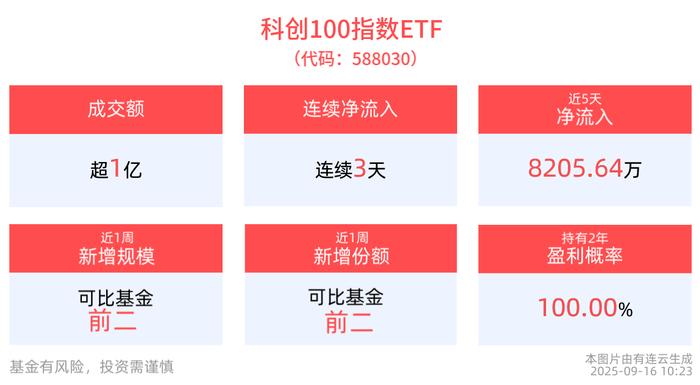
Core Viewpoint - The demand for AI chips is driving domestic chip manufacturers and internet giants to seize market opportunities amid supply instability from Nvidia, with significant orders being secured by companies like Kunlun Chip from China Mobile [3][4]. Group 1: Market Performance - As of September 16, 2025, the Sci-Tech Innovation Board 100 Index decreased by 0.10%, with stocks showing mixed performance; Plater Tech led with a 5.68% increase, while Hangke Technology fell by 8.60% [3]. - The Sci-Tech 100 Index ETF (588030) saw a slight decline of 0.23%, priced at 1.32 yuan, but had a 2.47% increase over the past week [3]. - The ETF recorded a turnover rate of 1.69% and a transaction volume of 101 million yuan, with an average daily transaction of 439 million yuan over the past year, ranking first among comparable funds [3]. Group 2: Industry Insights - Industry experts highlight that domestic companies like Cambricon, Haiguang Information, and Moore Threads have developed competitive AI inference chips, emphasizing the need to enhance production capacity to meet the rapidly growing demand for AI computing power [4]. - Shanghai Securities notes that a robust software platform is essential to maximize the hardware performance of intelligent chips, making them more adaptable to new demands from large models and lowering user barriers for efficient AI algorithm and application innovation [4]. - The top ten weighted stocks in the Sci-Tech 100 Index account for 23.82% of the index, with companies like Dongxin Co., Huahong Semiconductor, and BeiGene among the leaders [6]. Group 3: Fund Performance - The Sci-Tech 100 Index ETF experienced a significant growth of 350 million yuan in scale over the past week, ranking second among comparable funds [4]. - The ETF's share increased by 90 million shares in the same period, also ranking second among comparable funds [4]. - The ETF saw continuous net inflows over three days, with a peak single-day net inflow of 164 million yuan, totaling 246 million yuan and an average daily net inflow of 8.21 million yuan [4].

复旦微回应
半导体芯闻· 2025-09-15 09:59
Core Viewpoint - Fudan Microelectronics emphasizes its commitment to independent innovation and stable operations in response to being added to the U.S. BIS Entity List, highlighting its strategic reserves and diversified product offerings [2][3]. Group 1: Strategic Reserves - The company has strengthened its strategic reserves for core product lines, with inventory increasing from approximately 600 million yuan at the end of 2020 to about 3.1 billion yuan by mid-2025, enhancing supply chain stability and risk resistance [3]. Group 2: Industry Collaboration - Fudan Microelectronics maintains an open cooperation mindset, enhancing supply chain diversification since 2022 and deepening collaboration with domestic and international partners, which has improved supply chain resilience and production capacity [4]. Group 3: Frontier Innovation - The company has established a research and development platform for FPAI heterogeneous fusion architecture chips, covering a full range of computing power chips from 4 TOPS to 128 TOPS, with the first 32 TOPS product progressing well, supporting stable operations and long-term value growth [5].

芯片大战,再次爆发
水皮More· 2025-09-15 09:26
Core Viewpoint - The article discusses the new round of competition between China and the United States in the semiconductor sector, particularly focusing on the implications of the U.S. adding 23 Chinese companies to its export control entity list, which includes several semiconductor firms [4][5][8]. Semiconductor Industry Impact - Among the 23 companies listed, 13 are related to semiconductors and integrated circuits, including notable firms like Fudan Microelectronics and Shanghai Hualing Integrated Circuit [7]. - The U.S. Department of Commerce's announcement indicates that these semiconductor companies will be unable to access supplies from the overseas industry chain, effectively cutting off their supply [8]. - The article highlights the significance of analog chips, which are crucial for processing continuous signals and are widely used across various sectors, including consumer electronics and automotive [11]. Market Opportunities - The U.S. anti-dumping investigation may create market opportunities for domestic analog chip companies such as Sanan Optoelectronics, Nanjing Semiconductor, and others, as it raises the import costs and barriers for U.S. analog chips [12]. - The article suggests that the current geopolitical climate may allow Chinese companies to gain a competitive edge in the semiconductor market, potentially leading to a more self-sufficient industry in the next decade [12]. Strategic Signals - The ongoing competition signals a broader trend of decoupling in core technology sectors, with China beginning to establish its own market barriers to foster domestic growth [12]. - The article posits that within ten years, China may achieve parity with the U.S. in the semiconductor field, as non-100% self-controlled chips will gradually be replaced by fully autonomous solutions [12]. Upcoming Negotiations - A significant upcoming meeting between Chinese and U.S. officials is scheduled to discuss trade issues, including unilateral tariffs and export controls, indicating ongoing diplomatic efforts despite the competitive landscape [14][16].

被美列入实体清单,复旦微电:存货有31亿
Guan Cha Zhe Wang· 2025-09-15 05:05
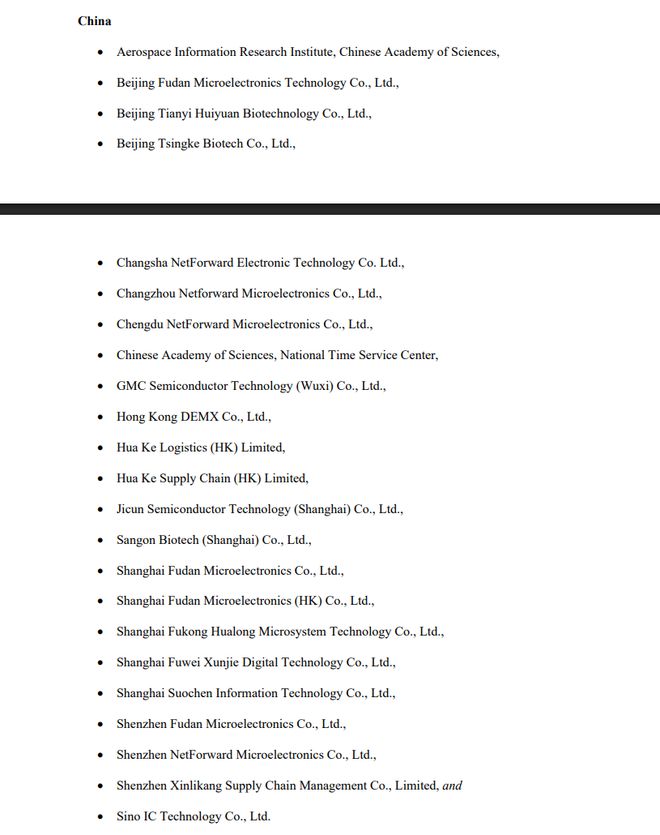
Core Viewpoint - The U.S. Department of Commerce's Bureau of Industry and Security (BIS) has added 23 Chinese entities to its Entity List, including Shanghai Fudan Microelectronics Group Co., Ltd., citing national security concerns related to advanced computing and semiconductor manufacturing support [1][3]. Group 1: Impact of Entity List Inclusion - Thirteen of the listed entities are related to semiconductors and integrated circuits, with others spanning biotechnology, aerospace, and industrial software [1]. - Fudan Microelectronics is notably the first Chinese IC design company to face such sanctions due to its commercial FPGA/MCU business, with nine other Chinese IC design companies also marked with a specific footnote indicating severe restrictions [3][5]. - The sanctions imply a full process blockade, affecting all manufacturing nodes and limiting access to U.S. equipment and design tools, which could extend R&D cycles and disrupt global supply chains [5]. Group 2: Company Response and Strategy - In response to the sanctions, Fudan Microelectronics issued a public letter emphasizing its commitment to legal and compliant operations, and its strategic reserve of key materials has increased from approximately 600 million yuan at the end of 2020 to about 3.1 billion yuan by mid-2025 [8]. - The company has diversified its supply chain and strengthened collaborations with partners to enhance resilience and production capacity [8]. - Fudan Microelectronics is advancing its R&D in heterogeneous computing architecture chips, with a product range from 4 TOPS to 128 TOPS, and has reported positive progress on its first 32 TOPS product [8]. Group 3: Financial Performance - For the first half of 2025, Fudan Microelectronics reported revenues of 1.839 billion yuan, a year-on-year increase of 2.49%, while net profit fell by 44.38% to 194 million yuan due to increased inventory provisions and reduced government subsidies [11]. - The company's R&D expenditure totaled 533 million yuan, a decrease of 10.80%, representing 28.99% of its revenue, down 4.32 percentage points from the previous year [11]. - As of September 15, 2025, Fudan Microelectronics' A-shares rose by 2.75%, with a market capitalization of 50 billion yuan [12].

第一创业晨会纪要-20250915
First Capital Securities· 2025-09-15 03:18
Macro Economic Group - In August, M2 growth was 8.8% year-on-year, the highest since December 2023, while M1 growth was 6.0%, the highest since January 2023, indicating a significant acceleration in the speed of money circulation [5][6] - The total social financing (TSF) in August was 2.57 trillion yuan, lower than the previous year's figure by 463 billion yuan, with a notable decrease in government bonds and loans [5] - Bank credit increased by 590 billion yuan in August, but this was a year-on-year decrease of 310 billion yuan, indicating a contraction in both household and corporate loans [6] Industry Comprehensive Group - Recent US sanctions on Chinese companies, including Shanghai Fudan, may lead to short-term stock sell-offs, but China's countermeasures could benefit domestic analog chip manufacturers [9] - The global analog chip market is recovering, with price increases from major manufacturers, suggesting improved profitability for domestic firms if anti-dumping investigations succeed [9] Advanced Manufacturing Group - In August, China's battery sales reached 134.5 GWh, a year-on-year increase of 45.6%, with lithium iron phosphate batteries accounting for the majority of the growth [11] - The National Development and Reform Commission aims for new energy storage capacity to reach 180 million kilowatts by 2027, driving significant investment in the sector [12] - The automotive industry is projected to see a 3% increase in total sales in 2025, with a 20% growth in new energy vehicle sales, indicating a shift towards smart and electric vehicles [12] Consumer Group - Jiangnan Buyi reported a total revenue of 5.548 billion yuan for the 2025 fiscal year, a 4.6% increase, driven by online sales and store expansion [14] - The company's membership system plays a crucial role, with over 80% of retail revenue coming from members, highlighting the importance of customer loyalty [14] Bond Research Group - The bond market experienced an overall rise in interest rates, influenced by concerns over high redemption fees for bond funds and a weak inflation outlook [16]
不惧“实体清单”!商务部出手,AI还得自主可控!科创人工智能ETF三连涨后首回调,迎逢跌布局机会?
Xin Lang Ji Jin· 2025-09-15 02:28
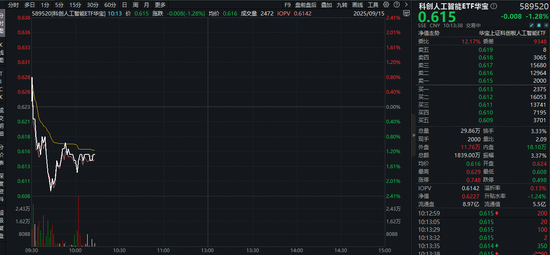
Group 1 - The core viewpoint of the news highlights the impact of U.S.-China chip tensions on the performance of the Sci-Tech Innovation Artificial Intelligence ETF (589520), which saw a decline of 1.28% on September 15, despite strong buying interest in the market [1][3] - The U.S. Department of Commerce added 23 Chinese entities, including Fudan Microelectronics, to its Entity List, citing national security concerns, which has implications for the semiconductor industry and China's AI development [3] - China's Ministry of Commerce announced an anti-dumping investigation into U.S. imported simulation chips, indicating a response to U.S. restrictions on advanced chip exports to China [3] Group 2 - The urgency for domestic chip alternatives is increasing due to U.S. restrictions on advanced chip exports and the pressure on domestic computing chips and AI models, suggesting a trend towards independent design and production of high-end AI chips in China [3][4] - The domestic AI model iteration is expected to continue evolving, with capital expenditures in computing likely to experience fluctuations but maintain a long-term expansion trajectory [4] - The Sci-Tech Innovation Artificial Intelligence ETF (589520) and its associated funds are highlighted for three key aspects: policy support for AI development, the importance of self-sufficiency in technology, and the ETF's high volatility and offensive potential due to its concentrated holdings in the semiconductor sector [4][5]
英伟达推出Rubin CPX,AI-PCB持续升级 | 投研报告
Zhong Guo Neng Yuan Wang· 2025-09-15 02:23
Core Viewpoint - NVIDIA has launched the Rubin CPX, a new GPU designed for large-scale contextual reasoning, which significantly enhances processing capabilities in AI applications [1][2] Group 1: Product Launch and Features - The Rubin CPX GPU is integrated into the NVIDIA MGX rack system, which includes 144 Rubin CPX GPUs, 144 Rubin GPUs, and 36 Vera CPUs, providing 8 EFLOPS of NVFP4 computing power [1][2] - The system features 100TB of high-speed memory and 1.7PB/s memory bandwidth, offering three times the attention mechanism processing capability compared to the NVIDIA GB300 NVL72 system [1][2] Group 2: Market Implications and Predictions - The value of PCBs supporting the CPX is expected to increase, alongside new PCB demand from the CX9 network card, leading to significant growth in the VR NVL144 CPX PCB value [2] - NVIDIA is advancing orthogonal backplane development and may adopt M9+Q materials, which could potentially double the PCB value in a single rack [2] - The technology for ASIC chip PCBs is evolving from high-layer to HDI, with future advancements expected from M8 to M9, continuously enhancing value [2] Group 3: Industry Trends and Demand - Micron has announced a price increase of 20%-30% for storage products, affecting all DDR4, DDR5, LPDDR4, and LPDDR5 products, with a halt in pricing expected for one week [2] - The U.S. Department of Commerce has added 23 Chinese entities, including 13 integrated circuit companies, to its entity list, which may create opportunities for domestic alternatives in analog chips [2] - The surge in downstream inference demand is driving strong growth in ASIC demand, with NVIDIA's technology upgrades boosting both PCB value and volume [2] Group 4: Sector Outlook - The demand for AI PCBs remains robust, with domestic PCB manufacturers likely to benefit from slow overseas expansion [4] - The overall outlook for various sectors is positive, with consumer electronics, PCB, semiconductor chips, and related industries showing stable to accelerating growth [4]

商务部对美模拟芯片启动反倾销调查,国产替代加速,科创100指数ETF(588030)上涨近1%,冲击3连涨
Xin Lang Cai Jing· 2025-09-15 02:04
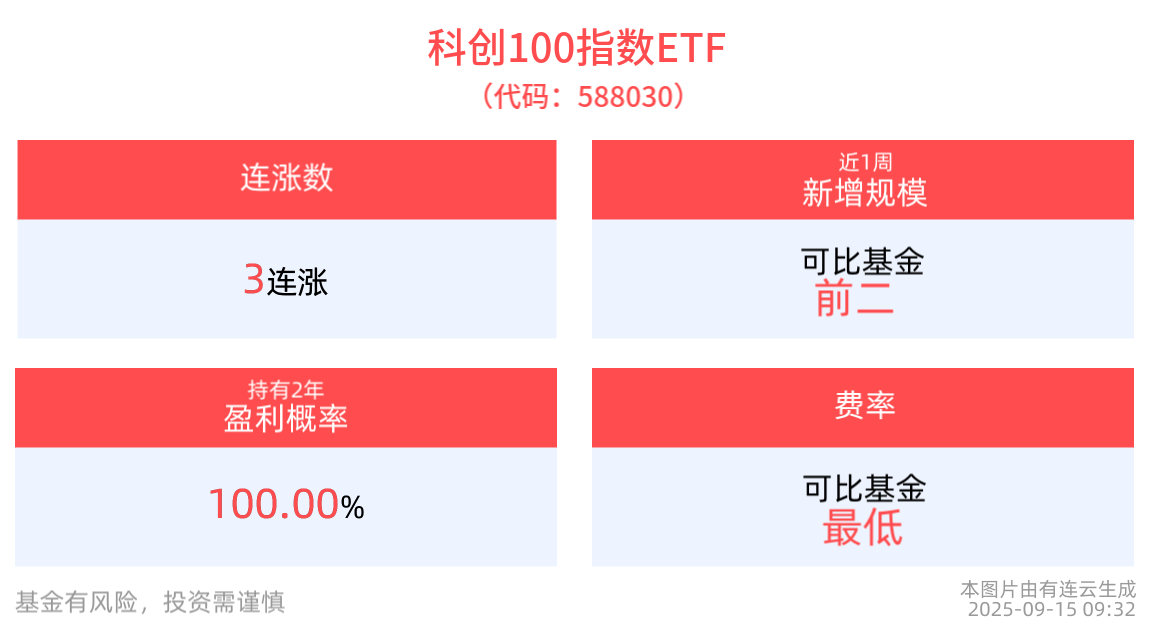
Core Insights - The Shanghai Stock Exchange Sci-Tech Innovation Board 100 Index has shown a strong increase of 1.13%, with notable gains from constituent stocks such as Si Rui Pu (up 16.40%) and Na Xin Wei (up 14.27%) [3] - The Ministry of Commerce announced an anti-dumping investigation into imported simulation chips from the U.S., indicating a potential escalation in trade tensions [3] - A State Council meeting emphasized the need to promote innovation in biomedical technology, aiming to enhance the quality and upgrade the biopharmaceutical industry [3] Industry Analysis - The two leading sectors in the Sci-Tech Innovation Board 100 Index are electronics and biomedicine, accounting for 39.69% and 19.31% respectively, both of which are expected to continue benefiting from favorable policies [4] - The Sci-Tech Innovation Board 100 Index ETF (588030) has seen a significant scale increase of 43.68 million yuan over the past week, ranking second among comparable funds [4] - The top ten weighted stocks in the Sci-Tech Innovation Board 100 Index account for 23.82% of the index, indicating a concentrated investment in key players within the sector [5]
中信证券:美国增加实体清单 中国开启反歧视调查 国产替代持续受益
智通财经网· 2025-09-15 01:16
Core Viewpoint - The U.S. Department of Commerce's BIS has added 23 Chinese entities to the Entity List, primarily affecting 13 semiconductor companies, prompting China to initiate an anti-discrimination investigation against U.S. measures in the integrated circuit sector [1][2][4] Group 1: U.S. Entity List and Its Implications - The U.S. has cited "violations of U.S. national security or foreign policy interests" as the reason for placing 23 Chinese entities on the Entity List [2] - Entities on the list require licenses for all items governed by EAR, with a presumption of denial for these licenses [2] - Notable companies on the list include Fudan Microelectronics Group, which is a leader in MCU, security and identification chips, and non-volatile memory [3] Group 2: China's Response - China has launched an anti-discrimination investigation into U.S. measures affecting the integrated circuit sector, focusing on discriminatory bans and restrictions since 2018 [4] - The investigation will begin on September 13, 2025, and typically lasts for three months, with potential follow-up measures based on the findings [4] Group 3: Investment Strategy and Focus Areas - The company maintains that U.S. restrictions on semiconductor exports will continue to strengthen but their effectiveness will gradually diminish, accelerating domestic substitution in China's AI and semiconductor industries [6] - Key areas for investment focus include: 1. Wafer foundries as core strategic assets for domestic semiconductor substitution [6] 2. Computing chip design firms that are rapidly building local technology systems [6] 3. Companies with low domestic production rates in advanced manufacturing equipment [6] 4. Advanced packaging technologies in AI chips, particularly in 2.5D/3D/HBM areas [6]

早新闻|美联储将公布9月利率决议
Zheng Quan Shi Bao· 2025-09-14 23:51
Group 1: Macroeconomic Developments - China and the US held talks in Madrid regarding trade issues on September 14 [1] - The Ministry of Commerce initiated an anti-dumping investigation into US-imported simulation chips, responding to domestic industry requests [1] - The State Council will release August's national economic performance data on September 15, with previous data showing industrial output growth of 5.7% and retail sales growth of 3.7% in July [1] Group 2: Automotive Industry - Eight departments, including the Ministry of Industry and Information Technology, aim for 32.3 million vehicle sales in 2025, a 3% increase year-on-year, with 15.5 million being new energy vehicles, reflecting a 20% growth [2] - The automotive manufacturing industry's value-added is expected to grow by approximately 6% [2] Group 3: Financial Sector - The People's Bank of China will conduct a 600 billion yuan reverse repurchase operation on September 15 to maintain liquidity [2] - In the first eight months of 2025, RMB loans increased by 13.46 trillion yuan, with total social financing reaching 26.56 trillion yuan, up 4.66 trillion yuan year-on-year [2] Group 4: Food Safety and Regulation - The State Administration for Market Regulation is seeking public opinions on a draft management method for food safety inspectors, with feedback due by October 13 [3] Group 5: International Cooperation - The "2025 Budapest Renminbi Initiative" forum highlighted the growing use of RMB in China-Hungary trade, with a 63% year-on-year increase in RMB settlements in the first half of the year [5] Group 6: Renewable Energy - The largest onshore wind power project in China, with a capacity of 1.5 million kilowatts, officially commenced commercial operation on September 14 [6] Group 7: Company News - Das Intelligent signed a contract worth 23.869 million yuan for a smart project with Xiaomi in Wuhan [8] - Huibo Yuntong plans to acquire 22.0875% of Baode Computing to gain control [9] - Zhonggang Tianyuan has fully released its capacity of 35,000 tons of battery-grade manganese tetroxide [10]