
美的集团

Search documents
美的集团(00300) - 翌日披露报表
2026-01-26 10:04
FF305 翌日披露報表 (股份發行人 ── 已發行股份或庫存股份變動、股份購回及/或在場内出售庫存股份) 公司名稱: 美的集團股份有限公司(於中華人民共和國註冊成立的股份有限公司) 呈交日期: 2026年1月26日 如上市發行人的已發行股份或庫存股份出現變動而須根據《香港聯合交易所有限公司(「香港聯交所」)證券上市規則》(「《主板上市規則》」)第13.25A條 / 《香港聯合交易所有限公司GEM證券 上市規則》(「《GEM上市規則》」)第17.27A條作出披露,必須填妥第一章節 。 | 第一章節 | | | | | | | | | --- | --- | --- | --- | --- | --- | --- | --- | | 1. 股份分類 | 普通股 | 股份類別 A | | | 於香港聯交所上市 | 否 | | | 證券代號 (如上市) | 000333 | 說明 | A股 (於深圳證券交易所上市) | | | | | | A. 已發行股份或庫存股份變動 | | | | | | | | | 事件 | | 已發行股份(不包括庫存股份)變動 | | | 庫存股份變動 | 每股發行/出售價 (註4) | ...
可选消费W04周度趋势解析:黄金持续创新高叠加新消费板块回暖,黄金珠宝板块本周表现最优-20260126
Haitong Securities International· 2026-01-26 09:54
Investment Rating - The report assigns an "Outperform" rating to multiple companies including Nike, Midea Group, JD Group, Haier Smart Home, Gree Electric, Anta Sports, and others, indicating a positive outlook for these stocks [1]. Core Insights - The gold and jewelry sector has emerged as the top performer this week, driven by new consumer sentiment and expectations of improved sales as the Spring Festival approaches. The sector saw a weekly increase of 12.9% [4][14]. - The report highlights a rebound in the new consumer sectors, with various segments such as gambling, overseas cosmetics, and retail also showing positive performance [4][14]. - The overall market sentiment is influenced by the performance of the MSCI China index, which has shown fluctuations in its weekly, monthly, and year-to-date performance [12][13]. Sector Performance Summary - **Gold and Jewelry**: Increased by 12.9%, with notable gains from Lao Pu Gold (20.5%) and Chow Tai Fook (5.9%) due to positive sales forecasts [6][14]. - **Gambling**: Rose by 2.9%, with MGM China and Galaxy Entertainment seeing increases of 4.0% and 3.6% respectively, attributed to market share gains [6][14]. - **Overseas Cosmetics**: Gained 2.1%, driven by E.L.F Beauty's strong performance and positive earnings outlook [6][14]. - **Retail**: Increased by 2.0%, with Wanchen Group rising 14.3% due to optimistic revenue forecasts [6][14]. - **Domestic Cosmetics**: Saw a modest increase of 0.9%, with companies like Proya and Runben showing positive trends [8][14]. - **Snacks**: Increased by 0.6%, with Youyou Foods and Qiaqia Foods showing gains [8][14]. - **Pet Sector**: Experienced a slight decline of 0.4%, with Zhongchong Co. facing market challenges [8][14]. - **Domestic Sportswear**: Decreased by 1.4%, with Li Ning showing a positive increase of 4.3% while Anta Sports faced a decline [8][14]. - **US Hotels**: Fell by 1.4%, with major hotel chains like Marriott and Hilton seeing declines [15][16]. - **Credit Card Sector**: Also decreased by 1.4%, with Visa and Mastercard facing market uncertainties [15][16]. - **Luxury Goods**: Declined by 1.6%, with Burberry experiencing a significant drop [15][16]. - **Overseas Sportswear**: Decreased by 1.8%, with Adidas facing a notable decline due to downgrades from investment banks [15][16]. Valuation Analysis - The report indicates that most sectors are currently undervalued compared to their historical averages, with expected PE ratios for various sectors such as overseas sportswear at 30.0x (56% of the past 5-year average) and domestic sportswear at 13.4x (70% of the past 5-year average) [10][17].
白色家电板块1月26日跌0.69%,澳柯玛领跌,主力资金净流出2.79亿元
Zheng Xing Xing Ye Ri Bao· 2026-01-26 09:37
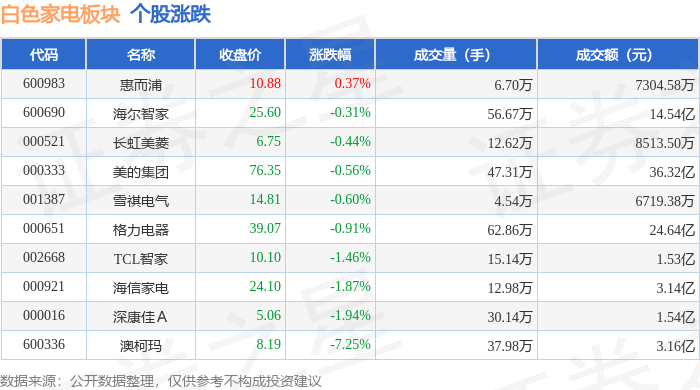
证券之星消息,1月26日白色家电板块较上一交易日下跌0.69%,澳柯玛领跌。当日上证指数报收于 4132.61,下跌0.09%。深证成指报收于14316.64,下跌0.85%。白色家电板块个股涨跌见下表: | 代码 | 名称 | 主力净流入(元) | 主力净占比 游资净流入 (元) | | 游资净占比 散户净流入(元) | | 散户净占比 | | --- | --- | --- | --- | --- | --- | --- | --- | | 600690 海尔智家 | | 1.19/Z | 8.16% | 346.59万 | 0.24% | -1.22 Z | -8.40% | | 000333 | 美的集团 | 1749.68万 | 0.48% | -3.58亿 | -9.85% | 3.40 Z | 9.37% | | 000921 | 海信家电 | 749.24万 | 2.39% | 1960.30万 | 6.25% | -2709.54万 | -8.64% | | 002668 | TCL智家 | 521.91万 | 3.41% | 904.19万 | 5.91% | -1426.11万 | -9 ...


“反内卷+跨境资本回流”修复企业自由现金流!300现金流ETF(562080)逆市劲涨2.07%再创历史新高!
Xin Lang Cai Jing· 2026-01-26 09:17
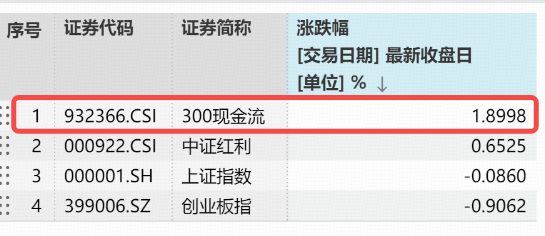
Core Insights - The core asset "cash cows" are performing strongly, with sectors like oil, petrochemicals, and non-ferrous metals leading the gains, as evidenced by the CSI 300 cash flow index rising by 1.9% against major indices like the CSI Dividend, Shanghai Composite, and ChiNext [1][19]. Performance Summary - The CSI 300 cash flow index closed with a gain of 1.8998% on January 26, 2026, outperforming the CSI Dividend index which rose by 0.6525%, the Shanghai Composite index which fell by 0.086%, and the ChiNext index which decreased by 0.9062% [2][19]. - The CSI 300 cash flow ETF (562080) opened high and closed up by 2.07% at ¥0.641, reaching a historical high of ¥0.646 during the trading session, with a trading volume of ¥55.94 million [4][21]. Fund Flow and Investment Trends - There has been a notable increase in fund inflows, with a net inflow of ¥41.56 million over the past five days [6][24]. - Among the 50 large-cap "cash cow" stocks, 33 saw price increases, with notable gains from Kingsoft International (up 9.93%), PetroChina (up 5.7%), and CNOOC (up 6.66%) [7][26]. Sector Analysis - The non-ferrous metals sector has seen a significant improvement in cash flow, with its representation in the CSI 300 cash flow index increasing from 4% to 11% between early 2024 and the end of 2025, enhancing profitability and resilience [31][33]. - The long-term performance of the CSI 300 cash flow total return index has shown a cumulative return of over 427% since 2014, with an annualized return of 15.31% [15][34]. Strategic Insights - The cash flow strategy is gaining traction as a robust investment approach, particularly in the current market environment that favors high-quality growth and shareholder returns [28][35]. - Investors are encouraged to consider the CSI 300 cash flow ETF (562080) and its associated funds for exposure to high-quality "cash cow" assets within the CSI 300 [35].
看世界 | 中国降温神器热销东南亚
Jing Ji Ri Bao· 2026-01-26 09:13
Core Insights - The extreme heat in Southeast Asia, exacerbated by the El Niño phenomenon, has led to a surge in demand for cooling products, particularly air conditioners, cooling mats, and fans produced in China [1][2]. Air Conditioning Market - The Southeast Asian air conditioning market is projected to exceed $5.5 billion by 2025, with an expected annual growth rate of over 10% from 2025 to 2030 [1]. - The International Institute of Refrigeration (IIF) forecasts a 13.9% increase in room air conditioner sales in Southeast Asia in 2024, with Indonesia being a key market attracting international brands, especially Chinese ones [1]. Cooling Mats and Fans Market - The demand for cooling mats and fans in Southeast Asia has significantly increased, with sales in the Philippines reportedly growing several times compared to previous years [2]. - Chinese cooling mats, including ice silk and linen varieties, are gaining popularity in markets like Vietnam, Indonesia, and Thailand, thanks to advancements in materials and manufacturing techniques [3]. - Chinese fans are recognized for their variety, reliability, and affordability, catering to diverse consumer needs across the region [3]. Marketing and Distribution Strategies - Chinese companies are investing heavily in marketing channels, collaborating with major retail chains and e-commerce platforms like Lazada and Shopee to enhance product availability and consumer access [4]. - Partnerships with local retailers, such as Gree's collaboration with Thailand's Central Group, have facilitated better product placement and promotional activities [4]. Economic Impact - The influx of Chinese cooling products is stimulating trade in Southeast Asia, benefiting logistics, warehousing, and transportation sectors, and creating more job opportunities [5]. - Retail sectors are experiencing increased foot traffic and sales, with reports of Malaysian logistics companies expanding their operations due to high demand for Chinese air conditioning and fan products [5]. Social Impact - The widespread availability of Chinese cooling products is improving the quality of life for Southeast Asian residents, with no significant increase in heat-related hospital visits despite record temperatures [6]. - The popularity of these products is enhancing consumer awareness of Chinese brands and fostering cultural exchange [6]. - There is a growing demand for energy-efficient and environmentally friendly cooling products, which presents an opportunity for Chinese companies to innovate and contribute to sustainable development in the region [6].



中国类人机器人调查:高接受意愿遭遇产品过早推出(英)
Morgan Stanley· 2026-01-26 08:40
Investment Rating - The report maintains a positive long-term outlook on humanoid robots, although it acknowledges that the industry is still in its early stages and that scaling production will take time [4]. Core Insights - The survey indicates a strong willingness to adopt humanoid robots, with 62% of respondents likely to deploy them in the next three years, suggesting significant potential [9][18]. - However, only 23% of respondents are satisfied with current humanoid robot offerings, highlighting a need for improvements in flexibility, functionality, and pricing [9][66]. - The report emphasizes that the adoption of humanoid robots is expected to accelerate in 2026 and beyond, supported by new models and government incentives [4][41]. Summary by Sections Adoption Intent - 62% of surveyed organizations plan to deploy humanoid robots or significant projects within the next three years, with initial deployments expected to be small [25][32]. - The most likely use cases for humanoid robots include logistics, warehousing, manufacturing, and customer service, aimed at improving productivity and reducing labor costs [25][54]. Product Readiness - Satisfaction with current humanoid robot performance is mixed, with only 23% expressing satisfaction, indicating substantial room for improvement [66][72]. - Key barriers to adoption include limited functionality, high upfront costs, and integration challenges with existing systems [72][79]. Market Dynamics - Unitree is identified as the most actively engaged brand among potential adopters, followed by Deep Robotics and UBTECH [85][87]. - The report notes that brand visibility and media exposure are likely to influence initial adoption decisions, with Unitree leading in brand recognition [97]. Employment Impact - The survey predicts that approximately 11% of jobs may be replaced by robots within the next five years, increasing to 28% over the next ten years [26][61]. Future Expectations - Respondents expect humanoid robots to perform specific tasks rather than general functions, with a strong emphasis on human-robot collaboration and IoT integration as desired future capabilities [71][81].
2025年度并购市场数据报告
Sou Hu Cai Jing· 2026-01-26 06:10
Core Findings - The 2025 Chinese M&A market shows significant structural differentiation, characterized by a "volume decrease and price increase" trend, with multiple dynamics including market stabilization, private equity fund exit recovery, and notable regional and industry concentration [1][16]. M&A Market Overview - In 2025, the number of announced M&A transactions decreased by 20.27% year-on-year to 5,086, marking a seven-year low, indicating a cooling market activity. However, the total disclosed amount for 3,499 transactions reached 23,735.15 billion yuan, a year-on-year increase of 29.08%, highlighting a significant expansion in single transaction sizes [13][16]. - The total number of completed transactions for the year was 3,342, a slight increase of 0.45% year-on-year, with the total disclosed amount for 2,026 transactions reaching 14,851.31 billion yuan, a substantial year-on-year growth of 54.41%, reversing the downward trend since 2019 [17][16]. Private Equity Fund Exit Trends - In 2025, private equity funds exited through M&A reached 469, a year-on-year increase of 22.77%, recovering to the highest level since 2022. The total capital returned was 642.15 billion yuan, up 8.54% year-on-year, indicating improved exit efficiency and capital circulation capabilities [2][26]. Major M&A Cases - In 2025, there were 20 transactions exceeding 10 billion yuan, with the largest being China Shipbuilding's merger with China Shipbuilding Industry Corporation at 1,151.50 billion yuan, marking a significant milestone in China's shipbuilding industry [30][31]. Cross-Border M&A Trends - The cross-border M&A market completed 144 transactions in 2025, a year-on-year decrease of 13.77%. The total disclosed amount for 105 transactions was 1,181.46 billion yuan, down 5.73% year-on-year, indicating a continued low activity level in the cross-border M&A sector [33][36]. Industry and Regional Distribution - Guangdong province led the M&A market in China, benefiting from the advantages of the Guangdong-Hong Kong-Macao Greater Bay Area. The electronic information, traditional manufacturing, healthcare, and energy mining sectors emerged as hot spots for M&A activity [3][38]. - In terms of transaction volume, electronic information accounted for 17.32% of the total, while the financial sector led in transaction scale with 2,035.96 billion yuan, representing 13.71% of the total disclosed amount [43][39].





2025Q4家电板块基金持仓点评:行业重仓仍处低位,白电持仓环比提升
Guolian Minsheng Securities· 2026-01-26 06:04
Investment Rating - The report maintains an "Outperform" rating for the home appliance industry [3] Core Insights - The home appliance sector's fund holding ratio remains low at 2.40% for Q4 2025, with a slight increase of 0.08 percentage points from the previous quarter, which is still at a low level compared to historical data since 2010 [6][9] - The white goods segment saw an increase in holdings, while the vacuum cleaner segment experienced a reduction in allocation [17][21] - There is a divergence in northbound holdings, with some companies like Hisense Home Appliances and Bull Group seeing increases, while others like Vatti and Roborock saw declines [42] Summary by Sections Home Appliance Sector Fund Holding Ratio - The fund holding ratio for the home appliance sector in Q4 2025 is 2.40%, ranking 12th among all sectors, with a cumulative increase of 4.09% in the CITIC home appliance index, also ranking 12th in absolute returns [6][9][14] White Goods Increase and Vacuum Cleaner Reduction - The fund holding ratios for sub-segments in Q4 2025 are as follows: white goods at 1.88% (+0.24 percentage points), small appliances at 0.71% (+0.08 percentage points), upstream appliances at 0.27% (-0.16 percentage points), black goods at 0.08% (-0.03 percentage points), kitchen appliances at 0.03% (-0.01 percentage points), and lighting at 0.03% (stable) [17][21] Northbound Holdings Divergence - The northbound holdings for the home appliance sector showed mixed results in Q4 2025, with increases for Hisense Home Appliances (+0.78 percentage points), Bull Group (+0.41 percentage points), and Yitian Smart (+0.41 percentage points), while declines were noted for Vatti (-2.31 percentage points), Roborock (-1.69 percentage points), and XGIMI (-1.47 percentage points) [42][44] Investment Recommendations - The report recommends leading white goods companies such as Midea Group, Haier Smart Home, Gree Electric Appliances, and Hisense Home Appliances, as well as TV leader Hisense Visual and cleaning appliance leaders Roborock and Ecovacs [57]


全国首个跨省域高新区更名
Guo Ji Jin Rong Bao· 2026-01-26 04:11
全国首个跨省域高新区命名获批。 近日,上海市政府网站发布《上海市人民政府 江苏省人民政府 浙江省人民政府关于同意长三角生态绿色一体化发展示范区跨省域高新技术产业开发区 命名为长三角青吴嘉高新技术产业开发区的批复》。 作为全国首个跨省域高新区,此次命名获批标志着其迈入规范化发展新阶段,更意味着长三角一体化发展进入"打破行政壁垒、共建产业生态"的全新阶 段,具有里程碑式意义。 江苏吴江区2024年实现GDP产值2660.09亿元,以丝绸纺织、电子信息、装备制造、新材料为四大千亿级主导产业,专精特新"小巨人"企业数量居苏州 市首位,民营经济活力突出。 浙江嘉善县2025年GDP可比增长5.8%,总量首次突破千亿元大关。该县坚持生态优先、产业升级,推动制造业向"智造"转型,获评国家级绿色园区,聚 焦数字经济与高端装备领域,与青浦、吴江形成产业互补、协同发力的发展格局,为高新区高质量发展筑牢根基。 2025年7月,长三角生态绿色一体化发展示范区联合招商会在嘉善举行。示范区跨省域高新区内的青浦园区、吴江园区、嘉善园区3个分园揭牌。《长三 角生态绿色一体化发展示范区一体化营商环境优化提升行动方案(2025—2027年)》发 ...

西部证券晨会纪要-20260126
Western Securities· 2026-01-26 02:50
Group 1: Shipping Industry - The global shipping market is expected to improve in 2026, with specific attention on container ships, bulk carriers, and tankers [1][5] - The resumption of operations in the Red Sea is crucial for container ships, while the West Simandou iron ore mine is anticipated to reshape global iron ore trade flows, benefiting bulk shipping [1][5] - OPEC+ has begun to increase production, leading to a tight supply-demand balance in the tanker market due to US sanctions on Russia [1][5] Group 2: Weigao Group (1066.HK) - Weigao Group is positioned for a transformation driven by R&D, with expectations of net profits of 2.091 billion, 2.287 billion, and 2.507 billion yuan from 2025 to 2027, reflecting growth rates of 1.18%, 9.37%, and 9.62% respectively [9][10] - The global biopharmaceutical market is projected to grow at a CAGR of 10.4% from 2024 to 2030, with significant demand for filters and consumables [9] - The company has a robust product portfolio with 927 domestic product registrations and 1,084 patents, including 218 invention patents [9] Group 3: AI Animation Industry - The continuous iteration of generative AI models is providing a technological foundation for the cost-effective and high-quality development of AI animation [16][18] - AI animations are gaining market acceptance, with significant growth in production and viewership, exemplified by the rapid increase in the number of AI animations launched on platforms like Douyin [16][17] - The cost advantages of AI animations compared to traditional animation methods are notable, with production costs significantly lower [17][18] Group 4: 3D Printing in Commercial Aerospace - 3D printing technology is effectively reducing costs and increasing efficiency in the commercial aerospace sector, with significant reductions in the number of parts and production time for rocket engines [20][21] - The domestic 3D printing equipment market is experiencing growth, with exports reaching 3.777 million units valued at 8.9 billion yuan in 2024 [21][22] - The technology is also being applied in the production of micro-nano satellite components, showcasing its advantages in mass production [21][22] Group 5: Zijin Mining (601899.SH) - Zijin Mining's Giant Dragon Copper Mine Phase II has commenced production, increasing annual copper output from 190,000 tons to an expected 300,000-350,000 tons in 2026 [28][29] - The mine's production capacity has significantly increased, positioning it as China's largest copper mine and one of the world's highest-altitude, low-grade copper mines [29][30] - The company anticipates further growth with plans for a Phase III project that could increase copper reserves and production capacity [30]