华为

Search documents
一线实探!华为小米已成新“年货” 后国补时代市场热度几何?
Xin Lang Cai Jing· 2026-02-12 01:49
Core Viewpoint - The Chinese government has allocated 62.5 billion yuan in subsidies to stimulate consumer spending during the Spring Festival, with a focus on home appliances and 3C electronic products, leading to increased sales and market activity [1][2][6]. Group 1: Subsidy Implementation and Market Response - The Ministry of Commerce has released the first batch of 62.5 billion yuan in national subsidies, which will be distributed to local commerce departments to ensure consumers can claim these subsidies during the Spring Festival [1]. - Consumers can now apply for subsidies online for digital and smart products, with reports of increased sales activity in stores, particularly for mobile phones and home appliances [2][3]. - The combination of national subsidies, brand discounts, and platform incentives is driving consumer interest and sales, particularly in the home appliance and 3C product sectors [2][6]. Group 2: Sales Performance and Consumer Trends - Sales of major home appliances such as air conditioners, refrigerators, and washing machines have seen a month-on-month increase of over 90%, with high-end smartphones dominating the market [2][7]. - The demand for efficient and technologically advanced home appliances is rising, with products like smart air conditioners and large-screen TVs becoming popular choices for consumers during the festive season [2][7]. - The sales of energy-efficient appliances have surged, with 92% of sales being of first-level energy efficiency products, indicating a shift towards greener and smarter home solutions [7][13]. Group 3: Manufacturer Strategies and Market Dynamics - Manufacturers are preparing for the Spring Festival by increasing inventory of energy-efficient products and optimizing supply chains to ensure availability during peak demand [8][9]. - Major 3C brands are enhancing promotional efforts during the Spring Festival, with additional discounts and marketing campaigns to attract consumers [9]. - Despite the positive impact of subsidies, rising costs of raw materials are leading to price increases for some products, which may affect overall sales volumes in the future [10][11]. Group 4: Future Outlook and Industry Challenges - The effectiveness of subsidies may diminish as consumers become accustomed to them, and the market faces challenges related to supply-demand mismatches [14]. - Industry experts suggest that continuous growth will depend on product innovation and the ability to meet evolving consumer preferences, particularly in the context of AI integration in home appliances [12][14]. - The anticipated decline in smartphone sales in 2026 highlights the need for brands to adapt their strategies in response to changing market conditions and consumer behavior [11].

赢下全球的宝马,不想只输在中国
3 6 Ke· 2026-02-12 01:40
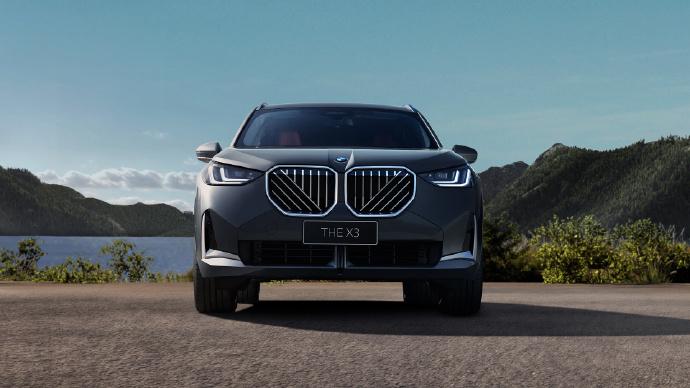
Group 1 - BMW Group announced a significant leadership change, appointing Christian Ach as the new President and CEO for Greater China, effective April 1, 2026, replacing Sean Green, who served for over twelve years [1][2] - BMW's global delivery volume showed a slight increase of 0.5% in 2025, with European market sales rising by 7.3%, while sales in China fell to 625,500 units, a decline of 12.5% year-on-year, marking two consecutive years of double-digit declines [1][3] - The luxury car market in China is undergoing a structural crisis, with the 300,000 to 350,000 RMB segment shrinking by 19.2% in 2025, leading to a significant loss of customers to local electric vehicle brands [3][5] Group 2 - BMW's X3 model experienced a dramatic sales drop of 30%, from over 110,000 units in 2024 to 76,900 units in 2025, due to design controversies and aggressive discounting strategies [3][5] - The German luxury car manufacturers, including BMW, Mercedes-Benz, and Audi, are facing a collective downturn, with Mercedes-Benz sales in China dropping by 19% to 575,000 units and Audi's sales down by 5% to 617,500 units [5][6] - BMW's strategy has been inconsistent, struggling to balance traditional driving pleasure with the new demands for smart technology and user experience in the Chinese market [6][8] Group 3 - The leadership change at BMW is seen as a decisive move to regain control and address the chaotic situation in the Chinese market, with a focus on efficiency and execution [8][12] - Christian Ach's mission includes leveraging his successful experience in the German market to boost electric vehicle sales in China, where the market dynamics are more complex [12][16] - In 2026, BMW plans to launch nearly 20 new models in China, including the iX3, which is crucial for establishing a high-end electric brand image [17][19] Group 4 - Ach faces several challenges, including aligning pricing with perceived value for the new iX3, adapting successful strategies from Germany to the dynamic Chinese market, and effectively communicating BMW's unique competitive advantages in the era of electrification and smart technology [22][23]
商业头条No.112|400亿狂热追逐:具身智能2025投资战事
Sou Hu Cai Jing· 2026-02-12 01:38
"GPT-1是搭建一个验证它是否可行的技术环境,GPT-2是本质上证明了某些技术路径是可行的。"张津剑对所谓具身智能的"GPT"时刻下如此定义。 智通财经记者 | 伍洋宇 智通财经编辑 | 文姝琪 2025年接近年末,绿洲资本创始合伙人张津剑跟成立刚一年的具身智能创企HillBot联合创始人苏昊共进了一顿晚餐。 苏昊给张津剑展示了一些数据,进而抛出一个想法:他觉得具身智能即将在2026上半年走到GPT-2时刻。 这在行业内并不是共识。更多受访者认为,行业应该还没走到GPT-1。 具身智能赛道火在大模型之后,又与大模型紧密相关。尽管从技术上无法完全对标,但投资人愿意用"GPT-1"之类的表述试图对行业发展阶段进行定位—— 这从根本上影响他们选择是否加码、何时加码以及加多少码。 这种定位十分重要。假设你在GPT-3.5和GPT-1/2两个时期投进OpenAI,那么2026年你得到的估值增长将分别是30倍和大约100倍。 奇怪的是,具身智能还远远没有走到GPT-3.5阶段,只因宇树科技在2025年春晚舞台上意外走红,就提前浮出了水面。 此后一年,行业投融资格局发生了翻天覆地的变化——已经入局的投资者继续加码,尚未出 ...

Omdia:2025年Q4全球智能手机市场同比增长4% 苹果以25%市场份额领跑
智通财经网· 2026-02-12 01:33
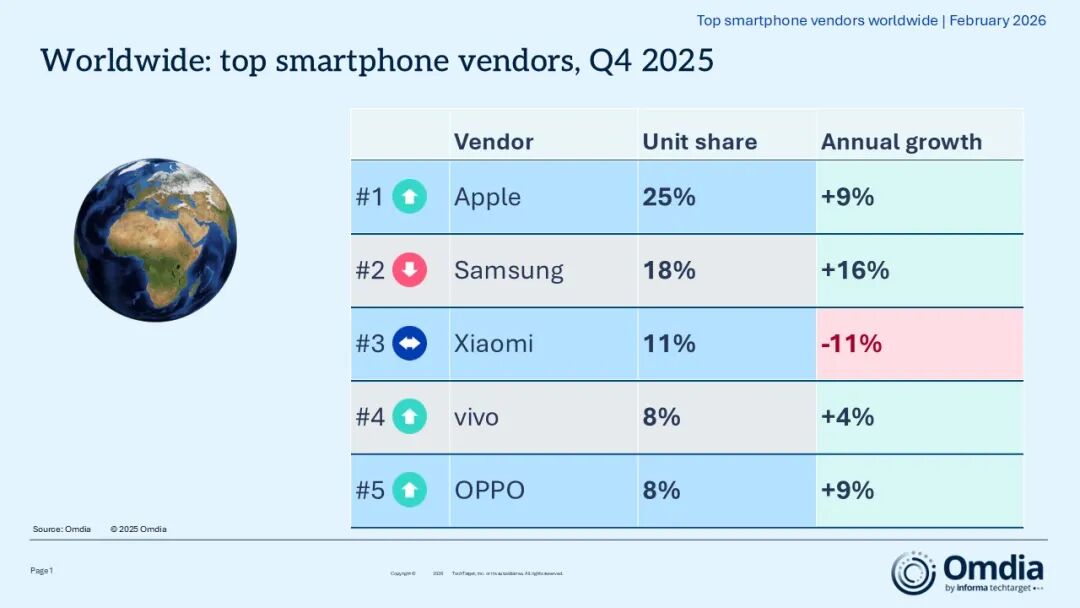
Core Insights - The global smartphone market is expected to grow by 4% year-on-year in Q4 2025, driven by seasonal demand recovery and improved inventory management, despite some manufacturers facing rising component costs [1] - Apple leads the market with a 25% share, benefiting from strong demand for the iPhone 17 series, achieving record quarterly shipments and maintaining its position as the largest smartphone manufacturer for three consecutive years, slightly ahead of Samsung [1] - Samsung holds the second position with an 18% market share, primarily driven by strong sales of models priced below $300, particularly the Galaxy A17 4G and 5G series [1] Global Market Rankings - In Q4 2025, the top smartphone vendors by unit share are: - Apple: 25% (+9% growth) - Samsung: 18% (+16% growth) - Xiaomi: 11% (-11% growth) - Vivo: 8% (+4% growth) - OPPO: 8% (+9% growth) [2] Regional Performance - In the APAC region (excluding Greater China), the top vendors are: - Samsung: 19% (+18% growth) - Apple: 18% (+4% growth) - Vivo: 15% (+11% growth) - OPPO: 11% (+6% growth) - Xiaomi: 10% (-23% growth) [4] - In Latin America, the rankings are: - Samsung: 33% (+21% growth) - Lenovo: 16% (+14% growth) - Xiaomi: 15% (+6% growth) - HONOR: 9% (+64% growth) - Apple: 7% (-8% growth) [4] - In India, the top vendors are: - Vivo: 25% (+16% growth) - OPPO: 16% (+4% growth) - Samsung: 14% (-11% growth) - Xiaomi: 12% (-26% growth) - Apple: 11% (-1% growth) [6] - In the United States, the rankings are: - Apple: 69% (+8% growth) - Samsung: 14% (-3% growth) - Lenovo: 9% (+13% growth) - Google: 3% (-15% growth) - TCL: 2% (-7% growth) [6] - In Brazil, the top vendors are: - Samsung: 39% (-1% growth) - Lenovo: 23% (+12% growth) - Xiaomi: 15% (+12% growth) - Apple: 11% (+10% growth) - realme: 5% (-7% growth) [7]


2025手机活跃存量增2% 苹果三星小米位列前三
Xin Lang Cai Jing· 2026-02-12 01:30
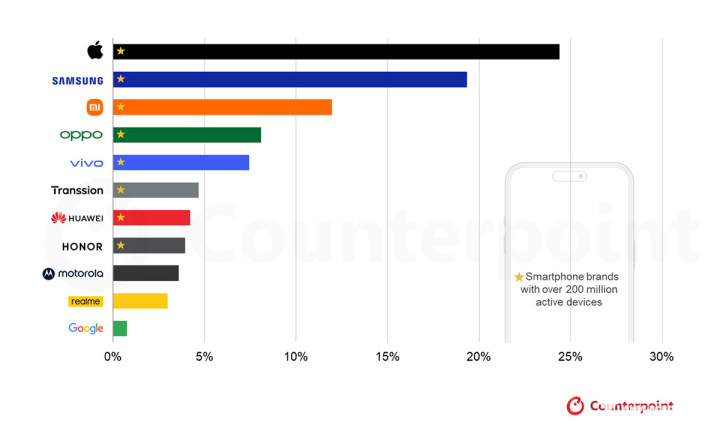
Core Insights - The report by Counterpoint Research indicates that eight smartphone manufacturers have surpassed 200 million active devices globally, collectively accounting for over 80% of the active device market share [1][6][8] - By 2025, the global active smartphone device stock is expected to grow by 2% year-on-year, with the average replacement cycle extending to nearly four years, marking a new phase of competition focused on existing users [1][5] Market Share Distribution - Apple and Samsung demonstrate a significant lead, being the only two brands with active devices exceeding 1 billion, together holding 44% of the global market share, with Apple at approximately 25% and Samsung at around 20% [5][8] - Xiaomi is the only other brand in the "200 million club" with a market share exceeding 10%, holding about 12%, while OPPO and vivo form the second tier [5][8] - The remaining brands, including Transsion, Huawei, and Honor, have closely matched market shares, with Honor making its debut in this club, while Motorola and realme are approaching the 200 million mark, indicating potential growth [5][8] Industry Challenges - The report highlights that due to soaring memory prices and extended replacement cycles, simple hardware upgrades are no longer sufficient to drive frequent device replacements among users [5][8] - The core challenge for smartphone brands moving forward will be to extract value from existing users and expand revenue through software and services [5][8]
2026年中国射频前端模块行业政策、产业链图谱、发展现状、竞争格局及未来发展趋势研判:5G与物联网双轮驱动,国产替代与多元应用开启成长空间[图]
Chan Ye Xin Xi Wang· 2026-02-12 01:08
Core Insights - The RF front-end module is a critical subsystem that directly impacts terminal communication quality, driven by the acceleration of global 5G commercialization and the increasing demand for multi-band compatibility in terminals [1][5] - The global market for RF front-end modules is projected to reach $14.881 billion by 2025, with modules accounting for nearly 70% of the market share [5] - China's RF front-end market is expected to grow from 22.9 billion yuan in 2020 to 33.6 billion yuan in 2024, and is projected to exceed 53 billion yuan by 2029, becoming the largest regional market globally [6][7] Industry Overview - RF front-end modules (RFFE) serve as the core components in wireless communication systems, integrating multiple RF devices into a single package to perform essential tasks such as signal processing [2][4] - The classification of RF front-end modules includes power amplifiers, low-noise amplifiers, filters, RF switches, and duplexers, among others, catering to various application scenarios [3] Market Dynamics - The demand for RF front-end devices is increasing due to the rapid commercialization of 5G, with a notable rise in the need for high-end products associated with key technologies like millimeter-wave communication [5] - The global RF front-end market is expected to grow at a compound annual growth rate (CAGR) of approximately 3.4% from 2025 to 2030, reaching $17.5 billion by 2030 [5] China's Market Growth - China's RF front-end market is experiencing rapid growth, driven by the acceleration of 5G commercialization, the rise of domestic smartphone brands, and the expansion of emerging applications like IoT [6][10] - The domestic market's growth is supported by policies promoting the semiconductor industry, which have created a robust support system for the RF front-end module sector [4] Industry Chain Analysis - The RF front-end module industry chain in China includes upstream suppliers of EDA design software and semiconductor materials, with domestic breakthroughs in certain areas [8] - Midstream focuses on module design, manufacturing, and testing, with local companies narrowing the technology gap with international giants [8] Competitive Landscape - The current market landscape shows a coexistence of international dominance and domestic breakthroughs, with major international companies holding about 76% of the global market share [12] - Domestic companies like Weijie Chuangxin, Huizhiwei, and Zhuoshengwei are gradually increasing their market share through continuous R&D and technological advancements [12] Future Development Trends - The RF front-end module industry in China is expected to develop along three main lines: technology, industry, and application, focusing on high integration and energy efficiency [13] - The trend of domestic substitution will deepen, with local companies aiming to penetrate high-end markets and enhance their competitiveness [14] - Application scenarios are expanding from consumer electronics to various fields, including smart vehicles and satellite internet, creating new growth opportunities [16]


Omdia数据快闪:2025年第四季度,全球智能手机重点市场厂商排名
Canalys· 2026-02-12 01:03
Core Insights - The global smartphone market experienced a year-on-year growth of 4% in Q4 2025, driven by seasonal demand recovery and improved inventory management, despite some manufacturers facing rising component costs [2] - Apple led the global smartphone market with a 25% market share, attributed to strong demand for the iPhone 17 series, achieving record quarterly shipments and maintaining its position as the largest smartphone manufacturer for three consecutive years, slightly ahead of Samsung [2] - Samsung ranked second with an 18% market share, boosted by strong sales of models priced below $300, particularly the Galaxy A17 4G and 5G series [2] - Xiaomi maintained its position as the third-largest manufacturer, although its market share declined to 11% due to shipment challenges in key markets [2] - Vivo achieved an 8% market share, benefiting from its leading position in the Indian market, while OPPO returned to growth, re-entering the global top five [2] Regional Summaries Global Key Regions - In Q4 2025, Apple held a 25% market share globally with a 9% annual growth, while Samsung had an 18% share with a 16% growth. Xiaomi's share fell to 11% with an 11% decline, Vivo and OPPO both held 8% shares with growth rates of 4% and 9% respectively [2] Europe - In Europe, Apple captured a 30% market share with a 6% growth, while Samsung followed closely with 28% and a 10% growth. Xiaomi's share was 17%, down by 3%, and Lenovo achieved a 6% share with a 13% growth [3] APAC (Excluding Greater China) - In the APAC region, Samsung led with a 19% market share and an 18% growth, followed by Apple at 18% with a 4% growth. Vivo and OPPO held 15% and 11% shares with growth rates of 11% and 6% respectively, while Xiaomi's share dropped to 10% with a 23% decline [3] Mainland China - In Mainland China, Apple ranked first with a 22% market share and a significant 26% growth. Vivo and OPPO followed with 16% and 15% shares, experiencing declines of 8% and growth of 9% respectively [7] India - In India, Vivo led with a 25% market share and a 16% growth, followed by OPPO at 16% with a 4% growth. Samsung's share was 14%, down by 11%, while Xiaomi's share fell to 12% with a 26% decline [7] United States - In the United States, Apple dominated with a 69% market share and an 8% growth, while Samsung held 14% with a 3% decline. Lenovo captured 9% with a 13% growth [9] Brazil - In Brazil, Samsung led with a 39% market share, experiencing a slight decline of 1%. Lenovo and Xiaomi both held 23% and 15% shares with 12% growth, while Apple had an 11% share with a 10% growth [10]

AI编程领域重磅!华为云码道代码智能体开启公测 参与人数已超1万人
Ge Long Hui· 2026-02-12 01:03
业内人士透露,华为云码道代码智能体在项目级代码生成等关键场景实现突破,可适配企业研发需求, 助力压缩开发周期、提升编码效率。 来源:格隆汇 2月11日获悉,华为云码道(CodeArts)代码智能体,已在马年春节前夕开启公测,参与公测人数已超1万 人。 华为云码道代码智能体是自带AI大脑的超级编程工具。它可以将编程中所需的编程环境、自主开发模 式、代码库检索等关键能力进行整合。 华为云码道代码智能体定位于实干派AI编程工具,其核心是高效替代高频重复的工程化开发工作,从 而大幅度降低编程门槛,有助于加速AI编码技术的产业化落地。 据中国基金报,AI智能编程领域,迎来重磅消息! 温馨提示:财经最新动态随时看,请关注金投网APP。 ...
经济学家大赞追觅CEO俞浩,加油,寻找中国的马斯克!
Sou Hu Cai Jing· 2026-02-12 00:56
追觅CEO俞浩在网络上的热度居高不下,一些激进的言论引发大家热议,不少人觉得俞浩就是在吹牛,不 过俞浩的一些言论确实也引起了一些人的欣赏。 今天,经济学家任泽平转发了俞浩前几天"为什么要不停跟马斯克比"的言论,对于俞浩的做法颇为赞同, 其中聊到"为啥马斯克吹牛,一批人无脑追捧,国内的青年企业家年少轻狂一下,却换来嘲笑","我们社会 倡导低调文化,但也需要高调勇闯世界的年轻人","神话就是用来打破的,寻找中国的马斯克"。 至于为什么俞浩总是要不停地和马斯克比,自己也给出了说法! 俞浩表示,"如果我不跟马斯克、黄仁勋他们比,就不可避免地会被拿来跟小米和华为比。可是我不想这 样,中国人不打中国人。""我永远尊敬小米和华为,永远尊敬雷总、余总和任总,因此,才将自己献祭于 一个更会被嘲笑的位置,不惜为了公司变成满嘴跑火车的形象,才主动开玩笑说世界首富"。 最后俞浩还强调了下,"永远尊敬小米和华为,永远尊敬雷总、余总和任总!永远喷特斯拉,永远喷马斯 克"。 至于为什么要公开喊出目标,俞浩今天也是给出了自己的解释,"其实100万亿美金最早是不想对外的,只 是一个自己知识或预测,但随着关心的人越来越多,如果还不面向公众,片面 ...

【点金互动易】AI电力+数据中心,公司已获华为、淡马锡等标志性数据中心项目,在北美地区已积累广泛客户资源
财联社· 2026-02-12 00:45
Group 1 - The article emphasizes the importance of timely and professional information interpretation in investment, focusing on extracting investment value from significant events and analyzing industry chain companies [1] - The company has secured notable data center projects from major clients such as Huawei and Temasek, and has built a broad customer base in North America, focusing on products like distribution cabinets and low-voltage components [1] - The company is producing high-activity nano copper powder, which exhibits superior conductivity and thermal conductivity, and has begun small-scale supply, with applications in microelectronics packaging and 3D printing [1]