易方达基金

Search documents
朗坤科技(301305) - 301305朗坤科技投资者关系管理信息20260120
2026-01-20 08:20
Group 1: Company Overview and Leadership - Shenzhen Longkun Technology Co., Ltd. is represented by Chairman Chen Jianxiang and other key personnel during investor relations activities [1][3] - The company is actively engaging with various financial institutions and analysts to discuss its business strategies and developments [2][3] Group 2: AI Application Center - The AI Smart Application Center was officially established on January 11, 2025, to enhance internal efficiency and management through AI technology [4] - The center focuses on two main areas: internal management and digital applications related to the company's core business in organic waste resource utilization and bioenergy [4] Group 3: Collaboration with Sinopec - Longkun Technology is collaborating with Sinopec to build a full industrial chain for the collection, pre-treatment, and deep processing of waste oil into biodiesel and sustainable aviation fuel (SAF) [4] - The partnership is progressing steadily, with a signing ceremony held on August 15, 2025, although specific details are under confidentiality agreements [4] Group 4: HMO Product Development - The company has completed trial production for its first phase of HMO products, with a capacity of 260 tons, which has passed inspections from multiple downstream clients [5] - HMO products include various types such as 2'-FL, 3-FL, and LNnT, with some already approved by health authorities [6] Group 5: SAF Policy and Market - Thailand has implemented a mandatory blending policy for sustainable aviation fuel, requiring a 1% mix starting January 1, 2026, to support carbon neutrality goals [6] - In China, the target for SAF consumption is set at 20,000 tons for 2025, with a cumulative goal of 50,000 tons during the 14th Five-Year Plan period [6][7] Group 6: Project Progress - The Beijing Tongzhou project is on track for completion and trial operation in the second half of 2026 [7]
易方达黄金ETF联接:地缘格局下的避险配置窗口
Sou Hu Cai Jing· 2026-01-20 07:06
Core Viewpoint - The international gold market continues its strong performance, with COMEX gold futures prices surpassing $4,700 per ounce, driven by escalating geopolitical risks and expectations of monetary policy changes [1][2] Group 1: Market Performance - COMEX gold futures prices increased by 2.28%, reaching a historical high [1] - Spot gold closed at $4,692.9 per ounce, contributing to the overall activity in the A-share gold sector [1] - The recent surge in gold prices is attributed to heightened geopolitical risks and expectations of interest rate cuts by the Federal Reserve [1] Group 2: Geopolitical and Economic Factors - President Trump's announcement of a 200% tariff on French wine and champagne, along with threats of additional tariffs on several European countries, has raised concerns about deteriorating transatlantic trade relations [1] - The ongoing trade protectionism under the Trump administration has increased global uncertainty, further supporting gold prices [2] - Central banks globally have increased their gold reserves for 14 consecutive months, with over 1,200 tons purchased in 2025, providing long-term support for gold prices [2] Group 3: Investment Opportunities - The E Fund Gold ETF offers a convenient tool for investors to gain exposure to gold assets, closely tracking the Shanghai Gold Exchange Au99.99 spot contract prices [1] - The E Fund Gold ETF has a current scale of 38.923 billion yuan, making it one of the largest gold ETFs in the Asian market [1] - The fund has shown strong performance, with a net value increase of 2.14% over the past week and a year-to-date return of 7.23% [1]
“不争气”的中证A500
Hu Xiu· 2026-01-20 07:05
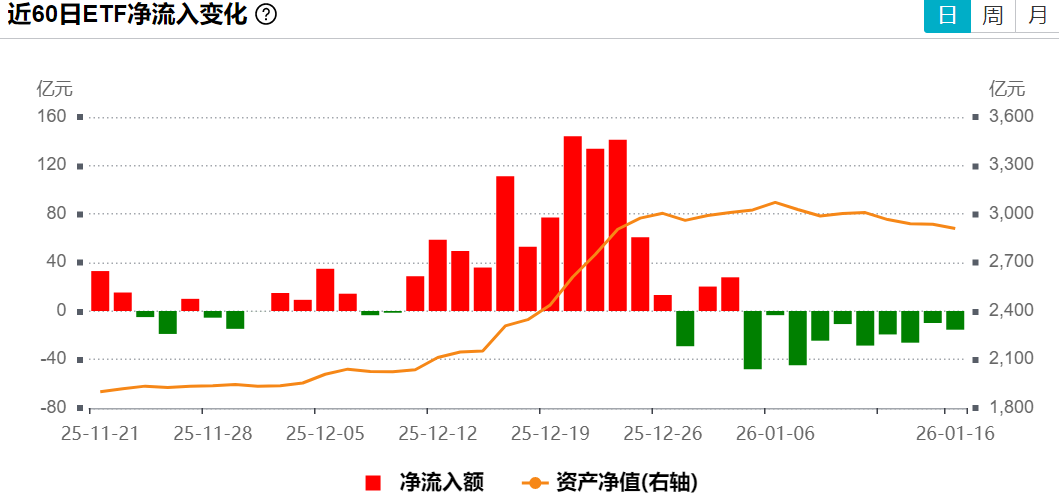
Core Viewpoint - The China Securities A500 ETF experienced a dramatic increase in scale at the end of 2025, with nearly 100 billion net inflow in December, but has since faced rapid outflows in 2026, dropping below 300 billion in total scale [1][3]. Fund Flow and Market Dynamics - The surge in A500 ETF's scale was primarily driven by expectations of options being introduced in Q1 2026, leading to intense competition among major public funds for "options eligibility" [3]. - Following the quarter-end, there was a significant outflow of funds, indicating that the initial inflow was not based on the investment value of A500 but rather to secure "thank you fees" from fund companies [3][4]. Performance Comparison - The A500 ETF, launched in October 2024, has not yet demonstrated a significant challenge to the dominant CSI 300 ETF, with its scale being less than a quarter of the CSI 300 ETF [4][9]. - In terms of investment value, the CSI 300 is more value-stable, while the A500 is more growth-oriented, particularly performing better in a tech bull market [6][7]. Historical Performance - Over the past three years, during the bear market of 2023 and 2024, the CSI 300 outperformed the A500 slightly, with returns of -11.38% and 14.68% for the CSI 300 compared to -11.42% and 12.98% for the A500 [8]. - In a growth-style bull market in 2025, the A500 showed a return of 22.43%, outperforming the CSI 300's 17.66% [8]. Institutional Investment Behavior - The lack of significant investment from state-owned funds in the A500 ETF is attributed to its timing and the established preference for the CSI 300 ETF, which has a more extensive operational history and familiarity [12][13]. - Institutional investors, including insurance and pension funds, have not heavily allocated to the A500 ETF, primarily due to its smaller scale and lack of derivative tools compared to the CSI 300 ETF [14][15]. Competitive Landscape - The A500 ETF has formed a competitive "3+2" tier structure among fund companies, with top players like Huatai-PineBridge and Southern Asset Management leading in scale [18][19]. - Future competition may hinge on the qualification for options, which could create a significant advantage for leading products, potentially widening the gap with other funds [20][21]. Future Outlook - In the short to medium term (1-2 years), the A500 ETF is unlikely to surpass the CSI 300 ETF in scale due to the absence of large-scale buying from state-owned funds [16]. - However, in the long term (5-10 years), the A500 ETF may have the potential to compete with the CSI 300 ETF as it aligns more closely with new economic growth sectors, provided it develops a robust ecosystem and derivative tools [17].

毕得医药股价跌5.04%,易方达基金旗下1只基金位居十大流通股东,持有90万股浮亏损失315万元
Xin Lang Cai Jing· 2026-01-20 06:52
Group 1 - Bid Medicine's stock price fell by 5.04% on January 20, closing at 66.00 yuan per share, with a trading volume of 52.74 million yuan and a turnover rate of 1.81%, resulting in a total market capitalization of 5.998 billion yuan [1] - The stock has experienced a continuous decline over three days, with a cumulative drop of 6.12% during this period [1] - Bid Medicine focuses on the front end of the new drug research and development industry chain, providing innovative drug molecular building blocks and scientific reagents [1] Group 2 - Among the top ten circulating shareholders of Bid Medicine, a fund under E Fund, specifically E Fund Value Growth Mixed Fund (110010), entered the top ten with 900,000 shares, accounting for 2.08% of circulating shares [2] - The estimated floating loss for E Fund Value Growth Mixed Fund today is approximately 3.15 million yuan, with a total floating loss of 4.077 million yuan during the three-day decline [2] - E Fund Value Growth Mixed Fund has a total asset size of 3.288 billion yuan, with a year-to-date return of 3.74% and a one-year return of 38.06% [2]

债券ETF资金持续流出 | 债券ETF跟踪
Xin Lang Cai Jing· 2026-01-20 06:39
Fund Flow - As of January 16, 2026, bond ETFs experienced a net outflow of 16.512 billion yuan over the past week, with interest rate, credit, and convertible bond ETFs seeing net outflows of 5.307 billion yuan, 14.018 billion yuan, and a net inflow of 2.814 billion yuan respectively [21][24] - Since 2025, cumulative net inflows for interest rate, credit, and convertible bond ETFs have reached 60.615 billion yuan, 487.023 billion yuan, and 25.964 billion yuan respectively, totaling 573.603 billion yuan [21][24] Index Performance - The China Bond New Comprehensive Index rose by 0.18% over the past week, while short-term pure bond and medium-to-long-term pure bond funds increased by 0.02% and 0.05% respectively [19][24] - The CSI AAA Sci-Tech Bond Index and the Shanghai Benchmark Market Company Bond Index both increased by 0.11% [19][24] Net Value Performance - Various types of bond ETFs generally saw an increase in net value, with the 30-year government bond ETF from Bosera rising by 0.37%, and the government bond ETF from Huaxia increasing by 0.31% [23][24] - Convertible bond ETFs and the Shanghai Convertible Bond ETF rose by 1.05% and 0.68% respectively [23][24] Credit Bond ETF and Sci-Tech Bond ETF Performance - As of January 16, 2026, the median unit net value for credit bond ETFs and sci-tech bond ETFs was 1.0128 and 1.0010, with increases of 0.09% and 0.07% respectively [25][32] - The Dachen credit bond ETF performed relatively well, increasing by 0.10% [25][32] Duration Tracking of Credit Bond ETFs - As of January 16, 2026, the holding durations for short-term bond ETFs, corporate bond ETFs, and urban investment bond ETFs were 0.34 years, 1.56 years, and 2.13 years respectively [32][34] - For market-making credit bond ETFs, the median holding durations for products tracking the Shanghai and Shenzhen market-making corporate bonds were 3.58 years and 2.80 years respectively [32][34]

净流出,超400亿元!
Zhong Guo Ji Jin Bao· 2026-01-20 06:22
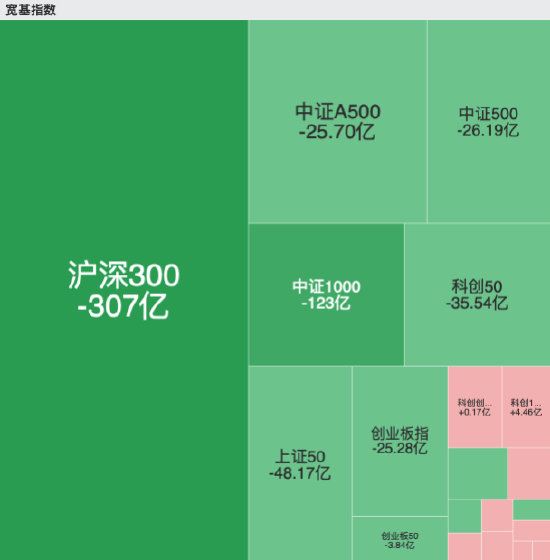
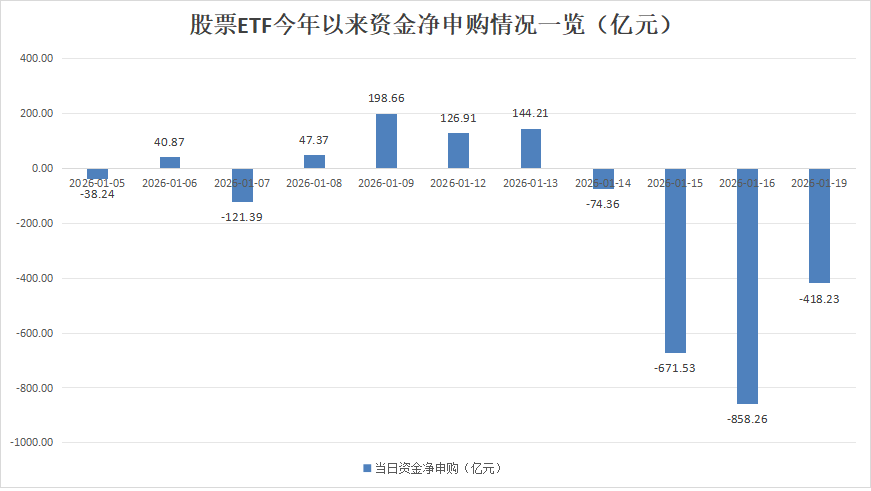
Core Viewpoint - The stock ETF market experienced significant net outflows, exceeding 400 billion yuan on January 19, marking the third consecutive day of substantial outflows, totaling over 1.9 trillion yuan in the past three trading days [1][2]. Group 1: Market Performance - The A-share market continued its volatile trend, with the Shanghai Composite Index rising by 0.29% to 4114.00 points, while the CSI 300 Index increased by 0.05% [2]. - Trading volume in the Shanghai and Shenzhen markets decreased to 2.73 trillion yuan, with weaker performance from large-cap stocks and stronger performance from growth-style sectors [2]. Group 2: ETF Fund Flows - The total scale of all stock ETFs (including cross-border ETFs) reached 4.61 trillion yuan, with a net outflow of 418.23 billion yuan on January 19 [2]. - Industry and commodity ETFs saw net inflows of 155.04 billion yuan and 22.44 billion yuan, respectively, while broad-based ETFs experienced net outflows of 586.07 billion yuan, leading to a decrease in their scale by 694.95 billion yuan [4]. Group 3: Specific ETF Performance - The top net inflows were observed in industry ETFs, with the Huaxia Electric Grid Equipment ETF leading at over 25 billion yuan, followed by the Penghua Chemical ETF with over 11 billion yuan [6]. - Four major CSI 300 ETFs collectively saw net outflows exceeding 300 billion yuan, with the Southern CSI 1000 ETF experiencing over 50 billion yuan in outflows [5][6]. Group 4: Market Sentiment and Outlook - Analysts noted that the recent net outflows from broad-based ETFs have contributed to a cooling effect on the previously hot market, aiding in the stable operation of the A-share market [7]. - The market is expected to maintain a volatile pattern in the short term, with potential support from funds adjusting their positions, while long-term sentiment remains optimistic [7].
净流出,超400亿元!
中国基金报· 2026-01-20 06:19
Core Viewpoint - The stock ETF market in China has experienced significant net outflows, with over 400 billion yuan withdrawn on January 19, marking the third consecutive day of substantial outflows, totaling over 1.9 trillion yuan in the past three trading days [2][5]. Group 1: Market Overview - On January 19, the A-share market continued its volatile trend, with the Shanghai Composite Index rising by 0.29% to 4114.00 points, while the CSI 300 Index increased by 0.05%. However, trading volume decreased to 2.73 trillion yuan, indicating weaker performance among large-cap stocks [5]. - The total scale of all stock ETFs (including cross-border ETFs) reached 4.61 trillion yuan as of January 19, with a net outflow of 418.23 billion yuan on that day [5]. Group 2: ETF Performance - Industry and commodity ETFs saw net inflows, with industry theme ETFs and commodity ETFs attracting 155.04 billion yuan and 22.44 billion yuan, respectively. In contrast, broad-based ETFs experienced net outflows totaling 586.07 billion yuan, with a decrease in scale of 694.95 billion yuan [7]. - Specific ETFs tracking the electric grid equipment index saw the highest net inflow of 25.83 billion yuan, while those tracking the CSI 300 index faced the largest net outflow of 306.94 billion yuan [7]. Group 3: Fund Company Insights - Major fund companies like E Fund and Huaxia Fund reported continued net inflows in certain ETFs. For instance, E Fund's robotics ETF saw a net inflow of 4.2 billion yuan, reaching a record high of 174 billion yuan [8]. - Huaxia Fund's electric grid equipment ETF and non-ferrous metals ETF also led in net inflows, with 25.83 billion yuan and 6.01 billion yuan, respectively [8]. Group 4: Outflow Analysis - The top ten ETFs with the largest net outflows were all broad-based ETFs, with four major CSI 300 ETFs collectively experiencing over 300 billion yuan in outflows. Other broad-based ETFs like the CSI 1000 ETF and the SSE 50 ETF also reported significant outflows [12]. - The net outflow from the top ten ETFs included notable amounts such as 55.64 billion yuan from the CSI 300 ETF managed by E Fund and 89.82 billion yuan from another CSI 300 ETF managed by Huatai-PB [13]. Group 5: Market Sentiment and Future Outlook - Industry experts suggest that the recent outflows from broad-based ETFs have contributed to cooling the initially heated market, which may help stabilize the A-share market. The overall market remains resilient, with active trading and continued inflows into industry theme ETFs supported by strong fundamentals [14]. - The market is expected to maintain a volatile pattern in the short term, with potential support from funds adjusting their positions, while the long-term outlook remains optimistic [14].

天智航股价跌5%,易方达基金旗下1只基金位居十大流通股东,持有1078.03万股浮亏损失1207.4万元
Xin Lang Cai Jing· 2026-01-20 05:26
Group 1 - Tianzhihang experienced a 5% decline on January 20, with a stock price of 21.26 yuan per share, a trading volume of 341 million yuan, a turnover rate of 3.44%, and a total market capitalization of 9.694 billion yuan [1] - Beijing Tianzhihang Medical Technology Co., Ltd. focuses on the research, production, sales, and service of orthopedic surgical navigation robots, with main business revenue composition: 58.31% from orthopedic surgical navigation robots, 23.86% from supporting equipment and consumables, 16.49% from technical services, and 1.31% from other sources [1] Group 2 - E Fund's ETF, E Fund Guozheng Robot Industry ETF (159530), entered the top ten circulating shareholders of Tianzhihang in the third quarter, holding 10.7803 million shares, accounting for 2.38% of circulating shares, with an estimated floating loss of approximately 12.074 million yuan [2] - E Fund Guozheng Robot Industry ETF (159530) was established on January 10, 2024, with a latest scale of 13.315 billion yuan, and has achieved a year-to-date return of 6.39%, ranking 2365 out of 5542 in its category, and a one-year return of 41.12%, ranking 1878 out of 4235 [2] Group 3 - The fund managers of E Fund Guozheng Robot Industry ETF (159530) are Li Shujian and Li Xu, with total fund assets of 19.758 billion yuan and 26.538 billion yuan respectively, achieving best returns of 136.18% and 175.17% during their tenure [3]

ETF午评 | 房地产产业链领涨,地产ETF涨3%
Ge Long Hui· 2026-01-20 04:02
Market Overview - The three major A-share indices collectively declined in the morning session, with the Shanghai Composite Index down 0.3%, the Shenzhen Component Index down 1.22%, and the ChiNext Index down 1.83% [1] - The total trading volume in the Shanghai and Shenzhen markets reached 186.54 billion yuan, an increase of 58.9 billion yuan compared to the previous day [1] - Over 3,300 stocks in the market experienced declines [1] Sector Performance - The chemical, cultural media, real estate, insurance, banking, airport shipping, retail, and semiconductor sectors showed the highest gains [1] - Conversely, the commercial aerospace, CPO, controllable nuclear fusion, minor metals, battery, and military sectors faced the largest declines [1] ETF Performance - Domestic demand sectors saw a broad increase, with the real estate industry chain leading the gains; specific ETFs such as Huabao Fund Real Estate ETF, Guotai Fund Building Materials ETF, and Yinhua Fund Real Estate ETF rose by 3.22%, 2.99%, and 2.87% respectively [1] - In the Hong Kong market, consumer stocks also rose, with ETFs like Huitianfu Fund Hong Kong Stock Connect Consumer 50 ETF and Fuguo Fund Hong Kong Stock Connect Consumer ETF increasing by 2.15% and 2.02% respectively [1] Specific Sector Declines - The commercial aerospace sector led the declines, with satellite ETFs from E Fund, GF Fund, and others dropping by 5% [2] - The photovoltaic sector also experienced a pullback, with photovoltaic ETFs and leading ETFs from GF Fund declining by 3.61% and 3.59% respectively [2]
1月19日ETF资金观察:宽基ETF延续流出,沪深300产品净流出超306亿元
Xin Lang Cai Jing· 2026-01-20 03:29
Group 1 - The ETF market experienced significant redemption pressure on January 19, with major broad-based ETFs showing a net outflow of funds, particularly the CSI 300 index ETFs [1][9] - The CSI 300 index ETFs had the most notable single-day net outflow, amounting to -30.694 billion yuan, while the CSI 1000 index ETF also saw a substantial outflow of -12.250 billion yuan [1][9] - Other mainstream broad-based index ETFs, including the SSE 50, STAR 50, and CSI 500, also experienced varying degrees of net outflows ranging from -2.5 billion to -4.8 billion yuan [1][9] Group 2 - Specific products such as the Huatai-PineBridge CSI 300 ETF (510300.SH) had the highest net outflow of -8.982 billion yuan, followed by the Harvest CSI 300 ETF (159919.SZ) and the China Asset Management CSI 300 ETF (510330.SH) with net outflows of -8.428 billion yuan and -7.649 billion yuan, respectively [4][15] - The total net outflow from these four leading CSI 300 ETFs exceeded 30.694 billion yuan [4][15] - Conversely, certain thematic industry ETFs, such as those related to semiconductor materials and specialized chemicals, saw inflows, with the semiconductor materials ETF gaining +1.633 billion yuan and the specialized chemicals ETF gaining +1.595 billion yuan [4][15]