
赛力斯

Search documents
车市2025|反“内卷”、闯关L3,十大热词看行业进化轨迹
Bei Ke Cai Jing· 2026-01-14 00:07
Core Insights - In 2025, the focus of competition in China's automotive industry shifts from domestic market share battles to global competition centered on technology, systems, and regulations [1] - The industry is moving towards sustainable value creation, with a significant emphasis on technological innovation and user experience [4] - Key developments include advancements in solid-state batteries and megawatt fast charging technology, aimed at addressing electric vehicle range and charging anxiety [1][16][20] - The trend of "going global" deepens into full value chain localization, while listings attract international capital to reshape the global industry landscape [1][22][24] Group 1: Order Restoration - A "revolution of order" is underway in the automotive industry, countering the detrimental effects of endless price wars that have driven profits to historical lows [2][3] - The government has initiated corrective actions against "involution" competition, with measures including price monitoring and cost investigations [3][4] Group 2: Anti-Involution Measures - The average profit margin in the industry fell to around 4% due to aggressive price wars, prompting a government response to restore healthy competition [3] - A collective commitment from 17 automakers to enforce a 60-day payment term for suppliers was established to stabilize the supply chain and improve cash flow for smaller enterprises [5][6] Group 3: Second-Hand Vehicle Regulations - The "zero-kilometer used car" issue has been addressed, with regulations requiring that exported vehicles labeled as "used" must provide after-sales service commitments and parts supply guarantees [7][8] Group 4: Intelligent Driving Advancements - The automotive industry in China is transitioning from the demonstration phase of intelligent driving to large-scale application and regulatory commercialization [9] - The penetration rate of L2-level assisted driving features in new vehicles reached approximately 64% by Q3 2025, with major automakers standardizing high-level assisted driving in key models [11][12] - The first L3-level automated driving models received conditional approval for road testing, marking a significant legal milestone in the industry [13][14] Group 5: Technological Innovations - The path to solid-state battery commercialization has become clearer, with major automakers announcing production timelines and breakthroughs in technology [17][18] - Megawatt-level ultra-fast charging technology has advanced significantly, with BYD achieving a charging power of 1 megawatt, enabling rapid charging capabilities [20] Group 6: Global Market Dynamics - Chinese automakers are entering a new phase of globalization, focusing on local production and high-end branding to navigate trade barriers [22][23] - A wave of listings in international capital markets is providing substantial funding for Chinese automakers, enhancing their global competitiveness [24][25]

港股开年上市潮涌 中资券商主导市场
Zhong Guo Zheng Quan Bao· 2026-01-13 22:16
Group 1 - The Hong Kong IPO market has started 2026 with strong momentum, with multiple companies successfully completing their IPOs across various sectors, including semiconductors and software services [1][2] - As of January 13, 2026, 11 companies have completed IPOs in Hong Kong, raising a total of HKD 33.1 billion, with significant contributions from the semiconductor and software service industries [2] - In 2025, the Hong Kong IPO market reached a total fundraising amount of HKD 612.4 billion, representing a year-on-year increase of over 250% [2] Group 2 - The refinancing market in Hong Kong also showed robust growth in 2025, with 574 companies involved, marking a 43.5% increase year-on-year, and a total refinancing scale of HKD 326.4 billion, up 278.15% [2][3] - The automotive sector emerged as a key player in refinancing, with major companies like BYD and Xiaomi leading the way [3] Group 3 - Chinese securities firms have established a dominant position in the Hong Kong IPO market, holding six out of the top ten spots in equity underwriting, with a combined market share exceeding 56% [4] - Notable firms such as CICC and CITIC Securities have significantly contributed to the fundraising efforts, with CICC raising HKD 66.2 billion and CITIC Securities raising HKD 48.6 billion [4] Group 4 - The pipeline for IPOs remains strong, with over 300 companies waiting to go public, primarily in the technology and pharmaceutical sectors [7] - The Hong Kong Stock Exchange's recent rule changes are expected to further enhance the market's competitiveness and liquidity, potentially leading to an IPO fundraising scale exceeding HKD 300 billion in 2026 [7] Group 5 - The overall performance of securities firms in 2025 has been bolstered by investment banking activities, with significant revenue growth reported across major firms [6] - CICC and CITIC Securities reported substantial increases in revenue, driven by strong performance in their core business segments [6]





赛力斯三年半采购华为750亿元
Xin Lang Cai Jing· 2026-01-13 17:09
Core Insights - The company Seres is projected to pay Huawei 20 billion yuan in procurement fees in the first half of 2025, which translates to approximately 141,000 yuan per vehicle sold, flowing into the Huawei ecosystem [1] - Since 2022, Seres has cumulatively paid over 75 billion yuan in procurement fees to Huawei [1]

今日新闻丨尚界Z7官图发布!问界M7长续航版上市!岚图汽车与引望签署深化战略合作协议!北汽新能源发布L3、L4战略成果!
电动车公社· 2026-01-13 16:13
Group 1 - The AITO M7 extended-range version has been launched with a price range of 299,800 to 319,800 yuan, offering two models [1][2] - The new AITO M7 features a battery capacity of 53.4 kWh, with a single motor output of 227 kW, achieving a 0-100 km/h acceleration time of 8.2 seconds and an improved CLTC pure electric range of 327 km [4][6] - The AITO brand has reached a milestone of producing its one millionth vehicle, the M9, in 46 months, with a target to achieve the next million in the next two years [6] Group 2 - The new Arcfox Kaola S has been launched with a price range of 99,800 to 119,800 yuan, offering three models and providing extensive warranty options for battery performance [2][11] - The Arcfox Kaola S features a 150 kW motor and a 58.8 kWh lithium iron phosphate battery, achieving a 0-100 km/h acceleration time of 7.95 seconds and a CLTC pure electric range of 520 km [11] - The design of the Arcfox Kaola S continues the existing model's aesthetics while enhancing features and lowering the entry price to boost sales [11] Group 3 - The official images of the Shangjie Z7 have been released, positioning it as a pure electric coupe with design elements reminiscent of the Porsche Taycan [12][17] - The Z7 is expected to compete with the Xiaomi SU7 in the market, indicating a focus on aesthetic appeal and performance [17] Group 4 - Lantu Automotive has signed a deepening strategic cooperation agreement with Yiwang, focusing on smart driving and intelligent cockpit development [19] - The collaboration aims to enhance user experience through joint teams and full value chain cooperation, leveraging Huawei's brand influence and technology [19] Group 5 - BAIC New Energy has announced strategic achievements in the smart mobility sector, launching the L3 version of the Arcfox Alpha S for trial operations in designated areas [22][24] - The L4 level strategy involves a partnership with Pony.ai to expand from a single model to a full spectrum of autonomous driving vehicles, aiming for international market expansion [22][27] - The Arcfox brand has seen significant growth, with sales doubling year-on-year and becoming one of the first to receive L3 autonomous driving vehicle product access licenses [27]



“九三浙商重庆行”成功举行 渝浙推动科技创新协同发展
Zhong Guo Xin Wen Wang· 2026-01-13 11:52
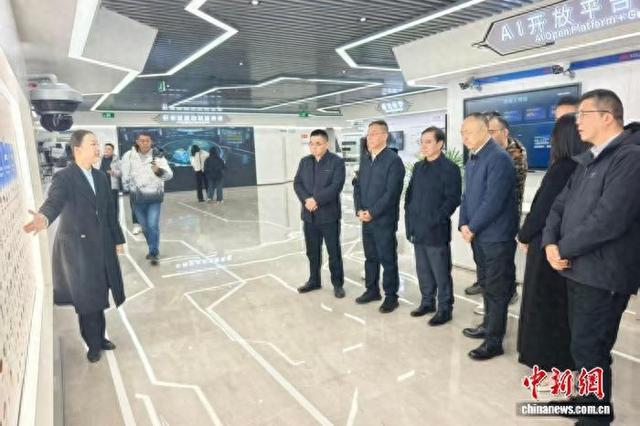
Group 1 - The "93 Zhejiang Business Chongqing Tour" event was held from January 11 to 13, inviting 17 Zhejiang enterprise leaders to explore advanced fields such as intelligent manufacturing, biomedicine, and new materials in Chongqing [1] - Chongqing is accelerating the construction of a modern manufacturing cluster system called "33618," leveraging national strategies like the Chengdu-Chongqing Economic Circle and the Western Land-Sea New Corridor, with rapid growth in industries such as intelligent connected new energy vehicles and next-generation electronic information manufacturing [1] Group 2 - The delegation visited Chongqing Hikvision Technology Co., Ltd., where they learned about AI-based intelligent monitoring equipment that enhances operational management decision-making through real-time video analysis [3] - At Zhongyuan Huijie Biotechnology Co., Ltd., the delegation observed the latest in vitro diagnostic instruments and diagnostic reagent products [3] - The tour included visits to leading companies in the Liangjiang New Area, showcasing the strength of advanced manufacturing and technological innovation [3] Group 3 - During a special seminar on cooperation between Chongqing and Zhejiang, both sides discussed national strategic positioning and industrial layout, focusing on key industries such as automotive, electronic information, high-end equipment, and digital economy [5] - The efficient and pragmatic service of Chongqing government departments impressed the delegation, particularly the one-stop service platform and transparent approval processes that allow companies to focus on technological innovation [5] - There is a strong desire to establish a regular communication mechanism between the two regions to promote the implementation of collaborative outcomes, with two Zhejiang enterprises expressing intentions to invest [5]
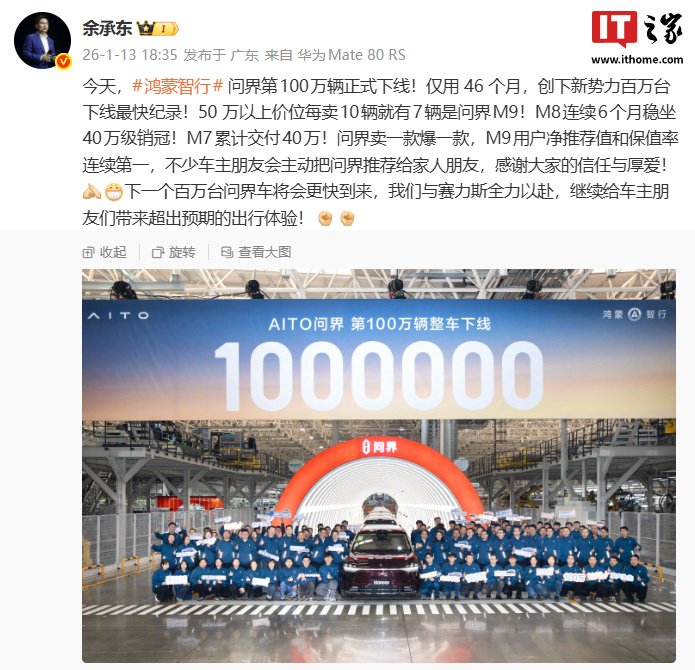
华为余承东:鸿蒙智行问界 100 万辆下线创新势力最快纪录,50 万以上每卖 10 辆有 7 辆是问界 M9
Xin Lang Cai Jing· 2026-01-13 11:27
Core Insights - Huawei's AITO brand has achieved a significant milestone with the production of its 1 millionth vehicle, setting a record for the fastest time to reach this figure among new energy vehicle manufacturers, taking only 46 months [1][6]. Group 1: Sales Performance - Among vehicles priced above 500,000, 70% of sales are attributed to the AITO M9 model, indicating strong market demand [3][8]. - The AITO M8 has maintained its position as the sales champion in the 400,000 price segment for six consecutive months [3][8]. - Cumulative deliveries of the AITO M7 have reached 400,000 units, showcasing the brand's growing popularity [3][8]. Group 2: Customer Satisfaction and Future Outlook - The AITO M9 has achieved the highest net promoter score and resale value in its category, reflecting strong customer satisfaction [3][8]. - The company anticipates that the next million AITO vehicles will be produced even more rapidly, indicating confidence in continued growth [3][8].
2025 年中西部投资激增42%:硬科技"广撒网",新能源"重押注"
Sou Hu Cai Jing· 2026-01-13 10:56
Core Insights - The investment activity in the Midwest region of China is significantly increasing, driven by resource advantages, with a total of 1,346 investment events in 2025, a year-on-year increase of 42.3%, and total investment amounting to 142.99 billion yuan, up 42.5% from the previous year [3][4]. Resource Endowment - The growth of the venture capital market in the Midwest is attributed to its rich resource endowment, which influences the distribution of industrial types and attracts capital inflow, establishing a pattern of "industry first, capital follows" [4][13]. - The Midwest has unique advantages in the new energy and new materials industries, with resources such as rare earths and lithium providing strong upstream support for battery and new materials industries [4][13]. Hard Technology - Investment events in the hard technology sector in the Midwest are expected to rise from 152 in 2024 to 289 in 2025, nearly doubling and increasing its share from 16.07% to 21.47% [6]. - The investment strategy reflects a "broad net" approach, focusing on early-stage projects and fostering a wider innovation ecosystem in the hard technology field [6][13]. New Energy/New Materials - In contrast to hard technology, the new energy/new materials sector shows a trend of capital concentrating on mature projects, with the number of investment events increasing from 189 to 238, a growth of 25.9%, while the investment amount surged from 38.49 billion yuan to 63.85 billion yuan, a 66.1% increase [8]. - The number of projects in this sector decreased from 19.98% to 17.68%, while the investment amount's share increased from 38.3% to 44.65%, indicating a focus on larger, more mature projects [8]. Top Financing Events - The top 20 financing events in the Midwest in 2025 highlight a clear concentration in three areas, confirming the logic that resource endowment drives industry and attracts capital [9]. - Among the top 20 companies, 10 are in the new energy/new materials sector, indicating that these industries account for half of the total financing events, with significant investments closely tied to local resource advantages [10]. Geographic Concentration - Chongqing and Wuhan emerge as the primary hubs for investment, with six and three companies respectively in the top 20, collectively accounting for nearly half of the total [10]. - This concentration reflects the capital's focus on a few core cities with strong industrial foundations, educational resources, and policy support [10]. Investment Round Concentration - Strategic investments dominate the financing landscape, with 13 occurrences, making up 65% of the total, indicating a preference for investments from industrial capital and state-owned enterprises that prioritize synergy with local resources [11].


赵长江发文回应入职智界;问界下线第100万辆整车丨汽车交通日报
创业邦· 2026-01-13 10:35
Group 1 - Zhao Changjiang announced his new role as Executive Vice President at Zhijie Automotive, emphasizing the importance of user value, technological innovation, and industry advancement, while expressing gratitude for his experience at BYD and acknowledging contributions from other Chinese automakers and Huawei [2] - BYD has maintained its position as the leading exporter of new energy buses for three consecutive years, exporting 4,234 units in 2025, representing an 18.2% year-on-year growth and capturing a 24% market share [2] - The AITO brand reached a significant milestone with the production of its one-millionth vehicle at the Seres Super Factory in Chongqing, with plans to achieve the next million in two years [2] Group 2 - GAC Trumpchi has undergone a leadership change, with He Xianqing stepping down as the legal representative and chairman, succeeded by Huang Jian, alongside other executive changes [2]

华纬科技:2026年1月13日投资者关系活动记录表
Xin Lang Zheng Quan· 2026-01-13 10:01
Core Viewpoint - The company is expanding its production capacity and diversifying its product offerings, particularly in the automotive and non-automotive sectors, while maintaining a focus on profitability and market share growth. Group 1: Main Product Pricing and Profitability - The company's core products, including suspension springs and stabilizer bars, have a unit price range of 120-200 yuan per vehicle, with an overall gross margin of 27% [1] - The gross margin for suspension components is relatively stable due to minimal impact from raw material price fluctuations, while the stabilizer bar's margin is closely linked to client demand due to high fixed costs associated with custom tooling [1] Group 2: Production Capacity Layout - The company's Chongqing production base is expected to commence operations in the first half of this year, with ongoing ramp-up throughout the year [2] - The production lines for stabilizer bars and springs are currently in the equipment installation and debugging phase, primarily serving key clients in the southwest region, such as Seres and Changan [2] Group 3: Non-Automotive Sector Expansion - The non-automotive business is a significant growth driver, with a strong focus on industrial robots, rail transportation, and construction machinery, particularly emphasizing industrial robots [3] - The company has entered the humanoid robot sector, supplying small springs for hand joints, leveraging its established design and manufacturing capabilities in valve and specialty springs [3] Group 4: Future Growth Path - The company aims to enhance its market share in the domestic stabilizer bar market, which still has considerable room for growth, especially as production capacity is released [4] - The overseas suspension system components market is identified as a blue ocean opportunity, with low participation from Chinese enterprises, prompting the company to actively pursue international business expansion [4] - The company is also focusing on upstream and downstream collaboration, exploring non-metal and new materials to mitigate downstream volatility risks and secure long-term growth [4]
华纬科技(001380) - 2026年1月13日投资者关系活动记录表
2026-01-13 09:26
Group 1: Product Pricing and Profitability - The main products of the company are suspension springs and stabilizer bars, with unit prices ranging from 120 to 200 RMB [2] - The comprehensive gross margin for suspension system components is approximately 27%, with stable margins expected for suspension springs if raw material prices remain stable [2][3] - The profitability of stabilizer bars is linked to client demand due to high fixed costs associated with developing individual tooling for each product [2] Group 2: Production Capacity and Clientele - The Chongqing factory is expected to start production in the first half of 2026, with ongoing production ramp-up throughout the year [3] - Key clients for the Chongqing factory include Seres and Changan Automobile, primarily serving the southwestern region [3] Group 3: Non-Automotive Applications - The non-automotive sector includes industrial robots, rail transportation, and construction machinery, with industrial robots having a relatively high market share [3] - The company focuses on top-tier clients in the non-automotive sector, aligning with its market expansion strategy [3] Group 4: Future Development Directions - Future growth paths include increasing market share for domestic stabilizer products and expanding into the overseas suspension system components market, which is currently underrepresented by Chinese enterprises [4] - The company is also considering upstream and downstream industry collaboration and is exploring materials close to the raw material sector to mitigate operational risks [4]