OPPO

Search documents
元旦“国补”拉动手机销量同比增长16.2%,OPPO涨幅32.4%位列第一
Xin Lang Cai Jing· 2026-01-05 05:39
Group 1 - The National Development and Reform Commission and the Ministry of Finance have implemented a policy for replacing old consumer goods, with an initial fund of 62.5 billion yuan allocated, providing a 15% subsidy on the selling price for digital and energy-efficient appliances through a simplified "buy now, subsidize later" process [3][5] - The mobile phone market saw a 16.2% increase in sales during the 2026 New Year holiday compared to the same period last year, driven by the national subsidy policy [3][5] - OPPO ranked first among major smartphone manufacturers with a sales increase of 32.4%, benefiting from the popularity of the Reno15 and OnePlus Ace6 series [3][5] Group 2 - OPPO experienced a significant sales increase of 60% in the 2.5K-4K price segment, securing the top market share in that range [3][5] - The X9 series and OnePlus 15 contributed to a remarkable 94.3% increase in the 4K-6K price segment, making OPPO the leader in that category as well [3][5]

宏芯宇冲刺港交所 中信建投国际为独家保荐人
Zheng Quan Shi Bao Wang· 2026-01-05 00:24
Core Viewpoint - Hongxin Yu has submitted a listing application to the Hong Kong Stock Exchange, with CITIC Securities International as its sole sponsor. The company has been focused on storage product applications since its establishment in 2018, offering embedded storage, solid-state drives, DRAM, and mobile storage products [1]. Company Overview - Hongxin Yu has built a full-stack technology platform that includes main control chip design, firmware algorithms, testing system development, and storage medium characteristic analysis, enabling the provision of customized storage products [1]. - According to Frost & Sullivan, based on 2024 revenue, Hongxin Yu ranks as the fifth largest independent memory manufacturer globally and the second largest in mainland China, while also being the largest independent memory manufacturer in the smartphone sector [1]. Product Applications - The company's products are widely used in various applications, including smartphones, tablets, AI cameras, personal computers, data centers, and vehicle control systems across consumer, automotive, and enterprise-grade scenarios [1]. - Hongxin Yu has established partnerships with well-known consumer companies such as Xiaomi, Transsion, and OPPO. In 2023, the company began providing storage products for automotive applications and entered the Tier 1 supplier chain, with plans to achieve mass production of enterprise-grade storage products by 2026 [1]. Market Trends - The global storage product market is rapidly growing, driven by AI demand, with projections indicating an increase from $263.3 billion in 2025 to $407.1 billion by 2029, representing a compound annual growth rate (CAGR) of 11.5%. The storage chip market is entering a "super cycle" [1].

手机市场再无“小而美”?华硕暂停手机业务,小众品牌集体逼近「斩杀线」
3 6 Ke· 2026-01-05 00:05
Core Viewpoint - ASUS has announced that it will suspend the launch of new smartphones, including the Zenfone and ROG Phone series, in 2026, marking a significant shift in the smartphone market and signaling the end of an era for small-sized flagship devices [1][3][15]. Company Overview - ASUS has historically focused on unique innovations rather than following mainstream trends, exemplified by products like the Padfone and ZenFone Zoom, which showcased its commitment to creativity [5][8]. - The Zenfone series targeted small-sized smartphone enthusiasts, with models like ZenFone 8, 9, and 10 receiving positive reviews for their compact design and flagship specifications [10][14]. - The ROG Phone series was designed specifically for gamers, featuring unique functionalities such as side charging ports and AirTriggers, catering to a niche market [11][13]. Market Challenges - The smartphone industry is facing rising costs, with a projected 25% increase in material costs by 2026 due to supply chain dependencies, which disproportionately affects smaller brands like ASUS [16][18]. - The competitive landscape is dominated by giants like Apple and Samsung at the high end, and Chinese brands like Xiaomi and OPPO at the mid to low end, leaving ASUS in a challenging position [19][22]. - ASUS's smartphone business has been a financial burden, with significant losses reported in previous years, and its market share in Taiwan dwindling to approximately 1.2% by 2025 [23][25]. Industry Implications - The exit of ASUS from the smartphone market reflects a broader trend where unique, niche products struggle to survive in an increasingly saturated and mature market [26][28]. - The success in the smartphone industry now hinges on supply chain management, cost control, and extensive distribution channels, rather than solely on product uniqueness [28].
硅谷流行“人才收购”,创始人拿钱走人
阿尔法工场研究院· 2026-01-05 00:03
Core Viewpoint - The article discusses the evolution of acqui-hire strategies in Silicon Valley, highlighting a shift from beneficial talent acquisitions to a method for large companies to eliminate competition, exemplified by Nvidia's acquisition of Groq for $20 billion, which effectively neutralized a potential rival in the AI chip market [5][6][7]. Group 1: Acqui-hire Evolution - Acqui-hire has transformed from a mutually beneficial exit strategy for startups to a tool for larger companies to eliminate competition without formal acquisitions [7][24]. - The acquisition of Groq by Nvidia involved the transfer of key personnel and technology while leaving behind a shell company, indicating a strategic move to maintain the appearance of competition [6][7]. - Historical examples, such as Facebook's acquisition of Instagram, illustrate a time when acqui-hire was seen as a win-win for all parties involved, with founders and employees benefiting significantly [9][10][11]. Group 2: Recent Trends and Comparisons - In 2024, several high-profile talent acquisitions occurred without formal purchases, with companies like Microsoft and Google opting for "technology licensing + talent recruitment," leaving behind empty shells [23][25]. - The financial outcomes of these recent transactions show a stark contrast to earlier acqui-hire deals, with only a small percentage of employees benefiting from the deals, highlighting a shift in the distribution of financial rewards [24][26]. - The article contrasts the U.S. market's approach to talent acquisition with China's, where large companies prefer to directly recruit talent rather than acquiring startups, leading to different market dynamics and outcomes for entrepreneurs [30][31][33]. Group 3: Market Implications - The changing landscape has made it increasingly difficult for startups to attract talent, as graduates prefer stable positions in large companies over the risks associated with startups [26]. - The article notes a significant decline in the number of AI startups in China, indicating a market that is rapidly differentiating between companies with commercial viability and those without [32]. - The contrasting fates of Groq and a Chinese startup, 波形智能, illustrate the divergent paths of companies in the two markets, with one being eliminated by a large acquisition and the other struggling to survive in a competitive environment [33].

买手机最高省500元、买家电最高补贴1500元、AI眼镜首次入选!新一轮“国补”将持续激活产业和市场
Mei Ri Jing Ji Xin Wen· 2026-01-04 23:36
2026年,国家继续向消费者发"大红包"。 元旦前夕,国家发展改革委、财政部联合发布《关于2026年实施大规模设备更新和消费品以旧换新政策的通知》,明确了 2026年消费品以旧换新政策。与此同时,2026年第一批625亿元超长期特别国债支持消费品以旧换新资金计划已提前下达。 根据政策,本次以旧换新全国统一覆盖四大领域,包括汽车报废与置换更新、6类家电以旧换新及4类数码智能产品购新。其 中,个人消费者购买手机、平板、智能手表手环、智能眼镜等4类产品(单价不超过6000元),按产品销售价格的15%给予补 贴,每人每类产品可补贴1件,每件补贴不超过500元。 个人消费者购买冰箱、洗衣机、电视、空调等6类家电中1级能效或水效标准的产品,按产品销售价格的15%给予补贴,每人 每类产品可补贴1件,每件补贴不超过1500元。 对消费者而言,有真金白银的补贴,无疑又是一个入手的好机会。 "AI(人工智能)眼镜正式纳入'国补'目录,肯定对AI眼镜的推广有着非常大的积极作用。这不仅能直接降低用户的尝试门 槛,还会加速市场教育,推动整个产业链的成熟升级。"界环方面对《每日经济新闻》记者(以下简称每经记者)分析。 奥维云网(AVC) ...

网传又一个玩家离场,华硕为何搞不定手机?
凤凰网财经· 2026-01-04 13:46
Core Viewpoint - ASUS is reportedly planning to exit the smartphone market, with no new smartphone releases planned for 2026, although the company has not officially confirmed this decision [1][3][4]. Group 1: ASUS's Smartphone History - ASUS entered the mobile phone market as early as 2002, initially focusing on ODM for European operators [3]. - The company launched its first self-branded phone, the J101, in 2003, marking the beginning of its brand recognition efforts [4]. - In 2008, ASUS acquired Garmin's smartphone business, launching the "Garmin-Asus" brand, but this partnership ended unsuccessfully due to the rise of the iPhone [4][5]. - The ZenFone series was introduced in 2014, targeting the budget market with high specifications, achieving significant popularity in emerging markets [5]. Group 2: Challenges and Decline - After 2018, the smartphone market became increasingly competitive, with Chinese brands like Huawei and Xiaomi dominating [7]. - ASUS struggled to compete in both the budget and innovation segments, leading to a decline in market presence and product iteration [7][9]. - The company faced significant losses in its mobile division, which accounted for less than 10% of total revenue and had been a financial burden for years [8][9]. Group 3: Current Situation and Future Outlook - ASUS's mobile division has been in a state of decline, with no new products planned and a focus on its core PC business [7][12]. - The company is shifting its strategy towards AI, cloud computing, and smart ecosystems, with plans to enter the memory module production sector in 2026 [12]. - The global PC market is showing growth, with ASUS ranking fifth in market share, indicating a stronger focus on its primary business [12].
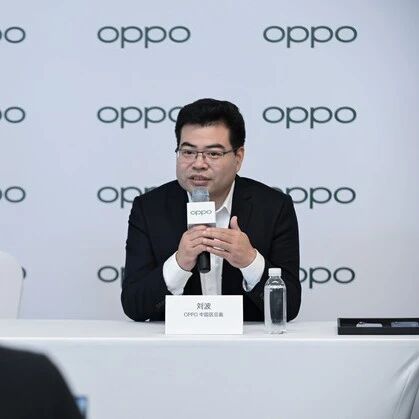
独家丨OPPO前中国区总裁刘波赴印,或涉合资股权布局
雷峰网· 2026-01-04 11:28
Core Viewpoint - OPPO is making strategic adjustments in response to market contraction, particularly focusing on enhancing its presence in the Indian market through high-level personnel changes and potential partnerships with local entities [2][3]. Group 1: Personnel Changes - Liu Bo, former president of OPPO China, has ended his executive training early to lead efforts in India, marking the second high-level personnel adjustment in three months aimed at overseas markets [2]. - Liu Bo has a long history with OPPO, having joined in 2005 and held various key positions, including Chief Procurement Officer and President of the Emerging Mobile Terminal Division [3]. Group 2: Market Strategy - OPPO aims to strengthen its market position in India, where it currently holds a 13.9% market share, surpassing Samsung to become the second-largest player as of Q3 2025 [2]. - The Indian government has specific requirements for joint ventures with Chinese mobile companies, mandating that local partners hold at least 51% of the shares and that local executives are appointed [3]. Group 3: Future Prospects - Liu Bo's trip to India is seen as a critical move to negotiate potential capital investments from the Indian government in OPPO's joint ventures, which could help navigate regulatory challenges [2][3].
上汽集团2025年销售450.7万辆 同比增长12.3% 自主品牌占比提升至65%
Zheng Quan Shi Bao Wang· 2026-01-04 11:09
Core Viewpoint - SAIC Motor Corporation aims to deepen reforms and focus on independent brand development and smart electric technology breakthroughs, achieving a total vehicle sales of 4.507 million units in 2025, a year-on-year increase of 12.3% [1] Group 1: Sales Performance - In 2025, SAIC's total vehicle sales reached 4.507 million units, with retail sales hitting 4.67 million units, maintaining industry leadership in China [1] - Sales of SAIC's independent brands (including Roewe, MG, Zhiji, Maxus, Wuling, and Baojun) reached 2.928 million units, a year-on-year increase of 21.6%, accounting for 65% of total sales, up 5 percentage points from 2024 [1] Group 2: Innovation and Technology - SAIC is accelerating the mass production of leading smart electric technologies, including solid-state batteries, digital chassis, DMH super hybrid, and "end-to-end" intelligent driving models [1] - In 2025, SAIC's new energy vehicle sales reached 1.643 million units, a record high with a year-on-year growth of 33.1% [1] Group 3: Product Development - The MG4 semi-solid battery model has started delivery, with safety performance improved by over 20% compared to industry standards [2] - The Roewe M7 DMH, equipped with the DMH 6.0 super hybrid system, achieves a pure electric range of 160 km and a comprehensive range of 2050 km with energy consumption as low as 2L [2] - The Zhiji LS9, featuring the Star Super Range Extender, offers a class-leading comprehensive range of 1508 km, addressing key user concerns [2] Group 4: Strategic Partnerships - SAIC is enhancing collaboration with partners like Huawei, Momenta, Horizon, OPPO, and Doubao to create a new ecosystem for smart mobility [2] Group 5: International Expansion - In 2025, SAIC launched its overseas strategy 3.0, focusing on a "Glocal" approach, achieving overseas sales of 1.071 million units, a year-on-year increase of 3.1% [3] - In Europe, SAIC MG sales exceeded 300,000 units, a nearly 30% increase, while in India, sales reached 70,000 units, up 17.8% [3] - SAIC's overseas market presence includes one region with sales of 300,000 units (Europe) and five regions with sales of 50,000 units each (Americas, Middle East, Oceania, ASEAN, South Asia) [3] Group 6: Future Outlook - In 2026, SAIC plans to further deepen reforms, focusing on smart and electric vehicle development, and aims to establish a new high-quality development pattern [4]

懂车更懂你 变革显成效,上汽集团2025年销售450.7万辆 同比增长12.3%
Zhong Guo Qi Che Bao Wang· 2026-01-04 07:36
Core Viewpoint - SAIC Motor Corporation has achieved significant growth in 2025, focusing on deepening reforms, enhancing independent brand development, and advancing smart electric technology, resulting in a total vehicle sales of 4.507 million units, a year-on-year increase of 12.3% [1] Group 1: Sales Performance - In 2025, SAIC's total vehicle sales reached 4.507 million units, with retail sales hitting 4.67 million units, maintaining its leading position in the domestic industry [1] - Sales of SAIC's independent brands (including Roewe, MG, Zhiji, Maxus, Wuling, and Baojun) amounted to 2.928 million units, a year-on-year increase of 21.6%, accounting for 65% of the group's total sales, up 5 percentage points from 2024 [4] Group 2: Product Innovation - SAIC's joint venture brands are also undergoing transformation, with the Buick brand launching a new high-end electric sub-brand "Zhijing" and the first mass-produced model from the new Audi brand, the E5 Sportback, successfully launched [6] - The company is accelerating the production of advanced technologies such as solid-state batteries, digital chassis, and DMH super hybrid systems, enhancing user experience with safer and more convenient travel options [7][9] Group 3: Strategic Collaborations - SAIC is committed to a "co-creation and win-win" strategy, collaborating with partners like Huawei, OPPO, and Momenta to develop a new intelligent travel ecosystem [10] - The launch of the new brand "SAIC Shangjie" in partnership with Huawei focuses on high-quality, durable vehicles, with the first product, Shangjie H5, achieving over 10,000 units in monthly sales [13] Group 4: International Expansion - In 2025, SAIC's overseas sales reached 1.071 million units, a year-on-year increase of 3.1%, with significant growth in Europe, India, and Thailand [14] - The company has established a robust overseas market presence, with sales exceeding 600 million units across over 170 countries and regions [16]
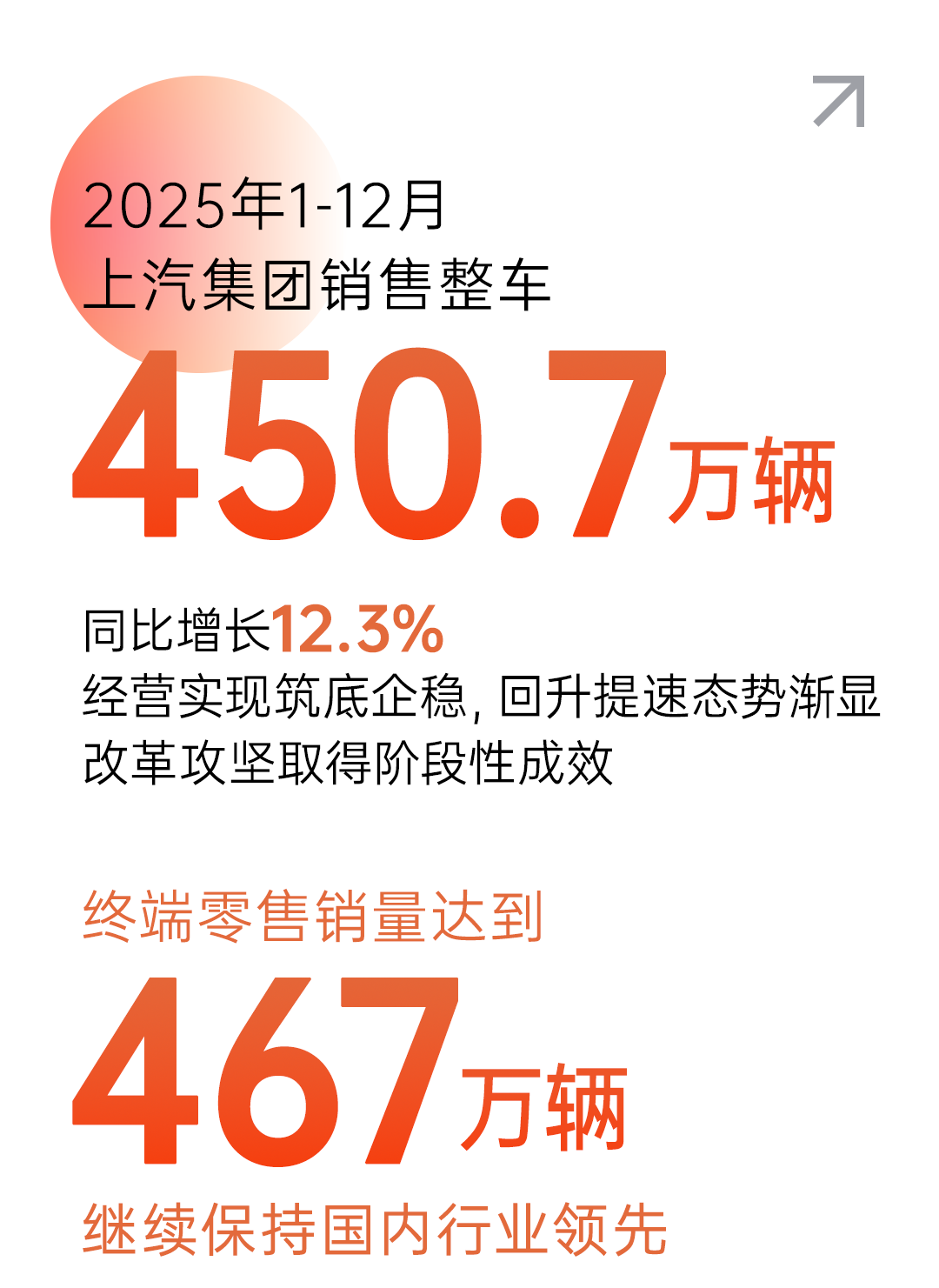
上汽集团2025年销量450.7万辆,同比增长12.3%
Ju Chao Zi Xun· 2026-01-04 07:14
Group 1 - The core viewpoint of the news is that SAIC Motor Corporation has shown significant growth in 2025, with vehicle sales reaching 4.507 million units, a year-on-year increase of 12.3%, indicating a stable recovery and successful reform efforts [2] - The retail sales volume reached 4.67 million units, maintaining the company's leading position in the domestic industry, laying a solid foundation for the "14th Five-Year Plan" [2] - The company's self-owned brand sales reached 2.928 million units, a year-on-year increase of 21.6%, becoming the main driver of the group's growth [2] Group 2 - The new energy vehicle business achieved record sales of 1.643 million units, a year-on-year increase of 33.1%, solidifying its position among industry leaders [3] - The company launched the all-new MG4 semi-solid battery model, which is the only mass-produced vehicle in the industry to feature this technology, improving safety performance by over 20% compared to the highest industry standards [3] - The new generation of the Zhiji LS6 offers spaciousness and flexibility, while the Roewe M7 DMH features a super hybrid system with an electric range of 160 km and a comprehensive range of 2050 km [3] Group 3 - In 2025, SAIC officially released its overseas strategy 3.0, transitioning from "product export" to "value chain export," with overseas sales reaching 1.071 million units, a year-on-year increase of 3.1% [4] - The European market saw significant growth, with MG sales exceeding 300,000 units, a nearly 30% increase, and cumulative sales approaching one million units [4] - The company has formed a market structure with one region achieving sales of 300,000 units (Europe) and five regions achieving sales of 50,000 units (Americas, Middle East, Australia/New Zealand, ASEAN, South Asia) [4] Group 4 - SAIC is deepening cross-industry collaborations, adhering to a development strategy focused on "equal rights-driven advancement and co-creating a better travel experience" [4] - The company launched a new brand "SAIC Shangjie" in collaboration with Huawei, with the first product achieving monthly sales exceeding 10,000 units [4] - Collaborations with OPPO and Doubao are aimed at creating a new generation of intelligent cockpit and AI vehicle systems, accelerating the application of top global technologies [4]