
中国太平

Search documents
1H25保险股p、CE-roCE估值体系更新:负债评估曲线差异分化净资产波动,人保彰显集团经营韧性
ZHONGTAI SECURITIES· 2025-09-10 11:22
Investment Rating - The report maintains an "Overweight" rating for the insurance sector [2] Core Insights - The P/CE-ROCE valuation system has been updated based on the 1H25 financial results of listed insurance companies, highlighting the resilience of group insurance companies amid fluctuating net asset values and differing liability assessment curves [5][27] - The report emphasizes the importance of the new valuation framework, which integrates comprehensive equity (CE) and comprehensive equity return rate (ROCE) to better reflect the true value of insurance companies under new accounting standards [5][42] Summary by Sections 1. P/CE-ROCE Valuation System Overview - The P/CE-ROCE valuation system was introduced to address the limitations of the previous P/EV-ROEV framework, focusing on comprehensive equity (CE) as a more accurate measure of insurance company value [5][11] - The system calculates CE as the sum of net assets (NA) and net contract service margin (CSM), providing a clearer picture of profitability and asset-liability matching [5][11] 2. Industry Performance Analysis - In 1H25, the comprehensive equity (CE) growth varied among listed insurance companies, with China Life Insurance leading at 7.0% growth, while Sunshine Insurance and Xinhua Insurance experienced declines of -4.2% and -6.7%, respectively [5][31] - The overall industry saw a 1.4% increase in CE, driven primarily by differences in net asset growth rates among companies [5][31] 3. ROCE Calculation Results - The non-annualized ROCE for listed insurance companies in 1H25 showed significant variation, with China Life Insurance achieving the highest ROCE at 9.2%, while Sunshine Insurance and Xinhua Insurance reported negative ROCE values [5][39] - The report notes a 13.0% year-on-year decline in overall comprehensive income (CI) for the sector, influenced by market interest rate changes and negative contributions from other comprehensive income (OCI) [5][37] 4. Valuation System Fit - The P/CE-ROCE system demonstrated a better fit for H-share listed insurance companies compared to A-share companies, indicating a positive correlation between ROCE and P/CE valuations [5][40] - The report concludes that the new CE valuation system provides a more prudent and comprehensive assessment of insurance companies' value, avoiding the over-reliance on long-term economic assumptions [5][42]

负债和资产中的经营线索-2025年保险行业中报综述
2025-09-09 14:53
Summary of Key Points from the Conference Call Industry Overview - The conference call discusses the insurance industry in China, particularly focusing on the performance of various insurance companies in the first half of 2025 and the impact of new accounting standards on financial reporting [1][4][31]. Core Insights and Arguments - **Profitability Divergence**: The profitability of insurance companies has shown divergence, with some companies like PICC and China Life experiencing a decline in net profit growth, while Ping An and Taiping have either narrowed their losses or returned to profitability [1][3]. - **Impact of New Accounting Standards**: The new accounting standards require fair value measurement of assets and liabilities, significantly affecting profit and loss statements, especially for participating and universal life insurance products [4][8]. - **Net Asset Value Concerns**: There are instances where profit growth does not correspond with net asset growth due to losses in other comprehensive income (OCI) exceeding net profit [5][6]. - **Return on Equity (ROE) Variability**: ROE has generally rebounded in the first half of 2025, but there is significant variability among companies, suggesting a need to focus on net asset growth rates [7][10]. - **New Business Value (NBV) Growth**: The overall NBV growth for life insurance companies was positive, with some companies showing growth even after adjusting for assumptions [2][14][17]. - **Dividend Policies**: Most listed Chinese insurance companies maintained their mid-year dividend policies, with significant growth in mid-year dividends compared to net profit growth [2][11][12][13]. Important but Overlooked Content - **Asset Allocation Changes**: There has been a noticeable increase in equity asset allocation, while fixed income allocation has decreased, although the scale of fixed income investments continues to grow [26][29]. - **Quality Indicators Improvement**: The quality indicators of insurance contracts have shown continuous improvement, reflecting positive changes on the liability side [18]. - **Agent Income Decline**: Some agents have experienced a significant decline in income, attributed to new business pressures and high base effects from the previous year [21]. - **Market Sentiment and Future Opportunities**: Despite recent weak performance in the insurance sector, there are long-term improvement trends in fundamentals, such as reduced liability costs and improved scale trends, which could present future investment opportunities [33][34]. Conclusion The conference call highlights the complexities and challenges faced by the Chinese insurance industry in 2025, emphasizing the need for careful analysis of financial metrics and market conditions to identify potential investment opportunities and risks.
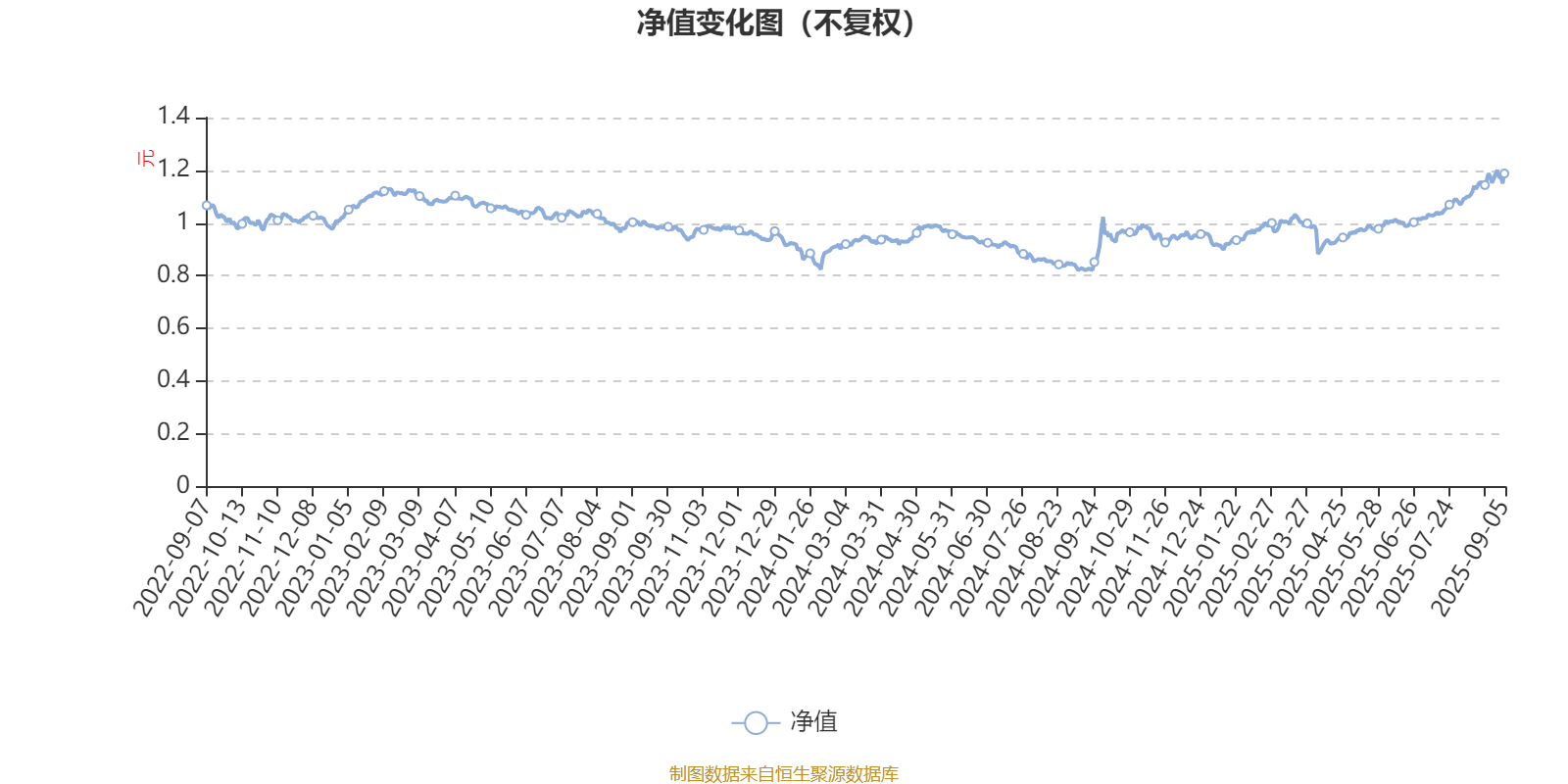
易方达逆向投资混合A:2025年上半年利润4174.96万元 净值增长率6.83%
Sou Hu Cai Jing· 2025-09-07 14:33
Group 1 - The core viewpoint of the article highlights the performance and outlook of the E Fund Reverse Investment Mixed A Fund, which reported a profit of 41.75 million yuan in the first half of 2025, with a net value growth rate of 6.83% [2] - As of September 5, 2025, the fund's unit net value was 1.188 yuan, and the fund manager, Yang Jiawen, has managed five funds with positive returns over the past year [2] - The fund's net value growth rates over different periods are as follows: 18.29% over the last three months, 20.45% over the last six months, and 41.16% over the last year, ranking 138/256, 93/256, and 138/256 among comparable funds respectively [6] Group 2 - The fund's weighted average price-to-earnings (P/E) ratio as of June 30, 2025, was approximately 17.19 times, significantly lower than the industry average of 26.16 times [11] - The weighted average price-to-book (P/B) ratio was about 1.48 times, compared to the industry average of 2.38 times, indicating a valuation discount [11] - The fund's weighted revenue growth rate for the first half of 2025 was 0.06%, and the weighted net profit growth rate was 0.09% [19] Group 3 - As of June 30, 2025, the fund had a total scale of 620 million yuan, with 31,400 holders collectively owning 611 million shares [33][36] - The fund's top ten holdings include major companies such as Tencent Holdings and Guizhou Moutai, reflecting a diversified investment strategy [41] - The fund's recent six-month turnover rate was approximately 212.23%, indicating active trading behavior [39]

上半年狂买 险资重仓板块曝光
Jing Ji Guan Cha Wang· 2025-09-06 10:02
Core Insights - Insurance funds have significantly increased their presence in the A-share market, with nearly 800 companies listed among the top ten shareholders as of June 2025, and over 280 stocks being increased in the second quarter alone [2][3] - The total investment scale of insurance funds reached 36 trillion yuan by the end of the second quarter of 2025, with stock investments amounting to 3.07 trillion yuan, a net increase of approximately 640 billion yuan compared to the previous quarter [2][3] Group 1: Investment Trends - The seven major A+H listed insurance companies have a combined investment scale of 21.85 trillion yuan, accounting for 60.30% of the total industry [2] - The stock investment scale of these companies reached 2.05 trillion yuan, with a net increase of 431.3 billion yuan, representing 67.39% of the industry's net increase [3] - Insurance funds are increasingly allocating to equity assets due to declining risk-free returns, with different companies showing varied strategies in their asset allocation [4][5] Group 2: Company-Specific Actions - China Ping An saw the largest increase in stock investment, with a net increase of 211.9 billion yuan, raising its proportion by 2.9 percentage points [4] - China Life's stock investment increased by 119.1 billion yuan, with a 1.1 percentage point rise in proportion [4] - Sunshine Insurance has the highest stock investment proportion among the seven companies at 14.1%, with a 23.9% increase [4] Group 3: Sector Preferences - As of mid-2025, insurance funds have allocated nearly 1 trillion yuan to high-dividend other comprehensive income (OCI) stocks, with a significant increase in the proportion of OCI stocks in their portfolios [6] - The top five sectors for insurance fund holdings include banking, transportation, communication, real estate, and utilities, with the media, communication, and utilities sectors seeing the largest increases in holdings [6] Group 4: Market Dynamics - Insurance funds have engaged in 30 "block trades" since the beginning of 2025, with the banking sector being the most active [8] - The shift in accounting standards is expected to influence the stability of insurance companies' net profits, prompting a greater focus on OCI asset allocation [9] - Recent policy changes have encouraged insurance companies to invest more in the A-share market, with a target of 30% of new premiums allocated annually [10]


上半年狂买 险资重仓板块曝光
经济观察报· 2025-09-06 09:07
Core Viewpoint - Insurance funds are increasingly becoming a significant presence in the A-share market, with substantial investments in various sectors and a notable shift towards equity assets as traditional fixed-income returns decline [2][4][11]. Group 1: Insurance Fund Presence and Investment Trends - As of June 2025, insurance funds are listed among the top ten shareholders in nearly 800 A-share companies, with over 280 stocks increased and more than 300 new positions established in Q2 [2][4]. - The total investment balance of insurance companies in stocks reached 3.07 trillion yuan, an increase of approximately 640 billion yuan from Q4 2024 [4]. - The seven major A+H listed insurance companies hold a combined investment total of 21.85 trillion yuan, accounting for 60.30% of the industry total [4]. Group 2: Investment Strategies and Asset Allocation - Insurance companies are focusing on balancing returns, duration, and cash flow due to the long-term nature of their liabilities, leading to a cautious approach towards risk [4][11]. - In a low-risk return environment, insurance funds are gradually increasing their allocation to equities, with varying strategies among different companies [4][5]. - The average dividend yield of stocks held by insurance funds is 2.30%, slightly down from previous periods due to rising stock prices [8]. Group 3: Specific Company Actions and Sector Preferences - China Ping An has seen the largest increase in stock investment, with a net increase of 211.9 billion yuan, while China Life and New China Life also reported significant increases [5]. - The top five sectors for insurance fund holdings include banking, transportation, telecommunications, real estate, and utilities, with media, telecommunications, and utilities showing the highest quarterly increases [8]. - Insurance funds have engaged in notable stock purchases, with China Life increasing positions in CITIC Bank and China Telecom, while reducing holdings in Sinopec [9][10]. Group 4: Regulatory Environment and Future Outlook - Recent regulatory changes have encouraged insurance companies to allocate more funds to the A-share market, with a target of 30% of new premiums to be invested annually [12]. - The overall market valuation is considered reasonable, with expectations for continued investment in technology, consumer manufacturing, and emerging markets [12].

“保险+养老”生态进阶:头部险企率先构筑抗周期增长极
Sou Hu Cai Jing· 2025-09-06 01:31
Core Insights - The insurance industry is transitioning towards a "insurance + elderly care" model, driven by aging populations and industry transformation, leading to a new competitive landscape [1][8] - Leading insurance companies are integrating resources across health, technology, and finance to reshape their value chains and enhance their competitive advantages [2][4] Group 1: Value Chain Reconstruction - The deep integration of elderly care ecosystems is transforming traditional insurance value chains, shifting from risk transfer to comprehensive solutions combining products, services, and ecosystems [2] - High-value clients are increasingly attracted to elderly care services, with data showing that clients with elderly-related insurance products see their individual value double [2][5] - Companies like Ping An and Dajia Life are leveraging their elderly care ecosystems to significantly enhance customer loyalty and asset management metrics [2][5] Group 2: Financial Flow Optimization - Annuity insurance products linked to elderly services provide stable cash flows that align with the long-term liabilities of insurance companies, enhancing profitability [3][6] - The integration of cross-sector resources is yielding multiplier effects, improving policy retention rates and overall service delivery [3][4] Group 3: Second Growth Curve Activation - The "insurance + elderly care" model breaks down industry barriers, facilitating collaboration across finance, healthcare, and elderly care sectors, thus creating new growth opportunities [4][7] - Companies are increasingly forming closed-loop ecosystems that enhance value across different business segments, leading to mutual benefits for insurance and elderly care services [4][5] Group 4: Contribution to Premium Growth - The elderly care ecosystem is becoming a key driver of premium growth, with companies like Dajia Life reporting a 79% year-on-year increase in new annuity premiums [5] - Ping An's clients with access to elderly care services account for nearly 70% of new business value, highlighting the effectiveness of the elderly care ecosystem in driving performance [5][6] Group 5: Anti-Cyclical Resilience - The elderly care ecosystem provides significant anti-cyclical resilience by offering stable cash flows and optimizing cost structures, which is crucial in a challenging economic environment [6][7] - Dajia Life's community model has achieved profitability through operational efficiency and cost reduction strategies, enhancing confidence in future investments [6] Group 6: Market Demand and Future Outlook - The aging population and changing attitudes towards retirement are driving explosive growth in demand for elderly care services, providing vast opportunities for insurance companies [7] - Companies with robust elderly care ecosystems are expected to gain a competitive edge in the increasingly crowded market, positioning themselves for future success [7][8]
交银国际:升中国太平目标价至20港元 维持“买入”评级
Zhi Tong Cai Jing· 2025-09-05 09:20
Group 1 - The core viewpoint of the report is that China Taiping (00966) maintains a "buy" rating due to strong performance in the liability side and significant progress in transforming towards dividend insurance [1] - The new business value's sensitivity to interest rate changes has significantly decreased, indicating improved stability in earnings [1] - The target price for China Taiping has been raised from HKD 15 to HKD 20 based on a price-to-book ratio of 0.8, reflecting a positive outlook for the stock market [1] Group 2 - China Taiping's net profit for the first half of the year increased by 12.2% year-on-year, primarily driven by the performance of its insurance services [1] - The insurance service performance grew by 9.5% year-on-year, with balanced contributions from new business value growth channels [1] - The transition towards dividend insurance has shown significant results, and the improvement in the combined ratio (COR) for property and casualty insurance aligns with industry trends [1]

交银国际:升中国太平(00966)目标价至20港元 维持“买入”评级
智通财经网· 2025-09-05 09:18
Core Viewpoint - The report from交银国际 maintains a "buy" rating for China Taiping (00966), highlighting strong performance in the liability side and significant progress in transitioning to dividend insurance, while noting room for improvement on the asset side [1] Financial Performance - China Taiping's net profit for the first half of the year increased by 12.2% year-on-year, with insurance service performance growing by 9.5% [1] - The contribution from new business value growth is balanced across channels, indicating effective strategies in place [1] Business Strategy - The transition towards dividend insurance has shown significant results, aligning with industry trends [1] - The improvement in the combined operating ratio (COR) for property and casualty insurance is consistent with the overall industry trajectory [1] Valuation and Target Price - The target price for China Taiping has been raised from HKD 15 to HKD 20, based on a price-to-book ratio of 0.8 [1]
一周保险速览(8.29—9.5)
Cai Jing Wang· 2025-09-05 08:46
Regulatory Voice - The State Council issued an opinion on September 4 to guide insurance institutions in developing insurance products for sports events and sports injuries [1] Industry Focus - On September 4, the China Insurance Industry Association released the first set of comprehensive insurance demonstration clauses and supporting underwriting and claims service guidelines for major technical equipment and new materials, marking a significant step in advancing technology insurance and supporting the national manufacturing strategy [1] - Five major A-share listed insurance companies, including China Ping An, China Life, China Pacific Insurance, China People’s Insurance, and New China Life, reported a total revenue of 1,333.86 billion yuan for the first half of 2025, a year-on-year increase of 4.89%, and a net profit attributable to shareholders of 178.19 billion yuan, up 3.72%. Despite revenue growth, net profit showed a mixed performance with four companies increasing and one decreasing. All five companies plan to steadily increase equity asset allocation, focusing on high-dividend value stocks and growth sectors to enhance long-term returns and smooth earnings [1] Financial Personnel - Bai Kai is proposed to be appointed as the Deputy General Manager of China Taiping Insurance Holdings, having previously served as Vice President of China Life Insurance [2] Leadership Changes - China Reinsurance Group announced a leadership change with Zhuang Qianzhi, the former Vice Secretary of the Party Committee and President, set to take over as Party Secretary and proposed Chairman, pending governance and regulatory approval [3] - Li Shihong has been approved to serve as the Chairman of Guobao Life Insurance, as confirmed by the Sichuan Financial Regulatory Bureau on September 1 [4]



大行评级|交银国际:上调中国太平目标价至20港元 维持“买入”评级
Ge Long Hui· 2025-09-05 06:17
Group 1 - The core viewpoint of the report indicates that China Taiping's net profit increased by 12.2% year-on-year, while pre-tax profit decreased by 38% [1] - The performance of the insurance service sector grew by 9.5% year-on-year, but investment performance declined [1] - The contribution from new business value growth channels was relatively balanced, with significant results from the transition to participating insurance [1] Group 2 - The combined ratio (COR) of property and casualty insurance improved, aligning with industry trends [1] - The firm maintains a "Buy" rating for China Taiping and keeps its profit forecast largely unchanged [1] - Due to the positive outlook in the stock market, the target price has been raised from HKD 15 to HKD 20 based on a price-to-book ratio of 0.8 [1]