迈瑞医疗

Search documents
12月2日医疗健康R(480016)指数跌1.46%,成份股泰格医药(300347)领跌
Sou Hu Cai Jing· 2025-12-02 11:00
证券之星消息,12月2日,医疗健康R(480016)指数报收于7315.52点,跌1.46%,成交161.03亿元,换 手率0.53%。当日该指数成份股中,上涨的有4家,济川药业以1.0%的涨幅领涨,下跌的有46家,泰格医 药以3.88%的跌幅领跌。 医疗健康R(480016)指数十大成份股详情如下: | 证券代码 | 股票简称 | 权重 | 最新价 | 涨跌幅 | 总市值(亿元) | 所属行业 | | --- | --- | --- | --- | --- | --- | --- | | sh603259 | 药明康德 | 13.66% | 89.42 | -3.12% | 2668.08 | 医药生物 | | sh600276 | 恒瑞医药 | 11.00% | 61.12 | -1.32% | 4056.66 | 医药生物 | | sz300760 | 迈瑞医疗 | 7.57% | 200.62 | -0.50% | 2432.40 | 医药生物 | | sh688271 | 联影医疗 | 4.27% | 128.71 | -1.97% | 1060.77 | 医药生物 | | sh600436 | 片 ...






迈瑞医疗多位高管接连增持,彰显未来发展信心
Sou Hu Wang· 2025-12-02 10:56
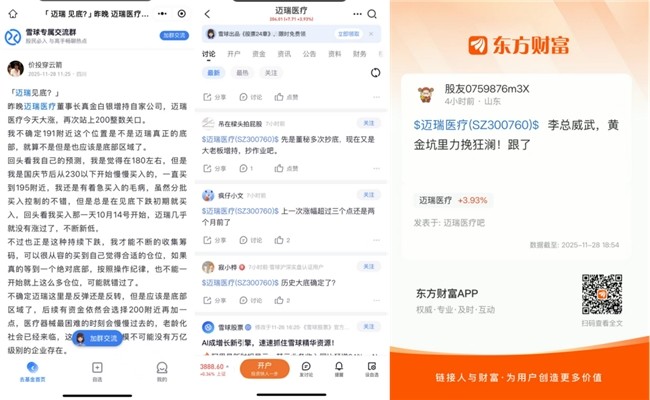
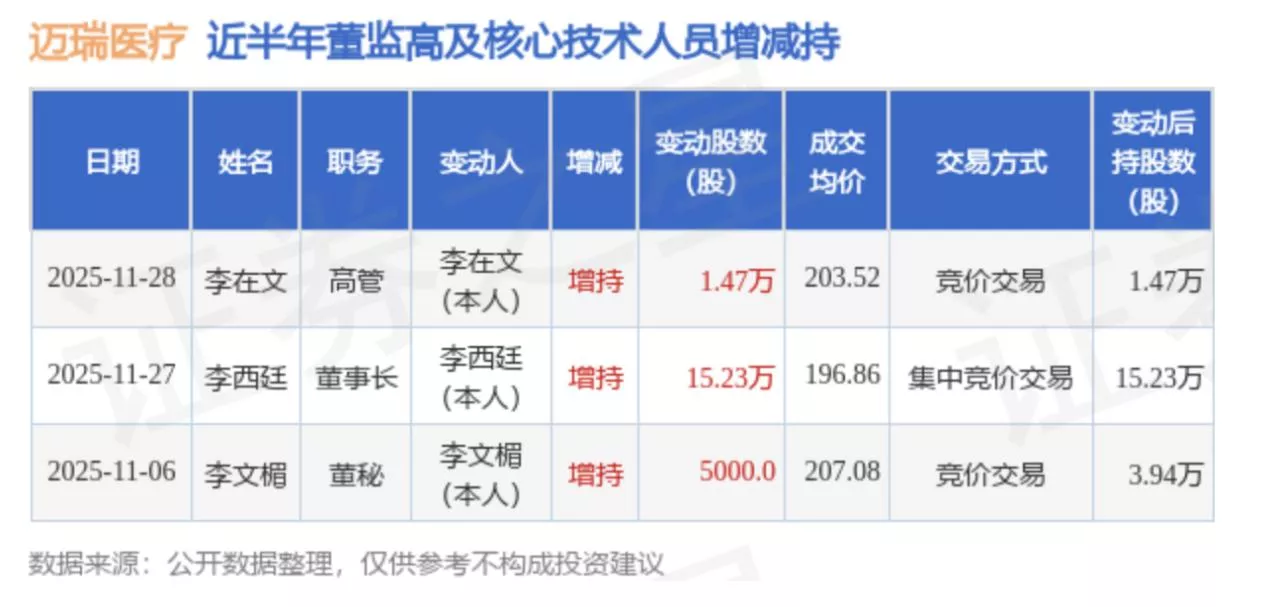
Core Viewpoint - The recent share buyback announcement by Mindray Medical (300760.SZ) has garnered significant attention in the capital market, signaling confidence from the company's management and potentially stabilizing the stock price [1][10]. Group 1: Share Buyback Details - On November 27, Chairman Li Xiting initiated a share buyback, purchasing 152,340 shares at an average price of 196.862 CNY per share, totaling approximately 29.99 million CNY [5]. - Li Xiting plans to continue buying shares over the next six months, with a total investment of 200 million CNY, funded by personal resources, without a fixed price range [5][6]. - Following the buyback, Li Xiting's direct shareholding increased, and he, along with his concerted parties, now controls 51.48% of the company's shares [5][6]. Group 2: Management Confidence - The buyback was followed by additional purchases from senior executives, including Senior Vice President Li Zaiwen, who bought 14,700 shares at an average price of 203.52 CNY per share on November 28 [4][6]. - The concentrated buying activity among the management team reflects a strong belief in the company's intrinsic value and future growth prospects [4][6]. Group 3: Market Reaction - Following the announcement, Mindray Medical's stock price rose by 3.93% to close at 204.01 CNY per share, with a trading volume of 2.378 billion CNY [13]. - The market response indicates that investors view the management's buyback as a positive signal, reinforcing their confidence in the company's long-term value [10][13]. Group 4: Company Performance - Mindray Medical is recognized as a leading domestic medical device company, with a projected revenue of 36.7 billion CNY in 2024 and a compound annual growth rate (CAGR) of over 18% from 2017 to 2024 [13]. - The company has maintained a net profit margin and return on equity (ROE) above 20%, highlighting its strong financial performance [13].
迈瑞医疗披露董事长计划增持2亿,引发市场广泛关注
Cai Jing Wang· 2025-12-02 09:45
Core Viewpoint - The recent share buyback announcement by Mindray Medical (300760.SZ) has attracted significant attention in the capital market, reflecting the confidence of the management team in the company's intrinsic value and future growth prospects [1][5]. Group 1: Buyback Details - On November 27, Chairman Li Xiting initiated a share buyback by purchasing 152,340 shares at an average price of 196.862 CNY per share, totaling approximately 29.99 million CNY [2]. - Li Xiting plans to continue buying back shares over the next six months, with a total investment of 200 million CNY, funded by personal resources, without a fixed price range [2]. - Following the buyback, Li Xiting's direct shareholding increased, and together with his concerted party, they control 51.48% of the company's shares [2]. Group 2: Management Confidence - The buyback activity is part of a broader trend, with multiple senior executives, including Senior Vice President Li Zaiwen and Secretary Li Wenmei, also increasing their holdings, indicating strong internal confidence in the company's future [3][4]. - Li Zaiwen bought 14,700 shares at an average price of 203.52 CNY per share on November 28, while Li Wenmei had previously purchased 5,000 shares at 207.08 CNY per share on November 6 [4]. Group 3: Market Reaction - The announcement of the buyback plan received a positive response from investors, with a notable increase in the stock price by 3.93% to 204.01 CNY per share on November 28, alongside a trading volume of 2.378 billion CNY [5]. - Investors view the buyback as a strong signal of confidence from the management, potentially stabilizing the stock price and providing reassurance to long-term investors [5]. Group 4: Company Performance - Mindray Medical is recognized as a leading domestic medical device company, ranking among the top 30 global medical device firms, with a projected revenue of 36.7 billion CNY in 2024 [5]. - The company has demonstrated robust growth, with a compound annual growth rate (CAGR) of over 18% in revenue and over 24% in net profit from 2017 to 2024, maintaining a return on equity (ROE) and net profit margin above 20% [5].
十余家上市公司密集披露年度利润分配预案,此为规定流程
Sou Hu Cai Jing· 2025-12-02 02:02
Core Viewpoint - The recent surge in annual profit distribution plans from numerous listed companies is a result of regulatory requirements rather than spontaneous corporate generosity, reflecting a structured process mandated by the China Securities Regulatory Commission (CSRC) and stock exchanges [1][2][8] Regulatory Framework - The CSRC revised the guidelines for cash dividends, mandating that companies clarify their profit distribution decision-making mechanisms and minimum dividend amounts in their articles of association [1] - The Shanghai and Shenzhen stock exchanges require timely disclosure of profit distribution plans, detailing the form, amount, and compliance with company bylaws [2] 2025 Dividend Landscape - As of October 22, 2025, 843 listed companies in the Shanghai and Shenzhen markets have announced profit distribution plans, marking a 22.71% increase from the previous year, with total cash dividends amounting to 6620.26 billion, up 18.93% [3][6] - Cash dividends remain the dominant form of distribution, with notable examples including Airo Energy proposing a cash dividend of 0.9375 yuan per share and Saltian Port continuing its cash distribution strategy [3][6] Dividend Characteristics - There is a noticeable trend of high cash dividend payouts, with companies like Dong'e Ejiao proposing a cash dividend that accounts for 99.94% of its net profit [6] - The dual model of mid-term and annual dividends is becoming common, with companies like Mindray Medical and WuXi AppTec adopting this approach to enhance shareholder returns [6] Process Interpretation - The profit distribution process involves four key steps: board proposal, public disclosure, shareholder meeting approval, and implementation within two months [7] - Companies must adhere to these steps, and any changes to the proposed plan must be disclosed promptly, ensuring transparency and compliance with regulations [7]
“金融有为”地方纵横谈丨以科技风险分担为核心的科技产业金融循环模式
Zhong Guo Jin Rong Xin Xi Wang· 2025-12-02 01:49
Core Insights - The "15th Five-Year Plan" emphasizes the combination of an effective market and a proactive government, aiming to enhance the role of the market in resource allocation while improving government functions [1][2] - Financial markets are identified as crucial for capitalizing and securitizing resources, with local governments encouraged to develop unique financial service systems based on regional conditions and industrial structures [1][2] Group 1: Financial Market Development - The plan highlights the need for local governments to explore financial service systems that cater to local characteristics, focusing on five development models: regional financial centers, technology industry financial cycles, government investment banking, new financial service elements, and local specialty financial services [1] - The integration of technology, industry, and finance is essential for driving innovation, with local governments tasked with creating mechanisms to share risks associated with technological advancements [3][4] Group 2: Role of Local Governments - Local governments are encouraged to provide foundational support for major technological research and development, recognizing that early-stage innovation often requires stable funding that the market alone cannot provide [4] - Establishing government-led funds and investment initiatives is crucial to attract social capital into areas deemed high-risk or difficult to evaluate [4][7] Group 3: Shenzhen's Experience - Shenzhen serves as a model for creating a synergistic system of technology, capital investment, and industrial transformation, demonstrating effective integration of financial and technological services [5][6] - The city has developed a comprehensive service system that connects technology achievements with capital markets, enhancing the ability to assess and commercialize technological innovations [6][8] - Shenzhen's government investment fund system operates on a model of "government guidance, market operation, risk sharing, and profit sharing," which has successfully supported numerous technology enterprises and led to a significant number of companies going public [7][8]
广东强化科技创新和产业创新深度融合
Ren Min Ri Bao· 2025-12-01 22:11
Group 1 - The core theme of the articles revolves around the integration of technology innovation and industrial development in Guangdong, emphasizing the establishment of innovation platforms and the promotion of deep integration between research and industry [1][2][3][4][5]. - Guangdong has established a robust ecosystem for innovation, with over 100 robot companies and nearly 10 universities and research institutions in Shenzhen's "Robot Valley," facilitating close collaboration between academia and industry [1]. - The National High-Performance Medical Device Innovation Center in Shenzhen has successfully developed several groundbreaking technologies, including the first domestic ECMO system, showcasing the center's role in bridging research and industry [2]. - Guangdong's reforms in technology achievement transformation, such as granting ownership rights to research teams, have led to the establishment of successful companies like Zhongke Yuntu, which specializes in drone remote sensing [3]. - The province's focus on policy innovation has resulted in significant funding for research and development, with a projected R&D expenditure of 510 billion yuan in 2024, reflecting a commitment to enhancing the innovation ecosystem [5]. Group 2 - The Guangdong provincial government has implemented a series of measures to support enterprise-led innovation, increasing the proportion of projects led by companies in key research and development plans to over 80% [4]. - The province's emphasis on creating a favorable policy environment has led to approximately 90% of research funding and patent applications originating from enterprises, highlighting the central role of companies in driving innovation [5]. - Guangdong is actively formulating a comprehensive plan for deepening scientific and technological system reforms during the 14th Five-Year Plan period, aiming to build a modern industrial system and enhance its competitive edge globally [5].
创新融资模式激活科创生态 四单民营股权投资机构科创债在银行间市场完成发行
Zhong Guo Jin Rong Xin Xi Wang· 2025-12-01 13:49
Core Insights - The issuance of technology innovation bonds by four prominent private equity investment institutions marks a significant advancement in the financial support system for technological innovation [1][3] - The "Technology Board" launched in May has rapidly gained traction, effectively connecting capital markets with the tech innovation sector through flexible structures and multi-layered risk-sharing mechanisms [1][3] Group 1: Company Highlights - Cornerstone Capital, established in 2001, has a total managed scale of 85 billion yuan, focusing on hard technology, advanced manufacturing, and healthcare, with a recent bond issuance featuring a 1+3+2 year term and a coupon rate of 2.10% [1] - Tongchuang Weiye, managing over 35 billion yuan and having assisted 120 companies in going public, issued bonds with a 5+5 year term and a coupon rate of 2.05%, aimed at enhancing liquidity in semiconductor and biomedicine sectors [2] - Shengjing Jiacheng, a key platform connecting top research resources with capital markets, issued 3-year bonds at a coupon rate of 2.43%, with funds directed towards establishing technology innovation funds in collaboration with social capital and local government [2] - Daohe Long-term Investment, a relatively new player with nearly 10 billion yuan under management, issued bonds of 30 million yuan with a 5-year term and a rate of 2.2%, focusing on integrated circuits and artificial intelligence [2] Group 2: Industry Trends - The issuance of technology innovation bonds reflects the effectiveness of risk-sharing tools in lowering issuance thresholds and boosting market confidence, with diverse investor participation [3] - The interbank bond market has supported nearly 300 companies in issuing technology innovation bonds, with around 250 being tech firms and about 50 being equity investment institutions, indicating a developing direct financing service system covering the entire innovation cycle [3] - The continuous enrichment of practical cases in the capital market is expected to foster a more efficient and precise "innovation power," contributing to high-quality financial development [3]
流动性&交易拥挤度&投资者温度计周报:杠杆&ETF资金分化趋势逆转-20251201
Huachuang Securities· 2025-12-01 13:11
Group 1: Liquidity Trends - The supply side of funds shows a slight decrease in newly established equity public funds, while leveraged and ETF funds are experiencing a reversal in their differentiation trend, with net inflows of leveraged funds recovering and significant outflows from stock ETFs[2] - The demand side of funds has slightly contracted, with both equity financing and industrial capital net reduction expanding, while southbound funds have shown a contraction, with a cumulative net inflow exceeding 700 billion over the past six months[2] Group 2: Trading Congestion - The trading heat index indicates that the media sector has increased by 23 percentage points to 73%, light industry by 18 percentage points to 60%, and military industry by 9 percentage points to 40%; conversely, the healthcare services sector has decreased by 12 percentage points to 43%, non-ferrous metals by 12 percentage points to 32%, and brokerage firms by 10 percentage points to 2%[2] Group 3: Investor Sentiment - Overall market sentiment has shown a cautious rebound, with retail investor net inflows into A-shares amounting to 47.37 billion, a significant decrease of 158.04 billion from the previous value, placing it at the 9.0% percentile over the past five years[2] - The trend of public fund clustering has strengthened, with a focus on value and consumer sectors[2]
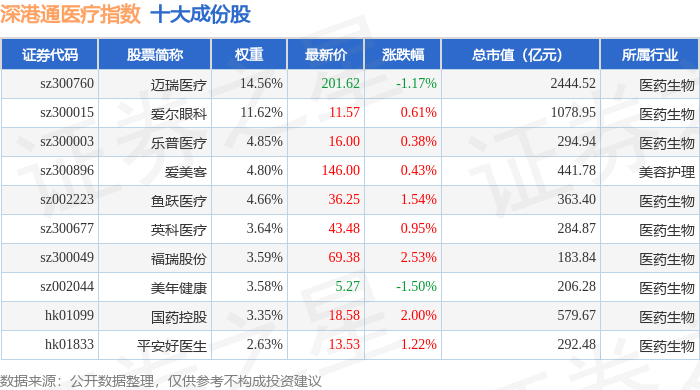
12月1日深港通医疗(983035)指数涨0.2%,成份股医渡科技(02158)领涨
Sou Hu Cai Jing· 2025-12-01 11:39
Core Points - The Shenzhen-Hong Kong Medical Index (983035) closed at 4554.17 points, up 0.2%, with a trading volume of 7.409 billion yuan and a turnover rate of 0.81% [1] - Among the index constituents, 38 stocks rose while 17 fell, with Yidu Technology leading the gainers at 3.5% and Mylab leading the decliners at 4.98% [1] Index Constituents Summary - The top ten constituents of the Shenzhen-Hong Kong Medical Index include: - Mindray Medical (sz300760) with a weight of 14.56% and a latest price of 201.62, down 1.17% [1] - Aier Eye Hospital (sz300015) with a weight of 11.62% and a latest price of 11.57, up 0.61% [1] - Lepu Medical (sz300003) with a weight of 4.85% and a latest price of 16.00, up 0.38% [1] - Aimeike (sz300896) with a weight of 4.80% and a latest price of 146.00, up 0.43% [1] - Yuyue Medical (sz002223) with a weight of 4.66% and a latest price of 36.25, up 1.54% [1] - Yingke Medical (sz300677) with a weight of 3.64% and a latest price of 43.48, up 0.95% [1] - Furuide (sz300049) with a weight of 3.59% and a latest price of 69.38, up 2.53% [1] - Meinian Health (sz002044) with a weight of 3.58% and a latest price of 5.27, down 1.50% [1] - Sinopharm (hk01099) with a weight of 3.35% and a latest price of 18.58, up 2.00% [1] - Ping An Good Doctor (hk01833) with a weight of 2.63% and a latest price of 13.53, up 1.22% [1] Capital Flow Analysis - The net outflow of main funds from the index constituents totaled 172 million yuan, while retail funds saw a net inflow of approximately 84.92 million yuan [3] - Notable capital flows include: - Sanbo Brain Science (301293) with a main fund net inflow of 26.77 million yuan [3] - Ruimait (301367) with a main fund net inflow of 16.21 million yuan [3] - Chutian Technology (300358) with a main fund net inflow of 11.20 million yuan [3] - The index constituents underwent an adjustment with one new stock added in the last ten days [3]


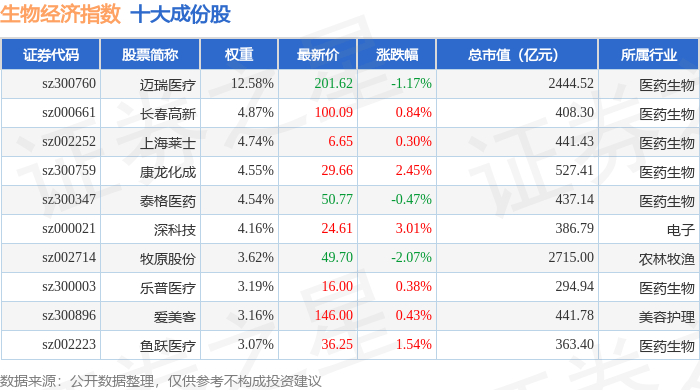
12月1日生物经济(970038)指数涨0.36%,成份股九强生物(300406)领涨
Sou Hu Cai Jing· 2025-12-01 11:39
Core Viewpoint - The Biotech Economy Index (970038) closed at 2159.74 points on December 1, with a slight increase of 0.36%, indicating a stable performance in the biotech sector [1]. Group 1: Index Performance - The trading volume for the Biotech Economy Index was 14.616 billion yuan, with a turnover rate of 1.03% [1]. - Among the index constituents, 38 stocks rose, with Nine Strong Bio leading with a 4.43% increase, while 10 stocks fell, with Wens Foodstuffs leading the decline at 2.99% [1]. Group 2: Top Constituents - The top ten constituents of the Biotech Economy Index include: - Mindray Medical (sz300760) with a weight of 12.58%, latest price of 201.62 yuan, and a market cap of 244.45 billion yuan [1]. - Changchun High-tech (sz000661) with a weight of 4.87%, latest price of 100.09 yuan, and a market cap of 40.83 billion yuan [1]. - Other notable constituents include Kanglong Chemical (sz300759) and Muping Co. (sz002714) with respective weights of 4.55% and 3.62% [1]. Group 3: Capital Flow - On the same day, the net outflow of main funds from the index constituents totaled 18.3835 million yuan, while retail investors saw a net outflow of 66.8875 million yuan [3]. - Notable capital flows included: - Deep Technology (000021) with a net inflow of 16.216 million yuan from main funds [3]. - Wens Foodstuffs (300498) experienced a net outflow of 50.9861 million yuan from retail investors [3]. Group 4: Index Adjustments - Recent adjustments to the Biotech Economy Index included the addition of 9 new stocks and the removal of 9 stocks [3]. - New additions include: - Super Research Co. (301602) with a market cap of 9.783 billion yuan [4]. - Kanghua Bio (300841) with a market cap of 10.631 billion yuan [4]. - Stocks removed from the index include Wens Foodstuffs (300498) and Jingxin Pharmaceutical (002020) [4].