长安汽车

Search documents
汽车早报|红旗全固态电池首台样车成功下线 大众汽车集团拟将核心品牌董事会成员削减三分之一
Xin Lang Cai Jing· 2026-01-22 00:41
Group 1: Regulatory Changes - The Ministry of Industry and Information Technology (MIIT) has revised the "Access Review Requirements for Road Motor Vehicle Production Enterprises" and "Access Review Requirements for Road Motor Vehicle Products," effective from January 1, 2027 [1] - The revised "Enterprise Review Requirements" includes 163 articles, maintaining the original framework while enhancing requirements for intelligent and connected capabilities, cybersecurity, data security, and software upgrades [2] - The "Product Review Requirements" have been updated to include safety, environmental, energy-saving, and anti-theft standards, with a focus on reliability testing and the integration of new technologies and materials [2] Group 2: Industry Developments - Hongqi's first solid-state battery prototype has successfully passed extreme heat abuse tests, achieving a high ionic conductivity of over 10 mS/cm [3] - Changan Automobile and Midea Group have signed a comprehensive strategic cooperation agreement to deepen collaboration in digitalization, smart manufacturing, and logistics [4] - Samsung Display will supply three types of car-mounted OLED screens for Zeekr's flagship SUV model, Zeekr 9X, starting in 2024 [5] - Zeekr has established a new sales service company in Taizhou, Zhejiang, with a registered capital of 5 million RMB, focusing on the sale of electric vehicles and related components [6] - Volkswagen Group plans to reduce the number of board members in its core brand group by one-third by summer 2026, aiming to streamline management and achieve cost savings of 1 billion euros by 2030 [7] - Ford is recalling over 119,000 vehicles in the U.S. due to a fire risk associated with engine block heaters, urging affected owners to contact dealers for free inspections [8]




开年价格战重现:汽车公司从最难的第一季度开始更难的一年
Xin Lang Ke Ji· 2026-01-22 00:03
Core Viewpoint - The automotive industry in China is facing a significant shift in 2026, with predictions of a price war initiated earlier than expected, influenced by changes in subsidy policies and market dynamics [2][3]. Group 1: Market Predictions - The China Passenger Car Association (CPCA) forecasts that domestic car sales in Q1 2026 may remain flat year-on-year but could drop by 25% compared to Q4 2025, with overall annual sales expected to show zero or minimal growth [2]. - Morgan Stanley predicts a substantial decline in Q1 2026 sales by 30%-35% due to reduced purchase tax subsidies, with an annual decrease of 5% anticipated, potentially reaching 7% without considering export sales [2]. - UBS shares a similar outlook, projecting a 2% decline in annual car sales, with export growth slowing from 28% in 2025 to 15% [3]. Group 2: Policy Changes - The National Development and Reform Commission and the Ministry of Finance have yet to announce the continuation of "two new" subsidies for 2026, with significant changes expected in the subsidy structure for new energy vehicles (NEVs) [3]. - The new policy will halve the purchase tax for NEVs, increasing costs for consumers, while the subsidy for new cars will be more detailed and based on vehicle price, with a maximum of 20,000 yuan [3]. Group 3: Industry Sentiment - Industry executives express cautious optimism regarding their companies' growth, with many expecting double-digit growth driven by overseas market expansion, despite a general conservative outlook on overall market growth [7]. - The total sales target for nine major automakers in 2026 is set at 18.339 million units, surpassing the actual sales of 3.86 million units in 2025 [7]. - New energy vehicle manufacturers have aggressive growth targets, with some aiming for increases of 70%-121%, while traditional automakers maintain more conservative targets [9]. Group 4: Price War Dynamics - A price war has already begun, with companies like BMW and Tesla implementing significant price cuts and financing options to stimulate demand ahead of the anticipated subsidy changes [10][13]. - Over 20 automakers have introduced purchase tax guarantees to attract customers, but initial sales data for January 2026 indicate a decline in demand compared to previous months [10][11]. - The adjustment of subsidy policies has raised the entry barriers for consumers, particularly affecting lower-priced vehicles, which may suppress demand in that segment [11]. Group 5: Competitive Landscape - The competition in the high-end market is expected to intensify, with new energy vehicles priced above 300,000 yuan becoming more competitive due to favorable subsidy policies [13]. - Companies like NIO, Xiaomi, and Xpeng are preparing to launch multiple new models in 2026, indicating a strategic focus on high-end segments [13].

免费领取!100+硅碳负极项目清单(第1批)——企业、产能、技术、进度......
DT新材料· 2026-01-21 16:05
| 800+ 200+ 30+ 50,000m | | --- | | 企业参展 科研院所 | | 2026 . 06 . 10 → 06 . 12 | 在新能源产业迭代升级的浪潮中,固态电池已成为撬动行业变革的核心支点,是衡量国家高端制造实力的重要 标志。 在固态电池体系中,负极直接决定电池的能量密度、循环寿命, 是制约电池整体性能升级的关 键环节 。 相比于传统石墨负极, 硅基负极凭借优异的性能 ( 硅理论 比容量 是传统石墨负极的10倍以上 )和与固态 电池体系的高匹 配 度( 降低 固-固界面阻抗,抑制锂 枝晶析出 ), 已成为当前固态电池体系主流选择 。 作为高能量密度电池的核心材料, 硅碳负极已成为固态电池产业链的关键布局方向。 2025年,国内硅碳负极 赛道更是呈现全面开花、项目密集落地的火热态势。 据 DT 新材料不完全统计,2025年国内硅碳负极落地项 目数量突破 100 个,规划总产能超 30 万吨,行业总投资额高达800 亿元! 我们已梳理2025年硅碳负极项目(涵盖受理、公示、开工、投产等全阶段)的核心信息 , 囊括产能规划、技 术路线、项目规模等关键内容。 扫描下方二维码,转发即可领 ...
智能驾驶再添“新军”!埃泰克主板上市申请过会
Shang Hai Zheng Quan Bao· 2026-01-21 13:46
Core Viewpoint - The Shanghai Stock Exchange has approved the IPO application of Wuhu Aiteke Automotive Electronics Co., Ltd., marking a new entrant in the automotive electronics sector [1] Company Overview - Aiteke has been focused on the research, production, and sales of automotive electronic intelligent solutions since its establishment in 2002, developing a product matrix covering four functional domains: body domain, intelligent cockpit domain, power domain, and intelligent driving domain [3] - The company has achieved a market share of 25.5% in the body control unit sector for domestic brand passenger cars in 2024, ranking first for three consecutive years, and has also secured the top position in the market for remote physical keys with a share of 13.83% [3] Financial Performance - Aiteke's revenue has shown steady growth, with reported revenues of 2.174 billion yuan, 3.003 billion yuan, and 3.467 billion yuan for the years 2022, 2023, and 2024 respectively, and net profits of 77.44 million yuan, 171 million yuan, and 202 million yuan [4] - For the first half of 2025, the company achieved a revenue of 1.522 billion yuan and a net profit of 85.61 million yuan, indicating strong operational and profitability capabilities [4] IPO Details - Aiteke plans to issue up to 44.7727 million shares in its IPO, raising 1.5 billion yuan for projects including the annual production of 5 million automotive electronic units and the expansion of its production base [4] - The company's largest customer, Chery Automobile, has increased its revenue contribution from 27.6% in 2022 to 50.26% in the first half of 2025, raising concerns during the IPO review regarding customer dependency and revenue stability [5] Industry Trends - The automotive industry in China is increasingly focusing on intelligent driving, with multiple companies accelerating their capital market activities since 2026 [6] - Companies like Daoyuan Technology and Zhenju Technology are also entering the market, focusing on high-precision positioning and electric control solutions for new energy vehicles [6][7]

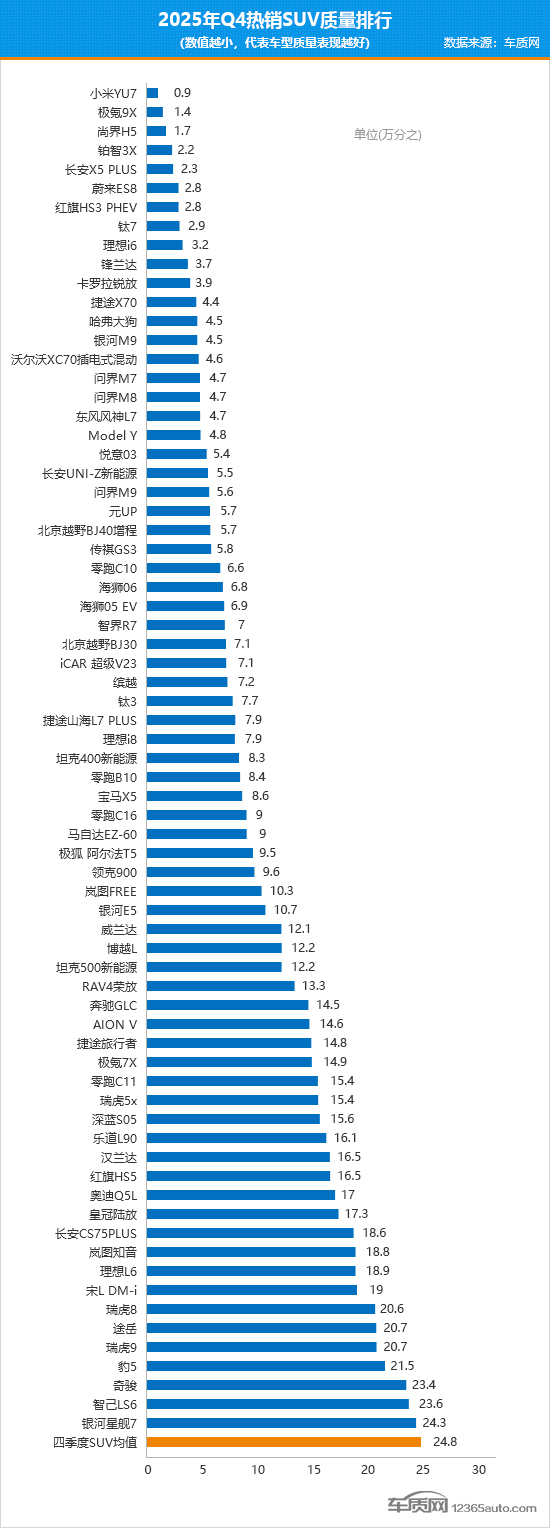
2025四季度国内热销SUV质量排行:小米YU7第一,投诉销量比为万分之0.9
Xin Lang Cai Jing· 2026-01-21 12:53
Core Insights - The report from the third-party automotive quality complaint platform Chezhizhong indicates a significant decrease in quality complaints for domestic SUVs in Q4 2025, with a total of 11,984 complaints received, reflecting a quality complaint-to-sales ratio of 24.8 per ten thousand units, a notable improvement from Q3 [1][4]. Group 1: Quality Performance - The average quality complaint-to-sales ratio for domestic SUVs in Q4 2025 is 24.8 per ten thousand units, which shows a substantial recovery in overall quality performance compared to Q3 [1][4]. - Among the 358 models analyzed, 71 models performed better than the average complaint ratio of 24.8 per ten thousand units [1][4]. Group 2: Top Performing Models - The top-performing SUV in terms of quality is the Xiaomi YU7, with a complaint ratio of 0.9 per ten thousand units [1][4]. - The second and third positions are held by the Zeekr 9X and the Shangjie H5, with complaint ratios of 1.4 and 1.7 per ten thousand units, respectively [1][4]. - Other notable models in the top eight include the Toyota Platinum 3X, Changan X5 Plus, NIO ES8, Hongqi HS3 PHEV, and the Fangcheng Bao Titanium, with complaint ratios ranging from 2.0 to 3.0 per ten thousand units [1][4].



乘联分会:1月1-18日全国乘用车市场零售67.9万辆 同比下降28%
智通财经网· 2026-01-21 11:23
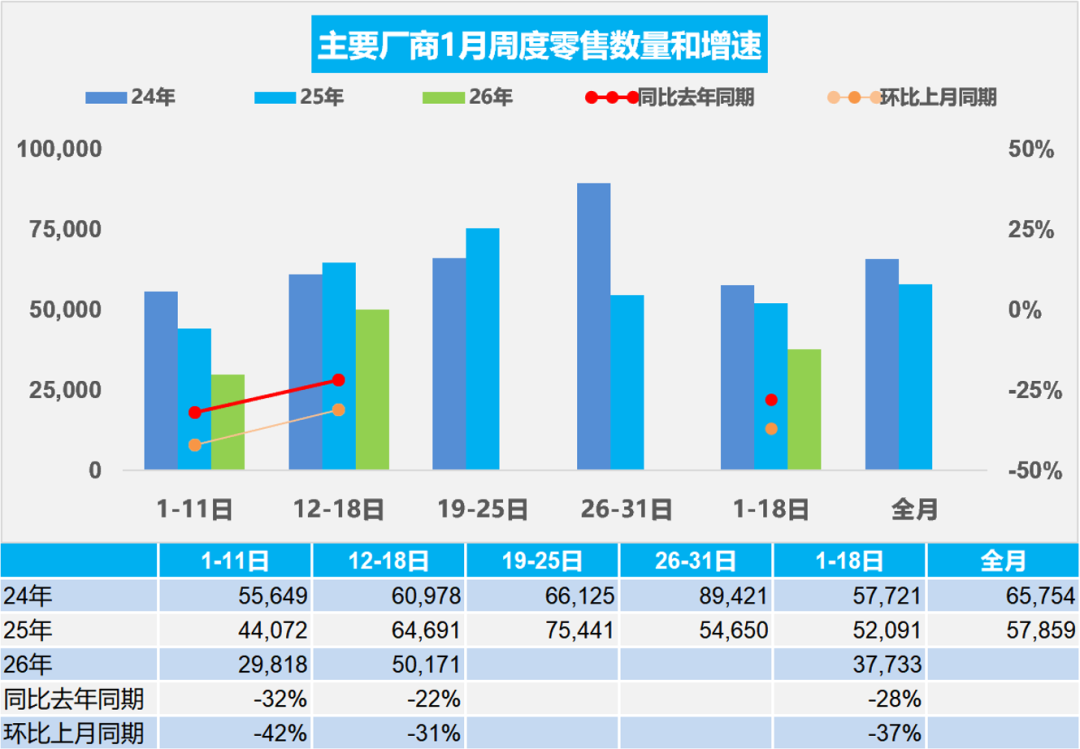
Group 1: Market Performance - From January 1 to 18, the national passenger car retail sales reached 679,000 units, a year-on-year decrease of 28% and a month-on-month decrease of 37% [1][5] - During the same period, the wholesale volume of passenger cars was 740,000 units, down 35% year-on-year and 30% month-on-month [1][9] - The retail sales of new energy vehicles (NEVs) in the same timeframe were 312,000 units, reflecting a 16% year-on-year decline and a 52% month-on-month decline [1][5] Group 2: Production Trends - In the first two weeks of January, the production of pure fuel light vehicles was 91,000 units, down 85% year-on-year and 77% month-on-month [1] - The production of hybrid and plug-in hybrid vehicles totaled 139,000 units, a year-on-year decrease of 65% and a month-on-month decrease of 75% [1] Group 3: Policy Impact - The National Development and Reform Commission announced a policy to implement large-scale equipment updates and a trade-in program, which is expected to boost domestic car consumption [5] - The subsidy for passenger car trade-ins is projected to decrease by 20% to 30% compared to 2025, indicating a structural adjustment in the policy [5][11] Group 4: Future Outlook - The market is expected to improve as local subsidy details and channels are fully launched, along with the gradual release of purchasing power before the Spring Festival [5] - The first month of the year typically sees a "New Year sales boost," and despite the current weak performance, there is an anticipation of a slight increase in year-on-year sales due to pre-orders and market dynamics [9][11]


【周度分析】车市扫描(2026年1月12日-1月18日)
乘联分会· 2026-01-21 10:57
Group 1: Market Overview - From January 1 to 18, the national retail sales of passenger cars reached 679,000 units, a year-on-year decrease of 28% compared to the same period last year, and a month-on-month decrease of 37% [1] - The wholesale volume of passenger cars during the same period was 740,000 units, down 35% year-on-year and down 30% month-on-month [1] - In the new energy vehicle sector, retail sales were 312,000 units, a year-on-year decrease of 16% and a month-on-month decrease of 52% [1] Group 2: Production Trends - In the first two weeks of January, the production of pure fuel light vehicles was 91,000 units, down 85% year-on-year and down 77% month-on-month [2] - The production of hybrid and plug-in hybrid vehicles during the same period was 139,000 units, down 65% year-on-year and down 75% month-on-month [2] Group 3: Policy Impact - The National Development and Reform Commission announced a policy to promote large-scale equipment updates and trade-in subsidies, which is expected to boost domestic car consumption [5] - The subsidy for scrapping and updating passenger vehicles is projected to decrease by 20% to 30% by 2026, while commercial vehicle subsidies remain strong [5][10] Group 4: Sales and Wholesale Trends - The average daily retail sales for the first week of January were 30,000 units, down 32% year-on-year, while the second week saw an average of 50,000 units, down 22% year-on-year [5] - The wholesale average for the first week was 35,000 units, down 40% year-on-year, and for the second week, it was 51,000 units, down 28% year-on-year [8] Group 5: Economic Context - In 2025, the total retail sales of consumer goods reached 501.2 billion yuan, a year-on-year increase of 3.7%, while automotive consumption decreased by 2% [9] - The production of automobiles in December 2025 was 3.41 million units, a year-on-year decrease of 3%, while new energy vehicle production increased by 9% [10] Group 6: Engine Market Stability - Despite the rapid development of the new energy vehicle industry, the automotive engine market remains stable, with gasoline engines maintaining a dominant position [11] - The production of gasoline engines reached 21.13 million units in 2025, while diesel engine production decreased to 2.61 million units due to market adjustments and stricter environmental policies [11] Group 7: Pickup Truck Market Growth - In December 2025, the pickup truck market sales reached 52,000 units, a year-on-year increase of 8.8%, with total sales for the year at 589,000 units, up 11.8% [12] - The export of pickup trucks in December was 28,000 units, a year-on-year increase of 12%, with total exports for the year reaching 300,000 units, up 21% [13]

英国要恢复疫情前市场规模?中国新车加速进程
Guan Cha Zhe Wang· 2026-01-21 10:38
Group 1 - The UK automotive market is attracting attention from Chinese manufacturers due to the lack of domestic automakers targeting the mass market and the absence of tariffs on Asian electric vehicle imports [1][3] - The UK automotive market has not yet recovered to its pre-pandemic level of 2.5 million vehicles annually, and the entry of Chinese brands is expected to accelerate this recovery [1] - Chinese brands, led by SAIC's MG, doubled their market share in the UK to 10% last year, with BYD and Chery increasing their shares significantly in December [3][5] Group 2 - New entrants such as Geely, Changan, Xpeng, and Leap Motor have entered the UK market since 2023, with Geely's premium electric brand targeting the UK after entering 12 European markets [3] - BYD plans to introduce its high-end brand Tengshi, while Chery may launch its new energy brand Lepas in the UK [5] - The UK market is projected to see Chinese brands capture 20% of the market share by 2028, with plans to offer not only electric vehicles but also fuel and hybrid models [5]




年销量不足10万辆!长安福特跌破行业“生存红线”
Xin Lang Cai Jing· 2026-01-21 10:01
Group 1 - Changan Ford's wholesale sales in China are projected to drop to 121,500 units in 2025, with retail sales at only 99,400 units, marking a significant decline from 247,000 units in 2024 [1] - The drop below the critical annual sales threshold of 100,000 units indicates severe operational pressure for the company, as this level is essential for cost-sharing and maintaining dealer network stability [1] - Changan Ford's sales have been on a downward trend since reaching a peak of 957,000 units in 2016, with a notable decline to below 200,000 units in 2019 and further drops in subsequent years [1] Group 2 - The sales structure is heavily imbalanced, with the Mondeo model alone accounting for 47,000 units, nearly half of the brand's total sales, indicating a vulnerability to market risks [2] - Changan Ford has eliminated popular models like the Focus to pursue higher unit profits, resulting in a gap in the 100,000 yuan price segment, which has led to a loss of market share as competitors adopt aggressive pricing strategies [4] - Changan Ford's sales have consistently declined for five consecutive months, with only 76,000 units sold in the first five months of 2025 [4] Group 3 - Changan Automobile reported total sales of 2.913 million units in 2025, with a significant 85% coming from its own brands, indicating a reduced reliance on joint ventures [5] - The decline in Changan Ford's performance reflects broader challenges faced by many joint venture brands in adapting to the rapidly evolving electric vehicle market, where domestic brands dominate with over 70% market share [5] - Traditional advantages of joint venture brands, such as durability and fuel economy, are losing relevance in the electric vehicle sector, where many brands struggle with outdated technology and insufficient range [5]
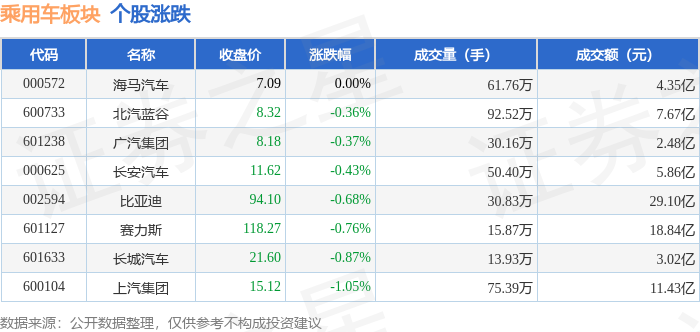
乘用车板块1月21日跌0.72%,上汽集团领跌,主力资金净流出6.59亿元
Zheng Xing Xing Ye Ri Bao· 2026-01-21 08:53
Core Viewpoint - The passenger car sector experienced a decline of 0.72% on January 21, with SAIC Motor leading the drop, while the Shanghai Composite Index rose by 0.08% and the Shenzhen Component Index increased by 0.7% [1] Group 1: Market Performance - The closing price for SAIC Motor was 15.12, down 1.05%, with a trading volume of 753,900 shares and a transaction value of 1.14 billion [1] - BYD closed at 94.10, down 0.68%, with a trading volume of 308,300 shares and a transaction value of 2.91 billion [1] - The overall passenger car sector saw a net outflow of 659 million from main funds, while retail investors contributed a net inflow of 518 million [1] Group 2: Fund Flow Analysis - GAC Group had a main fund net inflow of 2.196 million, with a retail net outflow of 18.38 million [2] - Changan Automobile experienced a main fund net inflow of 2.188 million, but a retail net inflow of 29.81 million [2] - BYD faced a significant main fund net outflow of 4.37 billion, while retail investors contributed a net inflow of 426 million [2]