滨江集团

Search documents
滨江集团:截至2025年10月20日公司合并普通账户和融资融券信用账户的在册股东总户数为26937户
Zheng Quan Ri Bao· 2025-10-21 11:37
Core Insights - The company, Binjiang Group, reported that as of October 20, 2025, the total number of registered shareholders in its consolidated ordinary accounts and margin trading accounts is 26,937 [2] Summary by Category - **Shareholder Information** - The total number of registered shareholders is 26,937 as of the specified date [2]


房地产行业第42周周报:本周楼市成交同比降幅收窄,成都出台公积金新政-20251021
Bank of China Securities· 2025-10-21 09:26
Investment Rating - The report rates the real estate sector as "Outperform the Market" [5] Core Insights - The real estate market has shown signs of improvement with a narrowing year-on-year decline in transaction volumes for both new and second-hand homes. New home transaction area increased month-on-month, while the inventory of new homes decreased [5][16] - A new housing provident fund policy in Chengdu broadens eligibility for converting commercial loans to provident fund loans, potentially stimulating demand [5][16] Summary by Sections 1. New Home Market Tracking - In the week of October 11-17, 2025, new home transaction volume in 40 cities reached 26,000 units, a month-on-month increase of 168.9% and a year-on-year decrease of 18.2%. The transaction area was 2.702 million square meters, up 170.6% month-on-month and down 22.9% year-on-year [17][24] - Transaction volumes in first, second, third, and fourth-tier cities showed month-on-month growth rates of 130.8%, 220.2%, and 122.2% respectively, with year-on-year declines of -35.3%, 0.01%, and -34.9% [17][19] 2. Second-Hand Home Market Tracking - In 18 cities, second-hand home transactions totaled 20,000 units, a month-on-month increase of 193.2% and a year-on-year decrease of 29.7%. The transaction area was 183,300 square meters, up 188.9% month-on-month and down 30.9% year-on-year [45][50] - First, second, third, and fourth-tier cities saw month-on-month transaction growth rates of 241.6%, 184.7%, and 163.8% respectively, with year-on-year declines of -27.5%, -30.7%, and -33.9% [45][51] 3. Inventory and Depletion Cycle - The inventory of new homes in 12 cities was 14.1 million units, with a month-on-month growth rate of 0.05% and a year-on-year decline of 13.7%. The depletion cycle for new home inventory was 20.9 months, down 0.8 months month-on-month and up 0.4 months year-on-year [27][39] - The depletion cycle for new homes in first, second, third, and fourth-tier cities was 21.0, 17.8, and 88.6 months respectively, with month-on-month declines of 0.6, 0.9, and 5.2 months [39][43] 4. Land Market Tracking - The total area of land transactions across 100 cities was 8.157 million square meters, down 28.4% month-on-month and down 59.5% year-on-year. The total land transaction price was 20.16 billion yuan, down 51.1% month-on-month and down 57.9% year-on-year [60][63] - The average land price was 2,471.3 yuan per square meter, down 31.7% month-on-month but up 4.1% year-on-year. The land premium rate was 2.2%, down 0.8 percentage points month-on-month and up 0.4 percentage points year-on-year [60][64] 5. Policy Developments - The Ministry of Housing and Urban-Rural Development announced reforms focusing on housing supply systems and urban construction, aiming to establish a new mechanism for real estate development [97]



房地产行业2025年9月统计局数据点评:受低基数以及一线城市新政影响,单月销售降幅收窄,今年以来单月投资降幅持续扩大
Bank of China Securities· 2025-10-21 09:09
Investment Rating - The report rates the real estate industry as "Outperform" compared to the market [32] Core Views - The monthly sales decline in the real estate sector has narrowed due to a low base and new policies in first-tier cities, but overall transactions remain sluggish, with cumulative sales decline further expanding [2] - The report anticipates a continued pressure on the real estate market due to high sales bases from the previous year, weak consumer confidence, and ongoing inventory issues [5] Summary by Sections 1. Property Sales - In September, the sales area was 85.31 million square meters, with a year-on-year decline of 10.5%, slightly narrowing from August's decline of 10.6%. The sales amount was 802.5 billion yuan, down 11.8% year-on-year, but the decline narrowed by 2.2 percentage points from August [2][6] - The average selling price of commercial housing in September was 9,407 yuan per square meter, down 0.8% month-on-month and 1.4% year-on-year, with the decline narrowing by 2.4 percentage points from August [8] - Cumulative sales from January to September showed a decline of 5.5% in area and 7.9% in sales amount compared to the same period last year [2] 2. Inventory of Commercial Housing - As of the end of September, the broad inventory of commercial housing was 1.58 billion square meters, with a year-on-year decrease of 16.7%. The de-stocking cycle was 25.8 months [5] - The current housing inventory accounted for 25.3% of the total inventory, reflecting an increase in pressure [5] 3. Real Estate Development Investment - In September, the development investment amount was 739.7 billion yuan, down 21.3% year-on-year, with the decline expanding from August [10] - The new construction area was 55.98 million square meters, down 14.4% year-on-year, marking the lowest level since 2006 [18] - Cumulative development investment from January to September was 6.77 trillion yuan, down 13.9% year-on-year [5] 4. Developer Financing - In September, the total funds available to real estate companies were 798.1 billion yuan, a year-on-year decrease of 11.5%, but the decline was less severe than in previous months [19] - The report indicates that the improvement in sales collections has contributed to the narrowing of the decline in funds [5] 5. Investment Recommendations - The report suggests focusing on companies with stable fundamentals in core cities, smaller firms with significant breakthroughs in sales and land acquisition, and companies benefiting from the recovery in the second-hand housing market [5]
土地周报 | 供求规模延续低位,杭州浦沿宅地溢价20%成交(10.13-10.19)
克而瑞地产研究· 2025-10-21 09:04
Core Viewpoint - The land supply and demand scale remains low, with overall land auction activity being subdued, while only a few high-quality plots maintain localized heat [1][2]. Supply - This week, the total land supply was 3.68 million square meters, a 30% increase from the previous week. Major cities like Beijing and Guangzhou each offered two residential plots with a combined base price of 3.916 billion yuan [2]. - In key cities, 78 residential plots were supplied this week, with an average plot ratio of 2.0. A notable plot in Beijing's Dongcheng District has a low-density residential land use with a plot ratio of 1.1 and a base price of 1.95 billion yuan, indicating a potential new home price exceeding 16,000 yuan per square meter [2]. Transaction - The total transaction area this week was 3.55 million square meters, a 17% increase from the previous week, with a transaction amount of 17.6 billion yuan, reflecting a 5% decrease [2]. - The average premium rate for land transactions was 1.6%, showing a slight recovery from low levels, although high-premium transactions remain limited [2]. Notable Transactions - Four residential plots were sold for over 1 billion yuan this week, with the highest being in Suzhou's Wujiang Taihu New City, sold for 1.936 billion yuan at a floor price of 17,600 yuan per square meter [4]. - The Hangzhou Pujiang plot was sold for a total price of 1.264 billion yuan, with a premium rate of 19.93%, highlighting its advantageous location near a metro station and educational institutions [3][12]. Market Trends - The land auction heat remains low, with the supply-demand scale continuing to decline, and the premium rates hitting new lows in the second half of the year [13].

房地产行业2025年9月70个大中城市房价数据点评
Bank of China Securities· 2025-10-21 06:53
Investment Rating - The industry investment rating is "Outperform the Market" [4][24]. Core Insights - In September 2025, new home prices in 70 major cities decreased by 0.4% month-on-month, while second-hand home prices fell by 0.6%. This marks a significant increase in the decline of new home prices compared to August [4]. - The number of cities with declining new home prices increased to 63, with an average decline of 0.47%, which is a 0.06 percentage point increase from August. All 70 cities experienced a decline in second-hand home prices, with an average drop of 0.64% [4]. - First-tier cities saw a month-on-month decline in new home prices of 0.3%, while second-hand home prices remained stable. The decline in second-hand home prices in first-tier cities was notably greater than in second and third-tier cities [4]. - The report suggests that the current housing market is under continuous downward pressure, with significant challenges in inventory reduction and weak consumer confidence. The market anticipates potential policy interventions [4]. Summary by Sections New Home Prices - In September, new home prices in first-tier cities decreased by 0.3%, while second-tier cities saw a decline of 0.4%. Third-tier cities also experienced a 0.4% drop [4][8]. - Only 10% of second-tier cities reported stable or increasing new home prices, with Hangzhou and Changchun showing slight increases [4]. Second-Hand Home Prices - All 70 cities reported a decline in second-hand home prices, with first-tier cities experiencing a 1.0% drop, second-tier cities a 0.7% drop, and third-tier cities a 0.6% drop [4][15]. - The report highlights that the decline in second-hand home prices in first-tier cities has been greater than in lower-tier cities for five consecutive months [4]. Investment Opportunities - The report recommends focusing on four main lines of investment: 1. Companies with stable fundamentals and high market share in core cities, such as Binjiang Group and China Resources Land [4]. 2. Smaller companies that have made significant breakthroughs in sales and land acquisition since 2024, like Poly Real Estate Group [4]. 3. Companies undergoing operational or strategic changes, such as New Town Holdings and Longfor Group [4]. 4. Real estate brokerage firms benefiting from the recovery in the second-hand housing market, including Beike-W and Wo Ai Wo Jia [4].
投资收缩快于销售下降,行业继续去库存当中:——房地产1-9月月报-20251021
Shenwan Hongyuan Securities· 2025-10-21 06:34
Investment Rating - The report maintains a "Positive" rating for the real estate sector, indicating optimism about future recovery driven by favorable policies and market dynamics [2][3]. Core Insights - The real estate industry is currently experiencing a phase of inventory reduction, with investment contraction outpacing sales decline. The report anticipates that investment recovery will be slower than in previous cycles, with projected declines in investment, new starts, and completions for 2025 [2][3][20]. - Sales metrics remain weak, with both sales area and sales amount showing declines. However, the report suggests that the industry is at a bottoming stage, with potential for demand recovery driven by proactive policies [21][34]. - Funding sources are under pressure, with a notable decline in domestic loans and self-raised funds. The report expects a gradual improvement in funding conditions as industry policies continue to relax [35][37]. Investment Analysis Summary Investment Side - From January to September 2025, total real estate investment reached 67,706 billion yuan, reflecting a year-on-year decline of 13.9%. In September alone, investment dropped by 21.3% compared to the previous month [3][20]. - New starts and construction activities also showed declines, with new starts down 18.9% year-on-year and construction down 9.4% [20][21]. Sales Side - The total sales area for real estate from January to September 2025 was 6.6 billion square meters, down 5.5% year-on-year. The sales amount reached 6.3 trillion yuan, a decline of 7.9% [21][34]. - The average selling price of commercial housing decreased by 3% year-on-year, with a slight improvement in the rate of decline in September [32][34]. Funding Side - Cumulative funding sources for real estate development from January to September 2025 totaled 7.2 trillion yuan, down 8.4% year-on-year. In September, the decline in funding sources was 11.5% [35][37]. - Domestic loans and self-raised funds saw significant declines, with domestic loans down 14.6% in September compared to the previous month [36][37].


房地产1-9月月报:投资收缩快于销售下降,行业继续去库存当中-20251021
Shenwan Hongyuan Securities· 2025-10-21 05:44
Investment Rating - The report maintains a "Positive" rating for the real estate industry, indicating optimism about future developments and recovery in the sector [2][3]. Core Insights - The real estate industry is currently experiencing a phase of inventory reduction, with investment contraction outpacing sales decline. The report anticipates that the "Good Housing" policy will create new pathways for recovery, particularly in core cities, and will lead to a shift in business models from finance-oriented to manufacturing-oriented [2][3][21]. Investment Sector Summary - **Investment Trends**: From January to September 2025, total real estate development investment reached 67,706 billion yuan, a year-on-year decrease of 13.9%. In September alone, investment fell by 21.3% compared to the previous month [3][20]. - **New Construction**: New construction area decreased by 18.9% year-on-year, with a slight improvement in the month-on-month comparison [20][21]. - **Completion Rates**: The completion of projects showed a positive trend in September, with a year-on-year increase of 1.5% [20][21]. Sales Sector Summary - **Sales Performance**: The total sales area for real estate from January to September 2025 was 6.6 billion square meters, down 5.5% year-on-year. In September, the sales area decreased by 10.5% compared to the same month last year [21][35]. - **Sales Revenue**: The total sales revenue was 6.3 trillion yuan, reflecting a year-on-year decline of 7.9%. The average selling price of properties decreased by 3% year-on-year [21][35][33]. Funding Sector Summary - **Funding Sources**: Total funding sources for real estate development amounted to 7.2 trillion yuan, down 8.4% year-on-year. In September, the decline in funding sources expanded to 11.5% [36][38]. - **Loan Trends**: Domestic loans saw a year-on-year decrease of 14.6% in September, indicating tightening financial conditions for the sector [36][38]. Recommendations - The report recommends several companies for investment, including: 1. "Good Housing" companies: Jianfa International, Binjiang Group, China Resources Land, Greentown China, China Jinmao, Jianfa Holdings [2]. 2. Companies with potential for commercial real estate revaluation: New Town Holdings, Yuexiu Property, China Merchants Shekou, Longfor Group, China Overseas Development, Poly Developments, Huafa Group [2]. 3. Second-hand housing intermediaries: Beike-W, with a focus on I Love My Home [2]. 4. Property management firms: Greentown Services, China Resources Vientiane, China Merchants Jiyu, Poly Property, China Overseas Property [2].


滨江集团涨2.08%,成交额1.13亿元,主力资金净流出274.61万元
Xin Lang Cai Jing· 2025-10-21 03:35
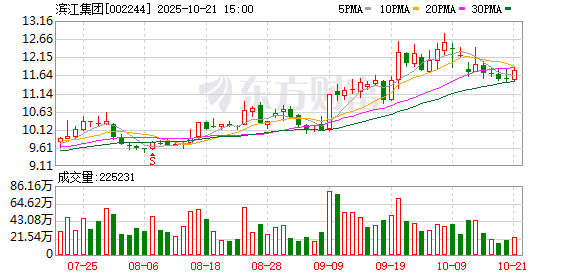
Core Viewpoint - Binhai Group's stock price has shown significant growth this year, with a year-to-date increase of 37.90%, despite a slight decline in the last five trading days [1][2]. Financial Performance - For the first half of 2025, Binhai Group reported a revenue of 454.49 billion yuan, representing a year-on-year growth of 87.80%, and a net profit attributable to shareholders of 18.53 billion yuan, up 58.87% year-on-year [2]. - The company has distributed a total of 47.35 billion yuan in dividends since its A-share listing, with 13.13 billion yuan distributed over the past three years [2]. Stock Market Activity - As of October 21, Binhai Group's stock was trading at 11.76 yuan per share, with a market capitalization of 365.91 billion yuan [1]. - The stock experienced a net outflow of 274.61 million yuan in principal funds, with significant buying and selling activity from large orders [1]. Shareholder Information - As of October 10, the number of shareholders for Binhai Group was 27,300, a decrease of 0.52% from the previous period, while the average circulating shares per person increased by 0.53% to 98,319 shares [2]. - The top ten circulating shareholders include notable funds, with the third-largest being the Fuguo Tianhui Growth Mixed Fund, holding 53 million shares [2].
上海八批次土拍收官:中海招商越秀争夺核心地块,滨江集团时隔多年入沪“陪跑”
Xin Lang Cai Jing· 2025-10-21 03:20
Core Viewpoint - The Shanghai land auction market in 2025 has seen the emergence of "land kings," with significant transactions and a cautious approach from developers amid changing market conditions [1][9]. Summary by Sections Auction Details - The eighth batch of land auctions in Shanghai included 6 plots with a total area of 191,600 square meters and a starting price of 18.495 billion yuan, attracting over 20 real estate companies [1]. - All 6 plots were sold, generating a total transaction amount of 19.877 billion yuan, with 3 plots sold at a premium and 3 at the starting price [1][9]. Key Transactions - The most notable transaction was the Xuhui Riverside plot, sold for 4.465 billion yuan with a floor price of approximately 148,500 yuan per square meter, setting a new record for the area [3][4]. - The Yangpu East Bund plot was sold to Poly Real Estate with a premium rate of 14.69%, highlighting competitive bidding among four participants [5][6]. Market Trends - Analysts noted a shift towards more conservative bidding strategies among developers, with premium rates significantly lower than in previous auctions [1][9]. - The overall market sentiment reflects a cautious approach as developers assess future market conditions and the potential for high-end residential sales [1][9]. Future Outlook - The upcoming ninth batch of land auctions is set to include 9 plots across various districts, indicating continued activity in the Shanghai land market [9]. - Experts anticipate that the rational performance observed in land auctions will gradually influence the new housing sales market [9].


三季度土地市场有所降温,四季度市场将如何演绎?
3 6 Ke· 2025-10-21 02:21
Core Insights - The real estate companies have been focusing on core cities for land acquisition, leading to a 12% year-on-year increase in land transfer fees across 300 cities in the first three quarters, despite an 8% decrease in transaction area [1][6][27] - In the third quarter, the land market cooled down as the supply of quality land in core cities slowed, with the average premium rate for residential land dropping to 5.8% and transaction area and transfer fees decreasing by 13% and 10% year-on-year, respectively [1][6][27] - The top 20 cities accounted for 61% of the national residential land transfer fees in the first three quarters, although this proportion decreased by 7 percentage points compared to the first half of the year due to the slowdown in land supply in core cities [1][15] Land Market Trends - The fourth quarter is typically a peak period for land supply, with expectations of increased market supply, but the heat of land auctions will depend on the recovery of new home sales [1][27] - The average premium rate for residential land has shown a downward trend, dropping to 3.8% in September, the lowest monthly level this year [9][27] - The land transfer fees for 300 cities reached 1.86 trillion yuan in the first three quarters, a slight increase of 3.1% year-on-year, while the third quarter saw a decline of 10.4% in transfer fees [6][7] City Concentration and Performance - The land transfer fees in first-tier cities have seen significant growth, with a year-on-year increase of 19.7% in the first three quarters, while second-tier cities also experienced growth, albeit at a lower rate [10][15] - The performance of third and fourth-tier cities remains weak, with both land supply and transaction metrics declining more than in first and second-tier cities [10][12] - The top cities for land transfer fees include Hangzhou, Beijing, and Shanghai, each exceeding 100 billion yuan in fees during the first three quarters [15][18] Corporate Strategies and Acquisitions - The top 100 real estate companies increased their land acquisition amounts by 36.7% year-on-year, with state-owned enterprises being the primary players in the market [18][24] - Companies are advised to focus on core cities and avoid high-priced land to ensure the safety, liquidity, and profitability of new projects [1][27] - Recent trends show companies forming joint ventures to acquire quality land at lower costs, indicating a strategic shift towards consolidating resources [28][29]