工商银行

Search documents
银行业周报:消费领域金融支持有望加强-20260208
Xiangcai Securities· 2026-02-08 15:03
Investment Rating - The industry rating is maintained at "Overweight" [7][36] Core Insights - The central bank's 2026 credit market work meeting emphasized the need for enhanced financial support in the consumer sector, with a focus on expanding domestic demand during the 14th Five-Year Plan period [6][32] - Structural monetary policy tools will be implemented to support key areas, including small and micro enterprises, technological innovation, and green upgrades [7][33] - Financial support for consumption is expected to increase, particularly in sectors such as health care, cultural tourism, and new consumption areas like digital and green initiatives [7][34] Summary by Sections Industry Performance - The banking sector index rose by 1.70% during the period from February 2 to February 8, 2026, outperforming the CSI 300 index by 3.04 percentage points [11] - The performance of various banking segments showed that city commercial banks led the market [11] Financial Market Conditions - The central bank's net withdrawal from the open market was 656 billion yuan, indicating a relatively loose funding environment [19] - The average issuance rates for interbank certificates of deposit increased, with net financing amounting to 236.19 billion yuan in February [22][23] Investment Recommendations - With the collaboration of financial and fiscal policies, the "opening red" phase of credit issuance is expected to remain stable, which may enhance core revenue growth for banks [9][36] - High dividend yields in bank stocks present significant investment value, with recommendations for state-owned banks and flexible regional banks [9][36]
国央企密集加码布局氢能,有的企业还改名了
第一财经· 2026-02-08 12:08
2026.02. 08 本文字数:1451,阅读时长大约2分钟 作者 | 第一财经 林春挺 今年以来,吉电股份(现电投绿能)、中国能建、国家能源集团等国央企密集布局氢能领域,通过战 略重组、机构升格、平台设置等举措,推动氢能从"辅助业务"向"核心战略板块"跃升,加速构建覆盖 技术研发、工程应用、市场消纳的全产业链生态。 2月4日,吉林电力股份有限公司(即"吉电股份")正式更名为国电投绿色能源股份有限公司(即"电 投绿能",000875.SZ)。截至2025年末,该公司管理资产规模超1000亿元。而此次更名后,公司将 聚焦"新能源+"和绿色氢基能源双赛道。 国家能源局发布的《中国氢能发展报告(2025)》指出,中国的氢能产业正从试点探索逐步进入有 序破局的新阶段。根据该报告,2024年中国氢能生产消费规模突破3650万吨,连续多年位居全球第 一,占全球总消费量的三分之一以上。国家发改委原副主任、中国国际经济交流中心特邀专家张晓强 预测,到2030年,中国绿氢产量完全有可能达300万吨以上,形成万亿元以上大市场。 微信编辑 | 苏小 第 一 财 经 持 续 追 踪 财 经 热 点 。 若 您 掌 握 公 司 动 ...


银行股迎结构性行情:大行回调、小行领跑
Di Yi Cai Jing· 2026-02-08 12:07
Group 1 - The core viewpoint of the articles indicates that the recent strength in A-share bank stocks is driven by a combination of fundamental improvements and capital inflows, with a notable performance from regional banks [1][4][9] - The banking sector has shown resilience with expectations of revenue and net profit growth gradually recovering in 2026, supported by a stable net interest margin and improved asset quality [1][4][9] - The performance of city commercial banks has outpaced that of larger banks, with significant stock price increases observed in banks like Xiamen Bank and Qingdao Bank, which have shown year-on-year gains of 40.36% and 35.29% respectively [2][3][4] Group 2 - The recent data shows that the banking sector has attracted approximately 22.49 billion yuan in net capital inflows, particularly into smaller banks, indicating a shift in investor preference towards stable cash flows and lower valuations [7][9] - The average price-to-earnings ratio for the banking sector is currently at 6.1 times, with a price-to-book ratio of about 0.52 times, suggesting that valuations are at historical lows and making the sector attractive for long-term investors [7][9] - Analysts believe that the banking sector is entering a new growth cycle in 2026, with expectations of a recovery in earnings and a potential increase in loan growth, which could further enhance the attractiveness of bank stocks [8][9]

财富管理系列研究之五:居民资产再配置:低利率环境下的美日经验启示
Ping An Securities· 2026-02-08 11:49
Investment Rating - The report maintains an "Outperform" rating for the industry [1] Core Insights - The ongoing low interest rate environment is prompting a reallocation of household assets, with a notable trend of "deposit migration" observed. By the end of December, the proportion of non-bank deposits reached 10.6%, up 1.2 percentage points from the beginning of the year, while public fund assets grew by 14.9% year-on-year [2][8] - The report draws insights from the experiences of the US and Japan regarding household wealth allocation under low interest rates, suggesting potential paths for the evolution of domestic asset allocation structures [2][8] Summary by Sections 1. Low Interest Rate Environment and Asset Reallocation - The report highlights the sustained low interest rate environment, with both the 1-year and 5-year Loan Prime Rates (LPR) at historical lows. The downward trend in deposit rates is expected to continue, influencing household asset reallocation [6][8] 2. US Experience: Decline in Low-Risk Assets and Rise in Equity Assets - In the US, the share of low-risk assets has decreased while equity assets have significantly increased. By the end of 2024, equity assets accounted for 51.1% of financial assets, up 17.9 percentage points from 1987 [11][12] - The report notes that during various interest rate cuts, low-risk assets saw a decline in both scale and growth rate, indicating a shift towards higher-risk, higher-return investments [21][25] 3. Japan Experience: Persistent Low-Risk Preference with Slight Increase in Equity Allocation - Japan has maintained a low-risk preference in asset allocation, with equity assets slightly increasing to 17.1% by the end of 2023, a modest rise of 4.3 percentage points since 1987. However, cash and deposits still dominate the asset mix [3][5] - The report emphasizes that despite low interest rates, there has not been a significant outflow of deposits in Japan, indicating a different response to low rates compared to the US [3][5] 4. Summary: Impact of Low Interest Rates on Asset Allocation Behavior - The report concludes that low interest rates influence household asset allocation behaviors, with macroeconomic conditions playing a crucial role in determining the flow and scale of funds. The shift from low-risk to higher-return assets is a common trend observed in both the US and Japan [2][3]
中国黄金等机构收紧回购规则的具体内容是什么?
Sou Hu Cai Jing· 2026-02-08 10:49
来源:新浪财富汇 2026年2月初,面对贵金属市场的剧烈震荡,中国黄金率先宣布收紧回购规则,随后多家头部金店及银 行同步跟进,引发投资者对黄金变现规则的广泛关注。 一、回购规则调整的核心内容 中国黄金等机构此次调整主要涉及三方面: 1. 时间限制:自2026年2月7日起,周六、周日及法定节假日(上海黄金交易所非交易日)全面暂停所有 渠道的贵金属回购业务,仅限周一至周五交易时段办理。 2. 限额管理: - 实施单客户单日累计回购上限与单笔回购总量上限; 2026年初,伦敦金现单日最大涨跌幅超5%,国内黄金T+D价格单克波动超30元,非交易日缺乏实时定 价机制,机构无法对冲金价暴跌风险(如假期金价大跌导致亏损)。 此前北京菜百曾现单日33公斤、近200人排队回购的集中变现潮,凸显流动性承压风险。 规避定价争议:非交易日市场报价缺失,易引发回购价差纠纷,暂停业务可保障双方权益。 推动行业标准化:针对此前回购市场存在的时段混乱、限额模糊、收费不透明等问题,此次调整与菜 百、工行、建行等机构联动,呼应2025年《黄金以旧换新经营服务规范》团体标准,促进行业透明化。 三、对投资者的实际影响与应对建议 时效性限制:投资者需 ...


变现不急了“旧换新”多了
Xin Lang Cai Jing· 2026-02-08 07:08
Core Insights - The recent fluctuations in gold prices have led to increased consumer activity in both selling and purchasing gold products, with many opting to wait and observe the market before making decisions [1][2][3] Group 1: Market Trends - There has been a noticeable increase in consumers visiting gold shops and banks to sell their gold products, particularly as international gold prices have experienced significant volatility [1][2] - The current gold recovery price is reported at 1059 yuan per gram, with many consumers choosing to hold off on selling due to recent price drops [2] - The "old for new" exchange model is gaining popularity among consumers, as it is perceived as a more cost-effective option compared to outright selling [3] Group 2: Consumer Behavior - Many consumers are adopting a wait-and-see approach due to the unpredictable nature of gold prices, with some expressing regret for not selling earlier [2][3] - As the Chinese New Year approaches, there is a surge in demand for gold jewelry, particularly items with symbolic meanings, which are especially popular among younger consumers [3] - The trend of consumers opting for smaller, intricately designed gold pieces is evident, with a focus on practicality and aesthetics [3] Group 3: Investment Strategies - Investors are becoming more rational in their approach to gold investments, choosing to accumulate gold in a staggered manner rather than making impulsive decisions based on price spikes [4] - There has been a noticeable increase in inquiries and purchases of investment gold bars, although sales have normalized following a price reversal at the end of January [4] - Financial institutions are adjusting their gold accumulation services in response to market fluctuations, indicating a shift in investment strategies among consumers [4]
2月7日金价对比!同样是黄金,价格却能差出430一克?
Sou Hu Cai Jing· 2026-02-08 06:09
Core Insights - The gold market experienced unprecedented price fluctuations on February 7, 2026, with international gold prices surging over 5%, reaching above $5000 per ounce, while domestic gold prices varied significantly across different sales channels [1][3]. Price Disparity - The price divergence in the gold market is attributed to different pricing mechanisms in international and domestic markets, influenced by geopolitical tensions in the Middle East and U.S. economic data, which affected investor sentiment and demand [3][6]. - Domestic gold consumption faced a seasonal demand slump post-Chinese New Year, leading brand gold stores to reduce prices to stimulate sales, while the Shanghai Gold Exchange reported a rise in spot prices [3][5]. Channel Pricing Differences - Bank investment gold bars are priced lower due to their focus on investment attributes, with prices around 1079.60 to 1106.64 yuan per gram, reflecting lower premiums compared to brand gold stores [5][6]. - Brand gold stores incorporate various costs such as design, processing, and operational expenses, leading to higher prices, with quotes ranging from 1480 to 1500 yuan per gram [5][10]. - The Shenzhen Shui Bei wholesale market offers competitive pricing at approximately 1247 yuan per gram, appealing to consumers seeking better value [5][11]. Recovery Market Dynamics - The gold recovery market operates on a different pricing structure, with recovery prices for 999 gold around 1050-1070 yuan per gram, disregarding brand premiums and craftsmanship [6][8]. - Consumers face potential pitfalls in the recovery market, including deceptive practices by some shops that reduce the actual recovery price [8][13]. Regional and Timing Factors - Regional price variations exist, with first-tier cities generally having higher prices due to increased operational costs, and the timing of price adjustments in domestic markets lagging behind international fluctuations [8][10]. - The gold market's short-term volatility is normal, with significant price swings observed, highlighting the risks for leveraged traders [10][15]. Consumer Guidance - Understanding the gold market's pricing logic and channel differences is crucial for consumers to make informed purchasing decisions and avoid overspending due to information asymmetry [15].

节假日暂停贵金属回购业务!部分品牌金店调整交易规则
Sou Hu Cai Jing· 2026-02-08 03:40
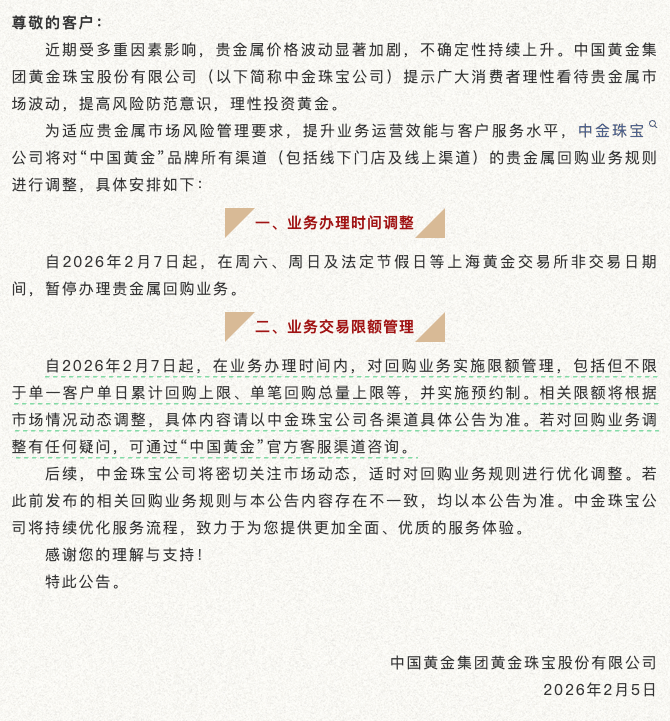
Core Viewpoint - The recent volatility in gold prices has prompted China Gold Group to adjust its gold buyback business rules, aiming to mitigate operational risks and ensure orderly operations [1][5]. Group 1: Business Adjustments - Starting from February 7, China Gold will suspend gold buyback services on non-trading days, including weekends and public holidays [2]. - The company will implement limit management on buyback transactions, including daily limits for individual customers and total limits for single transactions, along with an appointment system [3]. Group 2: Rationale Behind Adjustments - The adjustments aim to align with market pricing mechanisms, as gold prices are based on real-time quotes from the exchange, avoiding pricing disputes and operational risks on non-trading days [5]. - The changes are designed to control the company's risk exposure during periods of significant price fluctuations, preventing potential losses from acquiring physical gold without market price references [5]. - The adjustments also seek to enhance service consistency by standardizing buyback rules across online and offline channels, improving operational efficiency and reducing consumer misunderstandings [5]. Group 3: Industry Context - Other leading brands, such as Caibai Co., have also announced similar adjustments to their gold buyback services, reflecting a broader trend in the industry [7]. - Major commercial banks have made corresponding adjustments to their gold accumulation services, indicating a collective response to the current market conditions [7].
头部金店紧急调整回购规则!啥信号?
Xin Lang Cai Jing· 2026-02-08 02:40
Core Viewpoint - The company, China Gold Group, announced that it will suspend precious metal repurchase services during non-trading days starting February 7, 2026, due to significant price volatility in the precious metals market [1][12]. Group 1: Business Adjustments - Starting February 7, 2026, China Gold will halt precious metal repurchase services on weekends and public holidays when the Shanghai Gold Exchange is closed [1][12]. - The company will implement limit management on repurchase transactions during business hours, including daily repurchase limits per customer and total transaction limits, with a reservation system in place [2][9]. - Other companies, such as Cai Bai Jewelry, will also adjust their precious metal repurchase services similarly, indicating a broader industry trend [9][17]. Group 2: Market Conditions - Precious metal prices have experienced significant fluctuations, with international gold prices rising nearly 15% and silver prices over 8% since the beginning of the year [6][15]. - On February 6, 2026, gold prices saw a drop of over 2% before rebounding to above $4,950 per ounce, while silver prices dropped nearly 10% before recovering to above $77 per ounce [6][15]. - The trading sentiment in the precious metals market has shifted from risk aversion to speculation, increasing trading volatility and valuation risks [18]. Group 3: Company Performance - China Gold's stock price has shown significant volatility, peaking at 14.85 yuan per share on January 30, 2026, a 77.21% increase from 8.38 yuan on January 22, 2026, before falling to 11.42 yuan by February 6, 2026, a decline of 23.1% from the peak [6][15]. - The company has been increasing its gold reserves, reporting 7,419 million ounces at the end of January 2026, up from 7,415 million ounces at the end of December 2025, marking the 15th consecutive month of increases [10][18].
金价:今日金价1110克?不出意外的话,接下来金价可能会重演历史!
Sou Hu Cai Jing· 2026-02-08 02:14
Core Viewpoint - The gold market experienced a historic surge on February 4, 2026, with London gold prices rising by $204.55, a 4.29% increase, reaching $4977.7 per ounce, marking the largest single-day increase since the 2008 financial crisis [1] Group 1: Market Dynamics - The recent surge in gold prices followed a significant drop of 21% in the previous week, indicating a rapid shift from panic selling to aggressive buying within 72 hours, with price fluctuations exceeding $300 [1][3] - The Shanghai Gold Exchange raised margin requirements and expanded price limits, allowing for greater market volatility, which contributed to a 45% increase in COMEX gold trading volume [3] - The current market conditions align with historical bull markets driven by global economic uncertainty, geopolitical conflicts, and loose monetary policies, with active speculative trading amplifying price volatility [5] Group 2: Central Bank Activity - In January 2026, global central banks added a net 1200 tons of gold, with China increasing its gold reserves for 14 consecutive months, indicating a long-term strategic demand rather than short-term speculation [6] - The share of gold in global central bank reserves rose to 20%, surpassing the euro to become the second-largest reserve asset [6] Group 3: Geopolitical and Economic Factors - The surge in gold prices was directly triggered by escalating tensions between the U.S. and Iran, with military incidents prompting safe-haven investments in gold [6] - Weak U.S. employment data reinforced expectations for a Federal Reserve rate cut, contributing to a favorable environment for gold price recovery [6] Group 4: Consumer Behavior and Market Segmentation - The gold market is experiencing structural differentiation, with significant price discrepancies between bank gold bars and retail gold jewelry, exceeding 400 yuan per gram [8] - Traditional gold jewelry sales have declined due to high prices, leading brands to close underperforming stores and shift focus to the high-end market, while artisanal gold products are gaining popularity [9] - The stock market related to gold has seen significant gains, with nearly 30 stocks in the A-share gold concept sector hitting the daily limit, and some companies doubling their stock prices within a month [9] Group 5: Investor Sentiment - Ordinary investors are showing a polarized response, with some queuing to buy gold bars while others are cashing out profits due to rapid price increases, reflecting differing risk perceptions among market participants [11]