红旗连锁

Search documents
每天200万人出境游,都去了哪里?
Xin Lang Cai Jing· 2025-10-08 02:29
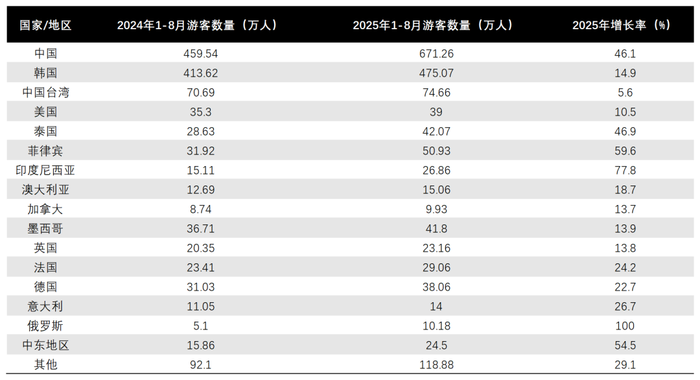
文| 霞光社 归去来 编辑|刘景丰 这个长假,每天大约200万人次进出国门,比去年的187万人次还多。这是中国国家移民管理局日前给出 的预测。其中,热门目的地依然是日本、韩国等周边国家。 不过,今年国庆黄金周的出境游市场,明显呈现"冰火两重天"的格局:一边是日本热度居高不下,另一 边是泰国持续遇冷。 Airbnb《2025国庆黄金周出境游趋势报告》显示,日本成为国庆出境游首选目的地,其搜索热度较去年 近乎翻倍。携程将日本列为海外热门目的地TOP1。同程旅行数据也显示,日本稳坐9月出境游目的地榜 首,"霸榜"之势十分明显。 这股热度并非偶然,是2025年以来日本旅游市场持续走强的直接体现。JINTO(日本旅游观光厅)数据 显示,2025年8月访日外国游客人数为342.8万人次,其中中国大陆游客居首;前8个月,日本入境游客 累计达2838.36万人次,中国游客超671万人。 从客源结构来看,日本入境游市场呈现全域增长、新兴市场爆发的强劲态势:印尼以77.8%的同比增速 领跑,俄罗斯增幅更达100%,实现翻倍。菲律宾(+59.6%)、中东地区(+54.5%)、泰国(+46.9%) 与中国大陆(+46.1%)同样增长 ...

国庆中秋,大马再掀中餐热潮!“鱼你速度”树出海标杆!
Sou Hu Wang· 2025-10-07 11:29
Core Insights - The article highlights the rising popularity of Chinese cuisine in Malaysia, particularly the chain "YONNY Fish You Together," which has quickly become a leading brand in the region within just six months of its establishment [1][3]. Market Potential - The Southeast Asian restaurant market is projected to exceed $100 billion by 2024, with a low restaurant density of only 15 restaurants per 10,000 people, indicating significant room for growth compared to more mature markets like the US and Japan [4]. - The Malaysian restaurant service market is expected to reach $23.95 billion by 2029, with a compound annual growth rate (CAGR) of 12.81% from 2024 to 2029, presenting a lucrative opportunity for brands like YONNY [11]. Brand Expansion Strategy - YONNY is transitioning from a "single-point trial" approach to a "regional densification" strategy, marking a significant step in its overseas expansion plans [10]. - The brand has successfully opened multiple locations in key areas such as Selangor, Kuala Lumpur, and Johor Bahru, indicating a clear strategy to establish a strong presence in Malaysia before expanding further into Southeast Asia [10]. Unique Selling Proposition - YONNY's success is attributed to its dual strategy of "Eastern aesthetics" and "deep localization," which allows it to resonate with local consumers while maintaining its core offerings [11][14]. - The brand has upgraded its English name to "YONNY" for better international appeal and has integrated Chinese cultural elements into its restaurant design to enhance customer experience [13]. Consumer Insights - Research indicates that Malaysian families prefer "shared dining," guiding YONNY in optimizing portion sizes and introducing family meal options [18]. - The brand's positioning as a go-to choice for family gatherings and social events has solidified its market presence in Malaysia [13]. Operational Insights - YONNY's management team is actively studying local consumer preferences and operational strategies to ensure effective market penetration and adaptation [15]. - The brand is focused on building a strong local talent pool to support its expansion and maintain high operational standards [14][21].
经济越冷,这些行业越火!这7个低门槛赛道逆势暴涨,现在入局刚刚好
Sou Hu Cai Jing· 2025-10-06 05:40
Core Insights - The article highlights eight sectors that are thriving despite the economic downturn, suggesting that wealth opportunities can be found in unexpected areas. Group 1: Second-Hand Economy - The second-hand economy is rapidly growing, with sales of items like light bottles reaching 150 billion yuan. Some individuals are successfully refurbishing old furniture and selling it at a 30% premium, while others are specializing in cleaning and reselling baby and digital products at an 80% markup [1]. Group 2: Emotional Value and Affordable Entertainment - Under pressure, consumers are willing to spend on affordable entertainment, with the 2025 Spring Festival box office expected to reach 7 billion yuan. The game "Black Myth: Wukong" sold 4.5 million copies in three months, generating over 1.5 billion yuan in revenue. Short dramas and gaming services are also seeing increased demand [3]. Group 3: Value of Affordable Consumption - The trend of affordable consumption is on the rise, with sales of low-cost food items like pickled vegetables and instant noodles soaring, and pickled vegetables seeing a price increase of 40%. Community group buying has surpassed 30 million daily orders, and discount snack stores are proliferating, with brands like Haitegou reporting annual revenue growth of 200% [5]. Group 4: Skills Exchange and Vocational Education - In tough economic times, there is a growing demand for skill enhancement, with orders for courses in Python programming and CAD design increasing by 230%. A former delivery worker has successfully launched a course on optimizing delivery routes, selling over 5,000 units at 298 yuan each [7]. Group 5: Silver Economy - The silver economy is emerging as a significant market, with over 300 million people aged 60 and above in China. New professions such as bathing assistants and elderly capability assessors are developing, with service fees ranging from 200 to 800 yuan per session [5]. Group 6: Repair Services - The demand for repair services has surged during the economic downturn, with a growth rate of up to 82%. High-margin repair projects, such as mobile phone screen repairs, can yield profit margins exceeding 60% [8]. Group 7: Domestic Substitution - The trend of domestic substitution is becoming essential, with companies like SMIC increasing production capacity and WPS software gaining 500 million users, growing at 30% annually. There are opportunities for service providers to teach users about domestic software [10]. Group 8: Green Economy - The green economy is witnessing new opportunities under the dual carbon goals, with significant growth in sectors like photovoltaics and energy storage. The number of buyers for new energy charging piles has increased by 2.5 times, with transaction volumes rising by 184% [13].

名创分拆的潮玩品牌 TOP TOY 交表;麦当劳拟4年内新增1万家店;贝恩资本或竞购 Costa丨品牌周报
36氪未来消费· 2025-10-05 14:12
Group 1: Costa Coffee Sale - Coca-Cola is evaluating the sale of Costa Coffee, with Bain Capital emerging as a potential buyer, following initial discussions with private equity firms [3][4] - Costa Coffee was acquired by Coca-Cola for £3.9 billion (approximately 34.7 billion yuan) seven years ago, but is now being sold for £2 billion (approximately 19.4 billion yuan), indicating a significant decline in value [3][4] - The performance of Costa has deteriorated since its acquisition, with revenue dropping from £1.3 billion in 2018 to a slower growth rate, and only 400 new stores added globally in seven years [3][4] Group 2: Competitive Landscape - The coffee market is facing intense competition from established brands like Starbucks and emerging players such as Luckin Coffee and McCafé, which are impacting Costa's market share [4][5] - Costa's growth in China has been particularly challenging, failing to meet its target of 1,000 stores, with only around 500 currently operational [4][5] Group 3: McDonald's Expansion Plans - McDonald's plans to open nearly 10,000 new stores globally within four years, aiming to surpass its competitor, Mixue Ice City, which currently has 46,479 stores [6][8] - The strategy includes expanding in both urban and rural areas, focusing on increasing brand visibility and reducing operational costs through efficient supply chain management [6][8] Group 4: Goyard's Performance - Goyard's revenue surged by 64% to €810 million in the 2024 fiscal year, with a significant portion of sales coming from international markets [9][10] - The brand has maintained a high resale value, surpassing Hermès with a 104% retention rate, indicating strong consumer demand despite the overall luxury market downturn [9][10] Group 5: Mijia Ice City Acquisition - Mijia Ice City has acquired a 53% stake in Fresh Beer Fulu Family for approximately 297 million yuan, expanding its product offerings into the fresh beer market [11][12] - Fresh Beer Fulu Family, established in 2021, focuses on affordable fresh beer products, with prices ranging from 5.9 yuan to 9.9 yuan per 500mL [11][12] Group 6: TOP TOY's Market Position - TOP TOY, a brand spun off from Miniso, reported revenues of 6.79 billion yuan in 2022, with projections of 19.09 billion yuan by 2024, but struggles to differentiate itself from competitors like Pop Mart [14][15] - The brand primarily relies on collaborations with international IPs, which limits its brand recognition and profitability compared to Pop Mart's unique IP creations [15][16]






猪猪侠开YU7?CEO卖蜜雪… Sora 2被网友玩坏了,律师警告
Xin Lang Ke Ji· 2025-10-05 08:46
Core Insights - OpenAI launched its advanced video generation model Sora 2 and the accompanying Sora App, which quickly became popular, topping the App Store in the U.S. and surpassing competitors like ChatGPT and Gemini [2][3][11] - The Sora App allows users to create immersive short videos by simply uploading a photo or entering a text prompt, marking a significant advancement in AI video generation technology [6][11] - The app's "Cameo" feature has led to a surge in user-generated content (UGC), with a reported 1200% increase in related content within 24 hours of its launch [11] Company Overview - OpenAI's valuation has reached $500 billion, and the company reported $4.3 billion in revenue for the first half of the year, exceeding its total revenue from the previous year, although it also faced a net loss of $13.5 billion [11] - The company is considering a potential IPO in the future and is currently facilitating a secondary sale of employee stock [11] Technology and Features - Sora 2 has made significant improvements over its predecessor, including synchronized audio and video generation, enhanced physical accuracy, and improved resolution and detail [6][11] - The app not only serves as an AI tool but also as a social entertainment platform where users can create and share video content [6][11] User Engagement - The introduction of the "Cameo" feature has made OpenAI's CEO Sam Altman a prominent figure on the internet, with users creatively incorporating his likeness into various scenarios [7][9] - Users in China are particularly active, creating localized content that features popular characters and trends [9] Legal and Copyright Concerns - The rapid rise of Sora has raised concerns about copyright infringement, as many videos generated using the app feature protected intellectual property (IP) without proper authorization [12][15] - OpenAI's "opt-out" policy for copyright content has been criticized for potentially increasing legal risks, as it allows users to generate content featuring copyrighted characters unless the rights holders request removal [15][16] - Legal experts warn that users could face multiple forms of infringement, including copyright and portrait rights, if they use the app to create videos featuring recognizable characters or individuals without permission [16][18]

55位新晋富豪在港交所集体敲钟,他们为何集体奔赴香港?
Sou Hu Cai Jing· 2025-10-05 05:26
Core Insights - 55 new billionaires gathered at the Hong Kong Stock Exchange, indicating a significant trend of companies listing in Hong Kong [1] - A total of 55 domestic enterprises are set to go public in Hong Kong by 2025, spanning various sectors including new energy, tea beverages, AI unicorns, and biomedicine [1] - The Hong Kong capital market serves as a crucial platform for Chinese companies to diversify financing and connect with international capital, reflecting a strong signal of industrial upgrading and capital resonance [1] Group 1 - 55 domestic companies are expected to list in Hong Kong, showcasing a diverse range of industries [1] - The sectors represented include new energy, tea beverages, AI, biomedicine, consumer goods, hard technology, finance, and manufacturing [1] - This wave of listings is seen as a response to the need for diversified financing options and international market access for Chinese enterprises [1]
聚焦“两高四着力”·一“县”观察丨温县 IP游创意圈粉
He Nan Ri Bao· 2025-10-04 23:28
Core Insights - The article discusses the integration of Tai Chi culture and the "Xue Wang" brand to create a unique cultural tourism destination in Wenxian, leveraging technology, cultural heritage, and creative inspiration [1][3]. Group 1: Cultural and Economic Development - Wenxian aims to build a "Tai Chi Cultural City" by connecting Tai Chi culture with modern tea drinking, enhancing resource sharing between Chenjiagou scenic area and Daka International's industrial tourism zone [3][4]. - The establishment of the "Tai Chi·Xue Wang Cultural Tourism Integration Demonstration Zone" is a strategic move to promote cultural tourism and economic growth [1][4]. - The local government is focusing on developing various economic sectors, including tourism, research, health, and events, to enhance visitor experiences and extend their stay [4][5]. Group 2: Visitor Experience and Engagement - A 3000-meter "Sweet Avenue" connects the birthplace of Tai Chi in Chenjiagou with Daka International's central factory, creating a vibrant tourist attraction [2][3]. - The integration of Tai Chi culture with the Xue Wang brand has led to increased visitor engagement, with over 10,000 expected participants in training programs this year [3][4]. - Visitors are transitioning from passive observers to active participants, enhancing their experience and increasing the likelihood of repeat visits [4]. Group 3: Infrastructure and Attractions - The development of themed attractions, such as the Xue Wang Carnival and immersive experience spaces, aims to create a unique and engaging environment for tourists [3][4]. - The local economy is benefiting from the popularity of Tai Chi-themed cultural products and the success of new hospitality ventures, such as the recently opened Minju Inn [3][4]. - The region is planning to implement several projects, including the Donggou North Extension and global fruit orchards, to further enhance the cultural tourism landscape [4].
为什么是鸡排哥?
混沌学园· 2025-10-04 11:59
Core Insights - The article discusses the rise of "Chicken Chop Brother" (Li Junyong) in Jingdezhen, exploring the deeper mechanisms behind his popularity and success in the street food industry [1][11]. Background of Chicken Chop Brother - Chicken Chop Brother, a 48-year-old from Nanchang, Jiangxi, transitioned from being a laid-off worker to a successful street food vendor, gaining a loyal customer base over years of experience [1][3]. Family Support - The success of Chicken Chop Brother is attributed to the support of his family, referred to as the "Chicken Chop Family," who assist in various aspects of the business [1][2]. Product Quality - The success is built on the high quality of the product, with a consistent pricing strategy of 6 yuan for chicken chops, which is significantly lower than competitors, while maintaining quality through fresh ingredients [6][10]. Emotional Value - Emotional engagement is a key aspect of the business, transforming the food stall into a space of interaction and warmth, enhancing customer experience beyond just the product [7][9]. Operational Rules - Chicken Chop Brother employs a set of operational rules that cater specifically to his target demographic, such as student discounts and queue management, which have improved efficiency and customer satisfaction [10][12]. Community Impact - The rise of Chicken Chop Brother has positively impacted the local community, creating a sense of pride and contributing to the local economy, while also highlighting the importance of a supportive business environment [11][12]. Business Philosophy - The philosophy of sharing knowledge and resources with family members reflects a community-oriented approach, emphasizing collective success over individual gain [3][14]. Long-term Vision - The article suggests that while Chicken Chop Brother has achieved significant popularity, the focus should remain on sustainable growth and maintaining quality, rather than rapid expansion [10][14]. Conclusion - The story of Chicken Chop Brother illustrates the importance of authenticity, quality, and emotional connection in business, serving as a reminder that genuine human interactions can drive success in a competitive market [19].

新茶饮们,提速出海
2 1 Shi Ji Jing Ji Bao Dao· 2025-10-04 05:39
Core Insights - The new tea beverage brands are rapidly expanding their presence globally, with significant growth in Southeast Asia and North America [2][3] - Despite the challenges faced in overseas markets, brands like Bawang Chaji are showing impressive performance, with overseas GMV reaching 235 million yuan, a year-on-year increase of 77.4% [2] Expansion and Revenue Growth - In the first half of 2025, five major listed tea brands achieved a total revenue of 31.581 billion yuan, a year-on-year increase of 30.12% [5] - Heytea opened its first overseas LAB store in Times Square, New York, achieving over 3,500 cups sold on the first day and maintaining an average daily sales of over 2,000 cups [5][6] - Tea Baidao is also expanding, with its first North American store opening in New York and plans for further expansion in Southeast Asia [5][6] Market Challenges and Strategies - Brands are facing challenges in overseas markets, with some, like Mixue Ice City, optimizing existing stores in Indonesia and Vietnam due to operational difficulties [6] - The focus is on quality and long-term brand value rather than just the number of stores, as emphasized by Tea Baidao's strategy [6] Localization Efforts - New tea brands are adapting their products to local tastes, moving away from simply replicating domestic menus [8] - For instance, Heytea has introduced localized products like "California Sunset" and "Matcha Coconut Blue" in the U.S. market, achieving significant social media engagement [8][9] Supply Chain and Operational Efficiency - A robust and flexible supply chain is crucial for success in overseas markets, with brands like Heytea establishing systematic supply chains in Europe and North America [9] - Bawang Chaji has adopted a deep partnership model in Thailand to enhance supply chain efficiency and local market integration [9] Market Selection and Consumer Insights - The choice of market location is critical, with brands like Ningji focusing on areas with favorable climates and logistics, such as Los Angeles [12] - Understanding local consumer behavior and preferences is essential for successful market penetration [14] Future Directions - The new tea beverage industry is transitioning from rapid expansion to a focus on sustainable growth and quality [14] - The ultimate success will depend on how well brands can integrate into local cultures and consumer lifestyles [14]

新茶饮们,提速出海
21世纪经济报道· 2025-10-04 05:33
Core Insights - The new tea beverage brands are rapidly expanding their presence globally, with significant growth in Southeast Asia and North America, as evidenced by the opening of numerous stores and partnerships with local giants [1][4][11] - Despite the impressive growth, these brands face substantial challenges in adapting to local markets, including supply chain stability and local talent acquisition [1][5][12] Group 1: Market Expansion - Bawang Chaji has opened its 200th store in Malaysia and formed a joint venture to deepen its presence in Southeast Asia [1] - Heytea has surpassed 100 overseas stores, increasing sixfold within a year, and has established a LAB store in New York with impressive sales [4][12] - Cha Bai Dao has opened its first North American store in New York and is actively expanding in Southeast Asia [4][5] Group 2: Financial Performance - In the first half of 2025, five major listed tea brands achieved a total revenue of 31.581 billion yuan, marking a year-on-year increase of 30.12% [2] Group 3: Localization Strategies - New tea brands are adapting their product offerings to local tastes, emphasizing the importance of local consumer preferences [7][8] - For instance, Heytea has launched products that blend local flavors with traditional tea elements, achieving significant social media engagement [7][8] Group 4: Supply Chain and Operational Challenges - The brands are focusing on building flexible supply chains to ensure product availability and compliance with local regulations [8][10] - Bawang Chaji has adopted a deep partnership model in Thailand to enhance operational efficiency and resource access [8][10] Group 5: Market Selection and Consumer Engagement - The choice of market locations is critical, with brands prioritizing areas with strong consumer demand and favorable logistics [10][11] - The brands are also rethinking their marketing strategies to align with local consumer behaviors, such as the preference for larger store formats in North America [10] Group 6: Future Outlook - The new tea beverage industry is transitioning from rapid expansion to a focus on sustainable growth and quality [12] - The success of these brands will depend on their ability to integrate into local cultures and consumer lifestyles [12]