翰森制药

Search documents
瑞银:降石药集团
Zhi Tong Cai Jing· 2025-09-30 07:09
Group 1 - The long-term potential of China's healthcare market remains optimistic, but the pharmaceutical sector has surged 64% this year due to licensing optimism, leading to a shift in market focus towards organic revenue/profit growth due to rising risks from potential U.S. executive orders and high valuations [1][2] - UBS downgraded the ratings of CSPC Pharmaceutical Group (01093) and Kelun Pharmaceutical (002422.SZ) to "Neutral" based on weak fundamentals, while changing its industry preference from 3SBio (01530) to Hansoh Pharmaceutical (03692) due to its stable traditional business and innovative pipeline [1] - The report indicates that the forward P/E ratio of Chinese pharmaceutical stocks is above the five-year average, with increasing risks from U.S. executive orders shifting market focus back to organic growth [1] Group 2 - CSPC's core traditional product NBP, which accounts for 32% of its 2024 finished drug revenue, continues to lose market share, and its high dependence on unconfirmed business development revenue increases uncertainty [2] - Kelun Pharmaceutical faces weak demand and intense competition, which may result in the lowest revenue growth among peers by 2025 [2] - The expected compound annual growth rate (CAGR) for CSPC and Kelun from 2024 to 2034 is only half of the average 13% CAGR of 3SBio, Hansoh, and Innovent Biologics [1]

瑞银:降石药集团和科伦药业至“中性”评级 行业首选改为翰森制药
Zhi Tong Cai Jing· 2025-09-30 07:07
Core Viewpoint - UBS maintains an optimistic outlook on the long-term potential of China's healthcare market, but due to a 64% increase in the pharmaceutical sector driven by licensing optimism, along with rising risks from potential U.S. executive orders and high valuations, the market focus is expected to shift back to organic revenue/profit growth [1] Company Ratings - The ratings for CSPC Pharmaceutical Group (01093) and Kelun Pharmaceutical (002422) have been downgraded to "Neutral" due to weak fundamentals [1] - The preferred stock in the industry has shifted from 3SBio (01530) to Hansoh Pharmaceutical (03692) because of its stable traditional business and innovative pipeline reserves [1] Long-term Pipeline Potential - The report indicates that the best performers in terms of long-term pipeline potential are Hengrui Medicine (600276) and Hansoh Pharmaceutical [1] Valuation and Market Focus - Chinese pharmaceutical stocks have a forward P/E ratio higher than the five-year average, but the rising risk of U.S. executive orders is shifting market focus back to organic growth [1] - CSPC and Kelun are expected to have the lowest compound annual growth rate (CAGR) in revenue from 2024 to 2034, at half the average rate of 13% for 3SBio, Hansoh, and Innovent Biologics [1] Company-Specific Challenges - CSPC's core traditional product NBP, which accounts for 32% of its 2024 finished drug revenue, continues to lose market share, increasing uncertainty due to high reliance on unconfirmed business development revenue [1] - Kelun Pharmaceutical faces weak demand and intense competition, which may lead to the lowest revenue growth among peers by 2025 [1]

瑞银:降石药集团(01093)和科伦药业(002422.SZ)至“中性”评级 行业首选改为翰森制药(03692)
智通财经网· 2025-09-30 07:01
Group 1 - UBS maintains a positive outlook on the long-term potential of China's healthcare market, but notes a 64% increase in the pharmaceutical sector this year due to optimistic sentiment from licensing agreements, alongside rising risks from potential U.S. executive orders and high valuations [1] - The focus is expected to shift back to organic revenue/profit growth due to weak fundamentals, leading to downgrades for CSPC Pharmaceutical Group and Kelun Pharmaceutical to "Neutral" [1] - UBS has changed its preferred stock in the industry from 3SBio to Hansoh Pharmaceutical, citing Hansoh's stable traditional business and innovative pipeline reserves [1] Group 2 - The report indicates that the forward P/E ratio of Chinese pharmaceutical stocks is above the five-year average, with rising risks from U.S. executive orders shifting market focus back to organic growth [1] - CSPC and Kelun are projected to have the lowest compound annual growth rate (CAGR) for revenue from 2024 to 2034, at half the average of 13% for peers like 3SBio, Hansoh, and Innovent Biologics [1] - CSPC's core traditional product NBP, which accounts for 32% of its 2024 finished drug revenue, continues to lose market share, increasing uncertainty due to high reliance on unconfirmed business development revenue [1] - Kelun faces weak demand and intense competition, which may result in the lowest revenue growth among peers by 2025 [1]
天风证券:首予荃信生物-B“买入”评级 目标价40.25港元
Zhi Tong Cai Jing· 2025-09-30 03:08
Group 1 - Tianfeng Securities initiates coverage on Qianxin Biologics-B (02509) with a "Buy" rating, projecting revenue of RMB 3.22 billion, RMB 4.41 billion, and RMB 5.93 billion for 2025-2027 respectively, and sets a target price of RMB 36.85, equivalent to HKD 40.25 for 2025 [1] - The autoimmune disease biopharmaceutical market in China is expected to reach RMB 36.3 billion by 2024, with biologics' market share projected to increase to 65.6% by 2030. The psoriasis market is anticipated to reach RMB 30.65 billion by 2030, while the ankylosing spondylitis market is expected to reach approximately RMB 46.3 billion by 2030 [1] - Current first-line treatments for autoimmune diseases like psoriasis and ankylosing spondylitis primarily involve corticosteroids, immunosuppressants, and non-steroidal anti-inflammatory drugs, which have limitations such as short treatment duration and systemic side effects [1] Group 2 - The company has a robust pipeline in monoclonal antibodies for autoimmune diseases, with QX001S being the first approved biosimilar of ustekinumab in China, significantly improving accessibility for psoriasis treatment [2] - QX008N has completed Phase II enrollment for chronic obstructive pulmonary disease, leading the domestic market, while QX005N has received breakthrough therapy designation and completed Phase III enrollment for nodular prurigo [2] - QX002N has completed Phase III trials for ankylosing spondylitis, with a BLA submission expected in H2 2025, and QX004N has shown significant efficacy and safety for psoriasis, initiating Phase III trials [2] Group 3 - The company is advancing differentiated long-acting bispecific antibodies and actively pursuing overseas business development and licensing collaborations [3] - The rabbit antibody development platform enables high-activity antibody screening and early commercial feasibility assessments, focusing on key signaling pathways in autoimmune diseases [3] - The company has multiple bispecific antibody pipelines, including QX030N, which has completed its first overseas New Co transaction, and QX027N and QX035N, which are set for IND submissions in China and the U.S. [3] Group 4 - The company is diversifying its commercialization efforts through strategic partnerships, including collaborations with Huadong Medicine for QX001S and QX005N, and exclusive licensing agreements with Hansoh Pharmaceutical and Health元 for various products [4] - An exclusive licensing agreement has been signed with Caldera Therapeutics for the global development and commercialization of long-acting bispecific antibody QX030N [4]

2025年中国植物生物碱行业提取工艺、相关政策、产业链、市场规模、竞争格局及发展趋势研判:在医疗保健、畜牧养殖等领域有良好的应用前景[图]
Chan Ye Xin Xi Wang· 2025-09-30 01:48
Core Viewpoint - The global plant alkaloid market is experiencing stable growth, with projections indicating an increase from $8.72 billion in 2015 to $14.49 billion in 2024, and further to $15.94 billion by 2025. The Chinese market is expected to grow from 37.27 billion yuan in 2015 to 60.32 billion yuan in 2024, reaching 62.6 billion yuan by 2025 [1][4]. Group 1: Industry Definition and Extraction Process - Plant alkaloids are nitrogen-containing organic compounds primarily found in plants, often existing as salts with organic acids. They are predominantly located in the roots, stems, leaves, and fruits of higher plants, especially in dicotyledons [2][3]. - The extraction methods for plant alkaloids include reflux extraction, ultrasonic-assisted extraction, and supercritical fluid extraction, with advancements in technology leading to the discovery of more alkaloids and their physiological activities [3]. Group 2: Current Industry Status - The plant alkaloid market is gaining attention due to its wide availability and excellent properties such as antioxidant, anti-tumor, and anti-inflammatory activities. The market is projected to grow steadily, with significant applications in healthcare and animal husbandry [4]. - The core product, paclitaxel, is experiencing a trend of increasing sales but decreasing prices, with new formulations being adopted rapidly. Key players in the market include Jiangsu Hengrui Medicine and Shijiazhuang Yiling Pharmaceutical [4]. Group 3: Industry Chain - The upstream of the plant alkaloid industry chain includes natural plant resources, with various plant families providing different alkaloids. The midstream involves extraction, processing, and formulation development, while the downstream focuses on applications in pharmaceuticals and health products [5]. Group 4: Development Environment and Policies - The biopharmaceutical industry is a key area for national strategic development, with policies introduced to promote high-quality growth in the pharmaceutical sector. The government is focusing on innovative drug development and improving clinical evaluation and approval processes [6]. Group 5: Competitive Landscape - Major companies in the plant alkaloid sector include Nanjing Green Leaf Pharmaceutical, Jiangsu Hengrui Medicine, and Shijiazhuang Yiling Pharmaceutical, among others. These companies are involved in the development and production of various alkaloid-based drugs [5][7]. Group 6: Industry Development Trends - The plant alkaloid industry is undergoing a transformation driven by technological innovation and market changes, with trends towards upgrading technology, green practices, and precision medicine. The demand for effective and accessible plant alkaloid drugs is rapidly increasing in emerging markets [12][13].




信立泰:全面布局CKM管线,创新出海加速推进:医药行业周报(25/9/22-25/9/26)-20250928
Hua Yuan Zheng Quan· 2025-09-28 15:23
Investment Rating - The investment rating for the pharmaceutical industry is "Positive" (maintained) [4][6]. Core Viewpoints - The report emphasizes that the Chinese pharmaceutical industry has completed the transition from old to new growth drivers, particularly highlighting the significant potential of innovative drugs. The report suggests that the industry is expected to rebound in the second half of 2025, driven by innovation and the aging population [53][54]. Summary by Sections Industry Performance - From September 22 to September 26, the pharmaceutical index fell by 2.20%, underperforming the CSI 300 index by 3.27%. The report notes a significant adjustment in small-cap stocks since August, but anticipates a stabilization and rebound in innovative drugs due to upcoming catalysts such as ESMO and BD meetings [5][34]. Company Focus: Xinlitai - Xinlitai has made significant strides in its innovative research and development, particularly in the cardiovascular-kidney-metabolism (CKM) chronic disease area. The company has a comprehensive pipeline covering hypertension, dyslipidemia, heart failure, and metabolic diseases, with multiple products already in clinical stages [3][9][15]. - The company’s innovative drug revenue accounted for 58% of its total drug revenue in the first half of 2025, indicating a strong shift towards innovation-driven growth [9][30]. Investment Recommendations - The report recommends focusing on companies that are well-positioned in the innovative drug sector, such as Xinlitai, Healer Pharmaceutical, and others. It also highlights the importance of companies with improving performance and low valuation levels, particularly in the CXO and supply chain sectors [6][53][54]. Market Trends - The report identifies several key trends driving the pharmaceutical industry, including the acceleration of aging demographics, the growth of chronic disease demand, and the increasing importance of innovative drugs in the market. It also notes that the healthcare payment system is evolving to support these trends [53][54]. Performance of Individual Stocks - The report lists top-performing stocks during the week, with Xinlitai showing a 16% increase. Conversely, it notes significant declines in stocks like Borui Pharmaceutical, which fell by 38% [34][36]. Future Outlook - The report anticipates that the pharmaceutical industry will continue to see structural growth, particularly in innovative drugs and medical devices, as well as in the aging population and outpatient consumption sectors. It suggests that companies with strong innovative capabilities and those involved in overseas expansion will be key beneficiaries [53][54].

汇丰看涨上证综指到4500点!不过是明年
Zhi Tong Cai Jing· 2025-09-28 13:24
Core Viewpoints - The discussion among investors regarding whether to hold stocks or cash during the upcoming holidays has intensified, with HSBC providing a point forecast for A-shares, predicting the Shanghai Composite Index at 4500 points, CSI 300 at 5400 points, and Shenzhen Component Index at 16000 points by 2026 [1][2]. Part 01: Market Dynamics - The current market is expected to see a shift from the optical module sector to other growth sectors such as the Apple supply chain, energy storage, and CXO (pharmaceutical sub-sectors), with the optical module sector still anticipated to rise [3]. - Innovation is identified as a core driver for the Chinese stock market's valuation increase, with China becoming a crucial part of the global supply chain due to enhanced innovation capabilities [4]. Part 02: Earnings, Valuation, and Liquidity - A structural recovery in earnings is projected for 2026, with a minimal downward adjustment of 0.2% in consensus earnings forecasts year-to-date [5]. - The expected earnings growth for high-growth sectors like electronics (+36.8%) and healthcare (+20.0%) is sufficient to support current valuations, while the power equipment sector is expected to see a 49.8% earnings growth that has not been fully priced in [6][7]. - The A-share market's valuation remains reasonable, with the overall market PE at 22.2x, CSI 300 at 14.0x, and the mid-cap index at 34.4x, all below historical median levels [8][9]. - Domestic liquidity is improving, with significant increases in non-bank deposits and a rise in retail investor participation, while foreign capital is expected to flow back into emerging markets due to anticipated interest rate cuts by the Federal Reserve [10]. Part 03: Index Targets, Market Style, and Sector Allocation - HSBC forecasts a 17%-20% upside potential for major indices by the end of 2026, with specific targets set for the Shanghai Composite Index, CSI 300, and Shenzhen Component Index [11][12]. - The trend of growth stocks outperforming value stocks is expected to continue, supported by high turnover rates and improving risk appetite among investors [13]. - Sector allocation recommendations include overweighting information technology and healthcare, while downgrading consumer discretionary due to valuation concerns [14]. Part 04: Investment Themes and Key Stocks - HSBC focuses on four major investment themes: 1. Artificial Intelligence (AI) with key stocks like Lanqi Technology and Zhongji Xuchuang benefiting from increased capital expenditure in cloud services [17]. 2. Healthcare with companies like Hansoh Pharmaceutical and WuXi AppTec positioned to capitalize on global pharmaceutical innovation [18]. 3. International expansion with firms like Yiwei Lithium Energy and Ninebot Company expected to grow overseas revenue [19]. 4. High-dividend quality stocks such as Hangzhou Bank, which are anticipated to perform steadily amid economic recovery [20].
丹麦巨头巨变,国产药千亿商机来了
投中网· 2025-09-28 09:16
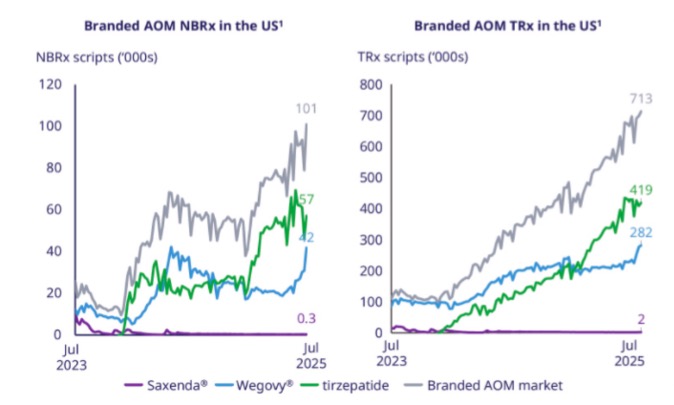
Core Viewpoint - The global weight loss drug market is undergoing significant restructuring, with Novo Nordisk's layoffs and strategic shifts indicating the end of its dominance and the rise of competition from other pharmaceutical companies, particularly in China [4][10][14]. Group 1: Novo Nordisk's Strategic Changes - Novo Nordisk plans to cut approximately 9,000 jobs globally, with around 5,000 in Denmark, as part of a resource reallocation strategy focusing on diabetes and obesity treatments [4][7]. - The company’s revenue from semaglutide exceeded $16 billion in the first half of the year, with annual sales expected to approach $40 billion, indicating a lucrative market despite internal challenges [7][8]. - Marketing missteps have led to market chaos in China, where semaglutide was initially marketed without a comprehensive strategy, resulting in misuse and regulatory scrutiny [8][9]. Group 2: Market Dynamics and Competition - The GLP-1 drug market is projected to exceed $70 billion, with significant growth anticipated in the Chinese market, where the obesity rate is rising [7][15]. - By 2030, the Chinese weight loss drug market is expected to reach nearly $25 billion, driven by increasing obesity rates and healthcare spending [15][16]. - Domestic players are entering the market, with over 20 semaglutide generics in clinical trials, indicating a shift towards a more competitive landscape [15][16]. Group 3: Challenges and Opportunities - The competitive landscape is characterized by the need for speed, patience, and differentiation among players, as the market becomes increasingly crowded [5][20]. - Novo Nordisk's challenges highlight the importance of effective marketing and understanding consumer needs, as well as the risks associated with drug development and safety [19][20]. - The potential for GLP-1 drugs extends beyond weight loss to other therapeutic areas, with a projected global market size of over $150 billion by 2031 [21][22].


趋势研判!2025年中国化疗药物行业全景速览:随着癌症患者人数不断增多,市场对化疗药物的需求持续增长,国内企业不断上市,市场竞争加剧[图]
Chan Ye Xin Xi Wang· 2025-09-28 01:32
Core Viewpoint - The chemotherapy drug market in China is experiencing growth due to increasing cancer patient numbers and rising consumer spending, despite competition from targeted therapies. Chemotherapy drugs remain dominant due to their stable efficacy, broad anti-cancer properties, and relatively low prices [1][4][5]. Group 1: Industry Overview - Chemotherapy drugs are a crucial method for cancer treatment, classified into various types such as alkylating agents, antimetabolites, and plant-derived anticancer drugs [2][3]. - The demand for chemotherapy drugs in China is projected to reach 3.858 billion units with a market size of 135.59 billion yuan in 2024, led by plant alkaloids and antimetabolites [5][6]. - The global chemotherapy drug market is expected to grow from 33.53 billion USD in 2024 to 36.84 billion USD in 2025, with the Asia-Pacific region holding a significant share [4][5]. Group 2: Market Dynamics - The Chinese chemotherapy drug market is characterized by a dual driving force of strong demand for certain drug types while facing pressure from generics and targeted therapies [5][10]. - The production of chemotherapy drugs in China is anticipated to increase to 3.432 billion units by 2025, reflecting a growth trend in domestic manufacturing capabilities [6][10]. - The competitive landscape is intensifying with local companies like Heng Rui Medicine and Qilu Pharmaceutical making significant strides in both generic and innovative drug development [10][11]. Group 3: Regulatory Environment - The Chinese government has implemented supportive policies to encourage the development of innovative cancer treatment drugs, providing a favorable environment for industry growth [8][9]. - The industry is witnessing accelerated drug approval processes and procurement policies that favor local manufacturers, enhancing competition [10][11]. Group 4: Future Trends - The chemotherapy drug sector is expected to evolve towards precision medicine, with advancements in targeted therapies and combination treatments [11]. - Innovations in drug delivery systems, such as nanotechnology, are anticipated to enhance treatment efficacy and patient outcomes [11].


丹麦巨头大裁员,掀开国产药千亿商机
Hu Xiu· 2025-09-27 02:12
Core Viewpoint - The recent layoffs at Novo Nordisk, which will affect approximately 9,000 positions globally, signal a significant shift in the weight-loss drug market, moving from a dominant position to a more competitive landscape where multiple players are emerging [1][3][19]. Group 1: Company Actions and Strategy - Novo Nordisk's layoffs are part of a broader strategy to reallocate resources towards diabetes and obesity treatment, indicating a transformation within the company [1][7]. - The company aims to save 8 billion Danish Kroner annually by 2026 through these layoffs, but the primary goal is to refocus on competitive areas rather than just cost-cutting [7][3]. - The layoffs come as Novo Nordisk faces increased competition from other pharmaceutical companies like Pfizer and Eli Lilly, which are investing heavily in next-generation weight-loss drugs [1][6]. Group 2: Market Dynamics and Competition - The GLP-1 drug market is projected to exceed $70 billion, with expectations of reaching a $100 billion market soon, driven by rising obesity rates and demand for effective treatments [3][11]. - In China, the obesity rate among adults is reported at 34.3%, with predictions that the number of overweight and obese individuals could exceed 500 million by 2030, leading to significant healthcare expenditures [11][12]. - The competitive landscape is shifting, with multiple Chinese companies entering the market, as the patent for semaglutide will expire in 2026, allowing for generic versions to emerge [12][13]. Group 3: Challenges and Risks - Novo Nordisk has faced marketing missteps, particularly in China, where it failed to effectively manage the off-label use of its diabetes drug for weight loss, leading to market chaos [4][5]. - The company has also struggled with supply issues in the U.S., losing exclusive supply rights for semaglutide due to underestimating market demand [6][5]. - The development pipeline for Novo Nordisk has been under scrutiny, with recent failures in new drug candidates raising concerns about its future competitiveness [6][15]. Group 4: Future Outlook - The GLP-1 market is entering a new phase, with expectations of diverse product offerings and increased competition, particularly from domestic players in China [11][12]. - The industry's growth potential is significant, with forecasts suggesting that the global market could surpass $150 billion by 2031 [18]. - Companies must navigate challenges related to safety, marketing, and strategic positioning to succeed in this evolving landscape [18][17].