康龙化成

Search documents
国内首款AI经皮穿刺导航机器人获批上市,医疗创新ETF(516820)红盘向上
Xin Lang Cai Jing· 2026-02-03 05:28
Core Viewpoint - The domestic AI-assisted medical technology is advancing, with significant developments in the approval of innovative medical devices and the application of AI in healthcare, indicating a potential for rapid growth in the AI+ healthcare market [1][2]. Group 1: Market Performance - As of February 3, 2026, the CSI Medical and Medical Device Innovation Index (931484) increased by 0.57%, with notable gains from stocks such as Aimeike (+4.07%), Jianfan Bio (+2.36%), and Xinhengcheng (+2.29%) [1]. - The Medical Innovation ETF (516820) also rose by 0.57%, with the latest price reported at 0.36 yuan [1]. Group 2: AI in Healthcare - AI applications in smart healthcare are becoming mature, particularly in medical imaging diagnostics, where AI assists doctors in improving interpretation efficiency [2]. - Recent AI medical products have accelerated their market entry, including the "Cervical Cell Digital Pathology Image Auxiliary Diagnosis Software" approved in January 2026 and the "Yuan Zhi" model from United Imaging, which achieved over 95% accuracy in complex lesion diagnosis [2]. - The combination of technological iteration and policy support is expected to drive rapid growth in the domestic AI+ healthcare market [2]. Group 3: Index Composition - The CSI Medical and Medical Device Innovation Index comprises 30 publicly listed companies with strong profitability, growth potential, and R&D innovation capabilities, reflecting the overall performance of profitable and growth-oriented medical and medical device companies [2]. - As of January 30, 2026, the top ten weighted stocks in the index include WuXi AppTec, Mindray Medical, and Hengrui Medicine, collectively accounting for 63.9% of the index [2].

医疗创新ETF(516820)连续12天净流入,政策持续助力医药产业发展
Xin Lang Cai Jing· 2026-02-03 03:27
Group 1 - The core viewpoint of the news highlights the positive performance of the medical innovation sector, with the CSI Medical and Medical Device Innovation Index showing mixed results among its constituent stocks, led by Aimeike with a 2.18% increase [1] - The Medical Innovation ETF has seen continuous net inflows over the past 12 days, with a peak single-day net inflow of 41.83 million yuan, totaling 234 million yuan, averaging 19.54 million yuan per day [1] - Policy support for the pharmaceutical industry is ongoing, with Shanghai accelerating the implementation of major industrial projects in fields such as integrated circuits, biomedicine, and artificial intelligence [1] Group 2 - The CSI Medical and Medical Device Innovation Index consists of 30 listed companies with good profitability, growth potential, and research innovation capabilities, reflecting the overall performance of profitable and growth-oriented pharmaceutical and medical device companies [2] - As of January 30, 2026, the top ten weighted stocks in the index include WuXi AppTec, Mindray Medical, and Heng Rui Medicine, accounting for 63.9% of the total index weight [2] - The success rate of Phase I clinical trials for dozens of AI-derived pipelines entering trials in 2025 is projected to be as high as 80%-90%, significantly exceeding traditional levels of 40%-65% [1]



财通证券:原料药板块有望周期性回升 创新链驱动第二增长曲线
智通财经网· 2026-02-03 01:24
炒股就看金麒麟分析师研报,权威,专业,及时,全面,助您挖掘潜力主题机会! 财通证券发布研报称,化学原料药PPI长期承压,行业经历低谷。随着上游成本上涨、政策驱动出清, 以及GLP-1口服小分子、小核酸等新药产业化趋势成熟,头部原料药企业凭借卡位MNC供应链的核心优 势,有望从周期股转向创新产业链,开启第二增长曲线。 财通证券主要观点如下: 化学原料药PPI指数长期承压 过去几年,原料药行业经历了艰难时期。各类产品价格下跌,其中沙坦类、肝素类、动保类等价格已跌 至历史低位,部分龙头企业甚至处于亏损阶段。同时,集采对化药制剂的降价效应逐渐传递到上游原 料,而致原料药利润率不断下降。化学原料药PPI指数长期承压。 原料药企业有望开启第二增长曲线 投资建议:关注头部中间体、原料药及CDMO企业,建议关注诚达药业、联化科技、药明康德、凯莱 英、九州药业、奥锐特、天宇药业、康龙化成、博腾股份等。 风险提示:商业化不及预期的风险;贸易摩擦的风险;产能提升不及预期的风险。 原材料价格及汇率上涨,反内卷政策有望驱动原料药行业加速出清,同时,新兴产业趋势走向成熟,原 料药企业有望开启第二增长曲线。由于石油化工相关上游原料价格有上 ...

创新链系列:中国创新药研发景气度渐趋改善,早研产业链或显著受益
Changjiang Securities· 2026-02-02 15:09
Investment Rating - The investment rating for the healthcare industry is "Positive" and maintained [14] Core Insights - The funding levels for Chinese innovative pharmaceutical companies are increasing, leading to a gradual improvement in the research and development (R&D) investment sentiment within the industry. This is expected to usher in a new cycle of prosperity for the innovative drug industry chain [5][12] - The trend of external business development (BD) is likely to benefit the domestic early-stage research industry significantly, as new business models allow early-stage projects to become tradable and monetizable assets, enhancing R&D investment returns [13] Summary by Sections Innovative Chain Development Review - Before 2020, multiple factors converged to initiate a significant rise in China's innovative drug sector, leading to the rapid development of the innovative chain, including CXO and life sciences services [10][30] - From 2020 to the first half of 2022, the global public health crisis accelerated capital inflow into the biopharmaceutical sector, resulting in high demand and a leap in the innovative chain segment, which also triggered a wave of IPOs and substantial supply-side expansion [10][39] - The second half of 2022 to 2024 saw a transition from a heated to a cooling phase, with a significant shift in supply-demand dynamics leading to industry internal competition and pressure on revenues and profit margins [10][54][57] Improvement in R&D Investment Sentiment - Starting from 2025, the R&D investment sentiment in China's innovative drug sector is expected to improve, with companies experiencing increased funding levels. The total amount raised through IPOs and additional offerings in 2025 is projected to reach 201.5 billion yuan, a 145% year-on-year increase [11][62] - The potential milestone payments from external BD are expected to reach 880.5 billion yuan in 2025, marking a 185.9% year-on-year increase, indicating a robust funding environment for innovative drug companies [11] Benefits to Early-stage Research Industry - The new external BD business model enhances the R&D investment return rates for Chinese innovative drug companies, thereby increasing their willingness to invest in R&D [11][13] - The early-stage research industry, including drug discovery CROs and clinical trial services, is expected to benefit significantly from the external BD trend, with leading companies in these segments poised for rapid growth [13]



2025年中国医药研发外包(CRO)行业龙头企业分析 药明康德:营收突破400亿元【组图】
Qian Zhan Wang· 2026-02-02 04:23
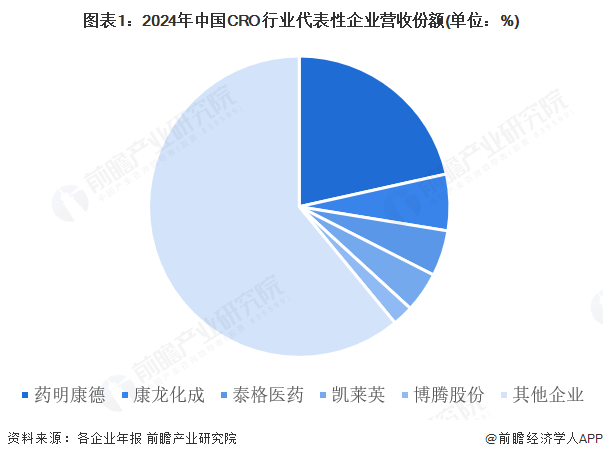
Core Insights - The report highlights the dominance of WuXi AppTec in the Chinese CRO market, holding nearly a quarter of the market share with a revenue of 29 billion yuan, significantly surpassing competitors like Kanglong Chemical and Tigermed [1] Group 1: Company Overview - WuXi AppTec was founded in 2000 in Wuxi, starting with basic chemical synthesis services and went public on the NYSE in 2007, marking its international expansion [3] - The company has integrated the entire industry chain from preclinical to commercialization through self-built production bases and cross-border acquisitions, becoming the absolute leader in China's CRO industry [3] Group 2: Revenue Growth - WuXi AppTec's revenue surged from 16.535 billion yuan in 2020 to 39.355 billion yuan in 2022, more than doubling in three years, with a continued high growth rate [6] - In 2023, the revenue exceeded 40 billion yuan, although a slight decline was observed in 2023-2024 due to the exit from COVID-19 commercialization projects, with revenues of 40.341 billion yuan and 39.241 billion yuan respectively [6] Group 3: Business Strategy - In 2024, WuXi AppTec's business layout is primarily focused on chemical services, generating 29.05 billion yuan, accounting for 74% of total revenue, with TIDES business revenue increasing by 70.1% to 5.8 billion yuan [8] - The company has a pipeline of 3,377 molecules, with laboratory analysis contributing 3.86 billion yuan and clinical CRO/SMO income at 1.81 billion yuan [8] Group 4: Global Positioning - WuXi AppTec is not only the leader in China's CRO industry but also ranks among the top globally, possessing significant international market influence [10] - The company aims to strengthen its global competitiveness by focusing on high-growth sectors like TIDES and CGT, while reducing non-core business activities [10]


华为云智慧医疗专区开放公测,医疗创新ETF(516820)连续11天净流入
Xin Lang Cai Jing· 2026-02-02 03:02
消息面上,2月1日,华为云正式宣布,"行业AI梦工厂"首个落地成果——智慧医疗专区亮相,同时,即 日起启动公开测试,率先开放健康管理与病理AI辅助诊断两大核心功能,面向广大医疗机构、医生及 大众开放服务与体验。该专区深度融合上海瑞金医院等顶尖医疗机构的临床经验与华为在云、AI及ICT 领域的技术积累,旨在构建一个端到端的AI赋能平台。 光大证券强调,在医保控费(DRG/DIP)与大模型技术奇点双重驱动下,AI已成为医疗新基建的核心 生产力;其中AI制药因能显著缩短研发周期、药企付费意愿最强,AI医学影像是当前落地最成熟的赛 道,而AI慢病管理和AI手术机器人则分别依托商业保险降本逻辑与医疗资源均衡逻辑,具备强国产化 替代潜力。未来竞争核心在于独家高质量私有数据与业务场景闭环能力。 医疗创新ETF紧密跟踪中证医药及医疗器械创新指数,中证医药及医疗器械创新指数从医药卫生行业的 上市公司中,选取30只盈利能力较好且具备一定成长性和研发创新能力的上市公司证券作为指数样本, 以反映兼具盈利性与成长性的医药及医疗器械上市公司证券的整体表现。 截至2026年2月2日 10:44,中证医药及医疗器械创新指数(931484)下 ...
中国手术机器人行业近况更新
2026-02-02 02:22
Summary of Key Points from Conference Call Records Industry Overview - **Surgical Robot Industry**: The Chinese surgical robot industry is experiencing rapid development, supported by national policies and capital investment. Key technological advancements include remote operation, miniaturization, and AI assistance. The market for laparoscopic surgical robots is projected to reach 40.543 billion yuan by 2033, with a CAGR of 28.7% from 2024 to 2033 [doc id='21'][doc id='19']. Core Insights and Arguments - **Investment Opportunities in Innovative Drugs and CRO**: Despite past challenges, investment activity in innovative drugs and Contract Research Organizations (CRO) is expected to rise significantly. Business development (BD) amounts are anticipated to reach new highs, with companies like Rongchuang and Shiyao achieving attractive upfront payment ratios [doc id='3'][doc id='4']. - **Medical Device Sector Recovery**: The medical device sector is nearing the end of its inventory destocking phase, with performance expected to improve gradually in 2026. The resumption of procurement rhythms and an increase in bidding volumes are noted trends [doc id='5']. - **IVD Sector Outlook**: The In Vitro Diagnostics (IVD) sector is expected to face pressure in 2025, but conditions are projected to improve in 2026 as pricing pressures ease and policies are fully implemented [doc id='8'][doc id='9']. - **Traditional Chinese Medicine (TCM) Recovery**: The TCM sector is anticipated to bottom out in Q2 2026, with a potential recovery in 2027 driven by policy support and demand resurgence [doc id='10']. Additional Important Insights - **AI Medical and Brain-Computer Interface Technologies**: AI in healthcare is crucial for enhancing productivity, though its commercialization path remains uncertain. The brain-computer interface sector shows promise but also faces commercialization challenges [doc id='6']. - **CRO Sector Performance**: The CRO sector is showing strong order and operational performance, with companies like Kanglong Huacheng making significant progress in commercial production [doc id='11']. - **Market Dynamics for Surgical Robots**: The market for surgical robots is transitioning from an introduction phase to a growth phase, with increasing sales but slower revenue growth, indicating a structural transformation [doc id='19']. - **Regulatory Developments**: The National Medical Insurance Administration's guidelines are expected to accelerate the clinical application of surgical robots by establishing legitimate billing items [doc id='19']. Company-Specific Highlights - **Shiyao Group and AstraZeneca Collaboration**: The collaboration in the weight loss and metabolism field has set historical highs for upfront payments and total package amounts, although the overall sentiment in the sector remains subdued [doc id='7']. - **Kanglong Huacheng's Growth**: The company is expected to see a significant increase in order retention rates with the launch of its Shaoxing Phase II project, enhancing its competitive position in the CRO market [doc id='12']. - **Emerging Companies**: Companies like Tianyu and Starly are projected to enter performance inflection points this year, with significant growth potential in the raw material pharmaceutical sector [doc id='13'][doc id='14']. This summary encapsulates the key points from the conference call records, highlighting the current state and future outlook of various sectors within the healthcare and pharmaceutical industries in China.
CXO行业系列专题报告(3):小核酸突围,大服务赋能
Guoxin Securities· 2026-02-01 07:44
Investment Rating - The report maintains an "Outperform" rating for the industry [1] Core Insights - The small nucleic acid drug market is experiencing robust growth, transitioning from technology validation to accelerated commercialization, with a global market size increasing from $2.7 billion in 2019 to $4.6 billion in 2023, and projected to reach $45.7 billion by 2033, reflecting a CAGR of 26.08% [2][39] - The small nucleic acid CXO sector is benefiting from technological breakthroughs and commercialization acceleration, establishing a comprehensive CRDMO service system [2] - Key players in the small nucleic acid field include CROs with core technologies and rich project experience, such as Chengdu XianDai and Kanglong Chemical, and CDMOs with leading production capabilities like WuXi AppTec and Kailai Ying [2] Summary by Sections 1. Small Nucleic Acid Drugs - Small nucleic acid drugs encompass various types, including ASO, siRNA, and aptamers, which target gene expression for disease treatment [11][12] - These drugs offer advantages such as shorter development cycles, broad therapeutic areas, sustained efficacy, and higher success rates compared to traditional drugs [15][16] 2. Market Expansion and BD Activity - The small nucleic acid market is expanding, with significant BD transactions occurring, including a $9 billion collaboration between Wobang Pharmaceutical and Novartis, and a $2 billion platform authorization between Rebio and Boehringer Ingelheim [48] - Domestic companies are actively developing drugs targeting hyperlipidemia, hypertension, and hepatitis B, with notable progress in clinical stages [45][47] 3. CXO Empowerment in Small Nucleic Acid R&D - The CXO industry is crucial for supporting the R&D and production of small nucleic acid drugs, with a focus on enhancing delivery technologies and chemical modifications to improve drug stability and efficacy [22][26]




外资CDMO纷纷易手,它们在华消失殆尽了
Di Yi Cai Jing Zi Xun· 2026-01-30 14:48
Core Viewpoint - The CDMO (Contract Development and Manufacturing Organization) business of multinational companies in China is not just shrinking but appears to be disappearing, with only a few remaining players like Boehringer Ingelheim still operating in the market [2][10]. Group 1: Current State of CDMO in China - The CDMO business in China has seen a significant decline, with major players like Lonza and Thermo Fisher Scientific facing operational challenges and even selling their facilities [5][6][8]. - Boehringer Ingelheim remains one of the few foreign CDMO companies still active in China, primarily due to securing a contract for the production of BeiGene's PD-1 drug [10]. - The CDMO market in China is experiencing a transformation, with many foreign companies exiting or downsizing their operations due to insufficient orders and market conditions [7][10]. Group 2: Market Dynamics and Trends - The implementation of the 2019 Drug Administration Law in China marked a turning point for the CDMO market, allowing for a separation of production and marketing licenses, thus lowering barriers for research-focused pharmaceutical companies [12]. - Despite the advantages of a large workforce and lower costs in China, many foreign CDMO companies have struggled to establish a foothold due to high pricing models that do not align with local market conditions [13][14]. - The Chinese CDMO market has grown significantly, with a compound annual growth rate of 39.9% from 2018 to 2023, increasing from 16 billion RMB to 85.9 billion RMB, and is expected to reach 208.4 billion RMB by 2028 [16]. Group 3: Future Outlook - Domestic CDMO companies are increasingly matching or surpassing the capabilities of foreign counterparts, offering higher efficiency and lower prices, which positions them favorably in the market [16][17]. - The evolution of the Chinese CDMO industry has transitioned from reliance on foreign technology and policy support to a focus on technological development and global capacity expansion [16].

外资CDMO纷纷易手,它们在华消失殆尽了 | 海斌访谈
Di Yi Cai Jing· 2026-01-30 13:39
Core Insights - The CDMO (Contract Development and Manufacturing Organization) business of multinational companies in China is experiencing significant decline, with many exiting the market entirely [1][8] - The Chinese CDMO market is growing rapidly, with a compound annual growth rate of 39.9% from 2018 to 2023, and is expected to reach 208.4 billion RMB by 2028 [16] Group 1: Multinational CDMO Operations in China - Multinational companies like Lonza, Thermo Fisher, and Merck have faced challenges in their CDMO operations in China, with many either closing facilities or selling them off [4][5][6] - Lonza's Guangzhou factory, which was operational for only three years, was sold to a local company due to insufficient orders [4] - Thermo Fisher's factory in Hangzhou is struggling with low order volumes, and its future remains uncertain [5][6] Group 2: Local CDMO Developments - Zhaoyan Biotech's new manufacturing base in Guangzhou, which focuses on large molecule CDMO, signifies a strategic move to enhance capacity and create a collaborative platform for biopharmaceutical innovation in Southeast Asia [3] - Local companies are increasingly building their own production capabilities, reducing reliance on foreign CDMO services [14] Group 3: Market Dynamics and Trends - The introduction of the MAH (Marketing Authorization Holder) system in 2019 has lowered production barriers, allowing more companies to utilize CDMO services [11] - Despite the advantages of a large workforce and lower costs, foreign CDMOs have struggled to establish a foothold in China due to high pricing models that do not align with local market conditions [12][13] - The efficiency and cost-effectiveness of Chinese CDMOs are becoming competitive with their foreign counterparts, leading to a shift in market dynamics [15][16]