三峡能源

Search documents
外资看好中国储能发展,新能源ETF(159875)早盘一度冲高涨近2%,成分股湘电股份10cm涨停
Xin Lang Cai Jing· 2025-09-23 03:23
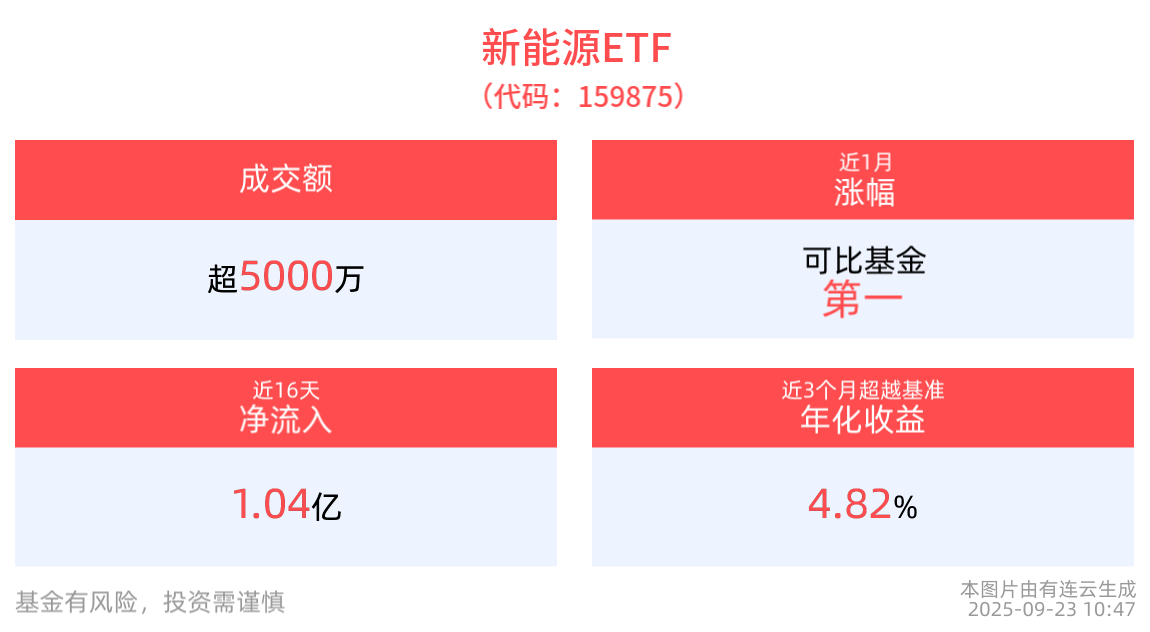
Group 1: Market Performance - The New Energy ETF has a turnover rate of 5.17% and a transaction volume of 58.64 million yuan [2] - As of September 22, the New Energy ETF's latest scale reached 1.118 billion yuan, with a total inflow of 104 million yuan over the past 16 trading days [2] - The net value of the New Energy ETF has increased by 59.51% over the past year [2] - The highest monthly return since inception was 25.07%, with the longest consecutive monthly increase being 4 months and a maximum increase of 31.31% [2] - The average return during the increasing months is 8.03%, and the annualized return over the past 3 months has exceeded the benchmark by 4.82% [2] Group 2: Industry Outlook - Foreign capital is optimistic about the development of energy storage in China, with Citigroup raising its forecast for global energy storage system (ESS) demand from 177.8 GWh in 2024 to an estimated 360.2 GWh by 2027, representing a compound annual growth rate of 26.5% [2] - The forecast for 2025 indicates a year-on-year growth of 37% to 243.7 GWh [2] - The Ministry of Industry and Information Technology has released a roadmap for the development of new energy storage technologies from 2025 to 2035, focusing on five key areas: electrochemical storage, mechanical storage, electromagnetic storage, thermal storage, and hydrogen storage [3] - Domestic energy storage system bidding has seen a significant increase, with a capacity of 47.2 GWh in August 2025, marking a year-on-year increase of 2158% and a month-on-month increase of 1142% [3] - Cumulative bidding for energy storage systems reached 144.1 GWh in the first eight months of this year, reflecting a year-on-year growth of approximately 216% [3] Group 3: Stock Performance - The top ten weighted stocks in the China Securities New Energy Index include CATL, Sungrow Power, Longi Green Energy, China Nuclear Power, and others, accounting for a total of 42.78% [6]







储能+电池概念齐发力,新能源ETF(516160)盘中涨近2%,湘电股份涨停,全球进入电力设备需求上行周期
Xin Lang Cai Jing· 2025-09-23 02:21
Group 1 - The New Energy ETF (516160) has increased by 1.72% with a transaction volume of 111 million yuan as of September 23, 2025, and the CSI New Energy Index has risen by 1.78% [1] - The New Energy ETF has seen a growth of 663 million yuan in scale since the beginning of September 2025, with a total of 145 million yuan attracted over the last 16 trading days [1] - The CSI New Energy Index has recorded a year-to-date increase of over 27%, while related funds like the Southern CSI Battery Theme Index have exceeded 50% growth this year, outperforming their benchmark [1] Group 2 - Global demand for electric equipment is entering an upward cycle, with global grid investment expected to exceed 400 billion USD in 2025, driven by AI and increasing electricity demand [2] - The transformer market in the US is experiencing strong demand, with high transformer price indices, and Middle Eastern demand for transformers is growing rapidly, leading to significant orders for Chinese companies [2] - The New Energy ETF closely tracks the CSI New Energy Index, which includes companies involved in renewable energy production, application, storage, and interaction devices [2]
和谐健康保险年内多次减持上市公司股份,自2017年起年报持续“暂缓披露”
Sou Hu Cai Jing· 2025-09-22 14:22
Core Viewpoint - Harmony Health Insurance has been reducing its holdings in several listed companies due to its operational needs, while its financial disclosures remain outdated, raising concerns about transparency and governance [2][11]. Group 1: Shareholding and Reduction Activities - Harmony Health Insurance has reduced its stake in Goldwind Technology by 8.77 million shares, with the latest reduction occurring on September 12, 2025 [2]. - The company plans to reduce its holdings in Wanda Information by up to 3% over the next three months, which would lower its stake to below 2% [2]. - Since March 2023, Harmony Health Insurance has made multiple reductions in its holdings of Goldwind Technology, totaling approximately 4.71 billion yuan [5]. Group 2: Financial Performance and Reporting - The company has not disclosed its annual report since 2016, and its solvency report is only updated to the first quarter of 2017, leading to a lack of clarity regarding its current operational status [2][9]. - As of 2024, Harmony Health Insurance reported total assets of 452.05 billion yuan, a year-on-year increase of 7.64%, and operating revenue of 75.33 billion yuan, up 30.27% year-on-year [9][10]. - The company has shifted its product strategy to focus on regular premium products, which has begun to show positive results in its operational performance [10]. Group 3: Management and Governance - Following a change in shareholders in 2020, the company has been under a transitional period, which has now ended, yet it still has not published key operational reports [9][11]. - The management structure remains unsettled, with several key positions still filled temporarily, indicating potential instability in governance [10][11]. - The company has approved a strategic development plan for 2025-2027, which aims to enhance its operational framework and investment strategies [10].


申万公用环保周报(25/09/15~25/09/19):8月发电量创同期新高全球气价窄幅震荡-20250922
Shenwan Hongyuan Securities· 2025-09-22 12:07
Investment Rating - The report does not explicitly state an investment rating for the industry Core Views - The report highlights that in August 2025, the average daily power generation exceeded 30 billion kilowatt-hours for the first time, with a total industrial power generation of 936.3 billion kilowatt-hours, reflecting a year-on-year growth of 1.6% [4][7][53] - The report emphasizes the continuous improvement in the power generation structure, with significant contributions from clean energy sources such as wind and solar power, amidst ongoing dual carbon policies and the development of a new power system [8][9][12] Summary by Sections 1. Power Generation - In August 2025, the total power generation reached 936.3 billion kilowatt-hours, with a daily average of 30.2 billion kilowatt-hours, marking a 1.6% increase year-on-year [4][7] - The breakdown of power generation types shows that thermal power generation increased by 1.7%, nuclear power by 5.9%, wind power by 20.2%, and solar power by 15.9%, while hydropower decreased by 10.1% [9][12] - Wind power contributed the most to the increase in power generation, adding 12.4 billion kilowatt-hours compared to the same month last year [8][9] 2. Natural Gas - The report indicates a stable supply-demand balance in the natural gas market, with global gas prices experiencing slight fluctuations [18][19] - As of September 19, 2025, the Henry Hub spot price was $2.89/mmBtu, reflecting a weekly decrease of 1.80% [19][21] - The report suggests that the LNG prices in Northeast Asia remained stable at $11.50/mmBtu, with expectations of a further decline in prices as summer heat waves end [18][35] 3. Investment Analysis - Recommendations for investment include: - Hydropower: Favorable financial conditions due to interest rate cuts, with suggested companies being Guotou Power, Chuan Investment Energy, and Yangtze Power [16] - Green Energy: Increased stability in returns for renewable energy operators, with a focus on companies like Xintian Green Energy and Longyuan Power [16] - Nuclear Power: Continued approval of new units, with recommendations for China Nuclear Power and China General Nuclear Power [16] - Thermal Power: Improved profitability due to falling coal prices, with recommendations for Guodian Power and Huaneng International [16] - Gas Utilities: Favorable conditions for city gas companies, with recommendations for Kunlun Energy and New Hope Energy [40]




申万公用环保周报(25/09/15~25/09/19):8月发电量创同期新高,全球气价窄幅震荡-20250922
Shenwan Hongyuan Securities· 2025-09-22 09:16
Investment Rating - The report maintains a positive outlook on the power and gas sectors, indicating a favorable investment environment for these industries [4]. Core Insights - In August, the average daily power generation exceeded 30 billion kilowatt-hours for the first time, with total industrial power generation reaching 936.3 billion kilowatt-hours, a year-on-year increase of 1.6% [9][57]. - The report highlights the continued growth of thermal power and the significant contribution of renewable energy sources, particularly wind and solar power, to the overall power generation increase [10][11]. - Global gas prices are experiencing narrow fluctuations, with a stable supply-demand balance in the market, particularly in the U.S. and Europe [20][29]. Summary by Sections 1. Power Generation - In August, the total power generation was 936.3 billion kilowatt-hours, with a daily average of 30.2 billion kilowatt-hours, marking a 1.6% increase year-on-year [9][57]. - The breakdown of power generation types shows thermal power at 6,274 billion kilowatt-hours (up 1.7%), hydropower at 1,479 billion kilowatt-hours (down 10.1%), nuclear power at 645 billion kilowatt-hours (up 5.9%), wind power at 738 billion kilowatt-hours (up 20.2%), and solar power at 538 billion kilowatt-hours (up 15.9%) [11][58]. - The report emphasizes the strong growth of renewable energy, with wind and solar power showing significant year-on-year increases of 20.2% and 15.9%, respectively [10][11]. 2. Natural Gas - As of September 19, the Henry Hub spot price was $2.89/mmBtu, reflecting a weekly decrease of 1.80%, while the TTF spot price in Europe remained stable at €32.00/MWh [20][21]. - The report notes that U.S. natural gas production remains high, contributing to a stable supply-demand balance and low price fluctuations [23][29]. - The LNG ex-factory price in China was 4,019 yuan/ton, with a weekly decrease of 0.84%, indicating a softening market due to weak domestic demand [41][44]. 3. Investment Recommendations - For hydropower, the report recommends companies like Guotou Power, Chuan Investment Energy, and Yangtze Power due to stable growth and financial benefits from interest rate cuts [18]. - In the renewable energy sector, companies such as Xintian Green Energy and Funi Co. are highlighted for their stable returns and high profitability [18]. - The report suggests focusing on integrated natural gas traders like New Hope Energy and Shenzhen Gas, as well as city gas companies benefiting from cost reductions [44].
绿动中国五年路 能源答卷映初心——我国能源行业绘就降碳减污扩绿新图景
Zhong Guo Dian Li Bao· 2025-09-22 07:51
Group 1: Core Insights - China aims to peak carbon emissions before 2030 and achieve carbon neutrality by 2060, as announced by President Xi Jinping [1] - The country has built the world's largest and fastest-growing renewable energy system, with one-third of electricity consumption coming from green energy [1] Group 2: Energy Structure Transformation - China's energy structure is transitioning from coal-dominated to a diversified and cleaner model, with a multi-energy complementary system forming [3] - The share of coal-fired power generation capacity and output has decreased by 13.5 percentage points and 4.7 percentage points, respectively, over the past four years [3] Group 3: Renewable Energy Development - The share of renewable energy generation capacity has increased from 40% to around 60% in the past five years, with wind and solar power installations reaching unprecedented levels [4] - Significant advancements in power grid construction have been made, including the ±800 kV Hami-Chongqing HVDC project and the world's largest clean energy base transmission project [4] Group 4: Technological Innovation - Energy companies have focused on key areas to enhance core technology and equipment, achieving significant breakthroughs in self-developed technologies [6] - The installed capacity of new energy storage has grown nearly 30 times in five years, reaching approximately 95 million kilowatts [6] Group 5: Hydrogen Energy Development - The hydrogen energy industry is gradually maturing, with projects like the "electric-hydrogen coupling" bus system and green hydrogen production initiatives [7] - By 2024, China's hydrogen production and consumption scale is expected to exceed 36 million tons, leading the world [7] Group 6: Ecological and Energy Synergy - Energy companies are integrating energy development with ecological protection and rural revitalization, enhancing economic, environmental, and social benefits [9] - Projects like "photovoltaic + ecology" and clean heating initiatives have significantly improved local environments and community well-being [9] Group 7: Overall Progress - The energy sector has undergone a profound green transformation, demonstrating the principle that "lucid waters and lush mountains are invaluable assets" [10] - The commitment to continue advancing in the dual carbon era is evident, with a focus on innovation and practical actions [10]
储能有望实现行业竞争格局优化,新能源ETF(159875)蓄势调整,帝尔激光领涨成分股
Xin Lang Cai Jing· 2025-09-22 05:45
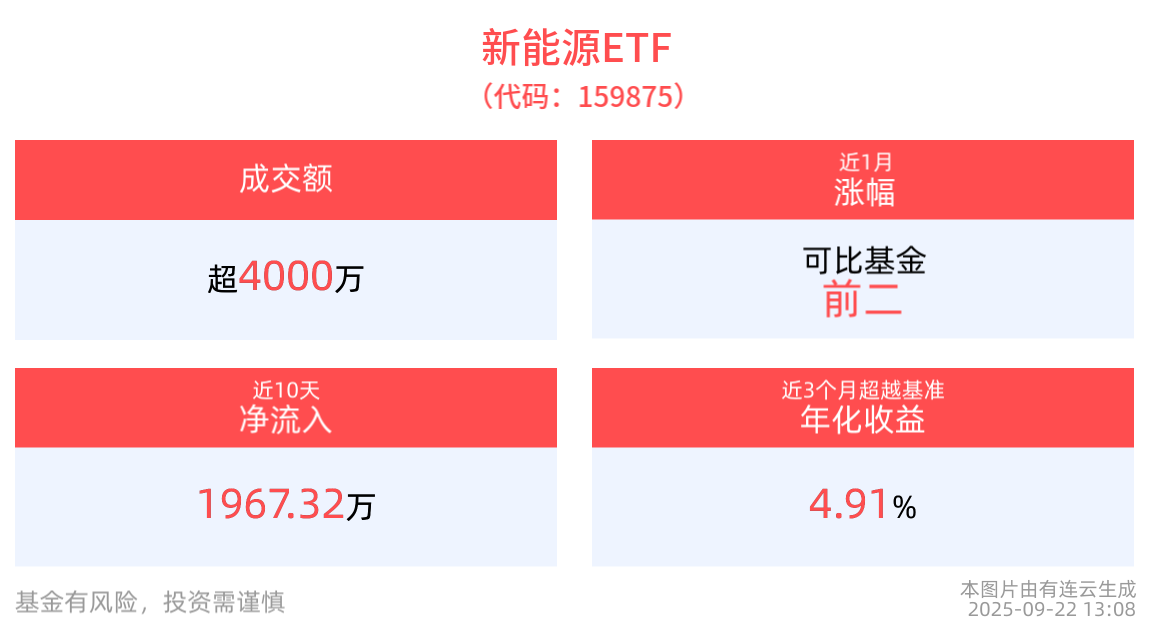
Group 1: Market Performance - The New Energy ETF has a turnover rate of 3.85% during trading, with a transaction volume of 43.23 million yuan [2] - As of September 19, the New Energy ETF's latest scale reached 1.129 billion yuan, with a total inflow of 19.67 million yuan over the last 10 trading days [2] - The New Energy ETF's net value has increased by 58.12% over the past year [2] Group 2: Investment Opportunities - The highest monthly return since the inception of the New Energy ETF was 25.07%, with the longest consecutive monthly increase lasting 4 months and a maximum increase of 31.31% [2] - The average return during the months of increase is 8.03% [2] - The global push for "carbon neutrality" positions the development of new energy as a long-term strategic direction, with China aiming for peak carbon emissions by 2030 and carbon neutrality by 2060 [2] Group 3: Industry Trends - Despite high market penetration of new energy vehicles, there remains significant potential for replacing traditional fuel vehicles based on ownership ratios [2] - The energy storage market is experiencing explosive growth, crucial for addressing the intermittency issues of wind and solar power generation, with domestic energy storage bidding volumes in August showing several-fold year-on-year growth [2] - According to Shenwan Hongyuan, the short-term focus remains on event-driven themes and price increase themes, while the medium-term outlook is optimistic for a structural bull market, particularly in the photovoltaic sector [3] Group 4: Company Performance - As of August 29, 2025, the top ten weighted stocks in the China Securities New Energy Index include CATL, Sungrow, Longi Green Energy, China Nuclear Power, and others, collectively accounting for 42.78% of the index [5] - Notable stock performances include CATL with a slight decline of 0.18% and Sungrow with an increase of 0.80% [5]





电力现货市场建设迈入关键阶段,央企现代能源ETF(561790)回调蓄势
Xin Lang Cai Jing· 2025-09-22 05:34
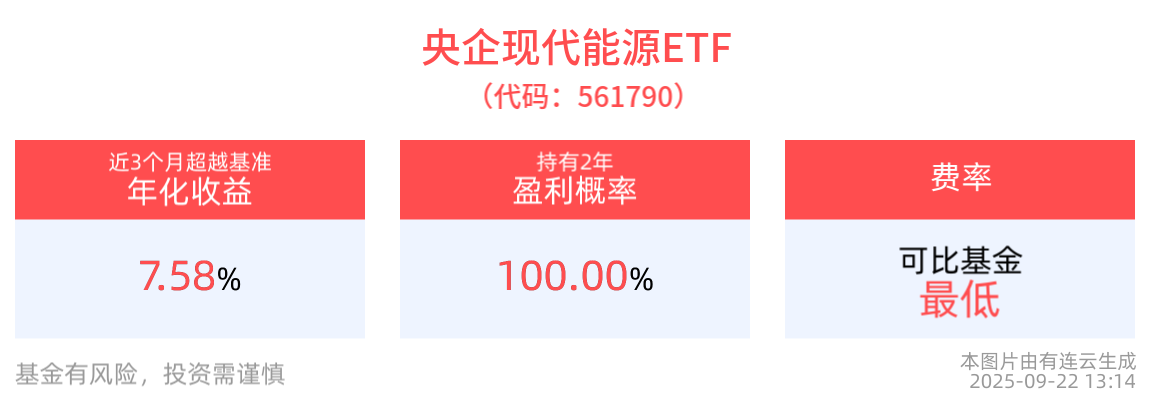
Core Insights - The China Securities National New State-Owned Enterprises Modern Energy Index has decreased by 0.56% as of September 22, 2025, with mixed performance among constituent stocks [3] - The Central State-Owned Enterprises Modern Energy ETF (561790) has seen a decline of 0.79%, with a latest price of 1.14 yuan, while it has increased by 0.97% over the past month [3][4] - The electricity spot market in China has begun to show its guiding role in the consumption of renewable energy, with inter-provincial spot market transactions of renewable energy reaching 7.75 billion kilowatt-hours, accounting for 36.5% of total transactions in the first eight months of the year [3] Market Development - The construction of the electricity spot market in China has entered a critical phase, with seven provincial-level spot markets officially operational as of August this year [4] - A multi-layered system is proposed for the future, including an energy market, capacity market, and ancillary services market to ensure long-term supply capabilities and reasonable returns for flexible resources [4] Index Composition - As of August 29, 2025, the top ten weighted stocks in the China Securities National New State-Owned Enterprises Modern Energy Index account for 48.28% of the index, including companies like Yangtze Power and China Nuclear Power [5]
广东136号文正式发布,藏粤直流特高压开工
Soochow Securities· 2025-09-22 05:24
Investment Rating - The report maintains an "Overweight" rating for the utility sector [1] Core Views - The report emphasizes investment opportunities in hydropower and thermal power as summer approaches, highlighting specific companies to watch [2] - The approval of new nuclear power units is expected to accelerate growth and enhance profitability and dividends for key nuclear power companies [2] - The launch of the Tibet-Guangdong DC transmission project is a significant development, expected to deliver over 43 billion kWh of clean energy annually to the Guangdong-Hong Kong-Macao Greater Bay Area by 2029 [5] Summary by Sections 1. Electricity Consumption - In the first seven months of 2025, total electricity consumption reached 5.86 trillion kWh, a year-on-year increase of 4.5%, with growth rates improving across all sectors [14] 2. Power Generation - Cumulative power generation for the first seven months of 2025 was 5.47 trillion kWh, reflecting a year-on-year increase of 1.3% [24] - Thermal power generation decreased by 1.3%, while wind and solar power saw increases of 10.4% and 22.7%, respectively [24] 3. Electricity Prices - The average electricity purchase price in June 2025 was 389 RMB/MWh, down 1% year-on-year and 1.3% month-on-month [37] 4. Coal Prices - As of September 19, 2025, the price of thermal coal at Qinhuangdao port was 704 RMB/ton, down 18.61% year-on-year but up 24 RMB/ton week-on-week [44] 5. Hydropower - The Three Gorges Reservoir's water level was 163 meters as of September 19, 2025, with inflow and outflow rates significantly higher than previous years, indicating a healthy water situation [52] 6. Installed Capacity - As of June 30, 2025, China's thermal power installed capacity reached 1.47 billion kW, with a year-on-year increase of 4.7% [46]


负荷为王,风电开发投资的逻辑变了!
Sou Hu Cai Jing· 2025-09-22 03:16
Core Viewpoint - The investment logic in the wind power sector is shifting from "building where the wind is strong" to "building where the electricity is consumed," marking a new era focused on load demand [1][10]. Group 1: Policy Changes - The issuance of Document No. 136 is a watershed policy for the wind power industry, breaking the previous fixed-price model and requiring that all renewable energy project output enter the electricity market for price formation [3][6]. - A new "price difference settlement mechanism" has been established, providing compensation when market prices fall below the mechanism price and deducting the difference when they exceed it, favoring projects near load centers [3][6]. - The green electricity direct connection policy encourages investment in projects that allow direct transactions between power producers and large electricity consumers, reducing losses and increasing negotiation space for electricity prices [3][4]. Group 2: Regional Policy Implementation - Various local policies emphasize a "load priority" approach, supporting green electricity connections for high-energy-consuming industries like aluminum and silicon photovoltaic projects [4]. - Policies in regions like Inner Mongolia and Jiangsu are designed to connect wind power projects directly with high-energy industries, promoting integrated demonstration projects [4]. Group 3: Market Dynamics - The marketization of wind power pricing has been in the making since 2019, with a significant shift expected in 2025, where project revenues will depend on market prices rather than government-set prices [6][10]. - The disparity in wind power revenue across regions is increasing, with resource-rich areas facing price pressures due to limited local demand, while load centers can achieve higher prices through local electricity markets [6][10]. Group 4: Investment Trends - Wind power companies are increasingly focusing on load centers, as seen in recent investments aimed at integrating wind power with high-energy industries and data centers [7][10]. - Projects like the one by Goldwind in Inner Mongolia aim to convert wind power directly into industrial raw materials, addressing consumption issues [7][10]. - The trend indicates a shift towards projects that are closely linked to industrial parks and data centers, which are seen as ideal partners for wind power due to their stable electricity demand [9][10].