韵达股份

Search documents
“反内卷”效果持续,多个电商重镇快递涨价
Xuan Gu Bao· 2025-08-24 23:19
因此,从成本端看,若后续快递小哥全员缴纳社保后,快递加盟商的成本增加,经营压力进一步提升, 而反内卷推动下的涨价将覆盖加盟商的新增社保成本,此次反内卷推动下的提价也具备一定的持续性。 各主要快递上市公司业绩弹性大。 公司方面,据国泰君安表示,核心公司主要包括顺丰控股圆通速递、中通速递、韵达股份。 *免责声明:文章内容仅供参考,不构成投资建议 点评:今年7月,国家邮政局先后召开党组会议及快递企业座谈会,明确提出治理行业内卷式竞争。 国泰海通认为,此轮"反内卷"自上而下将继续深化,后续多地或跟进治理。"反内卷"短期将缓和竞争压 力,更重要的是中长期继续保障良性竞争,有利于行业自然集中。 国盛证券表示,从需求端来看,此次反内卷效果具有一定持续性。最高人民法院强调依法参加社保是法 定义务,新规自9月1日起施行。以每人日均派件500票、按各地标准缴纳社保测算快递小哥全员缴纳社 保后,对单票的平均影响在6分钱。 据红星新闻8月24日报道,电商重镇广东、浙江多家快递公司目前已对电商客户涨价。 其中广东是重点调价地区,每件调价幅度在0.3元至0.7元之间,同时还设定1.4元/单的底线价。有业内 人士表示,广东地区贡献了快递公 ...



股市热度下反内卷板块的机会展望
2025-08-24 14:47
Summary of Key Points from Conference Call Records Industry Overview - The petrochemical industry is facing a new round of policy adjustments, with refineries under 2 million tons potentially being eliminated and older facilities over 20 years old undergoing adjustments, which will constrain domestic capacity utilization [1][2][3] - The petrochemical sector has entered a downward cycle since the second half of 2022, with significant declines in safety investments and capital expenditures [1][4] - The China Chemical Industry Index PB percentile is at historical lows, and leading companies like Wanhua, Hualu, and Yangnong are expected to see significant gains in the next year and a half due to favorable policies [1][6] Policy Impacts - The recent policies targeting the petrochemical industry began in July 2023, focusing on assessing and potentially shutting down or upgrading older capacities [2][3] - The actual capacity ceiling is between 950 million to 1 billion tons, with small refineries (under 2 million tons) accounting for approximately 35 to 40 million tons, which may be eliminated [3] - The coal sector is also affected by stricter production limits, with coal prices expected to fluctuate between 650-750 RMB depending on policy enforcement [1][8] Market Dynamics - The aluminum and copper sectors are experiencing accelerated industrial upgrades due to the cancellation of export tax rebates, with demand from AI driving up processing fees for certain copper products [1][16][17] - The express delivery industry has seen significant price increases, particularly in Guangdong, where average prices rose by about 0.5 RMB, which is expected to enhance profitability for major express companies [1][19] Economic Indicators - The dovish stance of the Federal Reserve has raised expectations for interest rate cuts, which is likely to lead to price increases for upstream resources like copper, aluminum, and gold [1][18] - Recent macroeconomic indicators such as M1 and M2 growth rates have rebounded, driven by increased demand for currency exchange and a high trade surplus [1][24] Investment Outlook - The petrochemical sector is expected to enter an upward trend, with leading companies likely to benefit from upcoming policy support [1][6] - The coal sector's profitability will depend on the strictness of policy enforcement regarding production limits [1][8] - The express delivery sector's price increases are anticipated to provide substantial earnings elasticity for listed companies [1][19] Additional Insights - The complexity of the current capacity reduction differs from previous supply-side reforms, as many capacities are relatively new and require more coordination among local governments and ministries [1][7] - The overall market liquidity is expected to increase, benefiting various asset classes, although the stock market may experience some marginal outflows to the bond market [1][27]
快递涨价背后:告别“价格战”,走向可持续发展新阶段
Sou Hu Cai Jing· 2025-08-24 13:45
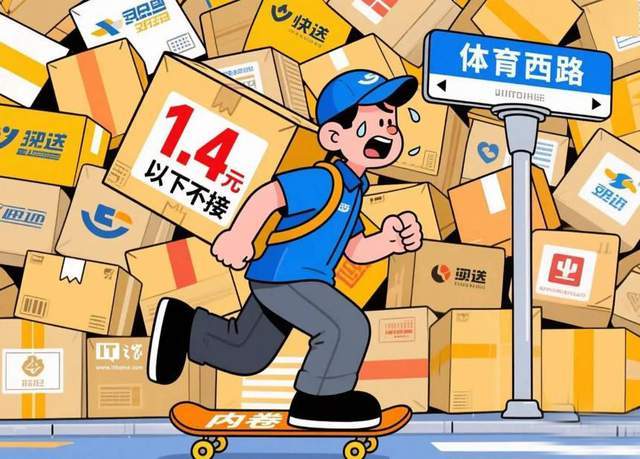
近日,广东、浙江等多地快递企业相继调高电商客户发货价格,每票上涨0.3元至0.7元,并设立1.4元/ 单的"底线价格"。这一变动虽看似微小,却折射出中国快递行业正在从持续多年的"价格战"中逐步抽 身,迈向更加理性、可持续的发展阶段。 本次调价并非单纯的市场行为,而是在国家邮政局明确反对"内卷式竞争"的政策背景下推进的结构性调 整。快递行业长期陷于恶性价格竞争,尤其是以"通达系"为代表的加盟制企业,在单量考核机制驱动 下,甚至出现"0.8元发全国"的亏损价。这种模式虽短期内助推电商繁荣,却严重侵蚀快递网点与快递 员的合理收益,最终损害的是整个生态的健康与服务质量。 从宏观视角看,此次涨价释放出几个重要信号: 一是政策调控开始见效。政府通过会议与座谈明确传递"反内卷"导向,推动企业从"以价换量"转向"以 质取胜"。这说明在平台经济强化监管的整体环境中,快递作为基础设施行业,其定价机制和竞争秩序 已进入国家层面的视野。 二是行业正在寻求成本与服务的再平衡。1.4元/单的底线价被业内视为"不亏本"的红线,这也反映出快 递企业正试图扭转"量增价跌"的畸形局面。尽管短期内电商商家面临成本上升压力——如文中所述,有 商家月 ...

粤浙快递费上涨,商家月增3万成本
3 6 Ke· 2025-08-24 12:09
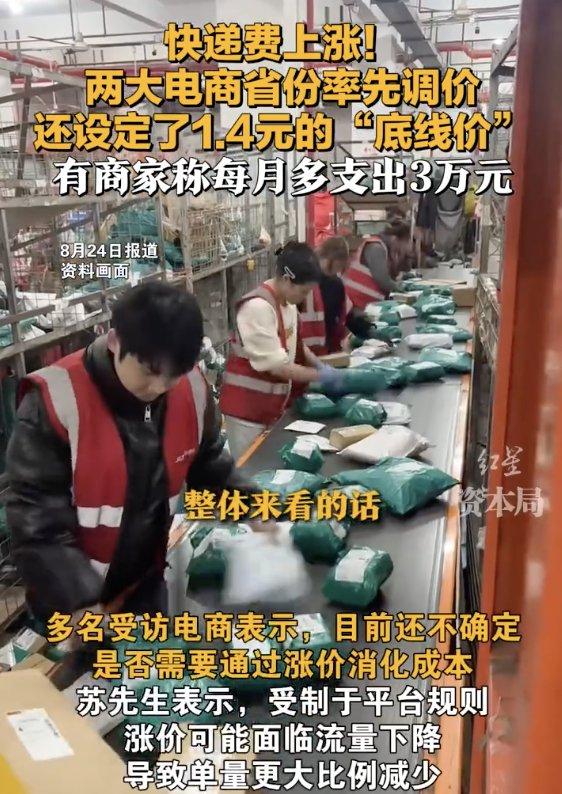
Core Viewpoint - Recent price increases in express delivery services in multiple regions, particularly in Guangdong and Zhejiang, are impacting e-commerce costs significantly, with some businesses reporting an additional monthly expense of at least 30,000 yuan due to these changes [1]. Group 1: Price Increases - Several express delivery companies in Guangdong and Zhejiang have raised prices for e-commerce clients, with price adjustments ranging from 0.3 to 0.7 yuan per package [1]. - Guangdong is identified as a key area for these price hikes, contributing the largest volume of deliveries while previously maintaining very low prices, such as 0.8 yuan for nationwide delivery [1]. Group 2: Impact on E-commerce - The recent price increases are expected to raise operational costs for e-commerce businesses, making it difficult for them to absorb these costs through product price increases [1]. - A merchant in Guangdong reported that the price increase, although seemingly small, translates to an additional 30,000 yuan in monthly expenses due to high delivery volumes [1]. Group 3: Industry Context - The price adjustments are part of a broader effort to address "involution" in the express delivery industry, which has been characterized by intense price competition and a prolonged price war among delivery companies [1]. - The State Post Bureau has initiated discussions to mitigate this competitive environment, particularly focusing on franchise-based delivery companies that have been heavily involved in price wars [1].
交通运输行业周报:“武鄂”首条低空货运航线开通,上海口岸暑运出入境客流持续高位-20250822
Bank of China Securities· 2025-08-22 11:14
Investment Rating - The transportation industry is rated as "Outperform" [2] Core Insights - The opening of the first low-altitude cargo route between Wuhan and Ezhou, along with high passenger traffic at Shanghai ports during the summer season, indicates growth in logistics and transportation [2][3] - Oil shipping rates remain low and fluctuating, while shipping rates for routes to Europe and the US continue to decline [3][16] - Joby Aviation successfully completed the world's first manned eVTOL flight between airports, showcasing advancements in aviation technology [3][17] - National railway coal shipments reached 1.02 billion tons in the first half of 2025, reflecting strong demand in the transportation sector [3][27] Industry Dynamics Shipping and Logistics - Oil shipping rates are experiencing low-level fluctuations, with the China Import Crude Oil Composite Index at 1064.60 points, up 0.7% from the previous week [15] - The shipping market is showing signs of weakness, with rates for routes to Europe and the US declining by 7.2% and 3.5% respectively [16] - The first low-altitude cargo flight between Ezhou and Wuhan was completed, marking a significant development in regional logistics [25][26] Passenger Transport - Shanghai's passenger traffic has remained high, averaging 129,000 daily entries and exits, a year-on-year increase of over 14% [18] - The peak day recorded 157,000 passengers, indicating a strong recovery in air travel [18] Freight and Rail Transport - In the first half of 2025, national railways transported 1.98 billion tons of goods, with coal shipments accounting for 1.02 billion tons [27] - The average daily loading of coal cars was 182,400, reflecting a 3.0% year-on-year increase [27] High-frequency Data Tracking - Air cargo prices have shown a slight decline, with the Shanghai outbound air freight price index at 4455.00 points, down 4.1% year-on-year [28] - The domestic air cargo flight volume increased by 7.61% year-on-year in July 2025, while international flights rose by 23.31% [37] Investment Recommendations - Focus on the equipment and manufacturing export chain, recommending companies such as COSCO Shipping, China Merchants Energy Shipping, and Huamao Logistics [5] - Consider opportunities in low-altitude economy investments, particularly in companies like CITIC Offshore Helicopter [5] - Explore investment opportunities in the road and rail sectors, with recommendations for Gansu Expressway, Beijing-Shanghai High-Speed Railway, and others [5] - Pay attention to the express delivery sector, recommending companies like SF Express, Jitu Express, and Yunda [5]
The Chinese Factor Behind Southeast Asia's USD184 Billion E-Commerce Boom丨CBN x ASEAN Watch
2 1 Shi Ji Jing Ji Bao Dao· 2025-08-22 09:57
Core Insights - The e-commerce market in Southeast Asia is projected to grow from USD 4 billion in 2012 to USD 184 billion in 2024, marking a 45 times increase, reflecting a similar trajectory to China's e-commerce growth a decade ago [2] - Chinese companies, particularly through investments and technology, are significantly influencing the e-commerce landscape in Southeast Asia, with platforms like Lazada benefiting from Alibaba's AI algorithms [3][5] E-commerce Growth - The e-commerce sales in Southeast Asia are expected to reach USD 184 billion by 2024, showcasing rapid growth in the sector [2] - The penetration rate of e-payments in Southeast Asia has surpassed 50%, with mobile payments based on QR code technology accounting for approximately 55% of e-commerce transactions in Thailand in 2024 [9] Infrastructure and Logistics - Chinese delivery companies, including Cainiao and JD Logistics, have established overseas warehouses in Southeast Asia, reducing delivery times to under 48 hours [7] - JD Logistics has added three new self-operated overseas warehouses in Malaysia and Vietnam in the first half of the year [7] Payment Systems - Chinese companies are leveraging partnerships with global payment platforms like PingPong to facilitate cross-border transactions, integrating with local payment apps to enhance convenience [8] - The integration of Chinese payment systems is enabling smaller players in the region to thrive, creating a supportive ecosystem for e-commerce [9] Localization and Market Adaptation - Chinese enterprises are adapting their strategies to local markets, with companies like Liu's cross-border e-commerce business establishing local teams to assist Chinese merchants in navigating Southeast Asian markets [5] - TikTok Shop is emerging as a significant platform for live-streaming commerce, with 75% of Southeast Asian consumers more willing to purchase based on influencer recommendations, indicating a cultural shift [11][12] Future Projections - The e-commerce market in Southeast Asia is projected to reach USD 410 billion by 2030, indicating ongoing growth and collaboration between Chinese firms and the region [13]

国海证券:“反内卷”逐步落地 期待8月快递行业价格修复
智通财经网· 2025-08-22 09:19
Core Viewpoint - The express delivery industry is experiencing a decline in single ticket revenue due to the trend of smaller packages and ongoing price wars, although there may be a recovery in prices in August under the backdrop of reduced competition [1][2]. Industry Overview - In July 2025, the express delivery industry reported a single ticket revenue of 7.36 yuan, reflecting a year-on-year decrease of 5.33% and a month-on-month decrease of 1.76% [1][2]. - The growth rate of express delivery business volume in July 2025 was 15.1%, outpacing the growth of physical online retail sales at 8.3% and social consumer retail sales at 3.7% [2]. Regional Analysis - In July 2025, the year-on-year growth rates of express delivery business volume in different regions were as follows: Class 1 regions at +14.2%, Class 2 regions at +16.8%, and Class 3 regions at +28.0% [2]. - The year-on-year growth rates of single ticket revenue in these regions were: Class 1 at -4.7%, Class 2 at -7.2%, and Class 3 at -12.1% [2]. Company Performance - In July 2025, the year-on-year growth rates of express delivery business volume for major companies were: YTO Express at +20.81%, Yunda Express at +7.56%, Shentong Express at +11.90%, and SF Express at +33.69% [3]. - The year-on-year changes in single ticket revenue for these companies were: YTO Express at -7.14%, Yunda Express at -3.54%, Shentong Express at -1.50%, and SF Express at -14.02% [3].


国泰海通|交运:快递单价降幅收窄,反内卷持续扩散
国泰海通证券研究· 2025-08-22 09:08
Core Viewpoint - The article highlights a narrowing decline in express delivery prices in July, indicating a stronger-than-expected effort to combat "involution" in the industry, leading to a temporary easing of competitive pressure. The outlook remains positive for leading express delivery companies with confirmed performance growth and potential valuation recovery opportunities in e-commerce logistics [1][3][4]. Group 1: Industry Performance - In July 2025, the total express delivery volume increased by 15.1% year-on-year, with SF Express leading the growth at 33.7% [1]. - For the first seven months of 2025, the total express delivery volume reached 1,120.5 billion pieces, reflecting an 18.7% year-on-year increase, surpassing the postal administration's forecast of over 8% for the entire year [1]. - The e-commerce express delivery sector saw significant growth, with YTO, Yunda, and Shentong reporting year-on-year increases of 20.8%, 7.6%, and 11.9% respectively in July 2025 [1]. Group 2: Market Concentration - The concentration of the express delivery industry continues to increase, with the CR8 (concentration ratio of the top 8 companies) reaching 86.9 in the first seven months of 2025, up by 1.7 compared to the previous year [2]. - In Q2 2025, the market shares of leading e-commerce express companies were as follows: Zhongtong at 19.5%, YTO at 16.0%, Yunda at 13.2%, Shentong at 12.9%, and Jitu at 11.1%, all showing an increase from Q1 [2]. Group 3: Pricing and Revenue Trends - The express delivery industry's revenue in July 2025 grew by 8.9% year-on-year, while the average revenue per ticket decreased by 5.3% [3]. - For the first seven months of 2025, the industry's revenue increased by 9.9%, with a 7.4% decline in average revenue per ticket [3]. - The decline in average revenue per ticket is seen as a sign of reduced price competition, supported by regulatory efforts to combat "involution" in the industry [3]. Group 4: Investment Recommendations - The article suggests that the ongoing "anti-involution" measures will effectively ease competitive pressures in the industry, leading to a recovery in e-commerce express delivery profitability in the second half of the year [4]. - Future profitability will depend on the sustainability of price increases, with a focus on regulatory strength from the postal administration [4].

《高质量发展下的ESG》—观察者网2025ESG典范企业榜单正式发布
Guan Cha Zhe Wang· 2025-08-22 09:06
当今世界,可持续发展已成为全球共识,而中国正以高质量发展为引领,探索一条具有中国特色的ESG实践之路。观察者网始终秉持"全球视野,中国关 怀"的立场,既关注国际可持续发展趋势,更重视本土化实践创新。 一个优秀的企业,他不仅仅是在生产、经营等企业活动中做到了行业的典范。同时他还担负起了应有的社会责任,或环境、或社会、或企业治理,你所关 注的每一个正义事业,都是优秀企业积极推动人类社会文明向前价值所在。而这也是观察者网的价值观所在,我们关注优秀的企业,并致力同优秀企业共 同成长。同时我们也高度关注后发企业,积极出谋划策,为后发企业变得更强贡献己所能及的力量。 观察者网自去年成功发起首届 "《高质量发展下的ESG》—2024 ESG典范企业评选榜单"评选后,获得了产业界、学术界以及企业伙伴的广泛关注与积极 反响。首届评选不仅成功挖掘出一批将ESG理念深度融入公司战略、引领行业绿色变革的标杆企业,也为公众理解ESG在中国本土实践中的内涵提供了重 要视角,推动了ESG从"概念"走向"行动"的共识。 承继首届成功经验,历经数月的筹备与评审,观察者网今日正式发布《2025观察者网ESG"典范企业"评选榜单》。本届评选在标准 ...






物流板块8月22日跌0.49%,恒基达鑫领跌,主力资金净流出3.17亿元
Zheng Xing Xing Ye Ri Bao· 2025-08-22 08:46
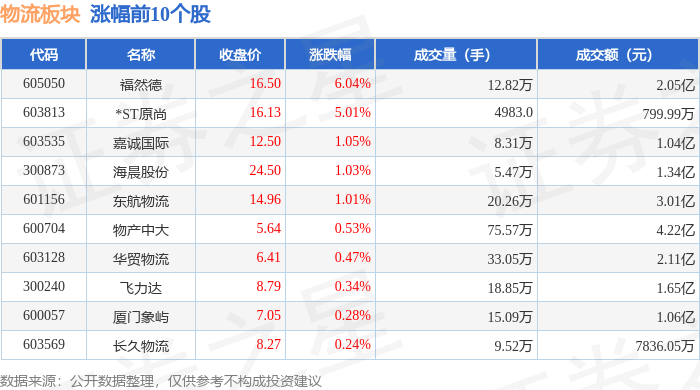
Market Overview - On August 22, the logistics sector declined by 0.49%, with Hengji Daxin leading the drop [1] - The Shanghai Composite Index closed at 3825.76, up 1.45%, while the Shenzhen Component Index closed at 12166.06, up 2.07% [1] Stock Performance - Notable gainers in the logistics sector included: - Furande (605050) with a closing price of 16.50, up 6.04% and a trading volume of 128,200 shares, totaling 205 million yuan [1] - ST Yuanshang (603813) closed at 16.13, up 5.01% with a trading volume of 4,983 shares, totaling approximately 800,000 yuan [1] - Major decliners included: - Hengji Daxin (002492) closed at 7.24, down 2.82% with a trading volume of 131,800 shares, totaling approximately 96.3 million yuan [2] - Huami Duhai (872351) closed at 29.92, down 2.54% with a trading volume of 26,700 shares, totaling approximately 80.1 million yuan [2] Capital Flow - The logistics sector experienced a net outflow of 317 million yuan from institutional investors, while retail investors saw a net inflow of 245 million yuan [2] - Notable capital flows included: - Donghang Logistics (601156) had a net inflow of 66.26 million yuan from institutional investors, but a net outflow of 46.13 million yuan from retail investors [3] - Furande (605050) saw a net inflow of 33.59 million yuan from institutional investors, with retail investors experiencing a net outflow of 12.39 million yuan [3]