
传音控股

Search documents
机构:第三季度全球智能手机市场同比增长3% ,厂商盈利能力承压
Zheng Quan Shi Bao Wang· 2025-10-15 11:52
Group 1 - The global smartphone market is showing signs of recovery with a 3% year-on-year growth in Q3 2025, driven by strong replacement demand and preemptive inventory stocking by manufacturers ahead of the busy Q4 [1] - Samsung maintains its position as the market leader with a 19% share, followed closely by Apple at 18% and Xiaomi at 14%, while Transsion and Vivo each hold 9% [1] - Consumer demand for smartphone upgrades is rebounding, contributing to the market's growth after earlier fluctuations in the year [1] Group 2 - Major brands have received positive responses to new product launches, with manufacturers achieving better balance between hardware and software, leading to increased production targets due to higher-than-expected initial demand [2] - Transsion has shown remarkable performance with double-digit growth compared to Q3 2024, attributed to effective inventory management and demand recovery in the Middle East and Africa [2] - Economic uncertainty continues to impact manufacturers' strategic planning, necessitating a careful balance between shipment volume, profitability, and revenue targets [2] Group 3 - Intense market competition is putting significant pressure on manufacturers' profitability, with rising component costs compressing the balance between competitive pricing and profit margins [3] - The rapid growth of data centers and AI investments is creating substantial cost pressures on semiconductor components, leading to fierce competition among smartphone manufacturers [3] - In emerging markets, challenges are particularly severe due to the dominance of entry-level devices, with financing options like installment payments helping to avoid price wars and maintain affordability for consumers [3]



42股受融资客青睐,净买入超亿元
Zheng Quan Shi Bao Wang· 2025-10-15 01:54
Core Insights - As of October 14, the total market financing balance reached 2.43 trillion yuan, an increase of 233.5 million yuan from the previous trading day [1] - A total of 1,762 stocks received net financing purchases, with 555 stocks having net purchases exceeding 10 million yuan, and 42 stocks exceeding 100 million yuan [1] - The top net purchase stock was Baogang Co., with a net purchase of 744 million yuan, followed by Zijin Mining and Yingweike with net purchases of 714 million yuan and 418 million yuan, respectively [1] Financing Balance and Stock Performance - The average financing balance as a percentage of circulating market value for stocks with significant net purchases was 4.05% [2] - Beijing Junzheng had the highest financing balance at 3.275 billion yuan, accounting for 8.86% of its circulating market value [2] - Other stocks with high financing balance percentages included Dongfang Caifu (8.47%), Guangqi Technology (7.70%), and Xiangnan Chip (6.98%) [2] Sector Analysis - The sectors with the most stocks receiving net purchases over 100 million yuan included electronics, power equipment, and non-ferrous metals, with 15, 7, and 7 stocks respectively [1] - In terms of board distribution, 28 stocks were from the main board, 7 from the ChiNext board, and 7 from the Sci-Tech Innovation board [1] Individual Stock Highlights - Baogang Co. had a price increase of 4.30% on October 14, with a net purchase of 743.65 million yuan [2] - Zijin Mining experienced a price drop of 5.75% but still had a net purchase of 714.21 million yuan [2] - Other notable stocks with significant net purchases included Longi Green Energy, Xingye Silver, and Huayou Cobalt, with net purchases of 357.63 million yuan, 307.54 million yuan, and 294.13 million yuan, respectively [1][2]





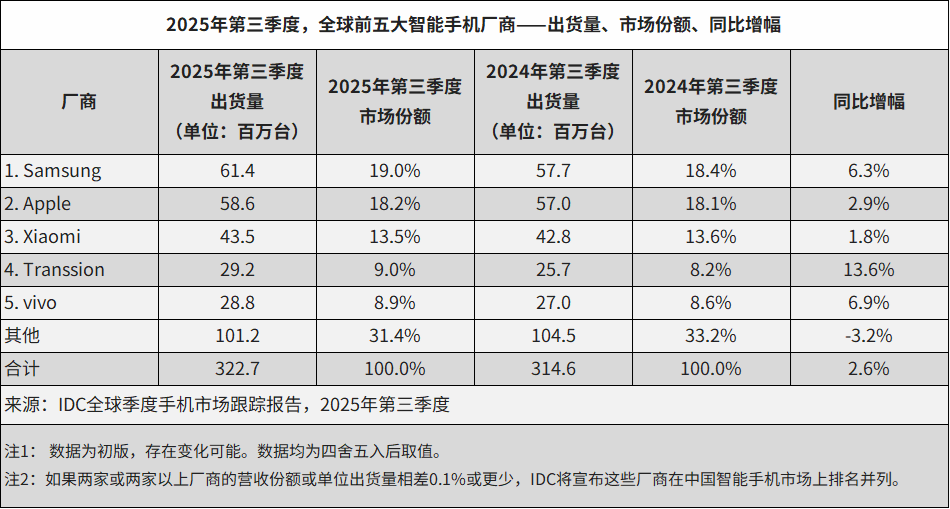
IDC:三季度全球智能手机出货量达3.227亿部 同比增长2.6%
Zhi Tong Cai Jing· 2025-10-14 23:20
Core Insights - The global smartphone market is experiencing a recovery, with Q3 2025 shipments reaching 322.7 million units, a 2.6% year-on-year increase driven by high-end market demand and innovative AI smartphones [1][2][3] Market Performance - Samsung and Apple are leading the high-end market, with Samsung shipping 61.4 million units (19.0% market share) and Apple 58.6 million units (18.2% market share) in Q3 2025, both showing significant year-on-year growth [4] - Xiaomi, Transsion, and vivo also reported notable growth, with Xiaomi shipping 43.5 million units (13.5% market share) and Transsion achieving a 13.6% year-on-year increase [4][3] Regional Insights - In China, the smartphone market saw a slight decline, with total shipments of 68.4 million units in Q3 2025, down 0.6% year-on-year, attributed to seasonal sales trends and tightening government subsidies [5] - Vivo led the Chinese market with 11.8 million units (17.3% market share), while Apple and Huawei followed closely [5] Future Outlook - IDC maintains an optimistic outlook for the smartphone market in 2025, expecting continued growth driven by strong promotional activities and a diverse product lineup from major manufacturers [3][2]


中国拒接美国电话原因找到了!外贸稳得很,加关税威胁毫无效果
Sou Hu Cai Jing· 2025-10-14 19:28
Group 1 - China's tightening of rare earth export controls has led to a significant escalation in international dynamics, with the U.S. attempting to communicate with China but failing to establish a dialogue [1] - The U.S. President's strong reactions indicate the credibility of the situation, reflecting his frustration with China's non-responsive stance [3] - Despite the U.S. imposing high tariffs on Chinese imports, China's exports have shown resilience, achieving growth against the odds [8][11] Group 2 - China's exports to ASEAN and the EU have been particularly strong, compensating for declines in exports to the U.S. due to tariffs [10] - Emerging markets, especially Africa, present substantial opportunities for Chinese products, with Chinese brands dominating the smartphone market [10] - The dual strategy of rare earth export controls and robust foreign trade resilience provides China with a significant buffer against U.S. trade pressures [11]

Omdia:全球智能手机市场在2025年第三季度增长3% 苹果创下史上同期最高纪录
Ge Long Hui· 2025-10-14 15:04
Core Insights - The global smartphone market is projected to grow by 3% year-on-year in Q3 2025, indicating a return to growth driven by the launch of several new products [1] Market Performance - The rebound in the market is attributed to strong replacement demand and preemptive stocking by manufacturers ahead of the busy Q4 2025 [1] - Samsung maintains its position as the global leader with a 19% market share for the third consecutive quarter, supported by the strong sales of its Galaxy A series and upgrades to its seventh-generation foldable models [1] - Apple’s iPhone shipments increased by 4% year-on-year, achieving its strongest Q3 performance ever, driven by early demand for the iPhone 17 series, resulting in an 18% market share [1] - Xiaomi showed stable performance with a market share of 14%, while Transsion and Vivo each captured 9%, collectively ranking among the top five manufacturers for the quarter [1]
Omdia:全球智能手机市场在2025年第三季度增长3%,苹果创下史上同期最高纪录
Canalys· 2025-10-14 14:18
Core Insights - The global smartphone market is projected to grow by 3% year-on-year in Q3 2025, driven by strong replacement demand and preemptive stocking by manufacturers ahead of a busy Q4 [2][5] - Samsung maintains the top position with a 19% market share, followed by Apple at 18%, Xiaomi at 14%, and both Transsion and Vivo at 9% each [2][5] Market Dynamics - The recovery in consumer demand for smartphone upgrades and replacements is evident, with all top five manufacturers showing year-on-year shipment growth [5][7] - Major brands have received positive responses to new product launches, with a focus on balancing hardware and software [5][9] Product Highlights - The iPhone 17 series has performed exceptionally well, with the base model upgrading storage without a price increase, while the new designs of iPhone 17 Pro and Pro Max continue to attract consumers [5][7] - Transsion has achieved double-digit growth compared to Q3 2024, marking its highest shipment volume in history, attributed to effective inventory management and demand recovery in the Middle East and Africa [7] Competitive Landscape - The smartphone market is highly competitive, with rising component costs putting pressure on profitability [9] - Manufacturers are exploring additional revenue opportunities through subscription services, accessories, and bundled sales to enhance consumer value propositions [9] Emerging Market Challenges - In emerging markets, the dominance of entry-level devices presents implementation challenges, necessitating sustainable operating models that avoid price wars while maintaining affordability for consumers [9]

IDC:三季度智能手机市场增长2.6%
2 1 Shi Ji Jing Ji Bao Dao· 2025-10-14 01:05
南方财经10月14日电,国际数据公司(IDC)周一发布的初步数据显示,受消费者对高端和支持人工智 能的设备的强劲需求推动,今年第三季度全球智能手机出货量增长2.6%。IDC的数据显示,第三季度全 球智能手机出货量增至3.227亿部,苹果第三季度取得了有史以来最好的表现,三星也实现了有记录以 来最强劲的季度增长。三星以6140万部的出货量保持了全球第一的位置,而苹果的出货量增长了近 3%,达到5860万部。小米、传音和VIVO在本季度也取得了显著增长。IDC表示,其对2025年剩余时间 的前景保持乐观,预计在积极的促销活动、不断扩大的人工智能功能和持续的设备创新的推动下,年底 的销售将会强劲。 ...
IDC:三季度智能手机市场增长2.6% 三星市占率19%居第一
Ge Long Hui· 2025-10-14 00:50
格隆汇10月14日|国际数据公司(IDC)周一发布的初步数据显示,受消费者对高端和支持人工智能的 设备的强劲需求推动,今年第三季度全球智能手机出货量增长2.6%。IDC的数据显示,第三季度全球智 能手机出货量增至3.227亿部,苹果第三季度取得了有史以来最好的表现,三星也实现了有记录以来最 强劲的季度增长。三星以6140万部的出货量保持了全球第一的位置,而苹果的出货量增长了近3%,达 到5860万部。小米、传音和VIVO在本季度也取得了显著增长。IDC表示,其对2025年剩余时间的前景 保持乐观,预计在积极的促销活动、不断扩大的人工智能功能和持续的设备创新的推动下,年底的销售 将会强劲。 ...
谁将是下一个劈开海外万亿市场的中国黑马?| F&M抢先看
虎嗅APP· 2025-10-13 09:44
Core Viewpoint - The article discusses the evolution of Chinese companies' globalization strategies, highlighting a shift from being mere manufacturers to becoming influential players in the global market, with a focus on three distinct phases of "going global" [5][25]. Group 1: Historical Phases of Chinese Companies Going Global - Phase 1: "Manufacturing Export" Era (1.0) - Characterized by OEM/ODM models where Chinese companies acted as silent manufacturers without brand ownership, relying on low labor costs and large production capacities [9][10]. - Phase 2: "Brand Export" Awakening Era (2.0) - Companies began to establish their brands and compete on technology and cost, with notable examples like Huawei and Xiaomi leading the charge [11][12][14]. - Phase 3: "Ecosystem Export" Era (3.0) - New generation companies aim to provide comprehensive systems and models rather than just products, focusing on creating brand matrices and cultural resonance [16][20][21]. Group 2: Emerging Strategies and Opportunities - Path 1: "Category Disruptors" - Companies focus on creating standout products in niche markets and replicating successful methodologies across various verticals, exemplified by Anker Innovations [18]. - Path 2: "Cultural Alchemists" - Brands modernize and globalize Chinese cultural elements to resonate with young audiences worldwide, as seen with Pop Mart and Bawang Tea [19]. - Path 3: "Ecosystem Creators" - Firms provide platforms and operational models that enhance efficiency and cost-effectiveness, such as J&T Express and Meituan KeeTa [21]. - Path 4: "Gold Diggers" in Emerging Markets - Companies are targeting regions like Southeast Asia and Africa, leveraging existing successful models to fill market gaps quickly and effectively [22][23]. Group 3: Future Outlook - The evolution from labor-intensive manufacturing to brand establishment and now to ecosystem creation signifies a transformative journey for Chinese enterprises, positioning them as key players in global markets [25][27]. - The next wave of successful companies will likely emerge as "ecosystem species," capable of dominating multiple verticals and redefining global market standards [27][28].

中国消费电子产业链中期信用观察:大国博弈与AI革命下,消费电子产业链分化前行
Zhong Cheng Xin Guo Ji· 2025-10-13 08:51
Investment Rating - The report does not explicitly state an investment rating for the industry Core Insights - The consumer electronics market is experiencing a moderate recovery in demand in the first half of 2025, driven by AI innovations and policy support, but the performance of various segments is diverging [4][23] - The smartphone market is entering a phase of stock competition with a growth rate of approximately 1.28% in the first half of 2025, while the PC market is benefiting from a replacement cycle and AI innovations, showing a growth of 5.53% [6][10] - The semiconductor sector is witnessing a significant recovery, with a projected market size exceeding $700.9 billion in 2025, reflecting an 11.2% year-on-year growth [21] Summary by Sections Key Focus Areas - The consumer electronics industry is extensive, involving various components such as chips, panels, batteries, and assembly manufacturers, with the overall performance improving but still facing challenges due to geopolitical tensions and inflation [5][6] - The demand for consumer electronics is recovering moderately, with different segments showing varied performance; ODM manufacturers are under pressure to explore new business areas due to shrinking profit margins [4][5] Market Performance - In the first half of 2025, the global smartphone market saw a slight increase in shipments to approximately 601 million units, while the PC market reached 132 million units, reflecting a steady growth trend [6][10] - Wearable devices are rebounding, with a 13% year-on-year increase in shipments in Q1 2025, driven by market demand and new product launches [9] Financial Performance - The overall revenue of sample companies in the consumer electronics industry increased by approximately 20.96% in the first half of 2025, with ODM companies showing the highest revenue growth of about 40.72% [24][27] - The semiconductor sector's net profit increased significantly by approximately 52.68% year-on-year, driven by the recovery in the global semiconductor market [27] Capital Expenditure and Debt - Capital expenditure in the consumer electronics industry is recovering, with a year-on-year increase of about 11.76% in the first half of 2025, although the semiconductor sector saw a decline in capital expenditure for the first time [33][34] - The total debt of sample companies in the industry increased by 10.78% to approximately 1,344.719 billion yuan, indicating a slight rise in financial leverage [34][35] Research and Development - R&D expenditures across various segments are increasing, with the semiconductor sector maintaining the highest R&D expense ratio at 17.89% in the first half of 2025 [25][26] Operational Efficiency - The inventory turnover rate for ODM and panel industry sample companies is relatively high, while the semiconductor sector still requires attention regarding inventory management [30][31]

