
大成基金

Search documents
A股定价权三问:谁在主导?谁能主导?谁将主导?
Shang Hai Zheng Quan Bao· 2025-08-18 23:53
Core Viewpoint - The A-share market has reached a new high, with the Shanghai Composite Index hitting 3745.94 points, driven by ample liquidity and active trading, particularly from leveraged funds and individual investors [1][2]. Group 1: Market Dynamics - The Shanghai Composite Index has surpassed 3700 points without exceeding a daily increase of 2% since early April, indicating a steady upward trend [1]. - The financing balance has exceeded 2 trillion yuan, reflecting increased market activity and a "deposit migration" phenomenon where household savings are moving into capital markets [1]. - Stock ETFs have seen a resurgence in trading volume, with significant daily transactions, particularly on August 18, where the trading volume reached 1454.54 billion yuan [2]. Group 2: Investor Composition - Individual investors are increasingly prominent among the top holders of newly issued ETFs, with a notable presence in funds like the E Fund ChiNext 50 ETF [2]. - Foreign and insurance capital are also becoming significant sources of incremental funds, with foreign investment in Chinese assets rising since July [2][3]. - The insurance industry's stock investment ratio has increased to 8.4%, indicating a potential for more aggressive stock investments as reforms progress [3]. Group 3: Future Market Outlook - The continued strong performance of public funds is expected to attract more incremental capital into the A-share market, with active equity funds outperforming the CSI 300 index [4]. - The issuance of new equity funds has surged, with several funds exceeding 2 billion yuan in scale, reflecting a positive market sentiment [4]. - The correlation between new institutional accounts and the issuance of equity funds suggests a reinforcing cycle of investment activity [5]. Group 4: Long-term Investment Focus - The long-term performance of funds is increasingly tied to the fundamentals of listed companies, with managers focusing on in-depth research and industry analysis [6]. - Recent trends show a significant increase in institutional research activities, with over 14,000 instances of company visits in the past month [6]. - Fund managers are adjusting their portfolios to favor companies with strong fundamentals and growth potential, particularly in sectors like AI and energy storage [7][8].
A股回暖催生基金“新高潮”,上千只主动权益基金月内创新高
Di Yi Cai Jing· 2025-08-18 11:58
Core Insights - The A-share market has shown a strong recovery, with over a thousand active equity funds reaching new net asset value (NAV) highs as of August 15, 2023, indicating a significant market rebound [1][3] - The number of "billion-dollar club" funds has drastically decreased, with over three-quarters disappearing in four years, highlighting a stark differentiation in fund performance [1][4] - The average return of the 24 billion-dollar active equity funds over the past year reached 41.95%, with some funds achieving returns exceeding 100% [3][4] Fund Performance - As of August 15, 2023, 1,164 active equity funds have refreshed their historical NAVs, representing over 25% of the total, showcasing a notable market profit effect [3] - The top-performing funds are closely aligned with market themes, managed by well-known fund managers, with some funds like Yongying Advanced Manufacturing Select A achieving a return of 169.33% [4][5] - The total number of billion-dollar active equity funds has decreased from 98 in Q2 2021 to only 18 currently, with the scale ceiling dropping from 898.89 billion to 349.43 billion [4][5] Market Trends - The current A-share market is characterized as a "slow bull" market, driven by the return of overseas capital and a positive cycle of improved corporate earnings [6][7] - The market's recent surge is attributed to a combination of macroeconomic fundamentals, regulatory approaches, and investor confidence, with a notable increase in retail investor participation [7][8] - Analysts suggest a potential shift in investment strategies, recommending a tilt from dividend sectors to technology growth sectors, particularly in high-value export-related areas [8]
ETF收评 | A股创10年新高,稀土、AI硬件领涨,稀土ETF易方达、稀土ETF涨6%,创业板人工智能ETF南方涨5.87%
Sou Hu Cai Jing· 2025-08-18 08:03
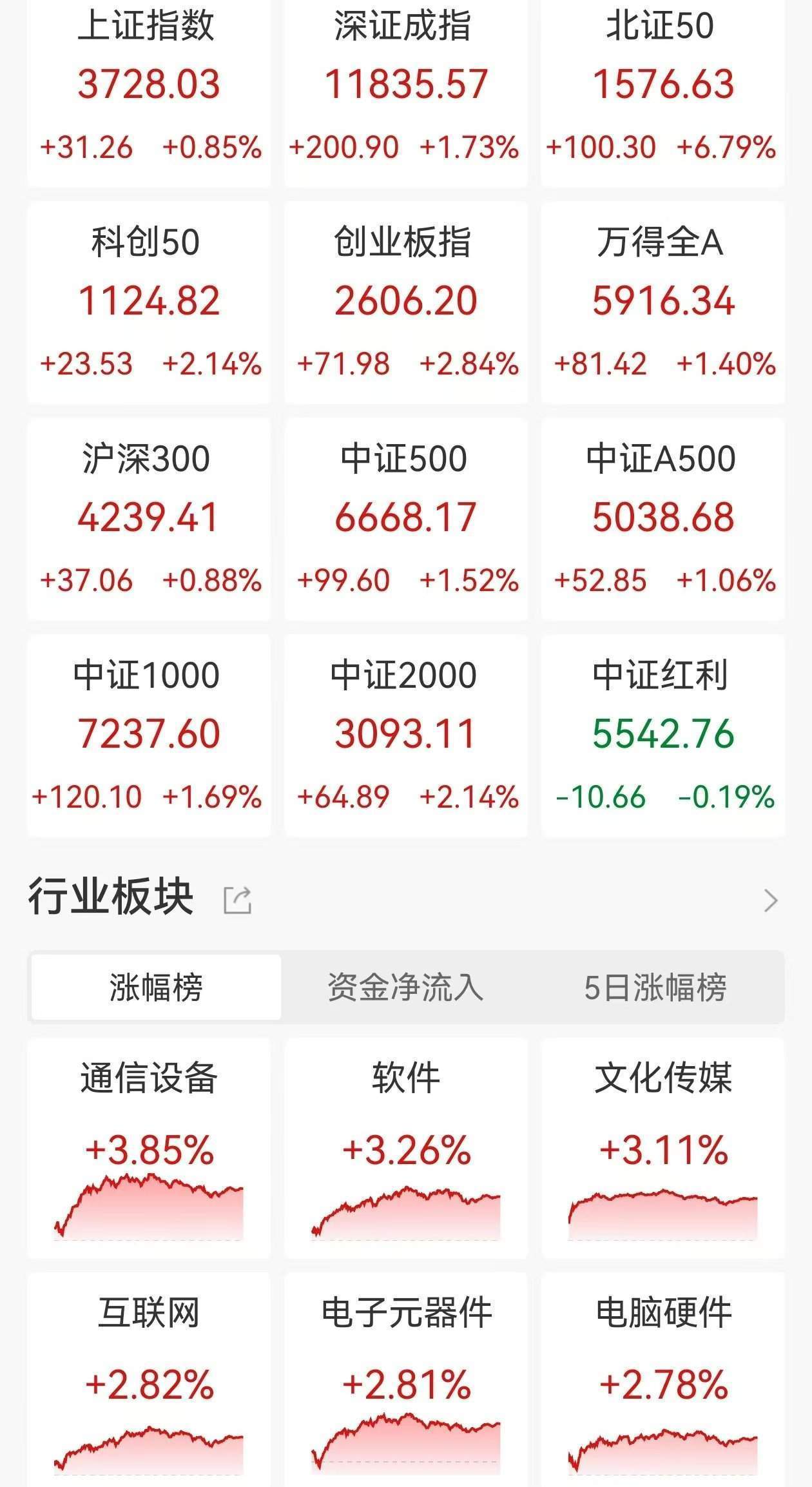
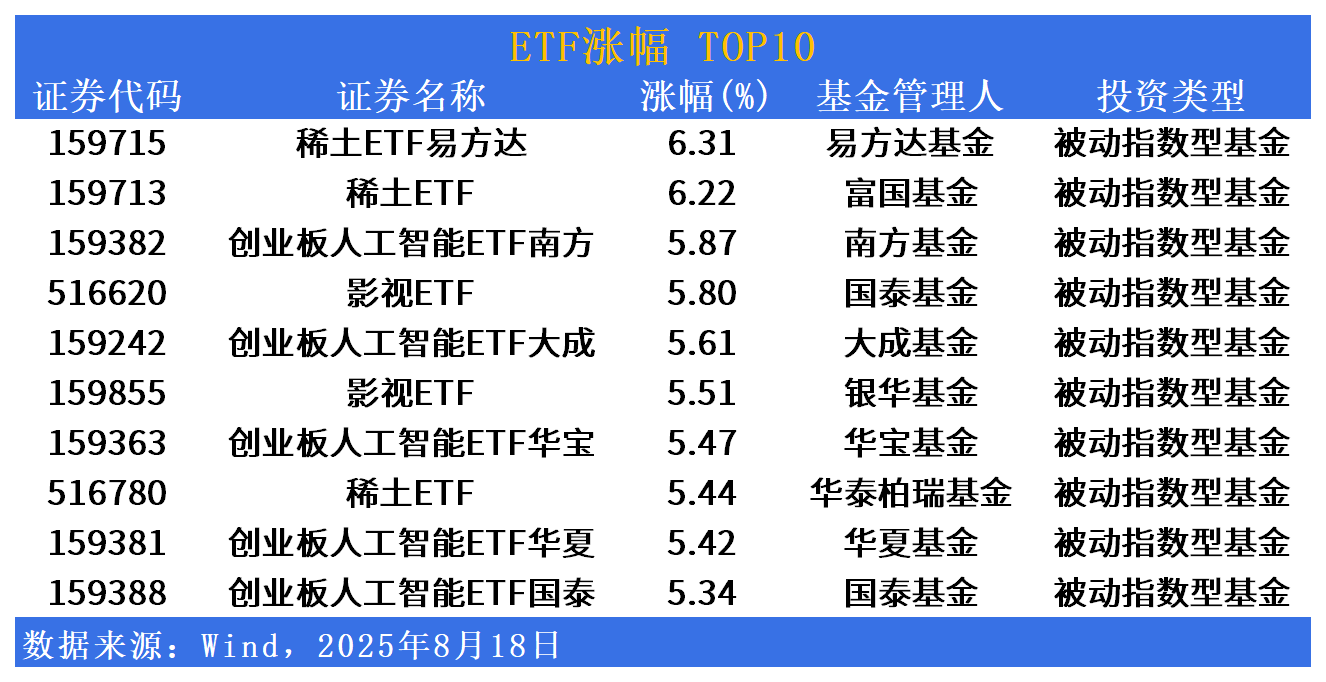
Market Performance - The three major A-share indices collectively rose, with the Shanghai Composite Index increasing by 0.85%, reaching a 10-year high [1] - The North Star 50 surged by 6.79%, marking a historical peak, while the Shenzhen Component Index rose by 1.73% [1] - The total trading volume across the Shanghai, Shenzhen, and Beijing markets reached 28,091 billion yuan, an increase of 5,363 billion yuan from the previous day, making it the third highest in history [1] Sector Performance - Over 4,000 stocks in the market experienced gains, with strong leadership from sectors such as stock trading software, liquid cooling, rare earths, and CPO concepts [1] - The military industry and stablecoin concepts gained momentum in the afternoon session, while cyclical stocks like coal and non-ferrous metals generally underperformed the indices [1] ETF Performance - The rare earth sector saw significant gains, with ETFs such as E Fund and FT Fund rare earth ETFs rising by 6.31% and 6.22%, respectively [4] - The CPO sector experienced a breakout, with various AI-related ETFs on the ChiNext rising between 5.47% and 5.87% [4] - The film sector also saw a broad increase, with ETFs like Guotai Fund and Yinhua Fund film ETFs rising by 5.51% and 5.8% [4] - Conversely, the long-term treasury bonds faced declines, with 30-year treasury ETFs dropping by 1.2% [4]


ETF市场日报 | 稀土、人工智能相关ETF领涨!黄金、跨境ETF回调居前
Sou Hu Cai Jing· 2025-08-18 08:01
Market Performance - A-shares continued strong performance with the Shanghai Composite Index reaching a ten-year high since August 2015, while the North Star 50 hit a historical peak. The Shenzhen Composite Index and ChiNext Index also surpassed their previous highs from October 2022. The Shanghai Composite Index rose by 0.85%, the Shenzhen Composite Index increased by 1.73%, and the ChiNext Index gained 2.84%. The total trading volume in the Shanghai and Shenzhen markets reached 27,642 billion, a significant increase of 5,196 billion compared to the previous trading day [1]. ETF Performance - The top-performing ETFs included rare earth and artificial intelligence-related funds, with the rare earth ETF from E Fund (159715) leading with a 6.31% increase, followed closely by another rare earth ETF (159713) at 6.22%. The ChiNext artificial intelligence ETF from Southern Fund (159382) rose by 5.87% [2][3]. Industry Insights - The global liquidity easing expectations have provided support for metal prices, with many metal varieties facing supply rigidity due to capital expenditures. The overall valuation remains low, indicating potential for price increases in the future. The non-ferrous metals sector, particularly rare earths, tungsten, cobalt, and antimony, is expected to see upward momentum due to improved supply-demand dynamics and policy support [3]. - The demand for rare earths is anticipated to improve further due to the development of emerging industries such as new energy and humanoid robots, leading to a more favorable supply-demand balance and long-term price increases [3]. Artificial Intelligence Sector - The AI sector is expected to continue its innovation trajectory in the second half of 2025, accelerating growth across the industry chain. Analysts recommend focusing on the "AI mainline" and see opportunities in AI applications and computing power sectors. The AI sector has not yet reached overheating levels, suggesting further expansion into more AI-related fields [4]. ETF Trading Activity - The Hong Kong Securities ETF (513090) recorded the highest trading volume at 33 billion. Other notable ETFs included the Short-term Bond ETF (211360) and Silver Hua Li ETF (211880) [7][8]. The turnover rate for the Sci-Tech Growth ETF (588070) was the highest at 337% [8]. New ETF Launches - A new AI-focused ETF from Huatai-PineBridge (589560) will begin fundraising, closely tracking the Shanghai Stock Exchange Sci-Tech Innovation Board AI Index, which includes 30 companies in the AI sector. This index emphasizes semiconductor companies and high R&D investment [9][10].
回本了!市场重回3700点上下,半数“高位基”已解套!
Cai Jing Wang· 2025-08-18 03:07
Core Viewpoint - The market has returned to around 3700 points, with over 50% of funds established during the last bull market now recovering to their initial net asset value (NAV) [1][2]. Fund Performance - As of August 15, 2023, 936 out of 1785 funds established in 2021 have a NAV above 1, representing 52.44% of the total [3]. - Notable funds like Invesco Great Wall's Long-Term Fund and Jin Ying New Energy Fund have recently achieved NAVs of 1.0055 and 1.0342, respectively, after significant rebounds [2][3]. - Some funds, however, remain underperforming, with about 30 funds established in 2021 having NAVs below 0.5 [3]. Performance Disparity - There is a significant performance disparity among funds established at the same market peak, with some funds achieving returns as high as 143.51% while others have negative returns [4][5]. - Funds that performed well tended to focus on sectors like materials and artificial intelligence, while underperforming funds were often concentrated in renewable energy sectors [4]. Market Dynamics - The market is experiencing a "redemption pressure" as funds that have returned to their NAVs face potential outflows due to investor behavior influenced by previous losses [6]. - Despite this, new active equity funds are seeing a resurgence in fundraising, indicating a potential recovery in the market [6][7]. - The market is expected to enter a positive cycle of capital inflow and price appreciation, driven by strong demand for high-return assets [7].
0.1折,卖基金!
Zhong Guo Ji Jin Bao· 2025-08-18 03:04
Group 1 - The core viewpoint of the articles highlights the intensifying price competition in the fund distribution market, with some small and medium-sized banks offering fund sales fees as low as 0.1% [1][2][4] - The recent fee reductions are seen as a strategy to attract customers amid increasing competition, but this approach may lack long-term sustainability [1][3] - Major banks have previously set the minimum discount at 10%, while the introduction of 0.1% fees by smaller banks is considered rare and indicative of a more market-driven approach in economically developed regions [2][4] Group 2 - The competitive landscape is characterized by large banks dominating market share due to their brand influence and extensive customer base, while small banks struggle to compete effectively [3][4] - The low fee strategy may provide short-term benefits by attracting cost-sensitive customers, but it risks leading to a focus on fees over fund performance and risk management [3][5] - The future of the fund distribution market is expected to shift from price competition to a focus on service quality, product selection, and asset allocation, necessitating banks to enhance their comprehensive service capabilities [5]
0.1折,卖基金!
中国基金报· 2025-08-18 02:59
Core Viewpoint - The article discusses the intensifying price competition in the fund distribution market among banks, particularly highlighting that some small and medium-sized banks have reduced their fund distribution fees to as low as 0.1% of the original rate, indicating a strategic move to attract customers amid fierce competition [2][4][8]. Group 1: Fee Reductions and Market Dynamics - Some small and medium-sized banks, such as Shenzhen Rural Commercial Bank and Changshu Rural Commercial Bank, have introduced fund distribution fee discounts as low as 0.1%, significantly lower than the previous minimum of 1% offered by larger banks [4][5]. - The fee reductions are seen as a response to the competitive pressures faced by smaller banks, which struggle against larger banks with strong brand influence and extensive customer bases [5][6]. - The current trend reflects a broader shift in the banking sector, where institutions are increasingly resorting to price cuts to attract fee-sensitive customers, particularly in economically developed regions like the Yangtze River Delta and Pearl River Delta [4][5]. Group 2: Implications of Price Competition - While the short-term effects of price cuts can lead to increased customer acquisition and fund sales, there are concerns that focusing solely on fees may lead investors to overlook critical factors such as fund performance and risk alignment [6][8]. - The article suggests that the ongoing price war may not be sustainable in the long run, as it could significantly reduce profit margins for banks and lead to chaotic competition without a clear competitive advantage [6][8]. - Experts predict that the competition in the fund distribution market will eventually shift from price-based strategies to a focus on service quality, product selection, and asset allocation, necessitating banks to enhance their comprehensive service capabilities [8][9]. Group 3: Future Trends in Fund Distribution - The article posits that the reduction of fund distribution fees to "floor prices" will accelerate the transition of more institutions towards a buyer advisory model, emphasizing the need for banks to adapt to changing market dynamics [9]. - It highlights the distinct advantages of different distribution channels, with internet platforms attracting customers through low costs and efficiency, while brokers offer professional advisory services, and banks leverage their extensive customer bases for comprehensive wealth management [9]. - The future of fund distribution is expected to involve a digital transformation, with traditional banks and brokers exploring online and intelligent development paths to restructure their fund sales processes [9].
回本了!市场逼近3700点 半数“高位基”已解套!
Zhong Guo Jing Ji Wang· 2025-08-18 00:44
Core Viewpoint - The market has returned to around 3700 points, with over 50% of funds established during the last bull market in 2021 now recovering to their initial net asset value (NAV) [1][2]. Fund Performance - As of August 15, 2023, 936 out of 1785 funds established in 2021 have a NAV above 1, representing 52.44% of the total [3]. - Notable funds that have recovered include Invesco Great Wall's Long-Term Fund, which reached a NAV of 1.0055, and Jin Ying New Energy Mixed Fund, which reached 1.0342 [2][3]. - Some funds, such as Dachen Industry Trend and Huatai-PB Health Life, have NAVs stabilizing above 1.5 [3]. Performance Disparity - There is a significant performance disparity among funds established at the same market peak, with some funds achieving returns as high as 143.51% while others have negative returns [4]. - For instance, Dachen Industry Trend has a return of 88.72%, while other funds like Huatai-PB National Bio-Medical ETF have returns of -59.77% [4]. Market Dynamics - The market is experiencing a "return to break-even" pressure, particularly in sectors like new energy and pharmaceuticals, which were popular during the previous bull market [5]. - Despite redemption pressures, new active equity funds are seeing a resurgence in fundraising, with July's issuance reaching around 10 billion [5][6]. - The market is moving out of a negative cycle, with a potential positive feedback loop emerging as the market's performance improves [6].
大逆转!“9·24”以来 小盘基金平均收益率超84%
Zhong Guo Jing Ji Wang· 2025-08-18 00:38
Core Viewpoint - The small-cap stocks have shown strong performance since the "9·24" market rally, leading to significant gains in related funds, with many products now entering purchase restrictions [1][4]. Group 1: Market Performance - Since the "9·24" rally, the small-cap index has surged by 120.96%, with a year-to-date increase of 55.71% despite a mid-June pullback [2]. - The average return of 39 small-cap funds reached 84.6%, with 12 funds exceeding a 100% net value increase [2]. - The ChiNext small-cap index and the Guozheng 2000 index have risen by 83% and 68%, respectively, ranking among the top two in performance among 20 Guozheng scale indices [2]. Group 2: Fund Restrictions - Currently, 21 small-cap funds are under purchase restrictions, accounting for nearly 54% of the total [4]. - The average scale of small-cap funds is below 4 billion yuan, with 32 funds having a scale under 1 billion yuan [4]. - The restrictions are attributed to the relatively weak liquidity of small-cap stocks compared to mid and large-cap stocks, which could impact trading costs if fund sizes grow too quickly [4]. Group 3: Market Drivers and Risks - The strong performance of small-cap stocks is driven by policy support, liquidity easing, valuation recovery, and capital speculation [3]. - There are concerns regarding the sustainability of small-cap stock gains, as the current market relies heavily on liquidity rather than earnings growth [5]. - The potential for increased trading costs and reduced strategy effectiveness as fund sizes expand poses risks to future performance [6].
回本了!市场逼近3700点,半数“高位基”已解套
Zheng Quan Shi Bao· 2025-08-17 22:21
Core Viewpoint - The market has returned to around 3700 points, with over 50% of funds established during the last bull market in 2021 now recovering to their initial net asset value (NAV) [1][2]. Fund Performance - As of August 15, 2023, 936 out of 1785 funds established in 2021 have a NAV above 1, representing 52.44% of the total [3]. - Notable funds like Invesco Great Wall's Long-term Growth Fund and Jin Ying New Energy Mixed Fund have recently achieved NAVs of 1.0055 and 1.0342, respectively, after significant rebounds [2][3]. - However, approximately 30 funds from 2021 still have NAVs below 0.5, indicating severe underperformance [3]. Performance Disparity - There is a marked performance disparity among funds established at the same market peak in 2021, with some funds achieving returns as high as 143.51% while others have negative returns exceeding -59% [4][5]. - Funds that performed well tended to focus on cyclical sectors like materials and chemicals, while poorly performing funds were heavily invested in renewable energy sectors [4]. Market Dynamics - The market is experiencing a "return to break-even" pressure on funds, particularly those concentrated in sectors like new energy and pharmaceuticals [6]. - Despite redemption pressures, new active equity funds are seeing a resurgence in fundraising, with July's issuance reaching around 10 billion [6]. - The market is transitioning from a negative cycle to a more stable environment, with a potential for positive cash flow and market growth [7].