丸美生物

Search documents
轻工、美护2026年年度策略:内需筑底深挖潜力,出海突围打开新局
HUAXI Securities· 2026-01-07 02:30
Group 1: Industry Overview - The light industry and beauty sector is expected to stabilize and improve due to the dual drivers of domestic demand policies and steady export growth [3] - The "14th Five-Year Plan" marks a year of enhanced domestic demand policies, coupled with consumers' increasing pursuit of high-quality living, creating significant growth opportunities for the industry [3] - The penetration rate of cross-border e-commerce has ample room for improvement, and the recovery of international relations and demand from emerging markets will further drive market expansion [3] Group 2: Beauty Sector - The cosmetics market is projected to grow steadily, with the skincare segment being the largest, reaching a market size of 4,619 billion yuan in 2024, and expected to grow at a CAGR of 8.6% from 2024 to 2029 [19] - The high-end cosmetics market is rapidly expanding, with the market size for high-end skincare products increasing from 749 billion yuan in 2019 to 1,144 billion yuan in 2024, reflecting a CAGR of 8.84% [19] - Key companies in the beauty sector include: - **Mao Geping**: Revenue reached 25.88 billion yuan in H1 2025, with a growth rate of 31.28% [23] - **Lin Qingxuan**: Revenue grew to 10.52 billion yuan in H1 2025, marking a 98.28% increase [27] - **Marubi**: Revenue is expected to reach 29.70 billion yuan in 2024, recovering from previous declines [32] Group 3: Medical Aesthetics - The medical aesthetics sector is facing short-term pressure due to cautious consumer spending, but the long-term growth potential remains strong, with a projected CAGR of 10%-15% from 2024 to 2027 [36] - The market penetration rate for medical aesthetics in China is currently at 4-5%, indicating a growth potential of 2-5 times compared to countries like the US and South Korea [36] - Key companies in the medical aesthetics sector include: - **Jinbo Biological**: Achieved revenue of 12.96 billion yuan in Q1-Q3 2025, with a year-on-year growth of 31.10% [45] Group 4: Daily Chemicals - The daily chemical industry is benefiting from domestic demand policies, with local brands poised to capture market share [49] - Companies such as **Dengkang Oral Care** and **Runben** are highlighted for their strong market positions and growth potential [51][55] - **Shanghai Jahwa** has shown significant growth, with revenue reaching 49.61 billion yuan in Q1-Q3 2025, reflecting a 10.83% increase [59] Group 5: Home Furnishing - The home furnishing sector is under pressure due to weak real estate sales, with a 15% decline in residential investment in 2025 [65] - National subsidies for home appliances and furnishings have provided some support, but the long-term effects are limited [65] - Leading companies such as **Oppein Home** and **Kuka Home** are noted for their strong channel capabilities and multi-category layouts [65]



2025年中国胶原蛋白护肤品行业发展历程、政策汇总、产业链图谱、市场规模、竞争格局及发展趋势分析:CR5市场占有率达69.3%[图]
Chan Ye Xin Xi Wang· 2026-01-07 01:33
Core Viewpoint - The skincare consumption in China is shifting from basic hydration to functional care, with collagen skincare products becoming a core choice for consumers seeking anti-aging solutions. The market for collagen skincare products is projected to reach 31.6 billion yuan in 2024, growing by 21.5% year-on-year, with recombinant collagen products capturing a significant market share of 36% due to their high activity and low allergenicity [1][9]. Industry Overview - Collagen is a structural protein found in animals, primarily maintaining the stability of skin and connective tissues. Collagen skincare products aim to supplement skin collagen, improve barrier function, and enhance skin elasticity through topical application [2]. - Collagen skincare products can be categorized based on source (animal, plant, recombinant), form (masks, serums, creams), and function (hydrating, anti-aging, soothing) [2][3]. Development History - The development of China's collagen skincare industry has progressed through four stages: exploration, rapid growth, standardization, and technology leadership, transitioning from animal-derived to recombinant collagen and synthetic biology [4]. Market Policies - The Chinese government has implemented various regulations to enhance the quality and safety of the cosmetics industry, including collagen skincare products, promoting a shift towards standardized and high-quality development [5]. Industry Chain - The upstream of the collagen skincare industry includes suppliers of collagen, moisturizers, emulsifiers, and packaging materials. The midstream involves R&D and production, while the downstream consists of various sales channels, including retail and e-commerce [7]. - The primary consumer demographic for collagen skincare products is women, accounting for 86.2%, with the age group of 25-45 years making up over 80% of the market. Safety is the top concern for 80% of consumers [7][8]. Current Market Status - The market for collagen skincare products is expected to reach 31.6 billion yuan in 2024, with recombinant collagen products leading the market due to their advantages [9]. Competitive Landscape - The market concentration for recombinant collagen skincare products has increased, with the top five companies holding a 69.3% market share. Key players include Giant Bio, Proya, and Marubi, leveraging technology and product innovation to maintain market leadership [9][10]. - Giant Bio, established in 2000, focuses on high-tech skincare and holds 186 patents, leading in recombinant collagen technology with significant revenue and profit margins [10]. Future Trends - The future of the collagen skincare industry will see recombinant human-like collagen becoming mainstream, with advancements in synthetic biology and green manufacturing. Products will expand beyond hydration and anti-aging to include whitening, sensitivity, and barrier repair, with clear clinical data supporting efficacy [11].


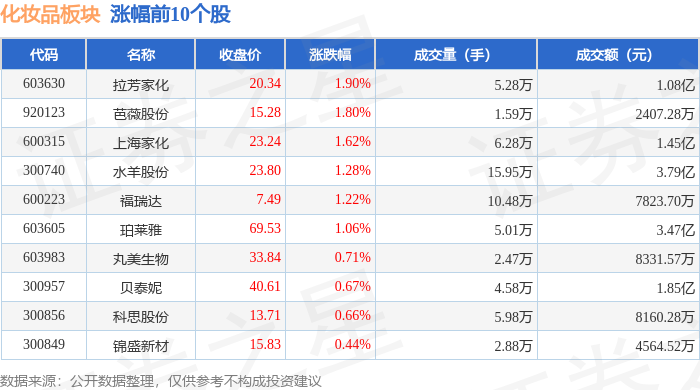
化妆品板块1月6日涨0.46%,拉芳家化领涨,主力资金净流出8196.79万元
Zheng Xing Xing Ye Ri Bao· 2026-01-06 09:03
Group 1 - The cosmetics sector experienced a rise of 0.46% on January 6, with Lafang Jiahua leading the gains [1] - The Shanghai Composite Index closed at 4083.67, up by 1.5%, while the Shenzhen Component Index closed at 14022.55, up by 1.4% [1] - Lafang Jiahua's closing price was 20.34, reflecting a 1.90% increase, with a trading volume of 52,800 shares and a transaction value of 108 million yuan [1] Group 2 - The cosmetics sector saw a net outflow of 81.97 million yuan from institutional investors, while retail investors had a net inflow of 67.35 million yuan [2] - The trading data indicates that major stocks like Shanghai Jahwa and Lafang Jiahua had mixed net inflows and outflows from different investor types [3] - Shanghai Jahwa had a net inflow of 9.64 million yuan from institutional investors, while it faced outflows from retail investors [3]



广东丸美生物技术股份有限公司 关于完成工商变更登记的公告
Zhong Guo Zheng Quan Bao - Zhong Zheng Wang· 2026-01-06 07:58
Core Viewpoint - The company has completed the registration of changes related to the cancellation of the supervisory board and the revision of its articles of association, as approved in previous board and shareholder meetings [1]. Group 1 - The company held the fifth board meeting on October 29, 2025, and the second extraordinary general meeting on November 28, 2025, where it approved the proposal to cancel the supervisory board and amend the articles of association [1]. - The company has completed the necessary business registration changes and the filing of the revised articles of association, with no changes to the business license registration information [1].

丸美生物(603983) - 广东丸美生物技术股份有限公司关于完成工商变更登记的公告
2026-01-05 09:45
证券代码:603983 证券简称:丸美生物 公告编号:2026-001 广东丸美生物技术股份有限公司(以下简称"公司")于 2025 年 10 月 29 日、2025 年 11 月 28 日分别召开了第五届董事会第九次会议、2025 年第二次临 时股东大会,审议通过了《关于取消监事会并修订<公司章程>及修订、新增公司 部分治理制度的议案》,具体内容详见公司于 2025 年 10 月 31 日在上海证券交易 所网站(www.sse.com.cn)披露的《关于取消监事会并修订<公司章程>及修订、 新增公司部分治理制度的公告》。 近日,公司已完成上述事项相关的工商变更登记及《公司章程》备案手续, 营业执照登记信息不变。 特此公告。 广东丸美生物技术股份有限公司董事会 2026年1月6日 广东丸美生物技术股份有限公司 关于完成工商变更登记的公告 本公司董事会及全体董事保证本公告内容不存在任何虚假记载、误导性陈述 或者重大遗漏,并对其内容的真实性、准确性和完整性承担个别及连带责任。 ...
大消费行业周报:市场稳健,板块分化-20260105
Ping An Securities· 2026-01-05 03:05
Investment Rating - The industry investment rating is "stronger than the market," indicating that the industry index is expected to outperform the market by more than 5% within the next six months [24]. Core Insights - The overall market performance is stable, with significant differentiation within the consumer sector. The upcoming New Year holiday is expected to boost certain segments, supported by favorable macro consumption policies that may lead to a recovery in consumer demand [3][4]. - The tourism sector shows potential for growth, with leading companies like Ctrip and Huazhu Hotels responding quickly to changing consumer demands. The retail tourism industry is stabilizing, with expectations for sales recovery [3][8]. - The beauty industry is experiencing steady growth, with a focus on companies that can quickly adapt to market dynamics and integrate products, brands, and channels [3]. - The film industry saw a strong performance during the New Year holiday, with box office revenues reaching 734 million yuan, led by the film "Zootopia 2" [14]. - In the food and beverage sector, the home dining market is expanding, with companies like Guoquan showing strong growth potential. The dairy supply-demand relationship is improving, and the restaurant supply chain is stabilizing [3][18]. - In the liquor segment, major companies are experiencing deeper profit adjustments, but leading brands are expected to maintain or increase market share due to superior management and branding [3][19]. Summary by Sections Social Services - The tourism sector is evolving, with a notable increase in travel demand during the New Year holiday, driven by a surge in ticket bookings and hotel reservations [8]. - Turkey has announced visa-free entry for Chinese passport holders, which is expected to enhance tourism flows [8]. Media - The film industry achieved a record box office during the New Year holiday, indicating strong consumer interest and spending in entertainment [14]. Food and Beverage - General - The home dining market is expanding, with companies like Guoquan leading the way. The dairy industry is seeing improved supply-demand dynamics, while the restaurant supply chain is stabilizing [3][18]. Food and Beverage - Alcohol - Major liquor companies are adjusting their profit margins, but leading brands are expected to capture more market share due to their strong brand presence and management capabilities [3][19].


“人、货、场”迭代升级,关注情绪消费赛道机会
KAIYUAN SECURITIES· 2026-01-04 08:46
Investment Rating - The industry investment rating is "Positive" (maintained) [1] Core Viewpoints - The retail industry is undergoing an evolution in the "people, goods, and scene" framework, driven by emotional consumption, which presents new opportunities for growth [3][25] - High-end gold and fashion jewelry are gaining traction among consumers, with a focus on product differentiation and cultural significance [3][32] - The cosmetics industry is innovating through the IP of technical ingredients and cultural confidence, enhancing product appeal and market competitiveness [3][37] - Offline retail is shifting from selling "goods" to offering "services and experiences," with companies like Yonghui Supermarket leading the transformation [3][41] Summary by Sections Retail Market Overview - In 2025, the retail sector index closed at 2422.59 points, with an annual increase of 8.21%, underperforming the Shanghai Composite Index, which rose by 18.41% [5][14] - The retail industry ranked 23rd among 31 sectors in terms of performance [15] Industry Dynamics - The emotional value is driving consumer intentions, with a focus on "research-based consumption," "self-satisfaction," and "long-termism" as key decision-making trends [25][28] - High-end gold is becoming a preferred asset for wealth preservation, while fashion gold is appealing to younger consumers through innovative designs and social media engagement [32] - The cosmetics sector is witnessing a shift towards self-developed core ingredients and cultural narratives, enhancing brand value [37] Investment Recommendations - Focus on high-quality companies in the emotional consumption theme, particularly in the gold jewelry sector, with recommendations for brands like Chao Hong Ji and Lao Pu Gold [6][50] - Emphasize offline retail companies adapting to market changes, such as Yonghui Supermarket and Ai Ying Shi [6][48] - Highlight cosmetics brands that innovate in emotional value and safety, including Mao Ge Ping and Po Lai Ya [6][48] - Consider differentiated medical beauty product manufacturers and leading medical beauty institutions, recommending companies like Ai Mei Ke and Ke Di-B [6][48]
解码美妆新质生产力:头部品牌的智造实践与研发深耕
艾瑞咨询· 2026-01-04 05:31
Core Viewpoint - The Chinese cosmetics industry is projected to reach a market size of 1.1 trillion yuan, with domestic brands surpassing international brands in market share and consumer preference [1][2]. Group 1: High-Quality Development and New Productive Forces - The domestic cosmetics market retail sales are expected to reach 470 billion yuan by 2025, indicating a significant growth trajectory for the industry [2]. - New productive forces are essential for the high-quality development of the cosmetics industry, transitioning from traditional manufacturing to intelligent and lean production [4]. - New productive forces enhance production efficiency and product consistency through automation and intelligent equipment, addressing quality control challenges [4]. Group 2: Intelligent Manufacturing Practices of Domestic Brands - The past decade has seen a shift in the cosmetics manufacturing industry from experience-driven to data-driven processes, evolving through three stages: semi-automated, automated, and now data-driven intelligent stages [6]. - Leading brands like Han Shu and Pechoin have made significant investments in intelligent manufacturing, achieving production capacity increases and improved quality control [8][10]. - Domestic brands have made historical advancements in intelligent manufacturing, with automation rates rising from approximately 40% to levels comparable to international brands [10]. Group 3: R&D Innovation and Cost Management - R&D expenditure rates vary across different categories, with skincare products averaging 1.5%-5% and medical beauty products at 2%-5%, reflecting a focus on compliance and clinical data [21][23]. - Domestic brands like Han Shu and Pechoin have R&D personnel ratios comparable to international leaders, indicating strong R&D capabilities [24]. - The production cost rates for various product categories range from 15% to 30%, with domestic brands leveraging self-researched technologies and integrated supply chains to maintain competitive pricing [27][28]. Group 4: International Competitiveness of Domestic Brands - Domestic brands have achieved significant breakthroughs in the cosmetics sector, enhancing core competitiveness through new productive forces [31]. - Intelligent manufacturing has enabled micro-level quality control, establishing trust in product quality [33]. - The integration of AI and 5G technologies in manufacturing processes positions domestic brands at the forefront of global standards, driving high-quality development in the industry [33].


美容护理系列深度报告2:技术、需求双轮驱动,PDRN应用提速
Orient Securities· 2025-12-31 15:40
Investment Rating - The report maintains a "Positive" investment rating for the beauty and personal care industry, specifically focusing on PDRN applications [6]. Core Insights - The report highlights that PDRN (Polydeoxyribonucleotide) is expected to unleash stronger commercial potential due to increasing registrations and search metrics. The extraction of PDRN is transitioning from animal sources to microbial fermentation and synthetic biology, laying a solid foundation for accelerated applications in the medical beauty and skincare sectors [3][4]. - The report emphasizes that domestic beauty companies are likely to redefine the value boundaries of PDRN, with leading firms accelerating their strategies in this competitive landscape [3][4]. Summary by Sections PDRN Overview - PDRN, derived from salmon and other sources, has a high similarity to human DNA (98%) and is known for its skin repair and cell regeneration properties. Its historical development spans from the 15th century to its current applications in medical aesthetics and cosmetics [8][13][19]. Market Growth Potential - The PDRN market is projected to grow significantly, with estimates indicating an increase from USD 0.72 billion in 2024 to USD 8.55 billion by 2031, reflecting a CAGR of 43%. The demand for anti-aging products is a core driver of this growth [8][30]. Competitive Landscape - Domestic companies are actively entering the PDRN medical and skincare sectors, with significant advancements in extraction technologies. Companies like Huaxi Biological and Lepu Medical are leading the charge in developing PDRN-based products [8][30][34]. Key Mechanisms and Benefits - PDRN operates through two main mechanisms: acting as an agonist for the adenosine A2A receptor to suppress inflammation and providing nucleotides for DNA synthesis, thus promoting cell regeneration and tissue repair [34][36]. - The primary benefits of PDRN include skin repair, anti-inflammatory effects, and anti-aging properties, making it suitable for various cosmetic and medical applications [34][39].
化妆品板块12月31日涨1.33%,水羊股份领涨,主力资金净流入5068.78万元
Zheng Xing Xing Ye Ri Bao· 2025-12-31 09:07
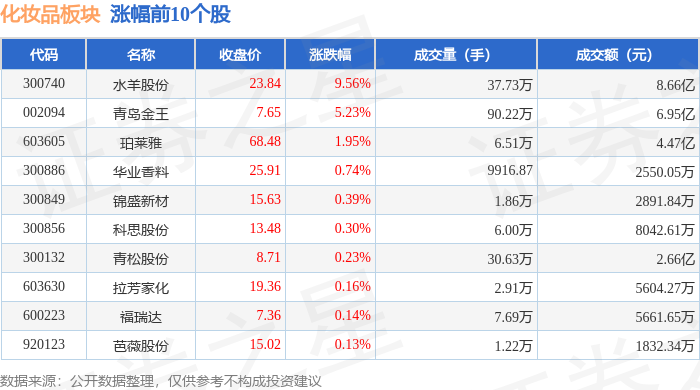
Group 1 - The cosmetics sector experienced a rise of 1.33% on December 31, with Shuiyang Co., Ltd. leading the gains [1] - The Shanghai Composite Index closed at 3968.84, up 0.09%, while the Shenzhen Component Index closed at 13525.02, down 0.58% [1] - Key stocks in the cosmetics sector showed varied performance, with Shuiyang Co., Ltd. closing at 23.84, up 9.56%, and Qingdao Kingking closing at 7.65, up 5.23% [1] Group 2 - The cosmetics sector saw a net inflow of 50.68 million yuan from institutional investors, while retail investors experienced a net outflow of 89.73 million yuan [2] - The stock performance of individual companies showed that Qingdao Kingking had a significant net outflow of 50.75 million yuan from institutional investors [3] - Shuiyang Co., Ltd. had a net inflow of 32.23 million yuan from institutional investors, indicating strong interest despite overall retail outflows [3]