
淡水泉

Search documents
全球资本“寻锚”中国
Shang Hai Zheng Quan Bao· 2025-12-01 19:23
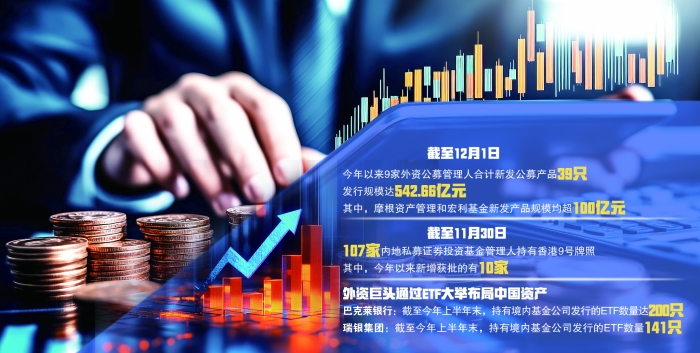
Core Insights - Global capital is increasingly entering the Chinese market, viewing it as a strategic asset for future growth and investment opportunities [2][3][9] Group 1: Foreign Capital Entry - Fidelity Investments has launched its first pension target fund in China, marking a significant shift from observation to active participation in the pension market [2][3] - As of December 1, nine foreign public fund managers have launched 39 new funds this year, raising over 50 billion yuan, indicating a strong commitment to the Chinese market [3][4] - Major foreign institutions like Morgan Stanley and UBS have significantly increased their holdings in Chinese ETFs, reflecting a broader strategy of asset accumulation [2][3][7] Group 2: Fundraising and Capital Increases - Fidelity's registered capital has increased from $18.2 million to $20 million this year, a nearly 10% rise, showcasing confidence in the Chinese market [4] - Other foreign public funds, such as Morgan Stanley and Invesco, have also raised their registered capital significantly, indicating a positive outlook on China's economic prospects [4] Group 3: Investment Trends - Foreign capital is increasingly favoring Chinese equity assets, with a notable rise in net purchases this year compared to previous years [5][6] - The trend of domestic private equity firms obtaining Hong Kong licenses is growing, with 107 firms now holding such licenses, indicating a shift towards international engagement [6] Group 4: Focus on Technology and Innovation - Foreign investors are particularly interested in China's technology sector, especially in AI and related applications, recognizing the potential for significant returns [10] - The focus is shifting from hardware to platform and application layers in technology, which may present new investment opportunities for Chinese internet and software companies [10]

私募超44000次调研,去了哪些行业?
中国基金报· 2025-11-30 15:06
Core Insights - The article highlights that private equity firms have conducted over 44,000 research activities on A-share listed companies in China this year, with a strong focus on hard technology sectors such as electronics, biomedicine, and machinery [2][4]. Group 1: Research Activities - A total of 2,579 private equity firms participated in A-share research activities, covering 2,184 stocks across 30 primary industries, with 44,702 total research instances [4]. - The top three industries by research frequency are electronics (8,732 times), biomedicine (6,341 times), and machinery (5,437 times) [4]. - Notable stocks in the electronics sector include Luxshare Precision, which was researched 335 times, and other prominent companies in the biomedicine sector such as United Imaging Healthcare and Mindray Medical [4][5]. Group 2: Investment Focus - Private equity firms are increasingly interested in sectors like artificial intelligence, innovative pharmaceuticals, and new consumption trends, as well as structural opportunities arising from "anti-involution" policies [2][9]. - The electronics industry is leading due to accelerated domestic semiconductor replacement and the initiation of a consumer electronics innovation cycle [7]. - The biomedicine sector is favored for its diverse stock options and the rapid approval of innovative drugs, while the power equipment sector benefits from the continuous growth of new energy installations [7]. Group 3: Market Outlook - The article suggests that the market is transitioning from valuation-driven to performance-driven, with a focus on high-growth sectors such as AI, innovative pharmaceuticals, and machinery [9]. - There is an expectation that individual stock performance will become more significant than sector performance in the future, with a focus on areas that show structural growth potential [9]. - Investment strategies are being adjusted to account for market corrections and style rebalancing, with an emphasis on sectors that can maintain profitability without relying on overall economic recovery [9].

创历史新高 私募管理规模突破22万亿元
Shang Hai Zheng Quan Bao· 2025-11-30 14:09
Core Insights - The private equity management scale in China has reached a historic high of over 22 trillion yuan, driven by structural market opportunities and the evolution of the industry ecosystem [1][4][5] Group 1: Private Equity Scale Growth - As of the end of October, the private equity fund management scale reached 22.05 trillion yuan, an increase of 1.31 trillion yuan from the end of September [1] - The number of existing private securities investment funds reached 80,214, with a total scale of 7.01 trillion yuan, marking a growth of over 1 trillion yuan compared to September [1][5] - In October, new registrations of private funds totaled 1,389, with a new registration scale of 670.1 billion yuan, where private securities investment funds accounted for 995 new registrations and 429.2 billion yuan [2] Group 2: Expansion of Billion-Level Private Equity - The number of billion-level private equity firms has increased to over 110, with 18 new firms entering this tier and one exiting [3] - Notable new entrants include firms such as Xiyue Investment and Shanghai Xinpu Private Equity [3] Group 3: Market Activity and Industry Purification - The ongoing structural market trends have significantly contributed to the record high in private equity scale, with many products achieving over 10% annual returns, attracting investors from fixed-income products [4] - The number of existing private fund managers has decreased to 19,367, down from 20,289 at the beginning of the year, indicating a trend of industry consolidation [5][6] Group 4: Future Market Outlook - Institutions are optimistic about future market conditions, with expectations of continued structural opportunities in the A-share market despite potential short-term adjustments [7] - The capital market is expected to maintain growth potential, particularly in emerging growth and cyclical sectors that do not rely on overall economic recovery [7]
内地私募出海加速!持香港9号牌数突破百家,头部私募成布局主力
证券时报· 2025-11-27 04:34
Core Insights - The private equity industry in China is undergoing a significant transformation, with leading firms accelerating their international expansion efforts, as evidenced by the approval of 10 new firms for Hong Kong's 9 license, bringing the total to 107 licensed firms [1][2]. Group 1: Industry Overview - As of November 26, 2023, the number of licensed private equity firms in China has surpassed 100 for the first time, indicating a shift from a trial phase to a new cycle of global competition [1]. - Among the licensed firms, subjective private equity firms dominate with 69 firms, followed by quantitative firms with 28, and mixed strategy firms with 10 [5]. Group 2: New Entrants and Market Structure - The newly approved firms include an equal number of subjective and quantitative private equity firms, with a clear tiered structure in terms of management scale [3]. - In the existing 107 licensed firms, large-scale private equity firms (over 10 billion) hold a significant market share, with 35 firms managing over 100 billion, accounting for nearly 50% of the total [3][4]. Group 3: Drivers of International Expansion - Key factors driving the internationalization of leading private equity firms include the high initial costs of compliance and market entry, a strong client base with global asset allocation needs, and accumulated compliance advantages [4]. - The global market offers diverse asset classes and financial instruments, which support private equity firms in expanding their investment strategies and identifying differentiated return opportunities [8]. Group 4: Future Outlook - The trend of private equity firms seeking global expansion is expected to continue, with industry experts predicting a new wave of growth in cross-border business over the next 3 to 5 years [8].

内地私募出海加速!持香港9号牌数突破百家,头部私募成布局主力
Zheng Quan Shi Bao Wang· 2025-11-27 01:25
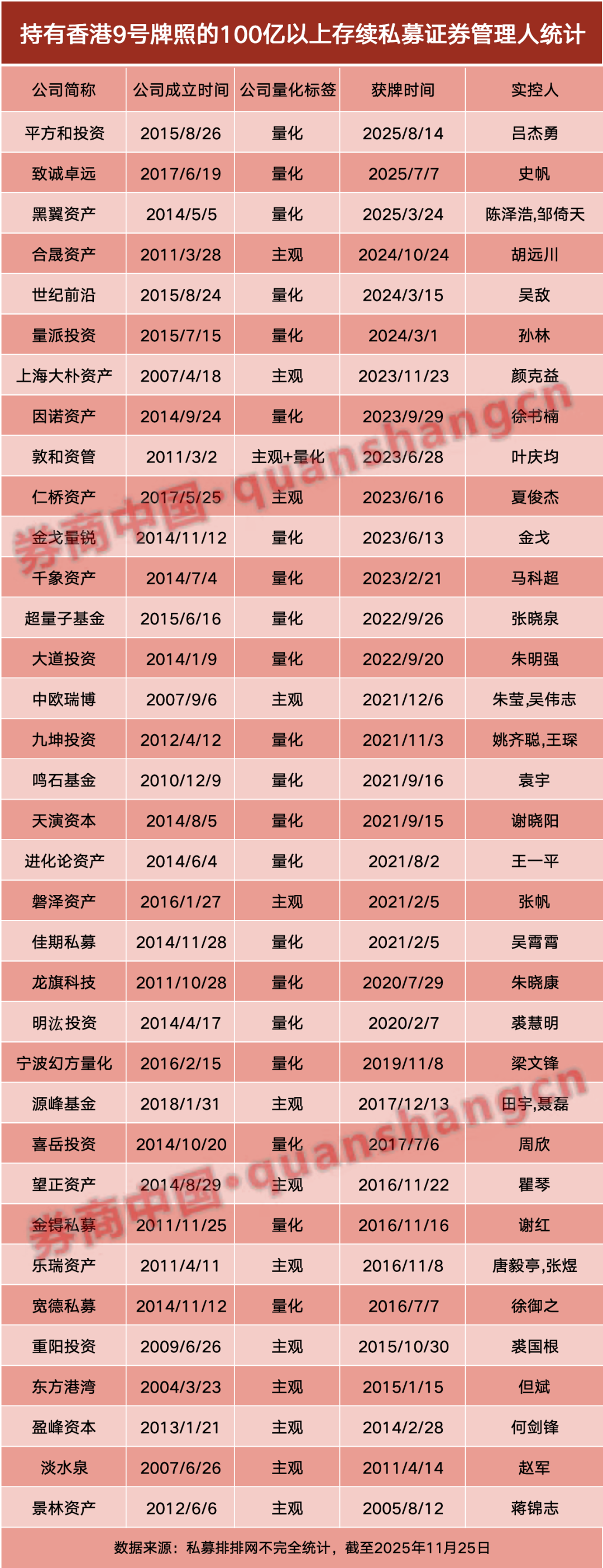
Core Insights - The private equity industry in China is undergoing a rapid transformation, with leading private equity firms accelerating their international expansion efforts [1][6] - As of November 26, 2023, the number of licensed private equity firms in Hong Kong has surpassed 100, indicating a significant milestone in the internationalization of Chinese private equity [1][2] Group 1: Industry Overview - A total of 10 new private equity firms have been approved for the Hong Kong license this year, with a balanced distribution between subjective and quantitative firms [2] - The majority of licensed firms are large-scale, with 35 firms managing over 10 billion yuan, representing nearly 50% of the total licensed firms [2][3] - The trend indicates that large private equity firms are becoming the main players in cross-border operations due to their financial strength and established client bases [2][6] Group 2: Firm Characteristics - Among the 107 licensed firms, subjective private equity firms dominate with 69 firms, accounting for over 60% of the total [3] - The large-scale private equity firms are primarily focused on international expansion, with 35 firms having obtained the Hong Kong license [4] - The historical timeline shows that 2021 and 2023 were peak years for large private equity firms obtaining the Hong Kong license, with multiple firms receiving approval during these years [5] Group 3: Strategic Drivers - The push for international expansion is driven by the need to diversify risks, enhance investment strategies, and meet the growing global asset allocation demands of clients [6] - The increasing regulatory requirements for cross-border operations favor larger firms that have accumulated compliance advantages over time [2][6] - The anticipated deepening of financial market integration between Hong Kong and mainland China is expected to create new opportunities for private equity firms in the next 3-5 years [6]
内地私募出海加速!持香港9号牌数突破百家,头部私募成布局主力
券商中国· 2025-11-27 01:14
Core Viewpoint - The private equity industry in China is undergoing rapid internationalization, with a significant increase in the number of licensed private equity firms in Hong Kong, indicating a shift from a trial phase to a new cycle of global competition [1][2]. Group 1: Growth of Licensed Private Equity Firms - As of November 26, 2023, there are 107 licensed private equity firms in Hong Kong, marking a historic milestone of surpassing 100 firms [1]. - In 2023, 10 new firms received licenses, with a balanced distribution between subjective and quantitative private equity firms, each contributing 5 firms [2]. - Among the licensed firms, those managing over 10 billion yuan dominate, with 35 firms managing over 100 billion yuan, accounting for nearly 50% of the total [2]. Group 2: Characteristics of Licensed Firms - The majority of licensed firms are subjective private equity firms, totaling 69, which represents over 60% of the total [4]. - Quantitative private equity firms account for 28 firms, approximately 26.17%, while mixed firms (subjective + quantitative) make up 10 firms, less than 10% [4]. Group 3: Drivers of Internationalization - The leading private equity firms are becoming the main players in cross-border operations due to their substantial financial resources, which allow them to absorb the high initial costs associated with compliance and market entry [3]. - There is a strong demand for global asset allocation among institutional investors and high-net-worth individuals, providing a natural client base for private equity firms looking to expand internationally [3]. - The stringent regulatory requirements for cross-border operations favor larger firms that have accumulated compliance advantages over time [3]. - Expanding into overseas markets is seen as a strategic necessity for private equity firms to overcome domestic competition and explore new growth avenues [3]. Group 4: Future Outlook - The trend of private equity firms accelerating their global expansion is expected to continue, driven by the need to diversify risks and enhance service capabilities to meet growing investor demands [7]. - The deepening integration of Hong Kong's financial market with mainland China's asset management industry is anticipated to create new opportunities for cross-border business expansion in the next 3 to 5 years [7].
世纪华通接待97家机构调研,包括淡水泉、重阳投资、众安保险、中邮基金等
Jin Rong Jie· 2025-11-26 11:40
Core Viewpoint - The company emphasizes the importance of the gaming industry in driving AI development and positions itself as a key player in the digital world, focusing on technology-driven content and a robust product matrix [2][3][5]. Company Strategy and Industry Outlook - The chairman believes that gaming is crucial for AI infrastructure, as it drives advancements in CPU/GPU technology, which are foundational for AI [2]. - The company aims to leverage gaming as a gateway to the digital world and enhance human-AI interaction [2]. Business Performance and Product Development - The company has a strong portfolio of classic long-term products, with several top IPs maintaining high ARPU and user retention, exceeding industry averages [3]. - The product matrix is diverse, with multiple genres being developed, particularly focusing on SLG and casual games, which are expected to see significant releases in the coming year [3]. - The company is recognized as the leading Chinese game company in overseas revenue, with a growing market share [3][5]. Competitive Advantage - The company's core competitive advantage lies in its integrated system capabilities that combine research, publishing, and operations, all driven by data [4][5]. - This data-driven approach minimizes subjective decision-making and enhances operational efficiency through extensive A/B testing [4]. Financial Performance - The company reported over 10 billion in revenue for Q3, ranking sixth among global gaming companies and achieving a doubling in growth rate [5]. - The company is noted for its ability to maintain growth despite its large scale, which is a rare combination in the industry [5]. Market Dynamics and Challenges - The company faces rising user acquisition costs both domestically and internationally, with increased competition in the domestic market [8]. - The company is adapting to changes in revenue models, such as the impact of platform fee adjustments, which are expected to have a minor effect on overall income but could improve user retention and payment rates [9]. Future Directions - The company plans to continue expanding its presence in the casual gaming sector, aiming for breakthroughs that could significantly impact its growth trajectory [6]. - The company is committed to optimizing its incentive mechanisms to ensure team stability and performance, particularly in its high-contribution segments [7].

107家内地私募持香港9号牌照
Guo Ji Jin Rong Bao· 2025-11-26 10:28
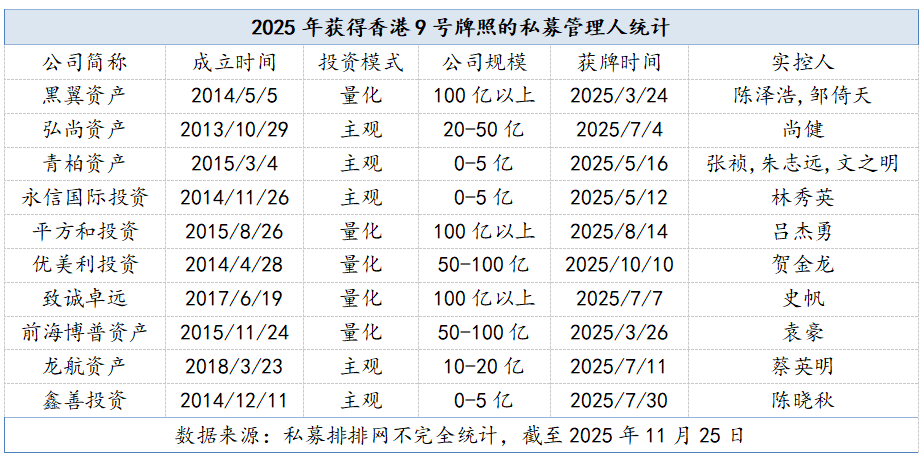
从年内新增持牌机构的特征来看,其投资模式呈现均衡分布态势,主观私募与量化私募各占5家,平分秋色。从管理规模来 看,100亿元以上及0至5亿元规模的机构数量居首,均为3家,前者包括黑翼资产、平方和投资、致诚卓远,后者为青柏资产、永信 国际投资、鑫善投资;50亿至100亿元规模的私募机构有2家,分别是优美利投资、前海博普资产;10亿至20亿元和20亿至50亿元规 模的私募机构各1家,依次为龙航资产、弘尚资产。 对于大规模私募成为持牌主力的现象,排排网财富研究总监刘有华解释道,跨境布局需承担合规体系搭建、海外团队组建、市 场调研等高额初始成本,唯有管理规模雄厚的头部私募具备资金实力消化前期投入。同时,大型私募长期服务机构投资者与高净值 客群,这类群体的全球化配置需求为其提供了天然客户基础。此外,头部私募在长期运营中积累的合规管理优势与公司治理经验, 使其更易通过香港地区严苛的监管审批。 | | 持有香港9号牌照私募管理人分规模统计 | | | --- | --- | --- | | 公司规模 | 公司数量 | 数量占比 | | 0-5 亿 | 37 | 34. 58% | | 100亿以上 | 35 | 32.71 ...
均衡配置 寻找确定性 年底私募投资“关键词”出炉
Zhong Guo Zheng Quan Bao· 2025-11-25 20:29
Core Viewpoint - The recent adjustment in the A-share market is attributed to a combination of internal and external factors, leading to a collective risk-averse behavior among investors [1][2]. Group 1: Market Adjustment Factors - The adjustment is seen as a result of multiple factors, including concerns over the economic fundamentals and a complex external environment, alongside fluctuations in liquidity expectations for December [2]. - The tightening of overseas liquidity, particularly following the Federal Reserve's hawkish stance, has led to a net outflow of foreign capital, putting pressure on high-valuation technology stocks in the A-share market [2]. - Defensive behaviors, such as profit-taking by institutional investors as the year-end approaches, have contributed to short-term market volatility [2][4]. Group 2: Private Equity Strategies - Private equity firms are responding to the high market positions with varied strategies, including maintaining high positions, using derivatives for risk hedging, and actively adjusting portfolios for future market conditions [1][4]. - As of November 14, the average stock position of private equity firms reached 81.13%, with large firms holding an even higher average of 87.07%, indicating a high level of market engagement [4]. - Some firms, like Dushuquan, are employing precise risk hedging techniques, such as purchasing out-of-the-money put options to protect against extreme drawdowns [5]. Group 3: Long-term Market Outlook - Despite short-term challenges, private equity firms maintain confidence in the long-term market, actively seeking new investment opportunities during the adjustment [7]. - Dushuquan emphasizes that the current market adjustment is a "healthy correction" within a long-term upward trend, which can help optimize market leverage levels and trading structures [8]. - Firms are focusing on sectors with structural growth potential that do not rely on overall economic recovery, particularly in emerging growth areas like AI technology, semiconductor, and new consumption trends [7].
年底私募投资“关键词”出炉
Zhong Guo Zheng Quan Bao· 2025-11-25 20:27
Core Viewpoint - The recent adjustment in the A-share market is attributed to a combination of internal and external factors, leading to a collective risk-averse behavior among funds [1][2]. Group 1: Market Adjustment Factors - The market adjustment is seen as a result of multiple factors, including concerns over the economic fundamentals and a complex external environment, alongside fluctuations in liquidity expectations for December [2]. - The tightening of overseas liquidity, particularly following the Federal Reserve's hawkish stance, has led to a net outflow of foreign capital, putting pressure on high-valuation technology sectors in A-shares [2]. - Defensive behaviors, such as institutions cashing in on floating profits as the year-end approaches, have contributed to short-term market volatility [2]. Group 2: Private Equity Strategies - Private equity firms have adopted varied strategies in response to the high market positions, with an average stock position of 81.13% among private equity firms, reaching a 112-week high [3]. - Some firms, like Zhiyu Zhi Shan, utilize risk hedging techniques, such as purchasing out-of-the-money put options to protect against extreme drawdowns [4]. - Others, like Yongjin Investment, have adjusted their portfolios to include cyclical stocks while maintaining a balanced approach to technology sectors [4]. Group 3: Long-term Market Outlook - Despite short-term challenges, private equity firms maintain confidence in the long-term market, actively seeking new investment opportunities during the adjustment [4][5]. - Firms like Dushuquan emphasize that the current market does not exhibit systemic bubbles, focusing on sectors with structural growth potential that can sustain performance without relying on overall economic recovery [5]. - The adjustment is viewed as a healthy correction within a long-term upward trend, helping to manage leverage levels and optimize market trading structures [5].