
LVMH

Search documents
X @Bloomberg
Bloomberg· 2026-01-27 17:05
Sales at LVMH’s key fashion unit fell over the holiday season as the Louis Vuitton owner continued to suffer from weak demand https://t.co/Rg6jAU2mSp ...
财报季前,奢侈品股遭遇抛售潮,投资者在担心什么?
Hua Er Jie Jian Wen· 2026-01-27 12:37
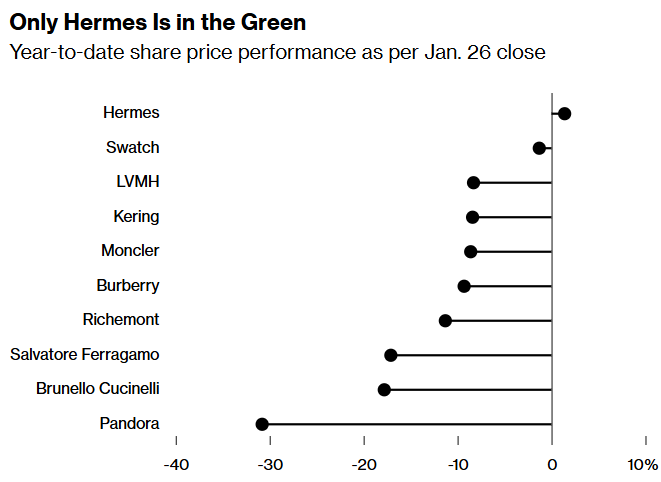
奢侈品股投资者正为即将到来的艰难财报季做准备。今年以来,地缘政治紧张局势加剧以及对消费者需 求的担忧,已引发板块显著抛售,抹去了去年下半年的多数涨幅。市场对行业能否在2026年实现预期中 的盈利反弹,正变得愈发谨慎。 地缘政治与贸易紧张局势是近期市场动荡的直接推手。本月新出现的贸易紧张态势导致股价再度下挫, 尽管上周局势因美国总统特朗普放弃了对欧洲国家的关税威胁而略有缓和。分析师视北美市场为今年增 长的重要驱动力,但不确定性依然存在。 市场聚焦点迅速转向即将密集发布的奢侈品公司财报。法国巨头LVMH将于周二公布第四季度业绩,成 为行业健康状况的下一个试金石。开云集团和爱马仕国际将分别于2月10日和12日发布财报。这些报告 将揭示行业面临的真实压力。 财报季成为关键压力测试 根据彭博行业研究汇编的数据,LVMH、爱马仕、盟可睐及开云集团第四季度的盈利预计平均下滑 6.1%,远逊于同期预计增长1.3%的MSCI欧洲指数。本轮财报季的关键在于,企业是否对在2026年实现 利润反弹抱有足够信心。 德意志银行分析师Adam Cochrane指出,LVMH的业绩将提供更好的观察视角。分析师预计,LVMH核 心的时装与皮具 ...
投资者预防“业绩杀”,欧洲奢侈品股绩前“先跌为敬”
Zhi Tong Cai Jing· 2026-01-27 11:08
Core Viewpoint - Investors are preparing for a challenging earnings season for luxury goods manufacturers, with geopolitical tensions and uncertain consumer demand in China impacting stock performance, leading to an 8.1% decline in a basket of luxury stocks under Goldman Sachs this year, erasing much of the gains from the previous two quarters [1][3] Group 1: Earnings Expectations - LVMH is set to release its fourth-quarter results, which will serve as a test for the overall industry, with Kering SA and Hermes International also scheduled to report earnings soon [3] - Analysts expect an average decline of 6.1% in fourth-quarter earnings for LVMH, Hermes, Kering, and Moncler, significantly underperforming the MSCI Europe index's expected growth of 1.3% during the same period [3] - The key focus for this earnings season is whether these companies can express confidence in achieving a profit rebound by 2026 [3] Group 2: Market Dynamics - The luxury sector has been viewed as "Europe's large tech stocks" due to their size, rapid growth, and robust business models, but overall performance has lagged behind the market since rising interest rates and weakening demand in China began in 2022 [3] - Recent easing of tariff pressures, particularly after Trump abandoned plans for tariffs related to Greenland, has provided some relief to the industry, with North America expected to be a significant growth driver this year [4][10] - Analysts note that the luxury sector's recovery is crucial, with expectations of a 5% revenue growth for the industry this year, although a decline of 1% is anticipated from 2023 to 2025 [7] Group 3: Consumer Sentiment and Valuation - The upcoming Chinese New Year holiday is a critical sales period for luxury goods, allowing executives to comment on observed trends during earnings calls [10] - Despite a slight recovery in market sentiment and early signs of consumer recovery in China, high-end brands are expected to perform better than entry-level brands in 2025, while fashion-forward and entry-level luxury brands face long-term demand challenges [10] - Investor caution is attributed to high valuations, with luxury stocks trading at a 74% premium over the Stoxx Europe 600 index, despite a recent decline in expected price-to-earnings ratios [10]

妙可蓝多创始人柴琇被免职:或加速融入蒙牛丨消费参考
2 1 Shi Ji Jing Ji Bao Dao· 2026-01-27 01:53
21世纪经济报道记者贺泓源、实习生徐鸿儒 蒙牛对妙可蓝多的控制或步入新阶段。 1月25日,妙可蓝多公告,柴琇被免副董事长、总经理及法定代表人职务,但继续担任公司董事。同 时,公司聘任蒯玉龙为总经理,法定代表人相应变更为蒯玉龙,其不再兼任公司行政总经理。柴琇为妙 可蓝多创始人。 蒯玉龙则有着浓郁的蒙牛背景。他于2021年随蒙牛入股担任妙可蓝多任财务总监,2025年升任行政总经 理。作为控股股东,蒙牛目前持股超37%。截至2025年末,柴琇依旧为妙可蓝多第二大股东,算上一致 行动人吉林省东秀商贸总计持股15.96%。 需要注意的,基于柴琇被免职,其与蒙牛关系显得有些尴尬。 柴琇此前已出具书面承诺,若因上述担保事项导致妙可蓝多产生直接或间接损失,将向公司足额补偿。 但经妙可蓝多的屡次敦促,柴琇截至公告日仍未履行该补偿承诺,也未给出明确的解决方案。 另据21世纪经济报道记者了解,柴琇对妙可蓝多的种种经营策略,在内部也遭遇了越来越多争议。 眼下,妙可蓝多终于回归增长区间。 2025年三季度,该公司营收同比增长14.22%至13.90亿元;归母净利润同比增长214.67%至4297万元。 背后是B端市场推动,尤其是在马苏 ...


好的创业一定伴随着乐趣
创业家· 2026-01-26 10:52
Core Viewpoint - The article emphasizes the importance of cultural empathy and brand storytelling in the growth of Chinese brands, particularly in the context of the global market where mere cost advantages are no longer sufficient for success [7]. Group 1: Brand Development Strategies - Chinese brands are transitioning from a focus on production capabilities to establishing their ecological positions and selling brand value in a competitive market [7]. - The article identifies the "golden decade" for lifestyle brands in sectors such as beauty, home, dining, and fashion, highlighting the need for brands to learn from European counterparts in creating emotional connections with consumers [7]. - The three core elements of enduring European brands are identified as scarcity narrative, supply chain control, and lifestyle definition [8]. Group 2: Learning from European Brands - Scarcity narrative involves shifting from "selling products" to "selling dreams," which is crucial for brand differentiation [8]. - Supply chain control is essential for defining industry standards, as exemplified by L'Oréal's integration of technology, content, and channels to create successful products [10]. - Lifestyle definition focuses on how design and innovation can reshape consumer experiences, as seen in the practices of brands like Prada and educational institutions like Le Cordon Bleu [12]. Group 3: Program Overview - The program includes visits to key locations in Paris and Milan, such as the IFM French Fashion Institute and Loro Piana, to understand the foundations of luxury branding and the importance of material quality [16][23]. - Participants will explore how to leverage brand origin stories and craftsmanship to build competitive advantages [18]. - The itinerary also covers insights into the integration of art and design in product offerings, as demonstrated by brands like FORMER, which has successfully elevated furniture to a higher value proposition [24].

Why European Wine Could Get Pricier Under New US Tariffs
Youtube· 2026-01-24 15:01
Core Viewpoint - President Trump's potential imposition of tariffs on European wines could significantly impact the U.S. wine industry, affecting both importers and domestic producers, while also raising concerns about the overall economic implications of such tariffs [1][2][3]. Industry Impact - The U.S. wine market consumed nearly 900 million gallons in 2023, valued at over $107 billion, with more than a third of that volume imported from abroad, making tariffs a critical issue for importers [1][2]. - Domestic wine distributors and importers derive approximately 75% of their revenue from imported wines, indicating that tariffs could severely disrupt their business models [1][2]. - California wineries, which produce nearly 90% of U.S. wine, are currently facing significant challenges, including over 500,000 excess tons of grapes and 77 million gallons of wine in storage, leading to potential closures of small farms and family businesses [1][2]. Economic Considerations - The U.S. imports about $5.3 billion worth of wine from the European Union, while American businesses generate nearly $23 billion from the sale of these products, highlighting a significant economic surplus despite the trade deficit concerns [2][3]. - The imposition of tariffs could lead to business contractions, resulting in closures and layoffs within the American wine industry, particularly affecting small businesses that rely heavily on imported wines [2][3]. Market Dynamics - The wine ecosystem is interconnected, with domestic vineyards relying on distributors who also sell imported wines, making tariffs detrimental not only to importers but also to domestic producers [1][2]. - There is a distinction between the fine wine market and the value wine segment, with the latter facing pressure from cheap, subsidized imports that threaten American growers [1][2]. Legal and Regulatory Context - A lawsuit challenging the tariffs is underway, with the U.S. Court of International Trade ruling in favor of the lead plaintiff, indicating ongoing legal battles regarding the administration's tariff policies [3][4].

一场两极分化的消费复苏正在发生
雪球· 2026-01-24 03:50
Core Viewpoint - The article discusses the recovery of luxury goods consumption in China, highlighting a rebound in demand and the differentiation between high-end and mass-market segments [5][11][31]. Group 1: Luxury Goods Market Recovery - In Q3 2025, LVMH reported total revenue of €18.2 billion, marking the first sales rebound of the year, with a 7% growth in the Greater China region [5][14]. - The consumer confidence index in China has been steadily rising since reaching a low in September 2024, indicating a gradual recovery in consumer spending [5][9]. - The luxury goods sector is experiencing a notable recovery, with many brands reporting their first positive growth since the pandemic, suggesting a restoration of industry confidence [12][18]. Group 2: Market Segmentation - The recovery in consumption is characterized by polarization, where high-end markets are recovering faster than lower-tier markets, which remain cautious and price-sensitive [11][21]. - High-end brands are benefiting from increased consumer confidence, while mass-market brands are pressured to lower prices and offer promotions, impacting their profit margins [21][29]. - The demand for high-end gold jewelry has surged, with companies like Chow Tai Fook reporting significant growth, contrasting with a 33% decline in overall gold jewelry consumption [23][31]. Group 3: Performance of Key Brands - Prada achieved a 10% growth in Q3 2025, driven by a 41% increase in its Miu Miu brand, appealing to a younger consumer demographic [18]. - The performance of luxury brands such as LVMH, Prada, and Hermès in Q3 2025 indicates a positive trend, with many brands returning to growth [13][19]. - The retail performance of high-end shopping malls, such as the Shanghai Taikoo Hui, showed a 41.9% increase in sales, further supporting the recovery narrative [20]. Group 4: Future Outlook - The article suggests that the recovery of high-end consumption may eventually extend to broader consumer segments, leading to a more sustained recovery in the luxury goods market [35]. - Investment opportunities in 2026 may arise from focusing on high-end segments while remaining cautious about the pressures facing mass-market brands [31].

经济越来越差,这八大行业越赚爆!
创业家· 2026-01-23 10:27
Core Insights - The article discusses how certain industries are thriving despite a general perception of economic downturn, highlighting eight key sectors that present significant business opportunities in a low-desire society [3][4]. Group 1: Key Industries - **Second-Hand Economy**: The second-hand luxury market in Japan, represented by companies like Daikokuya, has seen a surge in revenue. In China, platforms like Hongbulin and Panghu are experiencing similar growth, indicating a shift in consumer spending towards second-hand goods [6][7][8][9]. - **Pet Economy**: With declining birth rates, young people are investing more in pets, leading to a boom in pet food and healthcare products. Companies like Inaba in Japan and Guobao in China are capitalizing on this trend [11][12][14][15]. - **Adult Care Products**: The adult diaper market in Japan has surpassed $10 billion, indicating a growing demand for adult care products in China, with companies like Kexin showing potential for growth [16][17][18]. - **Health Food and Beverages**: The rise in health consciousness has led to increased sales of sugar-free beverages and functional drinks in both Japan and China, with brands like Suntory and Dongpeng gaining traction [21][22]. - **Beauty Economy**: The demand for beauty products, including collagen supplements and at-home beauty devices, remains strong, with companies like Jinbo Biological achieving significant market valuations [23][25]. - **Outdoor Recreation**: The outdoor equipment market is thriving, with brands like Snow Peak in Japan and various Chinese brands experiencing rapid sales growth, as consumers seek leisure activities despite economic constraints [25][26][27]. - **Emotional Economy**: Brands that provide emotional comfort, such as Labubu and Rio, are gaining popularity, reflecting a consumer willingness to spend on small pleasures even in tough times [28][29][30]. - **Convenience Economy**: The demand for convenience products, such as frozen foods and smart home appliances, is increasing as younger generations prioritize time-saving solutions [33][35][36]. Group 2: Market Trends - The article emphasizes that the current low-desire economic environment does not equate to a lack of opportunities. Instead, it suggests that businesses that can identify and invest in counter-cyclical sectors will emerge as winners [39].

格隆汇1月22日|LVMH于1月19日建仓中国中免(1880.HK),持股比例达6.30%。
Ge Long Hui· 2026-01-22 12:16
Group 1 - LVMH established a stake in China Duty Free Group (1880.HK) on January 19, with a holding percentage of 6.30% [1]

WPP’s CTO says AI is reshaping advertising. But creative judgment needs to remain in human hands
Yahoo Finance· 2026-01-21 18:04
Core Insights - The article highlights the significant adoption of WPP Open, an AI-enabled operating system, by WPP's workforce, indicating a major shift in how marketing campaigns are planned and executed [2] Group 1: AI Adoption and Workforce Engagement - Over 85,000 of WPP's 108,000 employees are using WPP Open monthly, a substantial increase from 30,000 in February 2024 [2] - WPP has implemented three levels of AI training to prepare its workforce, including a creative technology apprenticeship program aimed at training 1,000 apprentices over three years as part of a $400 million partnership with Google [4] - Senior staff at WPP are required to take courses on generative AI and its application in media planning and creative ideation [5] Group 2: Continuous Learning and Industry Trends - Ongoing AI upskilling programs are deemed essential, with the expectation that employees will continuously learn to work with AI tools [6] - A survey by Forrester indicates that 75% of ad industry executives expect their companies to use generative AI tools by 2025, up from 61% the previous year [6] Group 3: Financial Implications of AI Investments - Despite the adoption of AI, these investments currently represent a net cost for agencies, with the cost of business related to generative AI capabilities increasing by 83% in 2025 [7] - Only 7% of agencies have been able to sell generative AI capabilities as a separate service, indicating challenges in monetizing these investments [7]