上美股份

Search documents
【上美股份(2145.HK)】百尺竿头更进一步,从单品牌单平台向多品牌全渠道集团化蜕变——投资价值分析报告(姜浩/孙未未等)
光大证券研究· 2025-06-03 09:09
Company Overview - Shangmei Co., Ltd. is a multi-brand cosmetics group established in 2004, listed on the Hong Kong Stock Exchange in 2022, covering skincare, maternal and infant care, personal care, and makeup products [2] - The main brand, Han Shu, launched in 2003, is the second largest domestic beauty brand by GMV in online channels for 2024 and has the highest growth rate among leading beauty brands [2] - The company has capitalized on the growth of the Douyin platform, achieving rapid revenue growth with a compound annual growth rate (CAGR) of 59.3% in revenue and 130.5% in net profit from 2022 to 2024 [2] Industry Analysis - The Chinese cosmetics industry has shown fluctuating growth since 2020, with a projected market size of 537.2 billion yuan in 2024, reflecting a 2.0% year-on-year decline [3] - Mass-market positioning is outperforming high-end positioning, indicating a consumer preference for cost-effectiveness [3] - Subcategories such as makeup and infant care are performing better than the overall cosmetics industry [3] - Domestic brands are leveraging online channels to gain market share, with Douyin emerging as a significant player, where Han Shu ranked first in GMV for beauty products in 2023 [3] Brand Growth Strategies - Han Shu focuses on mass-market positioning and scientific anti-aging, targeting a broad user base and enhancing profitability through new product launches and channel diversification [4] - The brand "Yi Ye" is capitalizing on the children's care market with triple-digit growth for two consecutive years, supported by endorsements from well-known actors and parenting experts [4] - Other potential brands include a hair care brand targeting hair loss and a makeup brand in collaboration with makeup artists, indicating a strategy to build multiple growth curves [4]

上美股份:投资价值分析报告百尺竿头更进一步,从单品牌单平台向多品牌全渠道集团化蜕变-20250603
EBSCN· 2025-06-03 08:00
Investment Rating - The report assigns a "Buy" rating to the company with a target price of 86 HKD, based on absolute and relative valuation results [4][14][6]. Core Insights - The company, Shumei Co., Ltd. (2145.HK), is a multi-brand cosmetics group that has shown remarkable growth, particularly through its main brand, KANS, which has become the second-largest domestic beauty brand in terms of online GMV by 2024 [2][23]. - The company has capitalized on the growth of the Douyin platform, leading to a significant increase in revenue and net profit from 2022 to 2024, with projected compound annual growth rates of 59.3% and 130.5%, respectively [2][4]. - The cosmetics industry in China is experiencing both growth and competition, with opportunities in lower-tier markets and niche segments, particularly in color cosmetics and infant care [3][72]. Company Overview - Shumei Co., Ltd. was established in 2004 and went public in 2022, offering a wide range of products including skincare, maternal and infant care, personal care, and makeup [2][23]. - The main brand, KANS, has been a significant contributor to the company's revenue, accounting for 82.3% of total revenue in 2024, with a projected revenue of 55.91 billion CNY [25][23]. Financial Performance - The company achieved a revenue of 67.93 billion CNY in 2024, representing a year-on-year growth of 62.1%, and a net profit of 7.81 billion CNY, up 69.4% from the previous year [4][5]. - The report forecasts net profits for 2025, 2026, and 2027 to be 10.6 billion CNY, 13.8 billion CNY, and 17.4 billion CNY, respectively, with corresponding EPS of 2.65, 3.47, and 4.37 CNY [4][14]. Industry Analysis - The Chinese cosmetics industry is projected to reach a scale of 537.2 billion CNY in 2024, with a slight decline of 2.0% year-on-year, indicating a shift in consumer preference towards cost-effective products [3][72]. - The competitive landscape is characterized by domestic brands leveraging online channels, with Douyin emerging as a key platform for growth [3][72]. Growth Drivers - The main brand KANS is expected to continue its growth trajectory through product innovation and channel diversification, while the emerging brand Yipai is anticipated to achieve triple-digit growth in revenue for 2023 and 2024 [4][10]. - The company is also exploring new brands and product lines, such as the hair care brand Jifang and the makeup brand NAN beauty, to create multiple growth avenues [4][12].
上美股份(02145):投资价值分析报告:百尺竿头更进一步,从单品牌单平台向多品牌全渠道集团化蜕变
EBSCN· 2025-06-03 06:57
Investment Rating - The report gives a "Buy" rating for the company with a target price of 86 HKD, compared to the current price of 66.3 HKD [6][14]. Core Insights - The company, Up Beauty Co., Ltd. (2145.HK), is transforming from a single-brand platform to a multi-brand, omnichannel group, with significant growth driven by its main brand, KANS, which ranks second among domestic beauty brands in online GMV for 2024 [2][3]. - The company has experienced rapid revenue growth, with a projected revenue of 6.793 billion CNY in 2024, representing a year-on-year increase of 62.1%, and a net profit of 781 million CNY, up 69.4% [2][4]. Company Overview - Up Beauty Co., Ltd. was established in 2004 and went public in 2022. It operates multiple brands, including KANS, One Leaf, Red Elephant, and New Page, covering skincare, maternal and child care, personal care, and makeup products [2][23]. - KANS, the main brand, has become a leading player in the domestic beauty market, achieving significant online sales growth, particularly on platforms like Douyin [2][3][35]. Industry Analysis - The Chinese cosmetics industry has shown fluctuating growth since 2020, with a projected market size of 537.2 billion CNY in 2024, reflecting a 2.0% year-on-year decline. However, mass-market cosmetics are performing better than high-end products, indicating a shift in consumer preference towards cost-effectiveness [3][72]. - The report highlights that the segments of color cosmetics and infant care are performing relatively well compared to the overall market [3][72]. Growth Highlights - KANS is positioned as a mass-market brand focusing on scientific anti-aging, with plans for product innovation and channel diversification to enhance profitability [4][10]. - The New Page brand is capitalizing on the infant care market, with expected triple-digit growth in revenue for 2023 and 2024 [4][10]. - Other potential brands, such as Jifang and NAN beauty, are also being developed to create multiple growth avenues for the company [4][12]. Financial Projections - The company forecasts net profits of 1.057 billion CNY, 1.381 billion CNY, and 1.738 billion CNY for 2025, 2026, and 2027, respectively, with corresponding EPS of 2.65, 3.47, and 4.37 CNY [4][14]. - Revenue is expected to grow at a compound annual growth rate (CAGR) of 23.6%, 20.9%, and 16.2% from 2025 to 2027 [4][11]. Competitive Positioning - The company has successfully leveraged online channels, particularly Douyin, to drive sales, with KANS achieving significant growth in this space [3][35]. - Compared to peers, Up Beauty Co., Ltd. ranks second in revenue and fourth in net profit among domestic cosmetics companies for 2024 [56][58].
国泰海通:美妆个护国货崛起加速 优选产品上升周期成长型标的
Zhi Tong Cai Jing· 2025-06-03 06:27
Core Viewpoint - The cosmetics retail sales in China for January to April 2025 showed a year-on-year increase of 4%, underperforming the overall retail market by 0.7 percentage points, but this represents an improvement compared to 2024. The industry is characterized by four key trends: innovation in personal care products, breakthroughs in ingredient technology, rising emotional consumption, and the continuation of affordable consumption [1][3]. Investment Recommendations - The company recommends increasing holdings in the personal care sector, highlighting quality companies that benefit from product innovation and opportunities in Douyin channels, with key recommendations including Ruoyuchen (003010), Dengkang Oral (001328), and Runben Co. [2] - In the beauty sector, structural opportunities are identified, with key recommendations for companies like Jinbo Biological, Juzi Biological, and Marubi Co. that are positioned to benefit from the collagen restructuring trend. Additionally, brands like Maogeping, Shumei Co., Proya (603605), and Shanghai Jahwa (600315) are expected to gain from the overall increase in domestic market share [2]. - Companies expected to bottom out and potentially see a turning point include Lafang Household (603630), Shuiyang Co. (300740), Betaini (300957), Furuida (600223), Huaxi Biological, Fulejia (301371), Meilitiantian Medical Health, and Qingsong Co. (300132) [2]. Industry Overview - Demand remains stable, with the rise of domestic brands in the beauty and personal care sectors accelerating. The cosmetics retail sales for January to April 2025 increased by 4% year-on-year, which is a 0.7 percentage point underperformance compared to the overall retail market, but shows improvement from 2024. The overall demand is stable, with leading domestic brands performing well and the rise of new domestic brands spreading from beauty to personal care categories [3][4]. Trends - The industry is witnessing several trends: 1) Personal care transformation with new products in traditional categories, supported by content e-commerce creating a favorable environment for new product launches [4]. 2) Ingredient innovation, particularly in collagen restructuring, with various types and structural innovations expanding application scenarios [4]. 3) Emotional consumption, where cultural, stylistic, and experiential demands are driving the growth of domestic trends in cosmetics and fragrances [4]. 4) Affordable consumption, where the trend for cost-effectiveness continues under supply-demand resonance, benefiting strong supply chains and well-operated brands [4]. Key Companies - Looking ahead to 2025, the market risk appetite is expected to recover significantly. The beauty sector is characterized by substantial changes and a clear trend of rising domestic brands, indicating strong growth potential and leadership in new consumption [5]. The differentiation among brands is increasing, emphasizing the selection of high-growth targets driven by product innovation and attention to marginal improvements [5].




申万宏源:线上电商高速成长红利或进入尾声 线下渠道价值重估
Zhi Tong Cai Jing· 2025-06-03 02:22
Group 1 - The Chinese e-commerce market is transitioning from a phase dominated by incremental growth to a mature stage that balances both incremental and stock growth, with online retail sales of physical goods expected to reach 13.1 trillion yuan in 2024, growing at a rate of 6.5% [1][2] - The number of online shopping users is projected to reach 974 million by the end of 2024, with a penetration rate of 87.9% among internet users, indicating a saturated market [2] - Key indicators in live-streaming e-commerce, including transaction scale, user scale, and consumption growth rate, are declining year by year, intensifying competition among major players [2] Group 2 - Recent policies have been introduced to support offline business models, aiming to expand domestic demand comprehensively by 2025 [3] - Diverse and innovative offline business formats can enhance brand influence and consumer loyalty, providing new growth points for brands [3] Group 3 - The Chinese offline beauty market has potential for growth, with a market structure that can be upgraded, as evidenced by the decline in market share of department stores from 38.2% in 2018 to 27.2% in 2023 [4] - The market share of beauty specialty stores and health and personal care stores remains stable at around 7%, showing a slight downward trend, while supermarkets account for only about 3% of the overall market share [4] Group 4 - Leading domestic brands are focusing on differentiated offline strategies, such as Up Beauty's balanced multi-brand matrix, Shanghai Jahwa's extensive layout in department stores, and Proya's offline energy series [5] - Other notable brands include Betaini, which leverages pharmacy endorsements for a professional image, and Maogeping, which creates a unique high-end brand experience [5]

上市半年股价翻4倍,毛戈平是一家怎样的公司?
Sou Hu Cai Jing· 2025-06-03 01:12
Group 1 - The beauty and personal care sector has seen the highest growth in the Shenyin Wanguo industry since 2025, with an increase of 11.17% [1] - Notable stock performances in the A-share market include Lafang with a rise of 93.76%, Runben with 72.08%, and Haoyue Care with 58.81% [1] - In the Hong Kong market, Mao Geping has experienced a remarkable increase of over 118% this year, with its stock price quadrupling since its listing in December last year [1] Group 2 - Mao Geping is the only listed company in China focused primarily on makeup products, founded by renowned makeup artist Mao Geping in 2000 [2] - The company operates two main business segments: makeup artistry training and product sales [2] Group 3 - The makeup artistry training segment was the earliest developed business of Mao Geping Group, with the first school established in 2000 [3] - The training business has seen a decline in revenue contribution, peaking at 5.2% in May 2021, while other years remained below 4% [3] Group 4 - Mao Geping Group's primary brands include "Mao Geping" and "Zhi Ai Zhong Sheng," with the former positioned as a high-end brand and the latter as a cost-effective option [4] - The Mao Geping brand has consistently contributed over 96.5% to product sales from 2021 to 2023 [4] Group 5 - The Mao Geping brand is defined as high-end, with prices typically exceeding the industry average by at least 50% [7] - The company has adopted a strategy of offline expansion followed by online sales, with nearly equal revenue contributions from both channels by 2024 [8][9] Group 6 - By the end of 2024, Mao Geping had established 409 counters nationwide, employing 2,800 staff members [9] - The company plans to open 30 new counters annually, raising concerns about the efficiency of its expansion strategy [10] Group 7 - In 2024, Mao Geping achieved revenue of 3.885 billion yuan, a year-on-year growth of 34.61%, with a profit margin of 84.4% [14] - The company maintains a low R&D expenditure of less than 1%, relying on third-party ODM for production [17] Group 8 - Mao Geping's sales expenses over the past four years totaled 1.9 billion yuan, accounting for 49% of revenue, indicating a strong brand premium rather than purely marketing-driven sales [19] - The company’s marketing and promotion expenses in 2024 were 867 million yuan, reflecting a significant increase from the previous year [21] Group 9 - The membership model of Mao Geping offers personalized makeup services, contributing to a higher repurchase rate of 31%, which is above the industry average [26] - The training business has produced over 150,000 graduates, with a revenue of 152 million yuan in 2024 [32] Group 10 - Mao Geping's unique brand positioning and the founder's influence have created a significant competitive advantage, making it difficult for competitors to replicate its success [27][28] - The brand has redefined Chinese aesthetic standards, establishing a strong market presence and consumer loyalty [35]

作茧自缚是破茧而出前,必备一步
Ge Long Hui· 2025-06-02 01:26
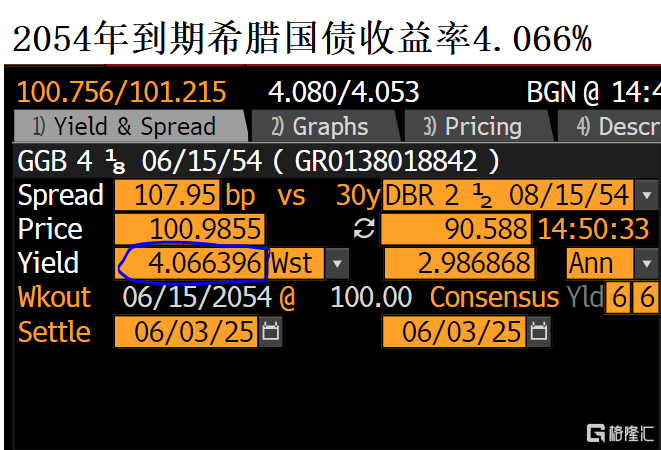
Group 1 - The recent performance of Hong Kong and A-shares has been lackluster, with market movements heavily influenced by U.S. events, particularly Trump's tariff actions [1] - Trump's recent threats to impose tariffs on the EU and increase steel tariffs to 50% have created volatility in the markets, reflecting the uncertainty surrounding U.S. fiscal policy [1][2] - The 30-year U.S. Treasury yield remains above 5%, raising concerns about the stability of U.S. debt and its implications for the broader financial market [1][2] Group 2 - The new consumption sector in Hong Kong is gaining attention, characterized by a diverse range of companies from bubble tea to beauty products, indicating a broad interpretation of consumer spending [5][6] - Major internet companies in China, such as Meituan and Xiaomi, reported strong earnings, with Meituan exceeding revenue and profit expectations despite ongoing competition with JD.com [6] - PDD's financial performance has been mixed, with revenue growth but a significant drop in net profit, attributed to government subsidies and market conditions, leading to volatility in its stock price [6] Group 3 - The IPO market in Hong Kong has shown a positive trend, with a low first-day loss rate of 28.6% for new listings, the lowest since 2017 [7] - New stock performance varies significantly, with some companies like Ningde Times and Guanshi Shuduan showing substantial first-day gains, while others like Paige Biopharma experienced significant losses [8] - The strategy for participating in new stock offerings emphasizes quick exits within three days, suggesting a focus on short-term gains rather than long-term holdings [8][9]






从线下渠道看美护企业差异化竞争力:线下渠道变革,美护破局增长
Shenwan Hongyuan Securities· 2025-05-29 09:16
Investment Rating - The report maintains a "Positive" investment outlook for the beauty and personal care industry, emphasizing the potential of domestic brands in the offline channel [3]. Core Insights - The report highlights the transformation of offline channels as a key growth driver for beauty brands, especially in the context of slowing e-commerce growth [4][5]. - It identifies the need for brands to enhance their offline presence to create a differentiated competitive advantage [5][7]. Summary by Sections 1. Online Channel Competition Intensifies, Offline Channel Advantages Emerge - E-commerce growth is slowing, with China's physical goods online retail expected to reach 13.1 trillion yuan in 2024, growing at 6.5% [4][15]. - The number of internet users in China is projected to reach 1.108 billion by the end of 2024, with an internet penetration rate of 78.6% [4][15]. - New consumption policies are being implemented to boost offline consumption, enhancing brand influence and customer engagement [4][27]. 2. Multi-Dimensional Analysis of Offline Channel Formats - Offline channels serve both sales and brand marketing functions, with a variety of formats emerging to meet consumer needs [40]. - High-end beauty counters are experiencing a phase of quality improvement, with a significant increase in average sales per counter from 3.36 million yuan in 2019 to nearly 5 million yuan in 2023 [46][50]. - The report notes that high-end brands are increasingly occupying the beauty counter space, with a 32% increase in high-end counters from 2019 to 2023 [50][53]. 3. Brand Strategies in Offline Channel Development - Domestic brands are actively expanding their offline presence, with several launching flagship stores in major cities [38][39]. - The report recommends specific companies for investment, including: - Shangmei Co., which is developing a balanced multi-brand matrix [5]. - Shanghai Jahwa, known for its extensive presence in supermarkets and counters [5]. - Proya, which is focusing on offline channels with its energy series [5]. - Betaini, leveraging pharmacy channels to establish a professional image [5]. - Maogeping, which has a unique offline counter layout [5]. - Runben, a leading brand in maternal and infant products, expanding its offline market [5].


国际化妆品医美公司25Q1业绩跟踪报告:业绩下滑或增长降速,国际集团复苏尚需时日
Shenwan Hongyuan Securities· 2025-05-28 08:41
Investment Rating - The report maintains a "Positive" outlook on international cosmetics and medical beauty companies for Q1 2025 [2]. Core Insights - The global beauty market is projected to grow at a rate of 4.5% in 2024, a decline from the 8% growth seen in 2023, with significant regional disparities [3][12]. - The North Asia market, particularly China, has shown signs of improvement, but overall performance remains subdued, with North America exhibiting signs of fatigue [3][12]. - International beauty groups are still grappling with performance declines or slower growth, which may become the new normal due to various factors including the pandemic and macroeconomic conditions [3][15]. - Companies are adopting localization strategies and investing in local brands to maintain market share amid fierce competition from domestic brands [3][19]. Summary by Sections 1. Global Beauty Market Trends - The beauty market continues a stable trend from 2024, with Europe outperforming other regions at a 7.5% growth, while North Asia has seen a 2% decline [3][12]. - The international beauty groups are facing a challenging environment with performance fluctuations and strategic adjustments [15]. 2. L'Oréal Performance - L'Oréal's Q1 2025 revenue growth slowed to 4.4%, with the Chinese market remaining flat and tourism retail channels under pressure [3][27]. - The company is actively investing in local brands and expanding its product matrix to compete with domestic brands [3][27]. 3. Estée Lauder Performance - Estée Lauder reported a 9.9% decline in revenue for Q1 2025, continuing a trend of three consecutive quarters of revenue decline [3][51]. - The company is undergoing strategic reforms to address issues related to brand and product positioning [47][51]. 4. Shiseido Performance - Shiseido's revenue decreased by 8.5% in Q1 2025, with its main brand struggling while the ELIXIR brand showed growth [3][18]. - The company is focusing on strategic product launches and price adjustments to enhance profitability [3][27]. 5. Investment Recommendations - Recommended companies include Up Beauty and Proya for their strong brand matrices and growth potential, as well as Marubi for leveraging Douyin traffic [4]. - In the medical beauty sector, companies with strong R&D capabilities and broad product pipelines, such as Aimeike, are highlighted as key investment opportunities [4].
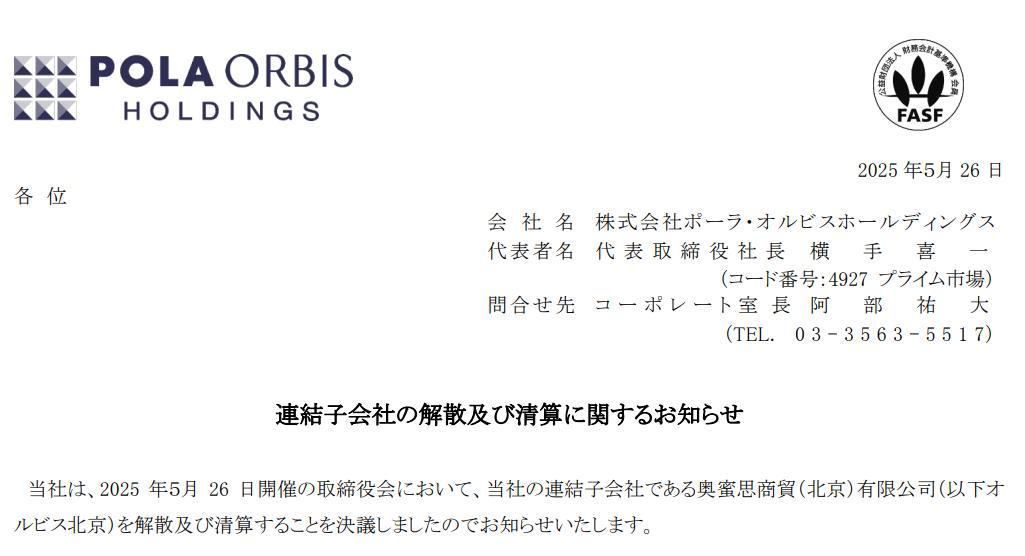
连亏3年,知名日妆解散中国子公司
3 6 Ke· 2025-05-27 02:59
Core Viewpoint - POLA ORBIS HOLDINGS has announced the dissolution and liquidation of its subsidiary, Orbis Beijing, indicating challenges in the Chinese market but not a complete exit from China [1][3][5]. Company Overview - POLA ORBIS was established in 1929, focusing on beauty care, real estate, and other sectors, with beauty care accounting for 97% of its total revenue in 2024 [6]. - The Orbis brand, launched in 1984, targets the mid-range market with products priced between 2,000 and 5,000 yen (approximately 101 to 252 RMB) [8]. Financial Performance - Orbis Beijing's revenue for 2024 was 783 million yen (approximately 39 million RMB), the lowest in three years, with continuous losses in operating profit and net profit [8][9]. - The financial data shows a decline in net assets and total assets over the past three years, with net sales dropping significantly [9]. Strategic Decisions - The decision to dissolve Orbis Beijing aligns with POLA's "VISION 2029" strategy, which aims to expand globally and optimize brand portfolios [10]. - The company cited the slowing Chinese economy and intensified e-commerce competition as reasons for the inability to achieve short-term profitability [10][11]. Market Challenges - POLA faces significant competition in the Japanese cosmetics market, ranking last among the top four Japanese cosmetic groups [11]. - The overall performance of POLA's brands has been declining, with the main brand POLA and Jurlique experiencing revenue drops, while Orbis showed some growth [15][20]. Industry Context - The Chinese beauty market is becoming increasingly competitive, with local brands like Proya and Han Shu achieving significant revenue growth, contrasting with the struggles of international brands [21]. - The challenges faced by POLA are not unique, as other Japanese cosmetic companies are also experiencing difficulties in the Chinese market [20][21].