
赛力斯

Search documents
DeepSeek提出全新mHC架构;安克创新回应“裁员30%”;特斯拉鸿蒙版App开启尝鲜...
Sou Hu Cai Jing· 2026-01-01 13:18
Group 1 - DeepSeek has released a new paper proposing a novel mHC architecture, with CEO Liang Wenfeng listed as one of the authors [1] - Anker Innovation has responded to rumors of a 30% layoff, stating that the reported figure is significantly exaggerated and that the adjustments are part of a strategic upgrade [2] - Tesla has launched a HarmonyOS version of its app in the Huawei app market, supporting features like remote vehicle control and mobile key [3] Group 2 - Xiaomi has announced a limited-time offer for the YU7 model, allowing customers to choose between a tax subsidy and a three-year interest-free option for orders placed before December [5] - The Redmi Note 15 series has been officially launched, starting at 999 yuan, with various color options available [6] - Huawei has released the Smart Screen V6, with prices ranging from 7999 to 14999 yuan, and is offering a limited-time discount on its high-end ADS feature package [7] Group 3 - Apple has updated its list of "vintage products," including the iPhone 11 Pro and the last Intel MacBook Air [8] - Seres Group announced that the AITO car deliveries exceeded 57,000 units in December, setting a new monthly record, with total deliveries surpassing 420,000 units for the year [9] - Li Auto plans to focus on adjusting its models in the 300,000 to 400,000 yuan price range while continuing to iterate on its pure electric i8 series [10] Group 4 - Li Auto has achieved a cumulative delivery milestone of over 1.5 million vehicles, becoming the first new force brand in China to reach this figure [12] - Huawei's Enjoy series has met its annual challenge goals for 2025, with plans to introduce more diverse products in 2026 [13] - TrendForce reports that Samsung is rigorously executing its production halt plan, which may lead to a significant increase in DDR4 memory prices in 2026 [14]


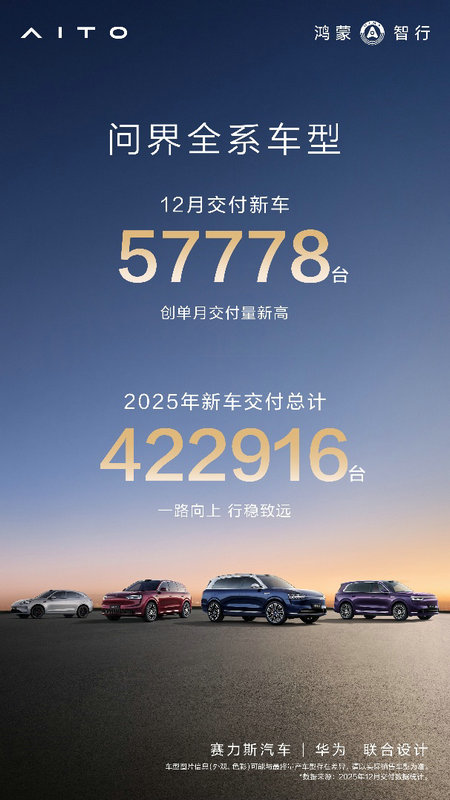
赛力斯:12月新车交付超57000台,再创单月交付新高
Jin Shi Shu Ju· 2026-01-01 13:16
赛力斯 :12月新车交付超57000台,再创单月交付新高。2025年新车交付超42万台。 ...

以实干成就伟业 以创新赢得未来——习近平总书记在全国政协新年茶话会上的重要讲话激励广大干部群众勠力同心昂扬奋进
Xin Hua She· 2026-01-01 12:35
新华社北京1月1日电 题:以实干成就伟业 以创新赢得未来—— 习近平总书记 在全国政协新年茶话 会上的重要讲话激励广大干部群众勠力同心昂扬奋进 新华社记者 岁序更替,华章日新,我们迎来崭新的2026年。 2025年12月31日, 习近平总书记 在全国政协新年茶话会上发表重要讲话,回顾过去取得的成就, 擘画未来发展蓝图,令社会各界深受鼓舞。 广大干部群众表示,要认真学习领会 习近平总书记 重要讲话精神,进一步坚定发展信心、凝聚发 展共识,勠力同心、实干笃行,向着"十五五"发展目标昂扬奋进,为强国建设、民族复兴伟业作出新的 更大贡献。 成就非凡 振奋人心 2025年12月31日,全国政协礼堂灯光璀璨、气氛热烈。 "2025年是很不平凡的一年。我们迎难而上、奋力拼搏,顺利完成经济社会发展主要目标。"现场聆 听 习近平总书记 重要讲话,全国政协常委张连起心潮澎湃。他表示,回望过去5年,在以 习近平 同志 为核心的党中央坚强领导下,我国经济、科技、国防等硬实力和文化、制度、外交等软实力明显提升, 高质量发展成色更足,中国式现代化步履坚实。我为国家发展成就感到振奋,也为人民政协在其中发挥 的作用感到自豪。 2025年,我 ...
今日财经要闻TOP10|2026年1月1日
Xin Lang Cai Jing· 2026-01-01 12:33
Group 1 - DeepSeek released a new paper on New Year's Day proposing a new architecture called mHC (Manifold-Constrained Hyperconnection) aimed at addressing instability issues in traditional hyperconnections during large-scale model training while maintaining significant performance gains [1] - The paper's first authors include Zhenda Xie, Yixuan Wei, and Huanqi Cao, with DeepSeek's founder and CEO Liang Wenfeng also listed as an author [1] Group 2 - The EU's Carbon Border Adjustment Mechanism (CBAM) will officially implement on January 1, 2026, with recent legislative proposals and implementation details released by the EU [2] - China expressed concerns over the EU's high default carbon emission intensity values for Chinese products, which are deemed unfair and discriminatory, and plans to gradually increase these values over the next three years [2] - The EU plans to expand the CBAM scope to include approximately 180 steel and aluminum-intensive downstream products by 2028, which China views as unilateral and protectionist [2] Group 3 - Multiple electric vehicle manufacturers have reported their delivery data for December 2025 and the entire year, with Li Auto delivering 44,246 vehicles in December and a total of 1,540,215 vehicles since inception [6][16] - NIO delivered 48,135 vehicles in December, marking a 54.6% year-on-year increase, and a total of 326,028 vehicles for the year, a 46.9% increase [6][16] - Xpeng Motors reported 37,508 vehicles delivered in December, with a total of 429,445 vehicles for the year, reflecting a 126% year-on-year growth [6][16] Group 4 - Warren Buffett officially retired as CEO of Berkshire Hathaway on December 31, 2025 [7][18]




2025港A股终章:“科技牛”叙事东渐,贵金属迎风劲舞!
Sou Hu Cai Jing· 2026-01-01 12:27
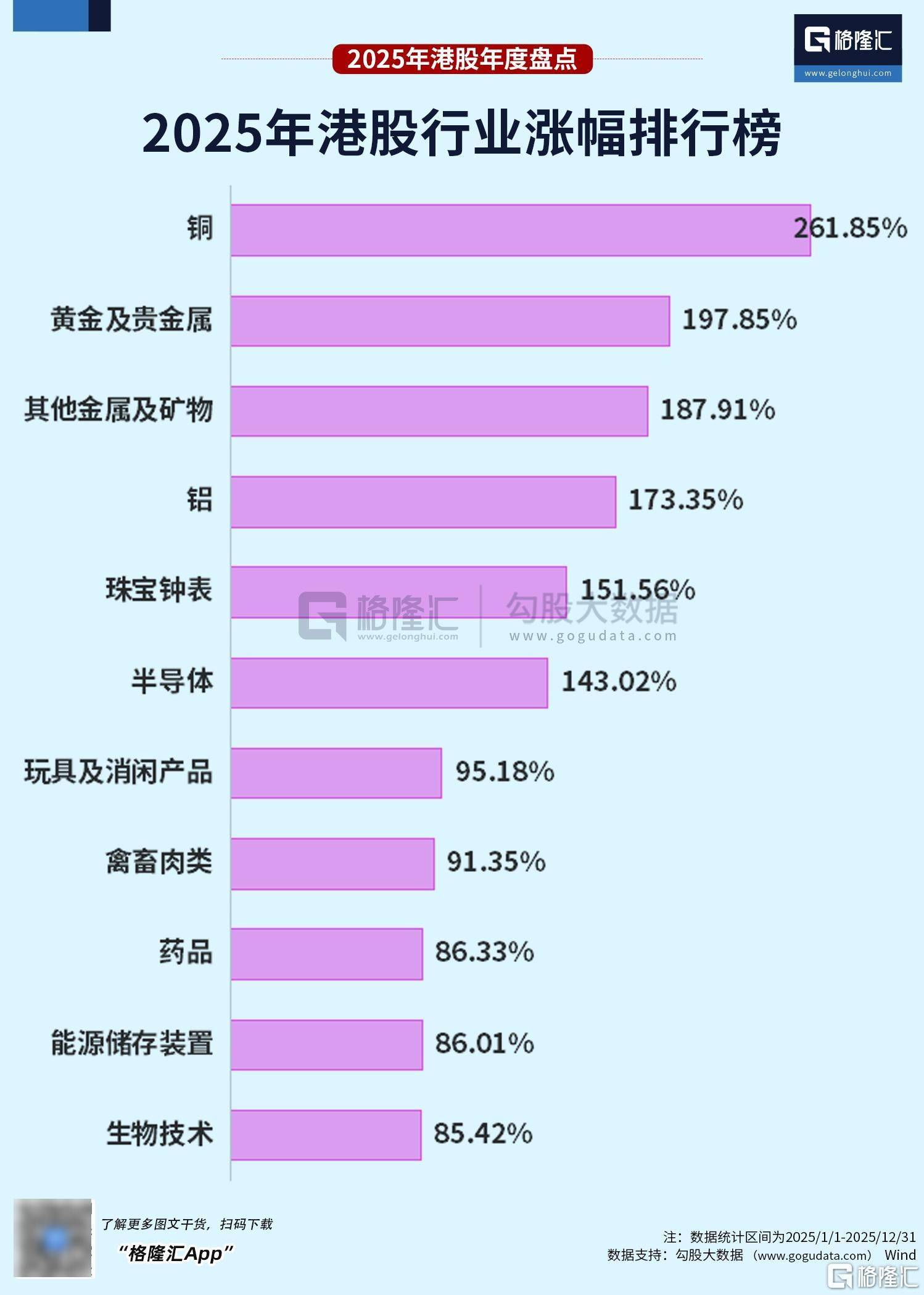
Group 1: Hong Kong Stock Market Performance - The Hong Kong stock market experienced a significant recovery in 2025, with the Hang Seng Index rising by 27.77%, marking its best annual performance since 2017 [1] - The Hang Seng Tech Index increased by 23.45%, achieving its best annual performance since its launch in 2020 [1] - The year saw a clear rotation of main themes across quarters, with technology stocks leading in Q1, a shift to domestic demand and innovative pharmaceuticals in Q2, tech stocks again in Q3, and financial stocks performing well in Q4 [1] Group 2: IPO Market and Fund Flows - The Hong Kong IPO market regained the top position globally, with 117 new listings in 2025, a 67.14% increase year-on-year, raising a total of 285.69 billion HKD, a 224.11% increase [8] - 19 A-share companies listed in Hong Kong for secondary listings, raising 139.99 billion HKD, nearly half of the total IPO funds [9] - Southbound capital saw a record net inflow of over 1.41 trillion HKD into Hong Kong stocks, with significant daily net purchases exceeding 100 billion HKD on more than 60 occasions [9] Group 3: A-Share Market Performance - The A-share market also delivered strong results, with the Shanghai Composite Index rising by 18.41% and the ChiNext Index increasing by nearly 50% [10] - The total trading volume in the A-share market surpassed 400 trillion CNY, with daily average trading volume maintaining above 1 trillion CNY, doubling from 2024 [11] - The strongest sectors included non-ferrous metals, communications, and electronics, with annual gains of 92.64%, 87.27%, and 49.40% respectively [13] Group 4: Market Outlook for 2026 - Institutions expect technology growth to remain the main focus for investment in 2026, with a potential "steady then rising" market pattern for A-shares [22] - Goldman Sachs predicts a 38% upside for the Chinese stock market over the next two years, maintaining an overweight rating and targeting 4600 points for the CSI 300 index in 2026 [22]



小米回应YU7配置调整:下架不影响维修;上汽大众今年将投放7款全新车型丨汽车交通日报
创业邦· 2026-01-01 10:18
Group 1 - SAIC Volkswagen plans to launch 7 new energy models by 2026, covering pure electric, hybrid, and range-extended power forms, with a target of over 1 million annual sales in 2025 [2] - Several new energy vehicle manufacturers have reported their delivery data for December 2025 and the entire year, with Li Auto delivering 44,246 vehicles in December and a total of 1,540,215 vehicles cumulatively [2] - NIO achieved a record high of 326,028 vehicle deliveries in 2025, marking a year-on-year growth of 46.9% [2] Group 2 - Xiaomi responded to configuration adjustments for the YU7 model, stating that the changes are aimed at optimizing production processes and improving delivery efficiency, ensuring that after-sales service will not be affected [3] - Kia China announced a nationwide fixed price for the K3 and 2026 model of the Yipao, with the Yipao priced at 55,900 yuan and the K3 at 69,900 yuan [4]

问界全年交付突破42万辆 树立中国高端汽车新标杆
Zheng Quan Shi Bao Wang· 2026-01-01 08:44
Core Insights - The company, Wenjie, achieved a record delivery of over 57,000 new vehicles in December 2025, leading the high-end electric vehicle market with total annual deliveries surpassing 420,000 units [1] - Since its launch, Wenjie has delivered over 970,000 new vehicles, establishing itself as a significant player in the Chinese new energy market [1] Group 1: Product Launches and Market Position - In 2025, Wenjie launched several models including the Wenjie M9 2025 version, the Wenjie M8 range extender and electric version, and the all-new Wenjie M7, enhancing its product lineup and driving strong sales growth [3] - The Wenjie M9, positioned as a "panoramic smart flagship SUV," has maintained the top sales position in the luxury SUV segment priced above 500,000 yuan for 20 consecutive months, with over 260,000 units delivered since its launch [3] - The Wenjie M8, marketed as a "family smart flagship SUV," has delivered over 150,000 units within 8 months of its launch, quickly capturing the high-end SUV market priced at 400,000 yuan [4] - The Wenjie M7, referred to as the "national SUV happiness flagship," has delivered over 370,000 units since its launch in September 2025, recognized as a value choice in the 300,000 yuan SUV segment [4] Group 2: Service Expansion and Future Outlook - Wenjie is actively expanding its offline service network, adding over 80 user centers in 2025, resulting in nearly 400 centers across more than 200 cities nationwide [6] - The company employs smart measures such as remote diagnostics and OTA upgrades to enhance user experience and care [6] - Looking ahead to 2026, Wenjie aims to uphold its "smart reshaping luxury" philosophy, focusing on user-centric approaches and the integration of smart technology, while continuously leading the high-end new energy vehicle market in China [6]
造车新势力2025年12月及全年交付“成绩单”一览
Xin Lang Cai Jing· 2026-01-01 08:29
Summary of Key Points Group 1: Delivery Data - Li Auto delivered 44,246 vehicles in December, with a total of 109,194 vehicles delivered in Q4 2025, bringing cumulative deliveries to 1,540,215 vehicles by December 31, 2025 [1] - NIO delivered 48,135 vehicles in December, a year-on-year increase of 54.6%, with Q4 deliveries totaling 124,807 vehicles, up 71.7%. The total annual deliveries reached 326,028 vehicles, marking a historical high with a 46.9% increase [1] - Xpeng Motors delivered 37,508 vehicles in December, a 2% year-on-year increase, and a total of 429,445 vehicles for the year, reflecting a 126% growth [1] - Xiaomi Auto exceeded 50,000 vehicle deliveries in December [1] - Leap Motor delivered 60,423 vehicles in December, a 42% increase, with total annual deliveries of 596,555 vehicles, up 103% [1] - Zeekr delivered 30,267 vehicles in December, a historical high with an 11.3% year-on-year increase, totaling 224,133 vehicles for the year [1] - Lantu Auto achieved total deliveries of 150,169 vehicles for the year, marking a 87% year-on-year increase [1] - Hongmeng Zhixing delivered 589,107 vehicles for the year, a 32% increase, with December deliveries reaching 89,611 vehicles, setting a new monthly record for three consecutive months [1] - Seres delivered over 57,000 vehicles in December, setting a new monthly record, with total annual deliveries exceeding 420,000 vehicles [1] - IM Motors achieved annual sales of 81,017 vehicles, marking a new historical high [1] - GAC Aion's Haobo Aion BU reached 40,066 vehicle sales in December, a new high, with the i60 model exceeding 10,000 sales in its first month [1]
再创新高!问界全年交付突破42万辆,单月超5.7万辆
Ge Long Hui· 2026-01-01 06:29
Core Insights - The company, Wanjie, achieved a record delivery of over 57,000 new vehicles in December 2025, totaling over 420,000 deliveries for the year, leading the high-end electric vehicle market [1] - Since its launch, Wanjie has delivered over 970,000 new vehicles, establishing itself as a significant player in the Chinese new energy market [1] Group 1: Product Launches and Market Position - In 2025, Wanjie launched several models including the Wanjie M9 2025 version, Wanjie M8 range-extended and electric versions, and the all-new Wanjie M7, enhancing its product lineup and driving strong sales growth [3] - The Wanjie M9 has maintained its position as the best-selling luxury SUV in the 500,000 yuan and above segment for 20 consecutive months, with over 260,000 units delivered since its launch [3] - The Wanjie M8 has quickly captured the high-end SUV market priced at 400,000 yuan, with over 150,000 units delivered in just 8 months [3] - The Wanjie M7, launched in September 2025, has become a value choice in the 300,000 yuan SUV segment, with over 370,000 units delivered [3] Group 2: Service Expansion and Future Strategy - Wanjie is expanding its offline presence, adding over 80 user centers in 2025, resulting in a service network covering over 200 cities with nearly 400 centers [5] - The company employs smart measures such as remote diagnostics and OTA upgrades to enhance user experience [5] - In 2026, Wanjie aims to uphold its "smart reshaping luxury" philosophy, focusing on user-centric approaches and integrating traditional luxury with technological advancements to lead the high-end new energy vehicle market [5]
赛力斯申请车辆控制方法专利,显著提升车辆在各种工况下的平稳性
Jin Rong Jie· 2026-01-01 02:24
Group 1 - The core point of the article is that Seres Automotive Co., Ltd. has applied for a patent related to vehicle control methods and systems, which aims to enhance vehicle stability under various operating conditions [1] Group 2 - The patent application, titled "Vehicle Control Method, Device, System, Vehicle, and Computer Equipment," was published with the number CN121224674A and was filed on November 2025 [1] - The method involves obtaining driver operation input data and vehicle operating status data to determine the required torque for driving, and it includes mechanisms to manage vehicle stability by adjusting torque distribution to each wheel based on road conditions [1] Group 3 - Seres Automotive Co., Ltd. was established in 2012 and is located in Chongqing, primarily engaged in the automotive manufacturing industry [1] - The company has a registered capital of approximately 1.063 billion RMB and has invested in 10 enterprises, participated in 26 bidding projects, and holds 4,589 patents along with 513 trademark registrations [1]