
鱼跃医疗

Search documents
《提振消费专项行动方案》政策点评:政策提振有望带动消费医疗复苏
Guotai Junan Securities· 2025-03-18 07:06
Investment Rating - The report maintains an "Overweight" rating for the industry [5] Core Views - The recent issuance of the "Special Action Plan to Boost Consumption" by the Central and State Offices is expected to significantly stimulate consumption, leading to a recovery in the consumer healthcare sector [3][5] - The report highlights that the medical service industry's performance is anticipated to improve due to better expectations and technological upgrades, despite facing challenges in 2024 [5] - The report identifies specific companies that are expected to benefit from these trends, including Aier Eye Hospital, Puren Eye Hospital, Tongce Medical, and others, all rated as "Overweight" [5] Summary by Sections Industry Overview - The report emphasizes the potential for a recovery in consumer healthcare driven by government policies aimed at boosting consumption [3][5] Investment Highlights - The report notes that the medical service sector is experiencing a slowdown in revenue growth due to external pressures, but demand remains strong, suggesting a rebound as economic conditions improve [5] - New surgical techniques and the implementation of supportive policies are expected to stabilize and enhance the average transaction value in consumer healthcare [5] - The home medical device market is projected to benefit from policies encouraging aging-friendly transformations and increased investment in healthcare and elderly care [5] Company-Specific Insights - The report lists several companies with "Overweight" ratings, including Aier Eye Hospital (market cap: 134 billion, projected net profit for 2024: 35.96 billion), Puren Eye Hospital, and others, indicating strong growth potential [6] - Companies like Kefu Medical and Meihua Medical are also highlighted as beneficiaries of the favorable policy environment, although they are not yet rated [5][6]
医药行业周报:国产GLP-1出海值得期待-2025-03-16
Huaxin Securities· 2025-03-16 09:33
Investment Rating - The report maintains a "Recommended" investment rating for the pharmaceutical industry [1]. Core Insights - The global new drug business development (BD) remains robust, with approximately 31% of innovative drug candidates introduced by multinational pharmaceutical companies in 2024 coming from China. In the first two months of 2025, there have already been 16 Chinese innovative drug BD projects, expanding from oncology to autoimmune diseases [3]. - The weight loss market is seeing multiple BD agreements, with significant sales figures reported by Novo Nordisk and Eli Lilly. Novo Nordisk's core products generated sales of approximately $27.94 billion in 2024, while Eli Lilly's Mounjaro saw a 124% year-on-year increase in sales to $11.54 billion [5]. - CAR-T cell therapy continues to progress, with global sales expected to reach approximately $4.53 billion in 2024. Chinese companies are also participating in the global CAR-T sales, indicating their technological capabilities [6]. - The gene sequencing industry is accelerating its domestic production capabilities following export restrictions on Illumina's sequencing instruments. Domestic alternatives are rapidly emerging, with several companies receiving regulatory approvals for their sequencing devices [7]. - AI in healthcare is advancing, with various AI models being developed for specific medical fields. Collaborations between tech companies and healthcare providers are enhancing the integration of AI into traditional medical practices [9]. Summary by Sections Industry Trends - The pharmaceutical industry outperformed the CSI 300 index by 0.18 percentage points in the past week, with a weekly increase of 1.77% [23]. - Over the past month, the pharmaceutical sector also outperformed the CSI 300 index by 0.22 percentage points, with a monthly increase of 1.94% [27]. Subsector Performance - The pharmaceutical commercial sector saw the highest weekly increase of 6.44%, while the medical device sector had the lowest at 1.09% [30]. - Over the past year, the chemical pharmaceutical sector had the highest increase of 6.49%, while the biological products sector experienced a decline of 17.62% [37]. Company Recommendations - The report recommends focusing on companies involved in weight loss and NASH, such as Zhongsheng Pharmaceutical, and highlights the potential of companies like Geli Pharmaceutical and Lianbang Pharmaceutical [12]. - Companies engaged in CAR-T technology, such as Kexin Pharmaceutical, are also recommended as they approach market entry [12]. - The report emphasizes the importance of AI integration in medical devices, recommending companies like Anbiping and RunDa Medical for their competitive advantages [12]. Recent Developments - The report notes significant recent financing and regulatory approvals for various companies, indicating a dynamic and evolving market landscape [54][55].
DeepSeek加速AI医疗落地,建议关注相关企业投资机遇
Caixin Securities· 2025-03-13 09:04
Investment Rating - The industry investment rating is "Outperform the Market" [3][28] Core Viewpoints - The report emphasizes the potential of AI in healthcare, particularly through the DeepSeek model, which accelerates the implementation of AI in medical settings, enhancing diagnostic efficiency and resource allocation [7][23][27] - The industry is expected to transition from scale expansion to higher-level development, focusing on high-quality growth and long-term investment opportunities [28] Summary by Sections Industry Overview - The medical device sector has shown a monthly increase of 8.67%, outperforming the pharmaceutical sector and the CSI 300 index by 2.26 and 6.04 percentage points respectively [11][15] - The average PE ratio for the medical device sector is 28.93, which is a 9.74% premium over the pharmaceutical sector and a 154.06% premium over the CSI 300 index [15][21] Key Stocks - Major companies highlighted include: - Mindray Medical: EPS of 9.55 in 2023, rated "Buy" [4] - Weili Medical: EPS of 0.66 in 2023, rated "Add" [4] - New Industry: EPS of 2.10 in 2023, rated "Add" [4] - Yuyue Medical: EPS of 2.39 in 2023, rated "Add" [4] - Kefu Medical: EPS of 1.22 in 2023, rated "Add" [4] AI Medical Applications - AI in healthcare is categorized into several applications, including drug development, medical imaging, healthcare robotics, and health management, all aimed at improving service efficiency and quality [25][24] - The report suggests that AI will help address the growing medical demand and resource distribution issues in China, enhancing early disease detection and treatment [24][26] Investment Recommendations - The report recommends focusing on companies with strong innovation capabilities and international expansion potential, such as Mindray Medical, Union Medical, and Weili Medical [28] - It also highlights the importance of AI models like DeepSeek in improving medical efficiency and resource optimization, suggesting attention to companies like BGI and Shengxiang Biological [28]




东兴证券晨报-2025-03-12
Dongxing Securities· 2025-03-11 23:57
东 兴 晨 报 东兴晨报 P1 分析师推荐 【东兴机械】机械行业:政府工作报告从提振消费、未来产业、有效投资三 维度利好机械设备行业(20250306) 事件:3 月 5 日,十四届全国人大三次会议在京开幕。《政府工作报告》提 出实施提振消费专项行动;培育壮大新兴产业、未来产业;积极扩大有效投 资。对应到机械设备行业,建议关注消费场景、具身智能、工程机械三条主 线。 冰雪消费高景气或每年带来设备增量超 200 亿元。政府工作报告提到落实和 优化休假制度,释放文化、旅游、体育等消费潜力,其中冰雪消费旅游近年来 需求旺盛,相关设备投资将带来增量市场。考虑到高端和大型滑雪场建设需 要特定的地形和气候作为自然资源禀赋,未来增长空间有限。高端和大型客 群主要以旅游度假为目的,其客群到访具有较强的季节性,集中在节假日到 访。而室内和中小型滑雪场客群为初学者或体验型客户,在掌握一定滑雪技 能后,成为大型高端滑雪场稳定客源。随着国内人均收入的提升和国家政策 的扶持,预计未来各地室内和中小型滑雪场数量将持续增长。我国目前有 333 各地级行政区,假设未来 5 年内每个地级区建设 2 家滑冰场或滑雪场,假设 每个中小型滑雪场或滑 ...
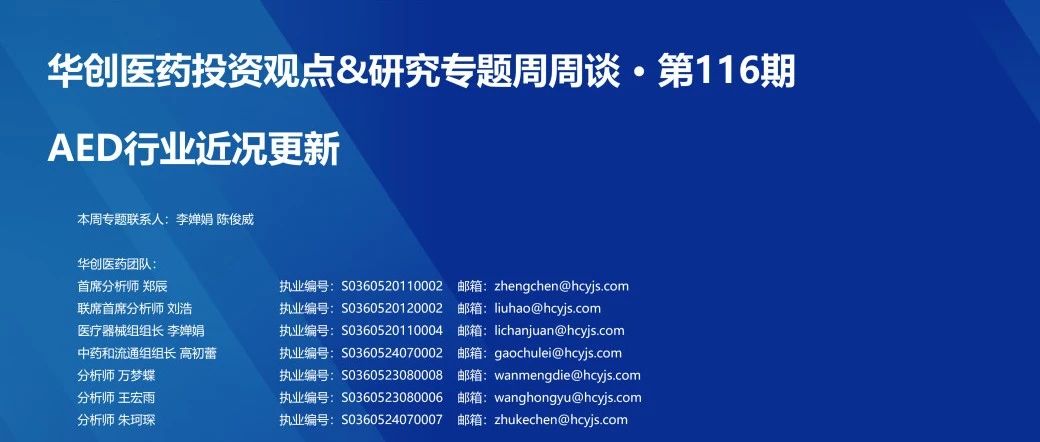
华创医药周观点:AED行业近况更新2025/03/08
华创医药组公众平台· 2025-03-08 08:07
Market Overview - The overall sentiment in the pharmaceutical sector remains optimistic, with low valuations and public fund allocations to the sector at a low point. The industry is expected to see growth driven by macroeconomic factors and significant product demand by 2025 [7][8]. - The CITIC pharmaceutical index increased by 1.08%, underperforming the CSI 300 index by 0.03 percentage points, ranking 18th among 30 primary sectors [4]. Key Stocks Performance - Top-performing stocks this week include: - Rejuve Bio: 34.39% - Berry Genomics: 25.72% - Anbiping: 19.90% - Aidi Pharmaceutical: 18.17% [3][4]. - Underperforming stocks include: - Jiangsu Wuzhong: -14.47% - Baili Tianheng: -12% - S*ST Longjin: -10% [4]. Investment Themes - **Innovative Drugs**: The domestic innovative drug sector is transitioning from quantity to quality, focusing on differentiated and internationalized pipelines. Companies to watch include Hengrui, BeiGene, and others [7]. - **Medical Devices**: The sector is expected to benefit from new equipment update policies, with key players like Mindray Medical and others positioned for growth [7]. - **Chinese Medicine**: The market for essential medicines is anticipated to grow, with companies like Kunming Pharmaceutical and Kangyuan Pharmaceutical highlighted for their potential [12]. - **Pharmacy Sector**: The pharmacy sector is expected to see significant growth due to prescription outflow and market optimization, with companies like YaoBai and YiFeng Pharmacy recommended for investment [12]. - **Medical Services**: The private medical sector is expected to gain competitiveness due to anti-corruption measures and the expansion of commercial insurance [12]. AED Industry Insights - The AED market is projected to grow significantly, with the global market expected to reach 161.2 billion yuan by 2028, driven by increasing cardiovascular disease rates [22]. - In China, the AED procurement amount is expected to rise from 3.95 billion yuan in 2021 to 6 billion yuan in 2024, indicating a strong growth trajectory [25]. - The domestic AED market is seeing a shift from reliance on imports to a higher domestic production rate, with the domestic market share expected to reach 79% by 2024 [27][29]. Policy Support for AED - National policies are increasingly supporting AED proliferation, with guidelines established for public spaces and healthcare facilities to ensure adequate AED availability [16][19]. - Local governments are also implementing specific policies to enhance AED distribution, such as requiring a certain number of AEDs per population in public areas [20]. Competitive Landscape - The AED market has shifted from heavy reliance on imports to a more competitive domestic landscape, with Mindray Medical leading the market with a 47.74% share [36]. - Companies like Yiyue Medical are expanding their AED offerings through acquisitions and product development, enhancing their market presence [37].


东兴证券:东兴晨报-20250307
Dongxing Securities· 2025-03-07 00:59
Group 1 - The government work report sets a GDP growth target of around 5% for 2025, with a fiscal deficit rate of 4% and a CPI target of 2%, aligning with market expectations [9][36] - The report emphasizes the importance of expanding domestic demand and boosting consumption as key drivers for economic growth, reflecting a strong commitment to stimulate the consumer market [27][28] - The focus on new technologies and emerging industries, particularly in artificial intelligence and digital economy, is highlighted as a priority for future development, indicating a significant investment opportunity in the tech sector [2][6] Group 2 - The report outlines ten measures to boost consumption, including enhancing service consumption and improving the quality of consumer goods, which is expected to benefit companies in the consumer sector [27][28] - The emphasis on high-quality development and the need to combat "involution" in the transportation industry suggests a shift towards more sustainable and efficient practices, which could impact logistics and transport companies positively [21][23] - The report mentions the importance of the low-altitude economy and new emerging industries, indicating potential growth areas for companies involved in logistics technology and smart transportation solutions [24][25] Group 3 - The government plans to issue 1.3 trillion yuan in special bonds to support consumption upgrades, which is expected to significantly stimulate demand in sectors like home improvement and consumer electronics [32][34] - The report indicates a strong focus on the integration of advanced manufacturing and modern service industries, suggesting opportunities for companies that can adapt to this evolving landscape [10][22] - The commitment to maintaining a stable monetary policy environment, with potential for interest rate cuts, is likely to create favorable conditions for investment in various sectors, particularly real estate and consumer goods [37][39]
医药行业周报:礼来与Magnet达成近13亿美元分子胶合作
Tai Ping Yang· 2025-03-04 05:17
2025 年 03 月 03 日 行业周报 看好/维持 医药 医药 礼来与 Magnet 达成近 13 亿美元分子胶合作 科伦药业(002422):公司发布公告,公司 5%以上持股股东雅安国资 拟通过集中竞价的方式增持公司股份,拟增持金额为 5000-9900 万元,增 持价格不超过 37.60 元/股,资金来源为自有资金和股票回购专项贷款。 鱼跃医疗(002223):公司发布公告,公司申请的自动体外除颤器(AED) 获得符合欧盟《医疗器械第 2017/745 号法规》(MDR)要求的 III 类医疗 器械 CE 认证证书,此次获批表明该产品具备欧盟市场的最新准入条件, 进一步提升了公司急救类产品在相应领域的综合竞争力。 昭衍新药(603127):公司发布公告,公司累计通过集中竞价交易方 式回购 A 股股份 3,269,820 股,占公司总股份的 0.4363%,回购价格区间 为 13.20-18.15 元/股,使用资金总额为人民币 52,991,757.40 元(不含 交易费用)。 ◼ 走势比较 报告摘要 市场表现: 2025年3月3日,医药板块涨跌幅+0.66%,跑赢沪深300指数0.70pct, 涨跌幅 ...
1.98亿!鱼跃医疗携手美国上市公司,共拓海外市场
思宇MedTech· 2025-02-25 03:51
合作伙伴征集:2025全球手术机器人大会 报名:首届全球眼科大会 | 展位有限 报名:首届全球心血管大会 | 奖项评选 报名:首届全球骨科大会 | 奖项评选 2025年2月25日, 鱼跃医疗 发布公告称,其全资子公司鱼跃(香港)控股有限公司通过认购Inogen定向增发的股票,并与Inogen签署了战略合作协议。具 体情况如下: 股票认购情况 战略合作内容 根据双方签署的《战略合作协议》,合作内容主要围绕以下几个方面展开: # Inogen公司简介 Inogen One系列 :便携式氧气浓缩器,具有轻巧、高效、低噪音等特点,适合日常使用和旅行。 认购主体 :鱼跃(香港)控股有限公司。 认购金额 :以每股10.36美元的价格,使用自有资金2720.98万美元认购2626425股普通股。(约1.98亿人民币) 股权占比 :约占本次投资完成后Inogen已发行普通股的9.9%。 交易进展 :截至公告披露日,鱼跃香港已向Inogen全额支付购买价款2720.98万美元,Inogen已向鱼跃香港增发2626425股普通股,交易的交割条件已满 足。 国际分销业务 : 双方将在美国和欧洲部分区域开展分销合作,涉及鱼跃医疗的台 ...

鱼跃医疗(002223) - 2024 Q3 - 季度财报
2024-10-25 11:14
Financial Performance - The company's revenue for Q3 2024 was ¥1,720,240,193.28, representing a 2.21% increase year-over-year, while year-to-date revenue decreased by 9.53% to ¥6,027,852,090.96[2] - Net profit attributable to shareholders for Q3 2024 was ¥411,396,523.81, a decrease of 40.95% compared to the same period last year, and year-to-date net profit decreased by 30.09% to ¥1,531,593,657.16[2] - The basic earnings per share for Q3 2024 was ¥0.4130, down 41.07% year-over-year, with year-to-date earnings per share at ¥1.5374, a decrease of 30.29%[2] - Total operating revenue for the current period is ¥6,027,852,090.96, a decrease of 9.55% compared to ¥6,662,976,651.29 in the previous period[15] - The company's net profit margin is under pressure due to increased sales expenses, which rose to ¥930,620,028.23 from ¥855,049,688.64[15] - The net profit for Q3 2024 was approximately ¥1.53 billion, a decrease of 29.5% compared to ¥2.18 billion in Q3 2023[16] - Operating profit for Q3 2024 was approximately ¥1.75 billion, down 32.8% from ¥2.61 billion in the same period last year[16] - Total comprehensive income for Q3 2024 was approximately ¥1.54 billion, compared to ¥2.18 billion in Q3 2023, indicating a decline of 29.5%[16] Assets and Liabilities - The company's total assets at the end of Q3 2024 were ¥15,494,924,606.69, a decrease of 2.96% from the end of the previous year[2] - The company's cash and cash equivalents decreased to ¥6,682,206,632.31 from ¥7,215,419,322.83, showing a liquidity contraction[12] - Total assets decreased to ¥15,494,924,606.69 from ¥15,967,458,083.34, reflecting a reduction in overall asset base[14] - Total liabilities decreased to ¥2,829,842,688.41 from ¥4,051,960,445.73, indicating a significant reduction in debt levels[14] Cash Flow - The net cash flow from operating activities for the year-to-date period was ¥1,382,295,411.79, down 20.85% compared to the previous year[2] - The company's investment activities generated a net cash flow decrease of 93.59% year-over-year, mainly due to the maturity of structured deposits in the previous year[6] - Cash flow from operating activities for Q3 2024 was approximately ¥1.38 billion, a decline of 20.9% compared to ¥1.75 billion in Q3 2023[17] - The company recorded a cash inflow from investment activities of approximately ¥102.30 million in Q3 2024, a significant decrease from ¥1.60 billion in Q3 2023[17] - The company’s operating cash inflow decreased to ¥6.31 billion in Q3 2024 from ¥7.12 billion in Q3 2023, a decline of 11.3%[17] Shareholder Information - The total number of ordinary shareholders at the end of the reporting period is 43,792, with the largest shareholder, Jiangsu Yuyue Technology Development Co., Ltd., holding 24.54% of the shares[7] - The top ten shareholders collectively hold a significant portion of the company's shares, with the top three shareholders alone accounting for 42.58% of the total[9] - The company announced a cash dividend distribution of RMB 4.00 per 10 shares, totaling RMB 400,801,594.80, based on a total share base of 1,002,003,987 shares[11] - The cash dividend distribution will be executed on October 10, 2024, with the record date set for October 9, 2024[11] - Jiangsu Yuyue Medical Equipment Co., Ltd. has a total of 5% or more shareholders, with the largest being China Bank Co., Ltd. holding 2.03%[9] - The company has not reported any changes in the top ten shareholders due to the transfer of shares[9] - The company has not disclosed any related party transactions or agreements among the top shareholders[10] - The total number of preferred shareholders and their holdings has not been applicable for this reporting period[10] - The company has not engaged in any share buyback activities during this reporting period[10] Operational Metrics - Accounts receivable increased by 125.91% compared to the beginning of the period, primarily due to reasonable receivables from normal business operations[5] - The company experienced a 43.02% increase in credit impairment losses year-over-year, attributed to the increase in accounts receivable[5] - Inventory decreased to ¥1,195,113,014.09 from ¥1,412,311,882.61, indicating improved inventory management[12] - Research and development expenses increased to ¥405,052,780.76, compared to ¥397,254,715.93 in the previous period, indicating a continued focus on innovation[15]
鱼跃医疗(002223) - 2024 Q2 - 季度财报
2024-08-23 10:51
Shareholder Structure - The total number of ordinary shareholders at the end of the reporting period is 41,848[91] - Jiangsu Yuyue Technology Development Co., Ltd. holds 24.54% of the shares, totaling 245,983,450 shares[91] - Wu Guangming holds 10.32% of the shares, totaling 103,438,537 shares[91] - Wu Qun holds 7.72% of the shares, totaling 77,389,840 shares[91] - Hong Kong Securities Clearing Company Ltd. holds 3.49% of the shares, totaling 35,021,001 shares[91] - China Bank - Huabao CSI Medical ETF holds 1.93% of the shares, totaling 19,318,094 shares[91] - China Everbright Bank - Xingquan Business Model Preferred Hybrid Fund holds 1.32% of the shares, totaling 13,243,042 shares[91] - Industrial Bank - Xingquan New Vision Flexible Allocation Fund holds 1.11% of the shares, totaling 11,078,650 shares[91] - Basic Pension Fund 802 Portfolio holds 1.00% of the shares, totaling 10,000,007 shares[91] - National Social Security Fund 113 Portfolio holds 0.91% of the shares, totaling 9,169,229 shares[91] Financial Performance - Total assets decreased from 15,967,458,083.34 yuan to 15,616,627,078.76 yuan, a decrease of 2.2%[100] - Cash and cash equivalents decreased from 7,215,419,322.83 yuan to 6,566,988,527.29 yuan, a decrease of 9.0%[99] - Accounts receivable increased significantly from 448,210,952.92 yuan to 1,109,191,401.44 yuan, a 147.5% increase[99] - Inventory decreased from 1,412,311,882.61 yuan to 1,239,219,309.04 yuan, a decrease of 12.3%[99] - Total liabilities decreased from 4,051,960,445.73 yuan to 3,359,372,945.56 yuan, a decrease of 17.1%[100] - Long-term equity investments decreased from 225,884,423.71 yuan to 63,977,361.43 yuan, a decrease of 71.7%[100] - Fixed assets increased slightly from 1,974,016,723.76 yuan to 2,001,724,995.64 yuan, a 1.4% increase[100] - Retained earnings increased from 8,412,104,595.40 yuan to 8,730,698,539.15 yuan, a 3.8% increase[101] - Short-term borrowings decreased from 274,896,028.80 yuan to 387,886,638.31 yuan, a 41.1% increase[100] - Total equity increased from 11,915,497,637.61 yuan to 12,257,254,133.20 yuan, a 2.9% increase[101] - Total revenue for the first half of 2024 decreased to 4,307,611,897.68 RMB from 4,979,904,160.12 RMB in the same period of 2023, representing a decline of approximately 13.5%[105] - Net profit for the first half of 2024 was 1,122,893,792.17 RMB, down from 1,481,490,935.07 RMB in the first half of 2023, a decrease of about 24.2%[106] - Total assets as of the end of the first half of 2024 were 15,004,870,740.15 RMB, slightly lower than the 15,370,544,619.54 RMB at the end of the first half of 2023[103][104] - Total liabilities increased to 4,013,548,739.91 RMB in the first half of 2024 from 4,389,183,483.67 RMB in the same period of 2023[103][104] - Research and development expenses for the first half of 2024 were 269,617,925.64 RMB, a slight decrease from 273,681,234.77 RMB in the first half of 2023[105] - Operating profit for the first half of 2024 was 1,288,049,438.08 RMB, down from 1,797,530,327.47 RMB in the first half of 2023, a decline of approximately 28.3%[106] - Total equity attributable to shareholders was 10,991,322,000.24 RMB at the end of the first half of 2024, compared to 10,981,361,135.87 RMB at the end of the first half of 2023[104] - Interest income for the first half of 2024 increased significantly to 115,157,364.09 RMB from 56,346,593.12 RMB in the same period of 2023[106] - Other income for the first half of 2024 was 178,451,529.82 RMB, up from 60,597,376.77 RMB in the first half of 2023[106] - Total current assets as of the end of the first half of 2024 were 7,887,888,767.18 RMB, slightly lower than the 8,065,843,771.44 RMB at the end of the first half of 2023[103] - Operating revenue for the first half of 2024 was 2.96 billion yuan, a decrease of 15.0% compared to 3.49 billion yuan in the same period last year[108] - Net profit for the first half of 2024 was 788.31 million yuan, a decrease of 8.0% compared to 857.18 million yuan in the same period last year[109] - Basic earnings per share for the first half of 2024 was 1.1244 yuan, a decrease of 25.3% compared to 1.5046 yuan in the same period last year[107] - R&D expenses for the first half of 2024 were 123.89 million yuan, a decrease of 22.2% compared to 159.29 million yuan in the same period last year[108] - Net cash flow from operating activities for the first half of 2024 was 1.01 billion yuan, a decrease of 32.4% compared to 1.50 billion yuan in the same period last year[110] - Sales revenue from goods and services for the first half of 2024 was 3.94 billion yuan, a decrease of 20.0% compared to 4.93 billion yuan in the same period last year[110] - Total comprehensive income for the first half of 2024 was 1.12 billion yuan, a decrease of 24.6% compared to 1.49 billion yuan in the same period last year[107] - Interest income for the first half of 2024 was 89.91 million yuan, an increase of 88.5% compared to 47.70 million yuan in the same period last year[108] - Other income for the first half of 2024 was 162.06 million yuan, an increase of 729.2% compared to 19.55 million yuan in the same period last year[108] - Foreign exchange translation difference for the first half of 2024 was 142,688.72 yuan, a decrease of 97.8% compared to 6.39 million yuan in the same period last year[107] - Investment activities cash outflow totaled 151.33 million yuan, a significant decrease from 1.79 billion yuan in the previous period[111] - Net cash flow from investment activities was 133.43 million yuan, down from 244.41 million yuan in the previous period[111] - Net cash flow from financing activities was -1.79 billion yuan, compared to -1.60 billion yuan in the previous period[111] - Cash and cash equivalents at the end of the period were 6.55 billion yuan, down from 7.19 billion yuan at the beginning of the period[111] - Sales revenue from goods and services was 2.60 billion yuan, a decrease from 3.73 billion yuan in the previous period[112] - Net cash flow from operating activities was 1.01 billion yuan, down from 1.58 billion yuan in the previous period[112] - Net cash flow from investment activities was -33.60 million yuan, compared to 276.56 million yuan in the previous period[113] - Net cash flow from financing activities was -1.65 billion yuan, compared to -1.48 billion yuan in the previous period[113] - Cash and cash equivalents at the end of the period were 5.99 billion yuan, down from 6.66 billion yuan at the beginning of the period[113] - Comprehensive income for the period was 1.12 billion yuan, contributing to the increase in owner's equity[115] - The company's capital reserve increased by 1,143,081.00 yuan in the current period, with a usage of 185,935.61 yuan, resulting in a net increase of 957,145.39 yuan[116] - The company's comprehensive income for the current period amounted to 6,394,245.91 yuan, contributing to a total comprehensive income of 1,500,412,381.74 yuan[118] - The company's owner's equity at the end of the period was 10,977,399,806.92 yuan, reflecting an increase from the beginning balance of 10,066,485,523.85 yuan[119] - The company's capital reserve saw an increase of 10,927,155.33 yuan due to owner's contributions and other equity tool holders' capital[118] - The company's profit distribution to owners (or shareholders) amounted to 597,748,057.20 yuan[119] - The company's special reserve for the current period was 1,543,355.10 yuan, with an extraction of 1,801,658.70 yuan and a usage of 258,303.60 yuan[119] - The company's other comprehensive income for the current period was -3,126,092.05 yuan, which was offset by a gain of 6,394,245.91 yuan[118] - The company's retained earnings at the end of the period were 7,510,322,405.74 yuan, up from 6,614,052,327.11 yuan at the beginning of the period[119] - The company's total owner's equity at the end of the period was 10,977,399,806.92 yuan, compared to 10,066,485,523.85 yuan at the beginning of the period[119] - The company's capital reserve at the end of the period was 2,000,189,502.09 yuan, up from 1,989,262,346.76 yuan at the beginning of the period[119] - Total comprehensive income for the period reached RMB 788.31 million[121] - Capital reserve increased by RMB 19.90 million due to owner contributions[121] - Profit distribution to owners amounted to RMB 801.60 million[121] - Comprehensive income for the period was RMB 857.18 million[124] - Owner contributions and capital reduction resulted in an increase of RMB 10.93 million[124] - Profit distribution to owners was RMB 597.75 million[124] - Total equity at the end of the period was RMB 10.99 billion[122] - Total equity at the end of the period was RMB 9.53 billion[125] Company Overview - The company was established in 1998 and went public in 2008[126] - Total share capital of the company is 1,002,476,929 shares, with public shares accounting for 56.2031% (563,424,319 shares)[127] - Jiangsu Yuyue Technology Development Co., Ltd. holds 24.5376% of the shares (245,983,450 shares)[127] - The company has 48 subsidiaries consolidated in the first half of 2024[128] - A new subsidiary, Shanghai Lisi Jie Health Technology Co., Ltd., was added in May-June 2024[129] - The company operates in the medical device manufacturing industry, with business segments including diabetes management, emergency care, and surgical instruments[128] - The company's financial statements are prepared in accordance with Chinese Accounting Standards and CSRC regulations[132] - The company has a 12-month operating cycle and uses RMB as its functional currency[136] - The company's accounting policies include specific methods for bad debt provision, inventory measurement, and revenue recognition[134] - The company has established a new subsidiary in the US, Yuyue Medical Technology LLC, added in March-June 2024[130] - The company's financial statements reflect no significant concerns regarding its ability to continue as a going concern for the next 12 months[133] Significant Financial Events - Significant bad debt provision for receivables: Single provision amount exceeds 5% of total bad debt provision for receivables and is greater than 20 million RMB[137] - Significant recovery or reversal of bad debt provision for receivables: Single recovery or reversal amount exceeds 5% of total bad debt provision for receivables and is greater than 20 million RMB[137] - Significant write-off of receivables: Single write-off amount exceeds 5% of total bad debt provision for receivables and is greater than 20 million RMB[137] - Significant R&D projects expensed or externally acquired: Single R&D project budget exceeds 2% of total R&D expenses and is greater than 10 million RMB[137] - Significant construction in progress: Single project budget exceeds 100 million RMB[137] - Significant investment activities: Single investment activity exceeds 10% of total cash inflows or outflows related to investment activities and is greater than 100 million RMB[137] - Significant joint ventures or associates: Long-term equity investment in a single investee exceeds 2% of group net assets and is greater than 50 million RMB, or investment income under equity method exceeds 5% of group consolidated net profit[137] - Significant subsidiaries: Subsidiary net assets exceed 5% of group net assets, or subsidiary total profit exceeds 10% of group consolidated total profit[137] - Significant contract liabilities: Single contract liability aged over 1 year exceeds 10% of total contract liabilities and is greater than 10 million RMB[137] - Significant accounts payable: Single account payable aged over 1 year exceeds 5% of total accounts payable and is greater than 30 million RMB[137] Financial Assets and Liabilities - The company's financial assets are initially measured at fair value, with transaction costs directly recognized in profit or loss for those classified as fair value through profit or loss, while other categories include transaction costs in their initial recognition amount[144] - Financial assets classified as amortized cost include cash, accounts receivable, notes receivable, and other receivables, managed under a business model aimed at collecting contractual cash flows[144] - Financial assets classified as fair value through other comprehensive income (FVOCI) include debt instruments managed under a business model that aims to both collect contractual cash flows and sell the financial assets[144] - The company irrevocably designates certain non-trading equity investments as FVOCI, with subsequent fair value changes recognized in other comprehensive income and no impairment provisions required[144] - Financial liabilities are classified as either fair value through profit or loss or amortized cost, with transaction costs recognized accordingly[144] - The company uses an expected credit loss model to assess impairment for financial assets and contract assets, considering historical repayment data, economic policies, and macroeconomic indicators[145] - Accounts receivable and contract assets are grouped based on credit risk characteristics such as aging, nature of receivables, and historical repayment patterns[145] - For accounts receivable within the consolidated group, the company considers the actual performance and historical repayment of related parties, with no bad debt provision required due to low credit risk[146] - The company assesses expected credit losses for notes receivable based on the credit risk of the acceptor, with no expected credit loss recognized for bank acceptance notes from listed commercial banks[147] - The company evaluates bank acceptance bills as having no significant credit risk and does not need to provide for bad debts[148] - Commercial acceptance bills are subject to bad debt provisions based on expected credit losses, similar to accounts receivable[148] - Other receivables are categorized into different groups based on credit risk, with some groups requiring no bad debt provisions due to low credit risk[149] - Long-term receivables are measured for expected credit losses based on the credit risk increase since initial recognition[149] - Financial asset transfers are recognized and measured based on the transfer of risks and rewards, with differences in book value and consideration received recorded in current profit or loss[150] - Financial liabilities and equity instruments are distinguished based on the company's obligation to deliver cash or other financial assets[150] - Financial assets and liabilities are presented separately in the balance sheet unless specific conditions for offsetting are met[150] - Accounts receivable are treated similarly to financial assets measured at amortized cost[151] - Receivables financing is treated similarly to debt instrument investments measured at fair value with changes in other comprehensive income[152] - Contract assets represent the right to receive consideration for goods transferred to customers, contingent on factors other than the passage of time[153] - Non-current assets held for sale are not depreciated or amortized, and interest and other expenses on liabilities within disposal groups held for sale continue to be recognized[156] - The company measures long-term receivables' expected credit losses based on three scenarios: 1) financial assets with no significant increase in credit risk since initial recognition, 2) financial assets with a significant increase in credit risk since initial recognition, and 3) purchased or originated financial assets that have already experienced credit impairment[157] - The company's long-term equity investments include investments in subsidiaries and associates, with significant influence typically assumed when the company holds between 20% and 50% of the voting rights[158] - The company uses the equity method to account for investments in joint ventures and associates, adjusting the carrying amount of the investment based on changes in the investee's net assets[159] - Investment properties are measured using the cost model, with land use rights depreciated over 50 years and buildings depreciated over 20 years with a 5% residual value[160] - The company defines fixed assets as tangible assets held for production, service provision, rental, or management purposes, with a useful life exceeding one year and a unit value exceeding 2000 RMB[161] - Depreciation methods for buildings: straight-line method over 20-30 years with a residual value rate of 5% and annual depreciation rate of 3.17%-4.75%[162] - Depreciation methods for machinery: straight-line method over 5-20 years with a residual