
海澜之家

Search documents
上证龙头企业指数下跌0.01%,前十大权重包含小商品城等
Jin Rong Jie· 2025-06-12 08:38
Group 1 - The A-share market's three major indices closed mixed, with the Shanghai Leading Enterprises Index down 0.01% at 3180.99 points and a trading volume of 79.626 billion yuan [1] - The Shanghai Leading Enterprises Index has increased by 0.25% over the past month, decreased by 1.96% over the past three months, and has fallen by 3.37% year-to-date [1] - The index selects leading companies from various secondary industries in the Shanghai market based on their size and market share, reflecting the overall performance of leading listed companies [1] Group 2 - The top ten weights in the Shanghai Leading Enterprises Index are: Guotai Junan (2.49%), Xiaoshangpin City (1.42%), Hailan Home (1.3%), China Merchants Bank (1.27%), Zijin Mining (1.24%), China Telecom (1.22%), Morning Light Co. (1.2%), COSCO Shipping (1.2%), Industrial and Commercial Bank of China (1.19%), and Agricultural Bank of China (1.19%) [1] - The index's holdings are entirely composed of companies listed on the Shanghai Stock Exchange, with a 100% representation [1] Group 3 - The industry composition of the index includes: Industrial (19.28%), Consumer Discretionary (14.74%), Materials (12.28%), Financials (12.05%), Communication Services (9.36%), Information Technology (8.76%), Consumer Staples (8.27%), Healthcare (6.39%), Energy (3.06%), Utilities (3.03%), and Real Estate (2.78%) [2] - The index samples are adjusted biannually, with adjustments implemented on the next trading day following the second Friday of June and December each year [2] - Weight factors are generally fixed until the next scheduled adjustment, with special circumstances allowing for temporary adjustments [2]

商业模式规划的终极法则:让所有人赚钱的秘密
Sou Hu Cai Jing· 2025-06-11 09:29
Core Insights - The essence of a business model is the transformation of resources into economic value, focusing on the keywords: resources, value, and transformation [2] - A successful business model must create new global increments, ensuring that all participants in the transaction structure benefit more than before [4] Business Model Principles - Successful business models are characterized by five core principles: 1. Entering high-profit areas by addressing industry bottlenecks and development trends, as seen with Alibaba and Cirque du Soleil [9] 2. Eliminating fatal shortcomings, as demonstrated by Nokia's collapse due to system flaws and poor decisions [9] 3. Occupying the high ground in the industry by focusing on core competencies, exemplified by the brand influence of Chu Orange [9] 4. Building competitive barriers to ensure sustainability, as illustrated by the downfall of Fu Yun Quan due to lack of protection against counterfeits [9] 5. Exceeding user value, where great business models ensure customer satisfaction while also generating profits for the company, like Ford's Model T [11] Steps to Design a Successful Business Model - Four key steps to planning a successful business model include: 1. Precisely identifying customer value by understanding who the customers are and what unique value can be offered [12] 2. Constructing a win-win transaction structure by listing all stakeholders and determining the value exchanges [12] 3. Designing a sustainable profit model that not only focuses on making money but also on continuously creating and distributing value, as seen with Starbucks [14] 4. Establishing key resource capabilities that are difficult for competitors to imitate, such as Toyota's lean production system [14] Common Pitfalls in Business Model Innovation - Three major pitfalls to avoid during innovation include: 1. Confusing exposure with persuasion, where high exposure does not equate to brand credibility [19] 2. Ignoring evolutionary trends, as modern enterprises must continuously optimize resource conversion efficiency [21] 3. Overcomplicating the business model, which can hinder implementation [23] Future Perspectives on Business Model Planning - The "systemic view" emphasizes that businesses are part of a deeply interconnected ecosystem, providing insights for collaboration [23] - The "evolutionary view" highlights the accelerated pace of innovation and the importance of resource conversion efficiency for survival in a fast-paced environment [23] Conclusion - Business model innovation is not a zero-sum game; designing new transaction structures that benefit all participants can lead to transformative outcomes [25] - The ultimate goal of a business model is to enable customers, partners, and the company itself to profit, as articulated by Liu Run [25]


古麒绒材(001390) - 001390古麒绒材投资者关系管理信息20250610
2025-06-10 09:58
Company Overview - The company focuses on the research, production, and sales of high-specification down products, primarily goose and duck down, used in clothing and bedding [2] - It aims to lead industry standards through technological strength and quality service, contributing to high-quality industry development [2] - The company operates a national-level green factory with a daily operation capacity of 10,000 tons of reclaimed water, promoting energy conservation and carbon reduction [2] Sales and Supply Chain - The company employs a direct sales model, signing contracts directly with brand customers such as HLA, Semir, and Bosideng [3][4] - Main raw materials include white goose down, white duck down, gray goose down, and gray duck down, with procurement based on market trends and production plans [4] - Strategic partnerships with core suppliers are being established, focusing on annual procurement agreements [4] Financial Performance - The company's gross profit margins for the reporting periods were 23.03%, 21.82%, and 25.57%, with an increase in 2024 attributed to a higher proportion of standard products and rising market prices [5] - Effective procurement strategies and prior inventory reserves contributed to the improved gross margin [5] Industry Relations - The upstream industry, particularly waterfowl farming, ensures stable raw material supply, directly impacting costs and availability of down materials [6] - The company's operations align with national industrial policies, being classified as an encouraged business and recognized as a national-level "green factory" [7] Regulatory Compliance - The company's business practices are in accordance with national economic development strategies and carbon neutrality goals [7]
【男装】行业市场规模:2024年中国男装行业市场规模约6500亿元 男裤市场占比约24%
Qian Zhan Wang· 2025-06-10 06:48
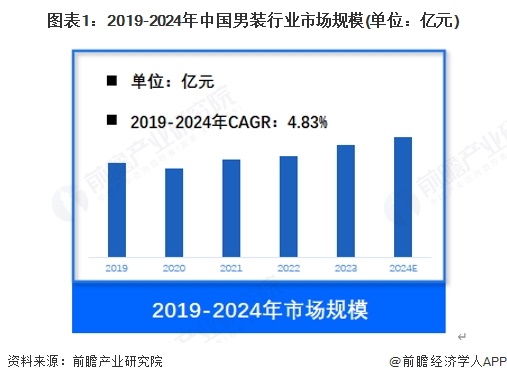
Core Insights - The Chinese men's clothing industry is projected to reach a market size of approximately 650 billion yuan in 2024, with a compound annual growth rate (CAGR) of 4.83% over the past five years [1][3]. Market Segmentation - Men's clothing can be categorized into formal wear, casual wear, sportswear, and underwear. Formal wear includes suits, shirts, and ties; casual wear encompasses casual pants, jackets, and T-shirts; sportswear consists of sports jackets, pants, and undergarments; while underwear includes base layers and thermal wear [3]. - According to Statista, the men's pants market and men's sportswear and swimwear market are the two largest segments within the Chinese men's clothing industry, accounting for 24% and 16% of the market share, respectively [3]. Industry Competition - Leading companies in the Chinese men's clothing sector include Hailan Home (海澜之家), China Lilang (中国利郎), and Baoxini (报喜鸟). The specific competitive landscape and strategies of these companies are detailed in the report by Qianzhan Industry Research Institute [5].


2025年纺织服装行业中期投资策略:内需复苏加速窗口,新成长方向浮现
Shenwan Hongyuan Securities· 2025-06-10 02:14
Group 1 - The report highlights the acceleration of domestic demand recovery, indicating a significant investment opportunity in the textile and apparel industry for 2025 [3][4] - The SW textile and apparel index increased by 5.5% from January 1 to June 6, 2025, outperforming the Shenwan All A index by 3.6%, ranking 11th among all industries [4][8] - The report identifies several high-growth areas, including high-performance outdoor apparel, discount retail, sleep economy, and maternal and infant consumption, with specific company recommendations [4][5][24] Group 2 - The outdoor apparel market is projected to reach 102.7 billion yuan in 2024, growing by 17% year-on-year, with a low current penetration rate of 25%, indicating substantial growth potential [4][29] - The discount retail sector is highlighted as a resilient area within the consumer market, with brands like Hailan Home showing strong performance through their JD Outlet model [43][46] - The report emphasizes the importance of core manufacturing capabilities in response to tariff changes, suggesting that companies with overseas expansion capabilities will benefit [4][5][24] Group 3 - The textile manufacturing sector is experiencing a mixed performance due to fluctuating tariffs, but leading companies maintain their competitive advantages [4][5] - The report notes that the domestic retail environment is improving, with a 4.7% year-on-year increase in total retail sales in the first four months of 2025, and a 3.1% increase in apparel retail sales [20][23] - The report suggests that the high-performance outdoor apparel segment is characterized by a fragmented market, with the top 10 brands holding only 27.2% market share, indicating opportunities for growth among domestic brands [33][36]
纺织服装行业2025年中期投资策略:关注细分趋势下品牌机遇,把握业绩弹性制造企业
Minsheng Securities· 2025-06-10 00:23
Investment Rating - The report suggests a positive investment outlook for the textile and apparel industry, focusing on resilient brands and manufacturing companies with performance elasticity [1]. Core Insights - The textile and apparel sector has shown stable growth in retail consumption, with a notable increase in apparel sales, while textile manufacturing exports have displayed a mixed performance [2][4]. - The report highlights the importance of brand strength and market trends, particularly in the sportswear and outdoor segments, which are expected to perform well [3][46]. - The impact of international trade policies, particularly U.S. tariffs, continues to be a significant factor affecting the textile manufacturing sector [4]. Summary by Sections Section 1: Market Review - Retail sales in April 2025 showed a year-on-year growth of 5.1%, with apparel and footwear sales increasing by 2.2% [2][12]. - Textile exports from China decreased by 0.5% year-on-year in April 2025, underperforming compared to Vietnam and Bangladesh, which saw growth rates of 18.15% [2][15]. Section 2: Brand Apparel - The sportswear segment is highlighted for its resilience, with outdoor brands experiencing high demand. Key companies to watch include Anta Sports and Nike [3][46]. - Discount retail formats are rapidly emerging due to consumer demand for value, with companies like Hailan Home benefiting from this trend [3][46]. - Policies such as childcare subsidies are expected to stimulate consumption, benefiting companies like Luolai Life and Mercury Home Textiles [3][46]. Section 3: Textile Manufacturing - The report emphasizes the need to focus on companies with performance elasticity, recommending firms like Crystal International and Zhejiang Natural [4]. - The textile manufacturing sector is experiencing a shift towards increased market concentration, with leading companies such as Huayi Group and Shenzhou International being favored [4]. - The overall demand outlook remains cautious, with brands maintaining a conservative stance on consumer spending [4][19]. Section 4: Stock Performance - As of May 30, 2025, the A-share textile and apparel sector saw a slight increase of 1.87%, while the H-share sector rose by 8.7% [39]. - The report identifies top-performing stocks in both A-share and H-share markets, highlighting significant variances in performance among individual companies [35][39]. Section 5: Company Focus - Anta Sports is noted for its strong brand momentum and expansion into outdoor segments, with plans to increase international revenue [57]. - The report also highlights Tmall's potential for recovery due to improved inventory turnover and a focus on Nike brand sales [60].



海澜之家 V.S 优衣库:相同的性价比,不同的发展路径
Changjiang Securities· 2025-06-08 13:25
Investment Rating - The investment rating for the industry is "Positive" and maintained [10] Core Insights - The report analyzes the differences in positioning, business models, and expansion paths between Haier and Uniqlo, both of which focus on high cost-performance in the apparel market [5][17] - Uniqlo has established itself as a global leader in mass apparel, achieving retail sales of 37.8 billion yuan in China, while Haier ranks first in men's apparel with sales of 29.3 billion yuan [5][17] - Both brands initially adopted low-cost sales and store opening strategies to establish their single-store models, but their paths diverged significantly during their growth phases [3][8] Summary by Sections Introduction - Uniqlo is recognized for its SPA model and successful global expansion, while Haier focuses on high cost-performance men's apparel, achieving significant market presence in China [5][17] Business Model Exploration - Positioning: Haier targets mid to low-tier cities with a focus on business casual men's wear, while Uniqlo emphasizes daily wear and basic styles, appealing to a more diverse customer base in high-tier cities [6][26] - Operations: Uniqlo employs a vertically integrated SAP model for product development and inventory management, while Haier relies on a more decentralized supply chain approach [6][26] Expansion Path Differences - Initial Phase: Haier utilized a light asset model for efficient expansion in a fragmented market, while Uniqlo focused on product value enhancement and store efficiency [7][8] - Later Phase: Haier faces challenges in domestic expansion and efficiency, prompting entry into new retail formats, while Uniqlo accelerates global expansion leveraging its strong brand and product capabilities [8][9] Market Comparison - Haier's retail strategy is characterized by a high number of small stores in lower-tier cities, while Uniqlo focuses on larger stores in higher-tier cities [28][31] - As of 2025 Q1, Haier has 5,812 stores with an average size of approximately 160 square meters, while Uniqlo has 1,032 stores, predominantly in second-tier cities and above [28][31] Performance Metrics - Uniqlo's store efficiency is significantly higher, with a store performance of 29.28 million yuan, compared to Haier's 4.28 million yuan [43] - Haier's sales per square meter are 27,000 yuan/year, outperforming other domestic men's apparel brands [43]
海澜之家V.S优衣库:相同的性价比,不同的发展路径
Changjiang Securities· 2025-06-08 12:44
Investment Rating - The investment rating for the industry is "Positive" and maintained [15] Core Insights - The report analyzes the differences in positioning, business models, and expansion paths between Haier and Uniqlo, both of which focus on high cost-performance in the apparel market [10][25] - Uniqlo has established itself as a global leader in casual wear, achieving retail sales of 37.8 billion yuan in China, while Haier ranks first in men's apparel with sales of 29.3 billion yuan [10][25] - Both brands initially adopted low-cost sales and store opening strategies to establish their single-store models, but their paths diverged significantly during growth phases [12][13] Summary by Sections Introduction - Uniqlo is recognized for its SPA model and successful global expansion, while Haier focuses on high cost-performance in business casual menswear [10][25] - As of 2024, Uniqlo's retail sales in China reached 37.8 billion yuan, making it the largest apparel brand, while Haier's sales were 29.3 billion yuan, leading in men's apparel [10][25] Business Model Exploration - Positioning: Haier targets mid to low-tier cities with a focus on business casual menswear, while Uniqlo emphasizes daily wear and has a more diverse customer base in high-tier cities [11][34] - Operations: Uniqlo employs a SAP model for integrated control from product development to retail, while Haier relies on a more decentralized supply chain management approach [11][12] Expansion Path Differences - Initial Phase: Haier utilized a light asset model for efficient expansion in a fragmented market, while Uniqlo focused on product upgrades and direct store models for growth [12][13] - Later Phase: Haier faces challenges in domestic expansion and efficiency, prompting entry into new retail formats, while Uniqlo accelerates global expansion leveraging its strong brand and product capabilities [12][13] Market Comparison - Haier's store count reached 5,812 by Q1 2025, primarily in lower-tier cities, while Uniqlo had 1,032 stores, mostly in higher-tier cities [39][40] - Uniqlo's store efficiency significantly outperforms Haier, with a store efficiency of 29.28 million yuan compared to Haier's 4.28 million yuan [53][50]
露露乐蒙 25Q1 经营稳健,维持全年营收增长指引
SINOLINK SECURITIES· 2025-06-08 10:03
Investment Rating - The report maintains a positive outlook for the industry, suggesting a potential growth exceeding the market average in the coming months [37]. Core Insights - Lululemon's FY25Q1 performance shows steady growth with revenue of $2.371 billion, a year-on-year increase of 7.32%, although slightly below analyst expectations of $2.57 billion. The gross margin improved by 0.62 percentage points to 58.34% due to reduced product costs and optimized discounts [10][12]. - The company expects full-year revenue to be between $11.15 billion and $11.30 billion, with a year-on-year growth of 5%-7%. Excluding the additional week in 2024, the expected growth is 7%-8% [15][10]. - In North America, revenue reached $1.675 billion, a 3% increase year-on-year, while the Chinese market showed strong performance with revenue of $368 million, up 21% year-on-year [12][10]. Summary by Sections Industry Data Tracking - In April, apparel retail sales grew by 2.2%, underperforming the overall consumer market due to adverse weather conditions affecting spring apparel sales. The report anticipates improvement in May due to better weather and increased consumer activity [16][3]. - Raw material prices remained stable, with fluctuations in cotton and synthetic fiber prices noted [19][20]. Investment Recommendations - For apparel brands, recommendations include Hai Lan Home, which is adapting to consumer trends and expanding its store presence, and Anta Sports, which is expected to benefit from strong performance in its multi-brand strategy. Additionally, recommendations include leading brands like Bi Yin Le Fen and All Cotton Times [22][4]. - In the upstream manufacturing sector, the report suggests that leading textile manufacturers like Zhejiang Ziran and Shenzhou International are well-positioned to benefit from market shifts due to tariff impacts [22][4]. Market Review and Company News - The textile and apparel sector saw a 1.89% increase in the past week, with notable performances from companies like Langsha and Huasheng [23][28]. - Key company announcements include Nanshan Zhishang's stock issuance and Jiangnan Buyi's land bidding for industrial use [34][34].
资本赋能高质量发展,古麒绒材推动行业低碳转型
Xin Lang Cai Jing· 2025-06-06 10:42
Core Viewpoint - The listing of Anhui Guqi Down Material Co., Ltd. marks a significant milestone for the company and the down industry in China, providing new momentum for the industry's upgrade and regional economic development [1] Industry Overview - The global down industry is experiencing rapid growth, with China being the largest producer of duck and goose down, producing approximately 400,000 tons of down and feathers annually, including about 65,000 tons of down [1] - The domestic down materials market demand is robust, with a scale of about 55,000 tons and a market value of 19 billion RMB, while the global down market demand reaches 13.7 billion USD, indicating substantial market potential [1] Company Strengths - Guqi Down Material has established itself as a leading supplier in the down materials sector, collaborating with well-known brands such as Bosideng and HLA, and has been recognized as a "little giant" enterprise by the Ministry of Industry and Information Technology [3][4] - The company has shown strong financial growth, with revenue increasing from 667 million RMB in 2022 to 967 million RMB in 2024, and net profit rising from 97 million RMB to 168 million RMB during the same period, reflecting compound growth rates of 20.37% and 31.67% respectively [3][4] Financial Performance - The total assets of Guqi Down Material increased from 949.56 million RMB in 2022 to 1.412 billion RMB in 2024, indicating a steady growth trend [4] - The company's gross profit from main business rose from 151 million RMB to 245 million RMB, with a stable gross profit margin, showcasing enhanced profitability [4] Fundraising and Investment Projects - The company raised approximately 604 million RMB through its IPO, with net proceeds of about 534.78 million RMB, which will be allocated to projects focused on capacity upgrades and technological innovation [5][6] - The first phase of the functional down green manufacturing project aims to produce 2,800 tons annually, addressing the growing demand for high-quality functional down products [6] Sustainable Development Initiatives - Guqi Down Material integrates green development into its corporate strategy, promoting low-carbon transformation across the entire industry chain [7] - The company has developed advanced clean production technologies that exceed national standards, enhancing product quality and environmental sustainability [7][8] Industry Influence - The company plays a significant role in setting industry standards, participating in the formulation of national standards for down and feather products, which enhances the overall quality and regulation of the down industry [9] Regional Economic Impact - The listing of Guqi Down Material significantly impacts the capital market in Wuhu, increasing the total number of listed companies in the city and attracting more quality enterprises to the region [10] - On its first trading day, the company's stock surged by 148.34%, reflecting strong market confidence and expectations [10] Future Outlook - Guqi Down Material aims to continue focusing on the down materials sector, enhancing clean production, technological research, and customer development to become a leading brand in the industry [11]