
菲利华

Search documents
基金老将,“反击”
Zheng Quan Shi Bao· 2025-08-02 08:17
Core Insights - The recent recovery in the equity market has allowed several veteran fund managers to overcome previous performance challenges, with some returning to the "Double Ten Fund Manager" status, indicating over ten years of managing the same fund with an annualized return exceeding 10% [1][2] Performance Recovery - Active equity funds have shown a significant performance rebound, with the mixed equity fund index yielding over 15% this year, and more than a thousand active equity funds achieving returns exceeding 20% [2] - Notable veteran fund managers, such as Wei Dong from Guolian An Fund and Guo Jun from Bosera Fund, have seen their funds recover from substantial drawdowns, with Guolian An's fund returning over 20% this year and Bosera's fund achieving a 27.54% return [2][3] Investment Strategy Evolution - Many veteran fund managers have shifted their investment focus towards high-quality growth sectors, adapting their strategies to align with the current macroeconomic transition towards technology-driven and high-quality development [4][6] - Fund managers like Wang Peng from Guotai Junan have successfully identified and invested in high-growth stocks, contributing significantly to their funds' performance recovery [4][5] Long-term Investment Philosophy - The performance recovery of veteran fund managers underscores the resilience of their investment philosophies, demonstrating their ability to adapt strategies across different market phases [6][7] - Fund managers emphasize the importance of identifying leading companies in China's manufacturing sector as key to future investment success, with a focus on sectors like semiconductors and military industries [6][7]
基金老将,“反击”!
券商中国· 2025-08-02 05:03
Core Viewpoint - The article highlights the recovery of active equity funds, particularly those managed by veteran fund managers, who are regaining strong performance after a period of underperformance, with many achieving significant returns in the current market environment [1][2]. Group 1: Performance Recovery of Veteran Fund Managers - Many veteran fund managers are emerging from a period of poor performance, with some achieving returns exceeding 20% this year [2]. - Notable examples include Wei Dong from Guolian An Fund, whose fund has seen over 20% returns this year, and Guo Jun from Bosera Fund, whose fund achieved a 27.54% return [2][3]. - Yang Gu from Nuon Fund has also seen a recovery, with his fund returning 18.89% this year after a challenging period [3]. Group 2: Investment Strategy Evolution - Veteran fund managers are adapting their investment strategies, shifting focus towards high-quality growth sectors in response to changing market dynamics [4][5]. - The macroeconomic transition towards technology-driven, high-quality development is creating new investment opportunities, prompting fund managers to actively adjust their portfolios [5]. - Specific stock selections, such as WuXi AppTec and Sunshine Power, have significantly contributed to the performance of funds managed by Wang Peng and Wei Dong, respectively [5][6]. Group 3: Long-term Investment Philosophy - The article emphasizes the importance of a robust investment philosophy that can withstand market fluctuations, with veteran managers demonstrating their ability to navigate risks and seize opportunities [7][8]. - Managers like Yang Gu and Wei Dong highlight the significance of identifying leading companies in China's manufacturing sector as key to future investment success [7][8]. - The article notes that while some fund managers have successfully recovered, many are still working to enhance their investment frameworks and capabilities [8].


热点追踪周报:由创新高个股看市场投资热点(第205期)-20250801
Guoxin Securities· 2025-08-01 14:03
- The report introduces a quantitative model named "250-Day New High Distance" to track market trends and identify leading stocks. The model calculates the distance between the latest closing price and the highest closing price over the past 250 trading days using the formula: $ 250\text{-Day New High Distance} = 1 - \frac{\text{Close}_{t}}{\text{ts\_max(Close, 250)}} $ where $\text{Close}_{t}$ represents the latest closing price, and $\text{ts\_max(Close, 250)}$ is the maximum closing price in the past 250 trading days. If the latest closing price reaches a new high, the distance equals 0; otherwise, it indicates the percentage drop from the peak[10][11][12] - The report evaluates the model positively, citing its ability to capture momentum and trend-following strategies effectively. It references prior research, such as [George@2004] and insights from investment books like "Stock Market Wizard," which emphasize the importance of tracking stocks near their 52-week highs[10][18][21] - The report applies the model to major indices, showing their respective 250-Day New High Distances as of August 1, 2025: - Shanghai Composite Index: 1.54% - Shenzhen Component Index: 4.38% - CSI 300: 4.73% - CSI 500: 2.25% - CSI 1000: 1.53% - CSI 2000: 1.08% - ChiNext Index: 8.93% - STAR 50 Index: 7.99%[11][12][33] - The report identifies industries and concept indices close to their 250-Day New Highs, such as Media, Communication, Pharmaceuticals, Defense, and Steel. Concept indices like Wind Microcap Equal Weight, Electronic Equipment, CRO, and Innovative Drugs also show proximity to their 250-Day New Highs[12][14][33] - The report tracks stocks that have reached 250-Day New Highs in the past 20 trading days. A total of 1,239 stocks are identified, with the highest counts in industries like Pharmaceuticals (192 stocks), Machinery (169 stocks), and Basic Chemicals (132 stocks). The highest proportions are found in Banking (64.29%), Steel (56.60%), and Nonferrous Metals (41.94%)[19][20][34] - The report introduces a factor named "Stable New High Stocks," which selects stocks based on criteria such as analyst attention, relative price strength, price path smoothness, and sustained new highs. Specific metrics include: - Analyst attention: At least five buy or overweight ratings in the past three months - Relative price strength: Top 20% in 250-day returns - Price path smoothness: Evaluated using metrics like cumulative absolute daily returns over 120 days - Sustained new highs: Average 250-Day New High Distance over the past 120 days - Trend continuation: Average 250-Day New High Distance over the past five days[24][27][28] - The report lists 50 stocks selected as "Stable New High Stocks," with the highest counts in Manufacturing (15 stocks) and Technology (14 stocks). Examples include Shenghong Technology, Borui Pharmaceuticals, and Feilihua[28][32][34]


由创新高个股看市场投资热点
量化藏经阁· 2025-08-01 12:29
Group 1 - The report tracks stocks, industries, and sectors that are reaching new highs, serving as market indicators and highlighting the effectiveness of momentum and trend-following strategies [1][4] - As of August 1, 2025, the distance to the 250-day new high for major indices is as follows: Shanghai Composite Index at 1.54%, Shenzhen Component Index at 4.38%, CSI 300 at 4.73%, CSI 500 at 2.25%, CSI 1000 at 1.53%, CSI 2000 at 1.08%, ChiNext Index at 8.93%, and STAR Market 50 Index at 7.99% [6][25] - Among the CITIC first-level industry indices, Media, Communication, Pharmaceuticals, Defense, and Steel are closest to their 250-day new highs, while Food & Beverage, Coal, Real Estate, Home Appliances, and Transportation are further away [9][25] Group 2 - A total of 1,239 stocks reached a 250-day new high in the past 20 trading days, with the highest number of new highs in the Pharmaceuticals, Machinery, and Basic Chemicals sectors [2][14] - The sectors with the highest proportion of new high stocks are Banking, Steel, and Non-ferrous Metals, with respective proportions of 64.29%, 56.60%, and 41.94% [14][16] - The manufacturing and cyclical sectors had the most new high stocks this week, with 381 and 297 stocks respectively, while the proportion of new high stocks in the CSI 2000, CSI 1000, CSI 500, CSI 300, ChiNext, and STAR Market indices are 21.85%, 20.30%, 21.80%, 19.33%, 16.00%, and 14.00% respectively [16][25] Group 3 - The report identifies 50 stocks that have shown stable new highs, including Shenghong Technology, Borui Pharmaceuticals, and Feilihua, with the most new high stocks in the Manufacturing and Technology sectors, totaling 15 and 14 respectively [3][21][26] - The Machinery industry had the highest number of new highs within the Manufacturing sector, while the Electronics industry led in the Technology sector [21][26]

A股,重磅信号!融资客加仓(名单)
Zheng Quan Zhi Xing· 2025-08-01 08:46
Market Overview - The A-share market experienced a technical adjustment with all three major indices slightly declining, reflecting a market structure that necessitates a pullback after rapid gains [2][9] - The Shanghai Composite Index fell by 0.37%, the Shenzhen Component Index by 0.17%, and the ChiNext Index by 0.24%, with over 3,300 stocks rising throughout the market [1][2] Sector Performance - The pharmaceutical sector showed resilience, with companies like Angli Kang (002940) and Weikang Pharmaceutical (300878) hitting the daily limit [1] - The photovoltaic sector rebounded, supported by regulatory measures aimed at enhancing energy efficiency in the polysilicon industry, leading to price stabilization across the supply chain [3] - The logistics and express delivery sector strengthened due to recent regulatory discussions aimed at promoting high-quality development and addressing competitive issues [4] Investment Trends - The innovation drug sector continues to thrive, with a positive outlook for Chinese innovative drugs entering international markets, although short-term volatility may increase [5] - Financing balance in A-shares reached a ten-year high of 1.971 trillion yuan, indicating strong market risk appetite, with net purchases exceeding 130 billion yuan in July [6][7] - A significant portion of the financing activity was concentrated in the pharmaceutical, electronics, and non-ferrous metals sectors, with notable net purchases [7][8] Future Outlook - Analysts suggest that despite the current technical adjustments, the medium-term upward trend in A-shares remains intact, with average P/E ratios indicating a favorable environment for long-term investments [9] - Investment strategies should focus on high-growth technology sectors, industries with strong earnings support, and potential opportunities arising from policy changes [10]



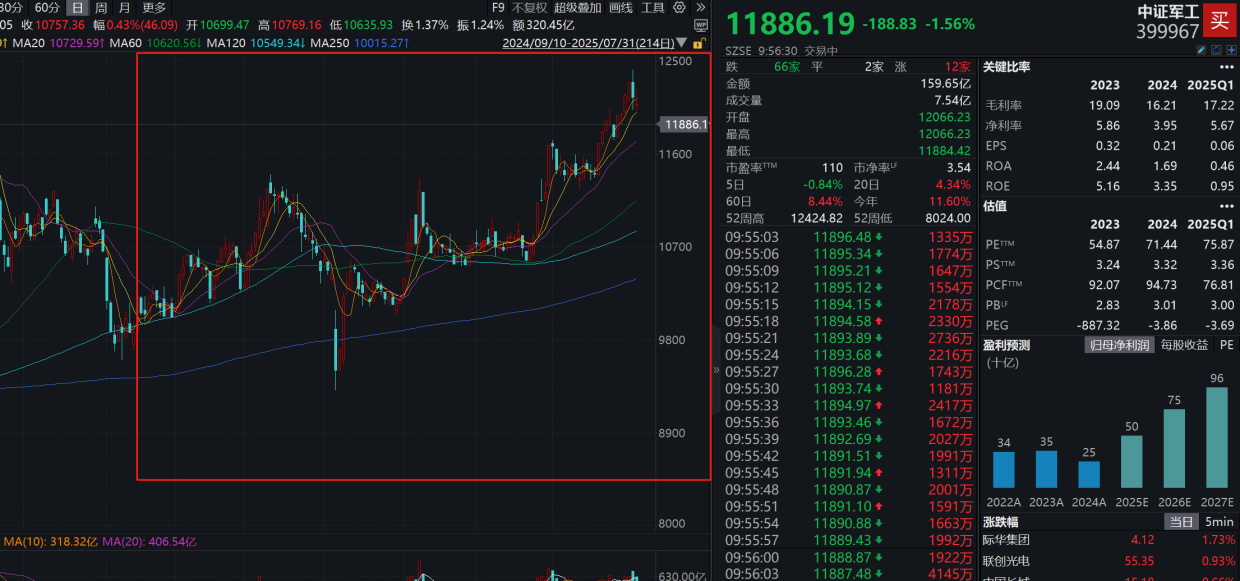
建军节+军贸订单催化,军工ETF是否能提前“阅兵”?
Xin Lang Cai Jing· 2025-08-01 08:13
Group 1 - The core viewpoint of the articles highlights the strong performance of the military industry sector in the capital market, particularly around the "August 1" Army Day, which marks the 98th anniversary of the People's Liberation Army [1] - Historical data shows that the military industry sector tends to outperform the broader market in August, with a 60% probability of rising and an average increase of nearly 1% over the past 15 years [1] - After the Army Day, the military index has a 66.67% probability of rising in the following five trading days, indicating a significant "post-holiday effect" [1] Group 2 - As of Q2 2025, public fund holdings in the military sector increased significantly, reaching 112.296 billion yuan, a 23.14% quarter-on-quarter rise, placing it among the top ten industries in the Shenwan classification [3] - The military-themed ETFs have seen substantial growth, with total assets rising from 29.733 billion yuan at the beginning of the year to 53.392 billion yuan, an increase of over 78% [5] - Notable ETFs include the Guotai CSI Military ETF and the Fortune CSI Military Leader ETF, which have seen significant growth in shares, 51% and 108% respectively [5] Group 3 - Long-term performance analysis shows that the Huabao CSI Military ETF and the E Fund CSI Military ETF have delivered total returns of 2.88% and 2.45% respectively over three years, indicating strong stability compared to peers [6] - The E Fund National Aviation Industry ETF has achieved a remarkable return of 21.59% year-to-date, making it the only military industry ETF to exceed 20% returns this year [5] - The military sector is expected to benefit from a recovering economy and increased military trade, which could become a second growth driver for the industry [7]
沪市融资余额突破万亿元,创10年新高
Sou Hu Cai Jing· 2025-08-01 08:12
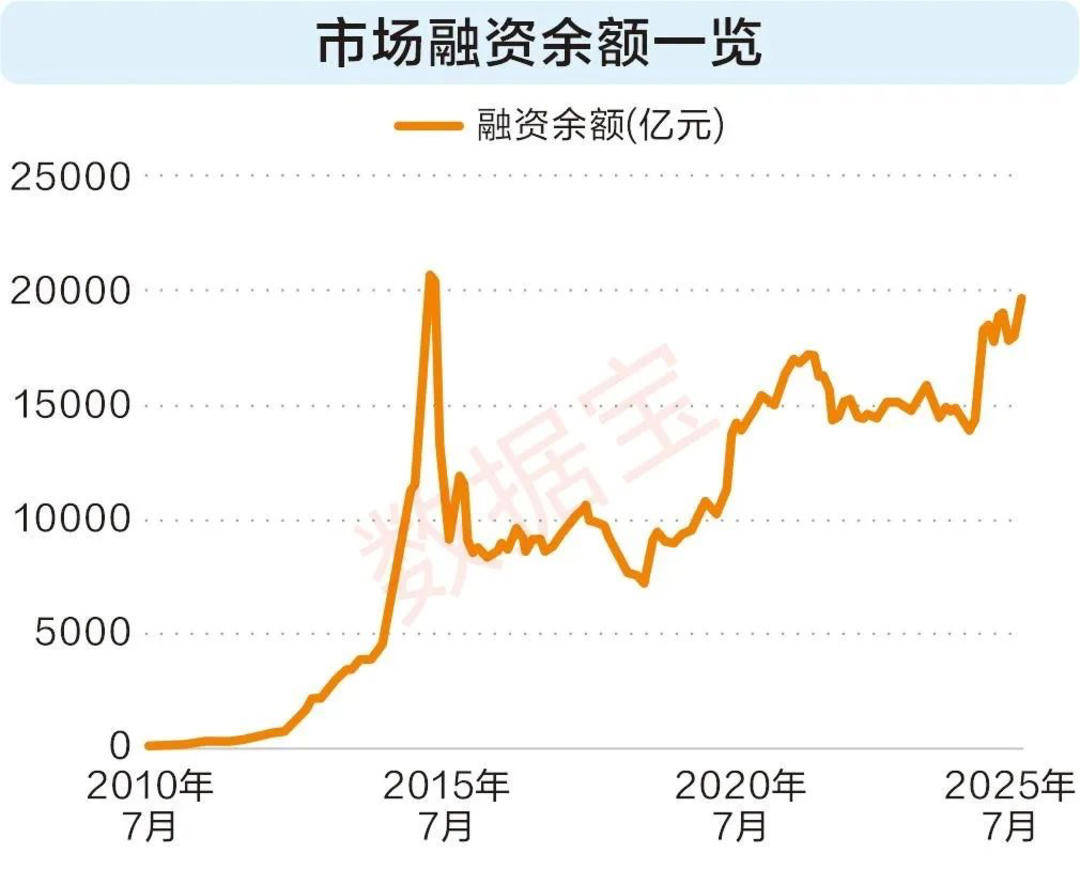
本轮融资余额持续增长始于6月23日,截至最新,融资资金已连续六周净买入超百亿元,累计金额达到1674.73亿元。历史行情显示,融资资金连续六周及 以上净买入的情况共出现过七次,其中前三次发生在2014年和2015年,后三次则集中在2024年"9·24"行情后。 6月23日以来,融资资金净买入居前的个股集中于算力、半导体、新能源汽车等科技赛道,共有56股累计净买入超5亿元,如CPO龙头新易盛净买入41.21 亿元,居于榜首,中科曙光、中际旭创亦上榜;半导体概念菲利华、澜起科技、寒武纪-U等个股上榜;新能源汽车概念股比亚迪、宁德时代、国轩高科 等也上榜。 校对 陶善工 扬子晚报网8月1日讯(记者 范晓林 薄云峰)截至7月29日,A股市场融资余额达到19684.21亿元,创2015年7月3日以来新高。沪市融资余额突破万亿元大 关,达到10008.36亿元,为2015年7月8日以来10年新高,深市融资余额达到9612.51亿元,刷新历史纪录。 市场融资余额一览表 ...
东吴证券晨会纪要-20250801
Soochow Securities· 2025-07-31 23:30
Macro Strategy - The report discusses the potential growth of bond ETFs, suggesting that despite the inherent advantages of actively managed bond funds, there is room for ETFs to leverage their product strengths. It highlights the significant improvement in liquidity for credit bonds through ETFs and suggests expanding the range of tracked indices [1][16]. - The report emphasizes the expected growth in the management scale of domestic index bond funds, particularly credit bond index ETFs and equity-linked ETFs, as the equity market recovers [1][16]. Macro Commentary - The July FOMC meeting maintained interest rates at 4.25-4.5%, signaling a hawkish stance as inflation targets remain distant compared to employment goals. This may delay rate cuts until Q4 2025, with expectations for 2-year and 10-year U.S. Treasury yields to rise to 4.05% and 4.5% respectively [2][17]. - The second quarter GDP growth in the U.S. was reported at +3.0%, reversing the previous quarter's -0.5% and exceeding market expectations. However, the core GDP indicator, PDFP, only grew by +1.2%, indicating that the growth was largely driven by inventory adjustments rather than strong internal economic growth [3][19]. Fixed Income Analysis - The report notes that the issuance of secondary capital bonds totaled 109.9 billion yuan, with a trading volume of approximately 288.1 billion yuan, reflecting an increase in market activity [7]. - Green bond issuance reached 35.9 billion yuan, with a trading volume of 61 billion yuan, indicating a growing interest in sustainable finance [7]. Company-Specific Insights - Su Shi Testing (300416) reported a 26% year-on-year increase in net profit for Q2, driven by strong growth in the integrated circuit sector. The profit forecasts for 2025-2027 have been adjusted to 280 million, 350 million, and 430 million yuan respectively, maintaining a "buy" rating [10]. - Contemporary Amperex Technology Co., Ltd. (300750) slightly exceeded profit expectations, with net profit forecasts for 2025-2027 set at 66.1 billion, 80.2 billion, and 96.6 billion yuan, maintaining a "buy" rating due to its leading position in the global battery market [11]. - Yonghui Supermarket (601933) plans to raise 4 billion yuan through a private placement to support store renovations, with adjusted profit forecasts reflecting a potential recovery in performance [13]. - Huaneng International (600011) reported a 24.3% increase in net profit for the first half of 2025, benefiting from a 9.2% decrease in coal costs. The profit forecasts for 2025-2027 have been adjusted to 13.78 billion, 16.02 billion, and 17.53 billion yuan, maintaining a "buy" rating [14].
7月融资客加仓1300亿元
Shen Zhen Shang Bao· 2025-07-31 18:34
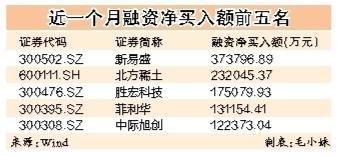
Group 1 - In July, the financing balance increased by over 130 billion yuan, marking the highest monthly growth in financing balance for the year [2] - Six industries attracted over 10 billion yuan in net financing, including electronics, pharmaceuticals, electric equipment, non-ferrous metals, computers, and non-bank financials [2] - The top three industries by net financing in July were electronics (14.7 billion yuan), pharmaceuticals (14.1 billion yuan), and electric equipment (12.7 billion yuan) [2] Group 2 - Among individual stocks, nine stocks saw net financing exceeding 1 billion yuan, with notable mentions being Xinyi Technology, Northern Rare Earth, and Shenghong Technology [2][3] - Xinyi Technology experienced a nearly 50% increase in July, with its stock price nearly doubling over the past two months [3] - The top five stocks with the highest net selling amounts included Wuliangye, Sunshine Power, BeiGene, Muyuan Foods, and Hengli Petrochemical, each exceeding 300 million yuan [3] Group 3 - As of July 30, six companies had financing balances exceeding 10 billion yuan, including Dongfang Wealth, China Ping An, Kweichow Moutai, CITIC Securities, BYD, and Yangtze Power, all of which are large-cap blue-chip stocks [3]






国联民生研究:2025年8月金股组合
Minsheng Securities· 2025-07-31 12:42
Market Overview - The market continued to rise in July, supported by both policy and liquidity[5] - Policies aimed at "anti-involution" have led to higher elasticity in commodity prices, driving cyclical industries to lead the market[5] - Future focus will remain on liquidity support and the gradual increase in risk appetite, although the likelihood of market adjustments is rising[5] Investment Recommendations - The "Golden Stock Portfolio" has achieved a year-to-date return of 30.37%[15] - Key recommended stocks include: - China Pacific Insurance (601601.SH) - Innovent Biologics (1801.HK) - Bairun Food (002568.SZ) - Muyuan Foods (002714.SZ) - Filihua (300395.SZ) - CATL (300750.SZ) - Hubei Yihua (000422.SZ) - Luoyang Molybdenum (603993.SH) - Conch Cement (600585.SH) - North Huachuang (002371.SZ)[12] Risk Factors - Risks include macroeconomic performance falling short of expectations, policy implementation delays, and overseas expansion not meeting projections[12]



